Mid-size Car Types: Best Uses and Buyer Fit Today
For midsize cars, choose a sedan for commuting and highway miles, a wagon or liftback for more cargo with carlike manners, and a crossover only if easier entry or taller load space matters more than fuel use. Pick the wrong body style and you pay with cramped cargo, extra fuel use, or daily inconvenience. This guide compares midsize car body styles by passenger room, cargo fit, fuel economy, and daily use.
This guide is part of our Vehicle types guide series.
What counts as a midsize car?
The EPA uses interior volume as its main yardstick for classifying passenger cars in the U.S. That puts a midsize car at about 110–119 cubic feet of interior volume, while a compact usually lands at 100–109 cubic feet. Wheelbase is a useful second clue because it helps separate smaller and larger footprints.
Typical compact cars commonly have wheelbases between 102 and 107 inches, while midsize cars commonly sit between 108 and 113 inches. That does not make every larger car feel roomy in the same way, but it does explain why midsize cars usually give more cabin length and a calmer ride over broken pavement.
On paper, the gap looks modest. In use, it is often the difference between “fine for short hops” and “comfortable on repeat highway trips.”
How midsize compares with compact on paper
Compact cars typically offer 100–109 cubic feet of interior volume, 35–37 inches of rear-seat legroom, and 12–14 cubic feet of trunk space in sedan form. Midsize cars generally range from 110–119 cubic feet, 38–40 inches of rear-seat legroom, and 15–16 cubic feet of trunk space in sedan form.
That spread is not abstract. Three to five inches of extra rear legroom matters to adult passengers, and an extra few cubic feet in the trunk can decide whether a stroller, two carry-ons, or a family’s grocery run fits without a second trip.
What are midsize cars best used for?
Midsize cars are best used for daily commuting, repeated highway travel, and family duty that needs more rear-seat room than a compact usually provides. They suit shoppers who want a calmer ride, a larger trunk, and enough cabin space for adults in the back without moving up to an SUV.
Daily commuting and highway stability
A midsize car often makes sense for long commutes because the added wheelbase and cabin length usually improve straight-line composure and reduce the cramped feeling that can build in smaller cars. That is especially useful if your route includes regular merging, passing, or long stretches at highway speed.
Suppose your weekday drive is 35 minutes each way with one passenger and a laptop bag. A midsize sedan gives you room to sit farther back from the dash, keep the rear seat usable, and still leave trunk space for a work tote or gym bag.
Two-adult trips and rear-seat comfort
Two-adult highway trips are a natural fit because the rear seat in a midsize car usually has 38–40 inches of legroom, compared with 35–37 inches in a compact. That difference becomes noticeable on longer trips, especially when rear passengers want to change positions instead of staying folded into the seatback.
Family errands, airport runs, and weekend cargo
Midsize sedans frequently reach 15–16 cubic feet of trunk space, which helps with airport luggage, school bags, and groceries. For light family duty, that space is often more useful than a taller cargo floor in a small SUV, because the load area is lower and easier to pack.
A common first-timer mistake is choosing a car by rear-seat width alone, then discovering the trunk opening is too small for a folded stroller. Check the opening shape, not only the quoted volume.
How much bigger is a midsize car than a compact?
A midsize car is usually one class larger than a compact in a few practical ways: 110–119 cubic feet of interior volume versus 100–109, 108–113 inches of wheelbase versus 102–107, and 38–40 inches of rear legroom versus 35–37. Those differences are enough to change how the car fits people and luggage every day.
Interior volume and rear legroom differences
The midsize rear-seat advantage is typically 3–5 inches. That sounds small until someone sits behind a tall driver. In that case, the extra space can be the difference between knees touching the front seatback and a tolerable riding position.
Trunk space and real luggage fit
Compact sedans commonly offer 12–14 cubic feet of trunk space, while midsize sedans frequently reach 15–16 cubic feet. That extra capacity matters most for awkward items: two large suitcases, a folded stroller, or several boxed purchases that would otherwise sit on the rear seat.
What the size gap feels like in daily use
For solo commuting, the gap may feel subtle. For full-car trips, the gap is easy to notice. The midsize car gives more freedom to keep the front seat where the driver wants it, rather than where the rear passenger can still survive the ride.
Mid-size car types by body style
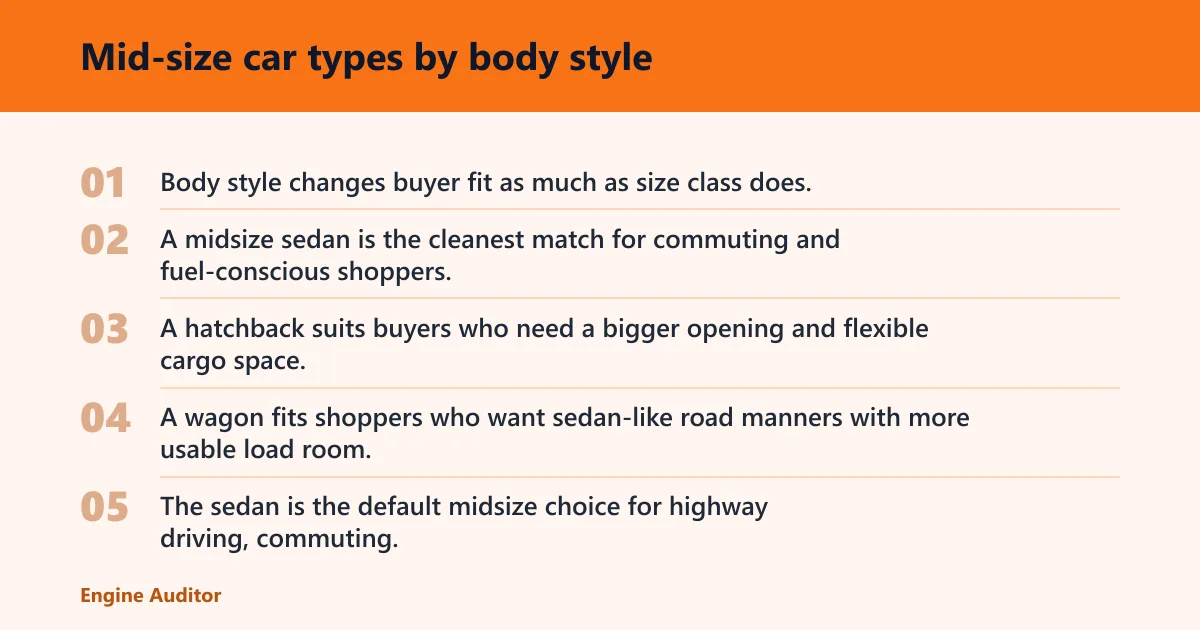
Body style changes buyer fit as much as size class does. A midsize sedan is the cleanest match for commuting and fuel-conscious shoppers. A hatchback suits buyers who need a bigger opening and flexible cargo space. A wagon fits shoppers who want sedan-like road manners with more usable load room.
Midsize sedan buyer fit
The sedan is the default midsize choice for highway driving, commuting, and shoppers who want the simplest shape to park and maneuver. It usually gives the best balance of trunk security, rear-seat comfort, and lower purchase cost inside the class.
Choose a sedan if your cargo is mostly bags, boxes, and strollers that fit through a trunk opening. Skip it if you regularly load tall items that need a wide hatch opening.
Midsize hatchback buyer fit
A midsize hatchback is the better pick when you want easier loading, fold-flat flexibility, and a cargo area that can handle bulky items without a sedan trunk lid in the way. It often suits active households, airport runs, and buyers who carry odd-shaped gear.
Check whether the folded rear seat leaves a level floor. If the step between cargo floor and seatbacks is large, the hatch is less useful than the spec sheet suggests.
Midsize wagon buyer fit
A midsize wagon is the strongest fit for shoppers who want car-like handling with more cargo usability than a sedan. Compared with many SUVs, it sits lower, is easier to load than a sedan, and often drives with less body motion on the highway.
Wagons are especially sensible for drivers who want long cargo length without moving to a taller vehicle. That makes them a good compromise for family errands, road trips, and everyday commuting.
Best uses and buyer fit matrix
This matrix turns the class discussion into pass-fail shopping checks. Use it to match body style to actual needs, not just to the idea of “more room.” A midsize car earns its keep when it solves a specific use case better than a compact or small SUV.
| Use case | Midsize sedan | Midsize hatchback | Midsize wagon | Buy if you need |
|---|---|---|---|---|
| Solo commuting | Pass | Pass | Pass | A comfortable daily driver with more rear-seat margin than a compact |
| Two-adult highway trips | Pass | Pass | Pass | Better rear legroom and a calmer long-distance feel |
| Child-seat installation | Pass if rear door opening is wide enough | Pass | Pass | Enough rear space for rear-facing seats and front-seat clearance |
| Trunk luggage capacity | Pass for 2 large bags in many models | Pass | Pass | Space for airport bags, folding gear, or weekly errands |
| Hybrid value threshold | Pass if fuel savings matter on long routes | Pass if efficiency and utility both matter | Pass if you want cargo space plus lower fuel use | Enough annual miles to justify paying more for a hybrid trim |
Read the table this way: if a compact already passes your daily checks, a midsize may be optional. If a compact fails rear-seat or cargo needs, the midsize class usually becomes the smarter floor rather than a luxury upgrade.
Do midsize cars use more gas than compact cars?
Midsize cars generally use a bit more fuel than compact cars, but the gap is often smaller than shoppers expect. A common rule of thumb is a 2–4 MPG advantage for compact cars over midsize cars, though exact results vary by engine, transmission, tires, and body style.
Why MPG is usually a bit lower
More cabin space and a larger footprint usually mean more mass and more air to move. That is why compact cars generally return better fuel economy than midsize cars. The difference is real, but it is not fixed across every model.
How hybrids narrow the gap
Hybrid variants can significantly narrow or erase the fuel economy gap. That matters because a midsize hybrid may bring a sedan-sized cabin, a larger trunk, and fuel use close to a compact gas car. In that case, the class label matters less than the powertrain.
Hybrid powertrains can turn a midsize car from a comfort-first choice into a value choice for high-mileage drivers. If your annual driving is heavy, the fuel savings can offset the higher starting price more quickly than a low-mileage commute would.
When a midsize hybrid beats a compact gas car
A midsize hybrid makes sense when you want rear-seat room and cargo space first, then want to reduce the fuel penalty. If a compact gas car meets your space needs already, the hybrid premium may be hard to justify. If the compact feels tight, the midsize hybrid can be the cleaner answer.
What should you check before buying a midsize car?
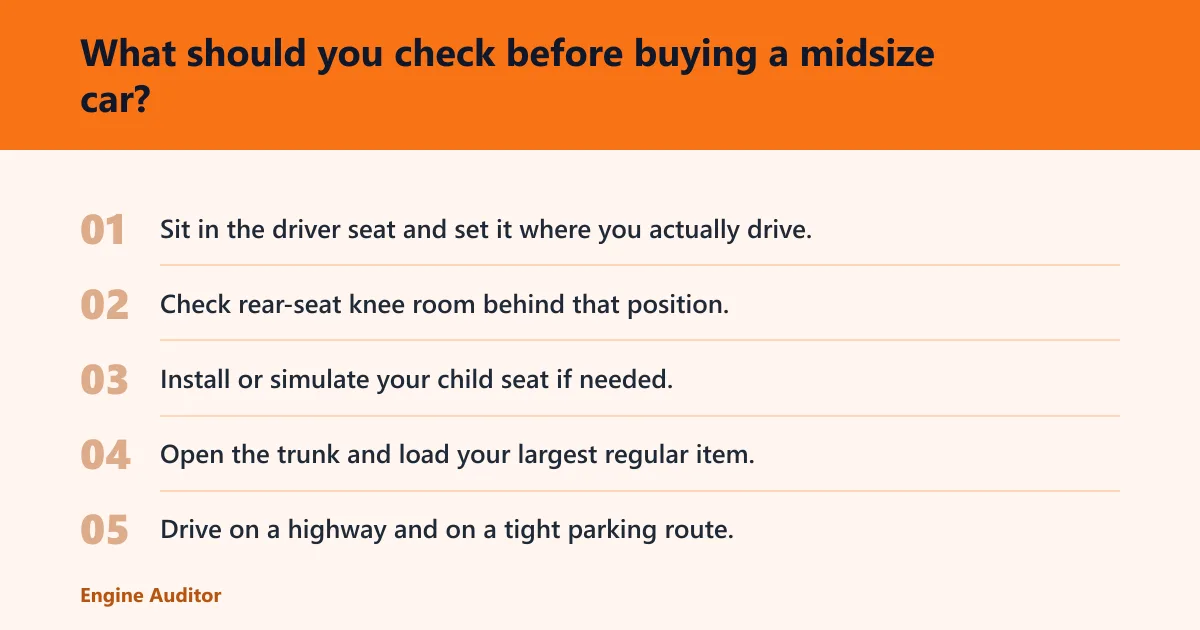
Check rear-seat legroom, child-seat fit, trunk opening shape, ride height, visibility, and parking ease before you buy. The paper dimensions are useful, but the right midsize car is the one that handles your passengers, your cargo, and your driving routes without tradeoffs that annoy you every week.
Rear-seat legroom and child-seat installation
Measure the space behind your usual driving position, not just the published rear legroom figure. If you carry child seats, confirm rear-facing seat clearance, LATCH access, and whether the front passenger seat still has usable room after installation.
Trunk opening, not just trunk volume
Trunk capacity tells only part of the story. A wide, low opening can make a 15–16 cubic foot trunk far easier to use than a narrower one with the same number on the spec sheet. Bring the items you load most often, or compare their dimensions against the opening.
Ride height, visibility, and parking ease
A midsize sedan is usually easier to drive than an SUV because it sits lower, has a smaller profile, and often feels simpler to place in a parking space. That said, some SUVs make entry and exit easier, so test the seating position if mobility or child loading is a priority.
- Sit in the driver seat and set it where you actually drive.
- Check rear-seat knee room behind that position.
- Install or simulate your child seat if needed.
- Open the trunk and load your largest regular item.
- Drive on a highway and on a tight parking route.
Is a midsize car good for families?
Yes, a midsize car can be very good for families when rear-seat comfort and trunk space matter more than a tall ride height. The class usually gives enough room for children, boosters, and weekend cargo without the bulk or fuel penalty of many small SUVs.
When families fit well
Families with one or two children may find midsize sedans, hatchbacks, and wagons easier to live with than smaller cars because the rear seat is often less cramped and the trunk or cargo area can be more usable. That matters most on school runs, airport trips, and long weekends.
When a small SUV may fit better
If you need easier child-seat loading, a more upright seating position, or taller cargo space, a small SUV may fit better. A midsize car still deserves a look first if you want lower running costs, easier parking, and a more carlike driving feel.
Are midsize cars worth it for highway driving?
For highway driving, midsize cars are often worth the step up if you value stability, rear-seat comfort, and luggage space more than the lowest possible fuel use. The extra wheelbase and cabin length usually make long trips less tiring for drivers and passengers alike.
They are especially persuasive for commuters who spend a lot of time at speed, families that travel with adults in the back, and shoppers who want a quieter upgrade from a compact without moving to an SUV. If highway use is light, the compact may still be enough.
Frequently asked questions
What are midsize cars best used for?
Midsize cars are best used for commuting, highway travel, and light family duty. They suit shoppers who need more rear-seat room and trunk space than a compact usually offers, but do not need the tall seating position or load height of an SUV. Sedans, hatchbacks, and wagons fit different cargo needs.
Is a midsize car good for families?
Yes, especially for families that want a lower driving position and a useful trunk. Midsize cars usually give enough rear-seat room for child seats and adult passengers on shorter trips, with more comfort than compacts. If easy loading matters most, a small SUV may still fit better.
How much bigger is a midsize car than a compact?
Typical midsize cars range from 110–119 cubic feet of interior volume, while compacts are usually 100–109. Midsize rear-seat legroom is commonly 38–40 inches versus 35–37 in compacts, and midsize sedans often offer 15–16 cubic feet of trunk space versus 12–14 in compact sedans.
Do midsize cars use more gas than compact cars?
Usually, yes. Compact cars generally return better fuel economy than midsize cars, often by about 2–4 MPG. The gap is not fixed, though. Hybrid variants can narrow or erase it, which is why a midsize hybrid may make more sense than a compact gas car for high-mileage drivers.
Is a midsize sedan easier to drive than an SUV?
Often, yes. A midsize sedan often sits lower, has a more compact profile, and may feel easier to place in parking spaces than many SUVs.s. That said, SUVs can be easier to enter and exit. The better choice depends on your mobility needs, cargo height, and parking environment.
What should I check before buying a midsize car?
Check rear-seat legroom behind your driving position, child-seat installation space, trunk opening shape, and highway comfort. Also test parking and visibility in the kind of spaces you use every day. If you are choosing between compact and midsize, compare the actual use cases, not only the label.
Products related to this article
Sponsored / affiliate links. As an Amazon Associate I earn from qualifying purchases. I may earn additional commission from eligible campaigns.