Best Vehicle Types for Resale Value: Which Bodies Hold Value?
Pickup trucks and body-on-frame SUVs usually lead five-year resale, often followed by some hybrids, crossovers, and sports cars. Large sedans, minivans, and convertibles usually drop faster. Pick the wrong body style and depreciation can swallow far more cash than the price gap suggests. This guide ranks body styles by resale strength and explains the demand and tradeoffs behind each one.
Which body styles hold value best?
The strongest five-year resale usually comes from pickup trucks and body-on-frame SUVs, followed by compact crossovers and sports cars in many comparisons. Five years is the standard comparison point because it gives a common comparison window across segments and is often used to reduce the impact of early incentives and first-year model changes.
Resale value is the used value left after several years compared with the original sticker price. Two figures matter at once: the percentage retained and the dollar loss. A body style can keep a decent share and still lose more money if its MSRP started high.
The model-specific percentages below come from the awards and projections cited in the article, while the table uses broader body-style ranges, so the figures are not directly comparable. A common first-timer mistake is to compare body styles alone instead of looking at which vehicles actually hold their resale value best. A truck priced around $30,000 that retains about 60% loses less cash than a luxury SUV priced around $80,000 that retains about 55%, even though the percentage gap looks small. Depreciation depends on MSRP, buyer demand, brand reputation, reliability, fuel economy, and how desirable the segment is.
Vehicle resale comparison table
| Rank | Body style | Typical 5-year value retention range | Typical dollar-depreciation risk at $30k / $50k / $80k MSRP | Demand driver and main resale risk |
|---|---|---|---|---|
| 1 | Pickup trucks | About 58% to 81% | $5,700 to $12,600 / $9,500 to $24,000 / $15,200 to $33,600 | Broad work, towing, and personal-use demand; risk rises with unpopular trims, weak engines, or hard fleet use. |
| 2 | Body-on-frame off-road SUVs | About 56% to 60% | $12,000 to $13,200 / $20,000 to $22,000 / $32,000 to $35,200 | Niche enthusiast demand and durable construction; risk comes from thirstier fuel use and narrower buyer pools. |
| 3 | Compact SUVs and crossovers | About 50% to 58% | $12,000 to $15,000 / $20,000 to $25,000 / $33,600 to $40,000 | High family demand and easy daily use; risk rises when a model is common, low-powered, or expensive to spec. |
| 4 | Sports cars and coupes | About 50% to 56% | $13,200 to $15,000 / $22,000 to $25,000 / $35,200 to $44,000 | Enthusiast demand and limited supply; risk is seasonal demand, manual-only narrowness, and higher insurance costs. |
| 5 | Minivans | About 45% to 52% | $14,400 to $16,500 / $24,000 to $27,500 / $38,400 to $44,000 | Practical family use keeps demand steady; risk is segment stigma, though hybrid versions can hold up better. |
| 6 | Luxury cars and luxury SUVs | About 40% to 50% | $15,000 to $18,000 / $25,000 to $30,000 / $40,000 to $48,000 | New-price premium inflates dollar loss; risk rises when repair costs, options, and old tech scare used buyers. |
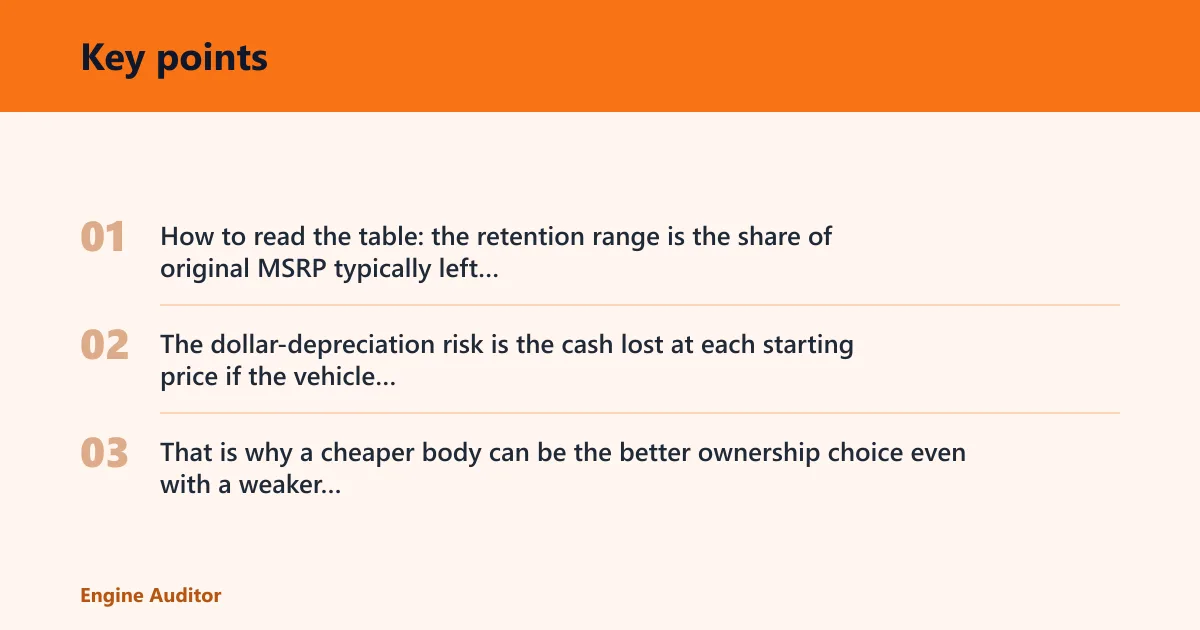
How to read the table: the retention range is the share of original MSRP typically left after five years. The dollar-depreciation risk is the cash lost at each starting price if the vehicle lands near that range. That is why a cheaper body can be the better ownership choice even with a weaker percentage.
Why trucks usually lead resale
Pickup trucks usually lead because private buyers, contractors, fleets, and towing shoppers all want them. That broad demand keeps used prices firm. The strongest truck body types are midsize and full-size pickups, while small pickups improve as fuel prices rise and heavy-duty trucks depend more on work demand than on everyday shoppers.
Which specific truck body types hold value the best?
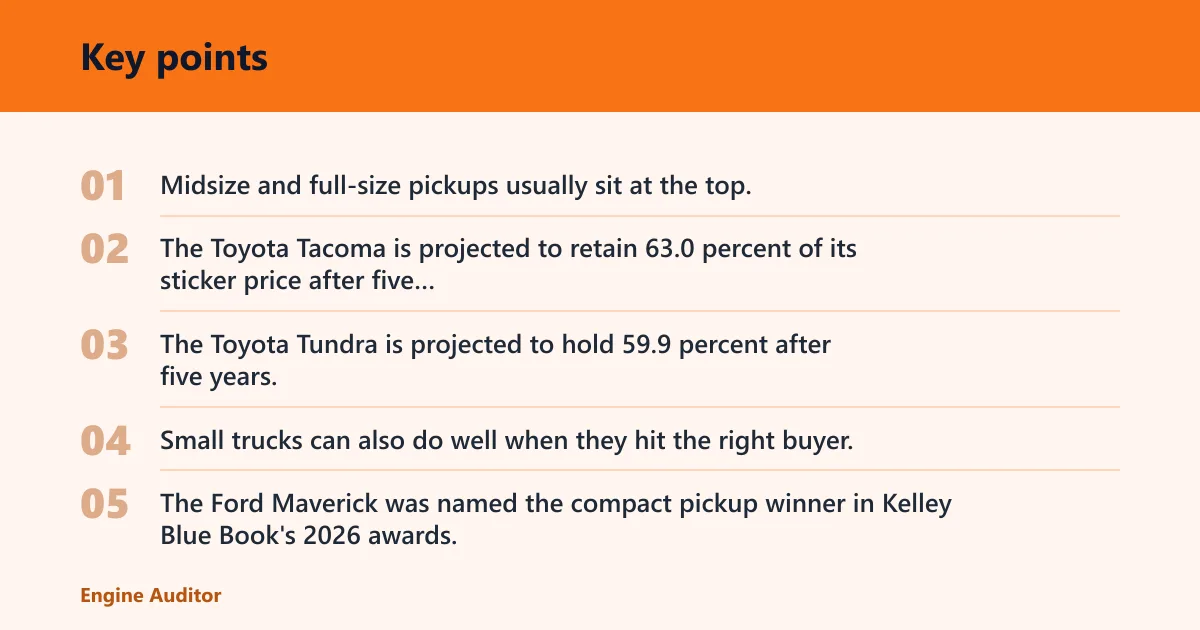
Midsize and full-size pickups usually sit at the top, especially when they are well-known names with broad trim appeal. The Toyota Tacoma is projected to retain 63.0 percent of its sticker price after five years. The Toyota Tundra is projected to hold 59.9 percent after five years.
Small trucks can also do well when they hit the right buyer. The Ford Maverick was named the compact pickup winner in Kelley Blue Book’s 2026 awards, and it is listed at 68.2 percent 5-year resale value among small trucks. The hybrid version can help because fuel economy matters more when gas prices rise.
Heavy-duty trucks are a narrower case. A Ram 3500 can hold value well when it is a sought-after tow rig, but the resale pool is smaller. Long beds, diesel power, and work use can support demand; high-mileage fleet history, empty-option work trucks, and mismatched trim can drag values down fast.
Picture two used trucks with the same age. One is a crew-cab Tacoma with 4WD and a mainstream trim. The other is a bare-bones heavy-duty truck with a large diesel, two-wheel drive, and visible job-site wear. The second truck may have cost more new, yet it can be harder to resell because the buyer pool is narrower.
Do SUVs beat trucks for resale?

Usually no, though the gap is smaller in certain SUV categories. Trucks tend to have the best resale overall, but compact SUVs can be close because they fit family use, commute use, and road-trip use at once. Body-on-frame off-road SUVs also hold up well, while luxury SUVs often lose money faster in dollar terms.
Compact SUVs and off-road SUVs
Among mainstream SUVs, compact crossovers are often among the strongest, while body-on-frame off-road SUVs can edge ahead in some rankings. The Honda CR-V was named the compact SUV winner in Kelley Blue Book’s 2026 awards, which fits the broader pattern: these vehicles are easy to park, efficient enough for daily use, and useful for families that do not want a truck bed.
Body-on-frame off-road SUVs are a different animal. The Toyota 4Runner is projected to retain 58.0 percent of its value five years out, which is strong for a utility vehicle that is not a pickup. Buyers want the rugged structure, the trail reputation, and the perception of long-term durability.
These SUVs can still suffer from fuel costs and wider tires, and some buyers move to crossovers instead. When fuel prices climb, smaller crossovers and hybrids usually soften that blow better than a thirsty off-road SUV with a tall stance and a heavy curb weight.
Luxury SUVs and why they often lag
Luxury SUVs usually depreciate faster because the sticker price is high and used buyers do not pay full freight for options. A $10,000 option package may add little to resale, while repair costs and complex electronics can scare budget-conscious shoppers. The badge matters, but it rarely saves the full original premium.
Range Rover is a good example of the risk: strong brand pull on the new-car side, but steep dollar loss once warranty coverage and maintenance concerns enter the picture. Lexus and Porsche often hold up better than many luxury peers because of stronger reputation and buyer trust, yet they still face the same math of high MSRP.
Sports cars and coupes that stay stronger
Sports cars and two-door coupes often hold value better than ordinary sedans because the buyers are more committed and the supply is tighter. They are not always the absolute best in percentage terms, but enthusiast demand can keep them stable long after a mainstream sedan has softened. Limited-production versions help even more.
The Toyota GR86 is listed among the strongest sports cars, which shows how well a light, affordable coupe can perform. The Toyota GR Supra is projected to hold onto 56.0 percent of its value after five years. A Porsche 911 typically benefits from collector interest, while a Chevrolet Camaro can hold up well when it is the right engine, transmission, and trim.
Do sports cars hold value better than sedans? Usually yes. Sedans have a larger supply, a broader mix of trims, and less emotional pull. Sports cars are bought for a specific reason, and that purpose helps support used demand.
Hybrid powertrains can matter here too, but less than on SUVs and trucks. Sports-car buyers care more about feel, performance, and badge appeal than fuel savings. Still, a more efficient drivetrain can widen the buyer pool when fuel prices are high.
Are minivans bad for resale value?
Usually yes relative to trucks and sports cars, but not always relative to sedans. Minivans usually trail the strongest body styles because many shoppers treat them as a necessity purchase, not a dream purchase. That limits enthusiasm in the used market, even though the vehicles are often excellent at what they do.
The Toyota Sienna was crowned the minivan winner in Kelley Blue Book’s 2026 awards, and that matters because hybrids can soften depreciation. The hybrid powertrain helps with fuel economy, which helps the Sienna in a market that increasingly watches gas costs. Even so, minivans still face a smaller pool of resale shoppers than crossovers and trucks.
A hybrid minivan is one of the better ways to buy this segment if you plan to sell later. The efficiency story appeals to families, rideshare buyers, and commuters who need sliding doors, but the body style still has to overcome image and buyer-pool limits.
Luxury cars and depreciation risk
Luxury cars usually depreciate faster in dollar terms because the starting price is high and the used market does not reward every feature. That does not mean every luxury model is a bad buy. It means the added new-car cost often disappears faster than shoppers expect, especially once warranty coverage and maintenance uncertainty enter the picture.
The problem is simple math. A sedan or SUV that starts at $80,000 can lose far more dollars than a mainstream vehicle while retaining a similar percentage. That is why luxury buyers should focus on the total ownership bill, not only the badge or the payment.
Lexus often resists depreciation better than many luxury brands because of reliability reputation. Porsche can also stay firmer than expected because of enthusiast demand and model loyalty. Range Rover, by contrast, is often pressured by repair risk and the cost of keeping it current after the first owner leaves.
Why resale changes by region and use case
Regional demand matters. Trucks sell especially well in towing markets, snow-belt states, and rural areas where four-wheel drive is useful. Compact SUVs can do well almost everywhere because they fit urban and suburban life. Off-road SUVs often benefit in western markets and among buyers who value winter traction and trail credibility.
Fleet demand also changes the picture. A work-focused pickup can stay strong if small businesses want it used, but it can weaken if the truck was run hard or spec’d too cheaply. The same logic applies to family vehicles: a popular crossover with clean history usually resells better than an identical model with an unpopular color, low-grade trim, or awkward options.
Fuel prices matter too. When gas climbs, hybrid trims and efficient crossovers can gain attention. When incentives distort the new-car market, used prices can move in odd ways, especially for electrified vehicles and models with large factory discounts.
How to choose the body style with the least depreciation
- Start with the body style that matches your real use, not your wish list.
- Compare five-year retention, not only sticker price.
- Estimate dollar loss at your likely MSRP, because that is the cash you will actually give up.
- Favor mainstream trims over obscure ones unless the trim is known to be desirable.
- Check local demand for trucks, towing rigs, hybrids, and off-road SUVs before you buy.
If two vehicles meet the same job, the one with the stronger used-market story is usually safer. A compact SUV with broad family appeal may beat a pricier luxury SUV on total depreciation. A midsize truck with a popular engine may beat a heavy-duty truck that is too specialized for the local market.
Frequently asked questions
Which vehicle body type holds its value best?
Pickup trucks usually hold value best overall, especially midsize and full-size models with broad demand. Body-on-frame SUVs come next in many markets, while compact SUVs and sports cars can also stay strong. The exact winner depends on MSRP, region, fuel costs, and how broad the buyer pool is when you sell.
Do trucks really have better resale value than SUVs?
Usually yes, but not by a huge margin in every case. Trucks benefit from work demand, towing demand, and broad appeal across buyers. Compact SUVs can come close because they are practical and easy to live with, while luxury SUVs often fall behind because high MSRP creates bigger dollar losses.
Which cars depreciate the slowest after 5 years?
Among passenger cars, sports coupes and enthusiast models usually depreciate the slowest. The Toyota GR86 is one of the stronger examples, which is unusually strong. Mainstream sedans generally do not hold up as well, even when the brand is respected.
What body style has the worst resale value?
Luxury cars often have the weakest resale on a dollar basis because they start expensive and lose more cash even when the retention percentage is not the lowest. Large sedans and some niche luxury SUVs can also fall hard. The worst case is usually a high-MSRP body style with narrow demand and expensive upkeep.
Is a pickup truck or SUV better for resale value?
Pickup trucks usually win, but the best SUV categories can be close. A compact crossover like the Honda CR-V can be strong, and a body-on-frame SUV like the Toyota 4Runner can hold up well. Still, trucks usually have the broadest demand across work, family, and towing buyers.
Do sports cars hold value better than sedans?
Usually yes. Sports cars and coupes tend to have tighter supply, stronger enthusiast demand, and better name recognition in the used market. Sedans are more common and less emotionally driven, so they often depreciate faster. Limited-production versions and desirable powertrains can make the gap even larger.
Products related to this article
Sponsored / affiliate links. As an Amazon Associate I earn from qualifying purchases. I may earn additional commission from eligible campaigns.