Vehicle Types That Are Best for Large Dogs
Wagons and boxy SUVs fit large dogs best when the cargo floor sits low, the hatch opens nearly vertical, and tie-down points are present. Choose the body style to match the dog, not the brochure. Poor fit means hard jumps, cramped lying space, and a muddy cargo area that takes longer to clean. This guide ranks vehicle types by access height, cargo shape, restraint compatibility, and cleanup practicality.
Top pick for large dogs
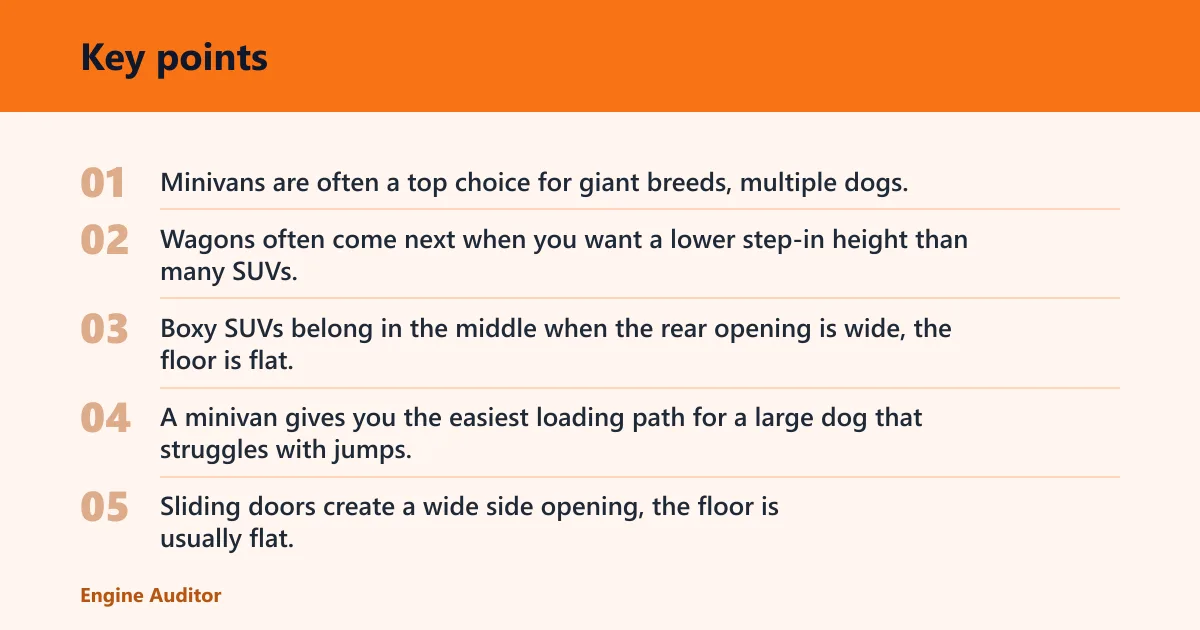
Minivans are often a top choice for giant breeds, multiple dogs, and crate transport because they typically combine sliding doors, a flat floor, and a large uninterrupted interior space. Wagons often come next when you want a lower step-in height than many SUVs. Boxy SUVs belong in the middle when the rear opening is wide, the floor is flat, and the lift-over is manageable.
Why minivans usually rank first for giant breeds
A minivan gives you the easiest loading path for a large dog that struggles with jumps. Sliding doors create a wide side opening, the floor is usually flat, and the interior shape is easier to measure for a crate than a sloped hatch area. That matters more than badge prestige or optional leather.
Minivans are also the cleanest fit for crates and more than one dog. The cargo area is typically simple to hose, wipe, or vacuum, and the straight sides waste less usable space around a crate than a tapered rear roofline.
When an SUV is the better fit
An SUV works well when it has a low step-in height, a wide rear hatch, rear vents, and a flat cargo floor. Some SUVs fail here because they sit high, have a split or sloped cargo floor, or place the dog into a deep lift-over that makes entry awkward for a senior dog.
The Subaru Outback is a useful example of why size alone is not the whole story. It has 32.5 cubic feet behind the rear seats, expands to 75.7 cubic feet with the seats folded down, uses symmetrical all-wheel drive, and is described as having a low ride height and wide-opening rear doors. The Honda CR-V offers 39.2 cubic feet behind the rear seats, expands to 75.8 cubic feet with the seats folded down, and is described as having a low cargo floor and wide rear doors.
When a wagon beats both
Wagons can be better than many SUVs when the load floor is lower and longer. That shape gives a large dog a more natural place to lie down, and it usually reduces the jump from pavement to cargo floor. For a dog that rides behind a second row, that lower opening can matter more than a taller boxy rear end.
Wagons are especially useful when you want car-like road manners with cargo practicality. The tradeoff is simple: a wagon’s roofline can limit standing room for a crate, so it suits dogs that travel loose in a restraint or in a low-profile crate better than tall crates.
Quick picks by dog and use case
Match the body style to the dog’s size and mobility. A giant breed, a pair of large dogs, and a senior dog with joint limits need different cargo shapes.
- One large dog: A wagon or a low-floor SUV usually fits best if the rear opening is wide and the floor is flat.
- Two large dogs: A minivan is the easiest choice because the square cargo area and sliding doors reduce loading friction.
- Crate transport: A minivan first, then a boxy SUV with a straight load floor and measured crate clearance.
- Senior dogs or dogs with mobility limits: A wagon or low step-in SUV helps most because lift-over height is easier to manage.
Large dog vehicle decision table
This table ranks body styles by how they work in real use. The scores are decision scores, not lab measurements. Higher is better.
| Vehicle type | Entry height | Cargo-floor flatness | Crate fit | Rear airflow | Restraint options | Single large dog | Two large dogs | Crate transport |
|---|---|---|---|---|---|---|---|---|
| Minivan | Low to moderate | Excellent | Excellent | Usually strong | Barrier, crate, restraint | 5 | 5 | 5 |
| Wagon | Low | Very good | Good | Good | Restraint, crate, barrier | 4 | 3 | 3 |
| Boxy SUV | Low to moderate | Good if the floor is flat | Good | Good if rear vents are present | Restraint, crate, barrier | 4 | 4 | 4 |
| Hatchback | Low | Mixed | Poor to fair | Fair | Restraint, small crate, barrier | 2 | 1 | 2 |
| Pickup cab | Moderate | Poor for most large dogs | Poor | Fair in cab, poor in bed | Restraint in cab only | 1 | 1 | 1 |
Entry height and lift-over
Low step-in height matters because large dogs still need to enter without a difficult jump. Petful says a dog-friendly vehicle should have a low step-in height or liftgate, and that guidance is practical for senior dogs and breeds with joint stress. The lower the sill, the easier the daily routine.
For large dogs, the better question is not “how tall is the vehicle?” but “how high is the floor from the ground and how far does the dog have to jump?” A short lift-over can beat a bigger cargo number if the dog enters more willingly.
Cargo-floor flatness and usable length
Large dogs need usable cargo length more than brochure volume. The dog has to lie down, turn around, and stretch without the floor pinching into a narrow wedge. The same source recommends spacious cargo areas with flat floors, and that flatness matters because a sloped or broken-up floor wastes real space.
Use the longest flat section you can measure from the closed hatch to the back of the second row. A flat rectangle is more useful than a deep but tapered bay. A dog bed fits better there too, especially if it stays in place during braking.
A common first-timer mistake is choosing by cubic feet alone instead of checking whether the vehicle has a low cargo floor and enough room for a large dog to stand, turn, and lie down comfortably. A cargo area can look large on paper and still fail a long-bodied dog if the roof slopes early or the second row cuts the usable floor short.
Crate fit and tie-down points
Crate transport works best when the cargo opening is square, the floor is flat, and the side walls do not squeeze the crate frame. Tie-down points matter because they help keep the crate from sliding. A cargo barrier helps manage the cabin, but it does not replace proper crate anchoring.
For dogs over about 50 pounds, the Dogington Post says crash-tested restraints tend to outperform other restraint options. That does not make a barrier useless, but it does make the restraint choice clearer: use a crash-tested restraint for the dog, or a secured crate when the size and shape allow it. Do not rely on an extension tether.
Rear airflow and climate control
Rear air vents and temperature control matter on long trips and in warm weather. The same source lists rear air vents as a dog-friendly feature, and that tracks with common sense: a cargo area that traps heat is uncomfortable fast, especially for a thick-coated dog.
Look for rear vents that actually reach the cargo zone, not only the front row. In a minivan or larger SUV, the second and third rows can block airflow if the rear controls are weak or absent.
Cleanup and interior materials
Cleanup matters because fur, mud, slobber, and the occasional accident are part of real use. Simple cargo shapes are easier to vacuum, and washable liners work better when the floor is flat and the side panels are straight. Deep carpeted pockets collect debris and waste time.
Cloth is usually easier to live with than delicate trim, but the bigger issue is layout. A cleanable cargo bay with a flat floor and removable mat beats a fancy cabin with an awkward split-level load area.
Are SUVs better than cars for large dogs?
Usually, yes, but only when the SUV has a low cargo floor, a wide rear hatch, and enough flat floor behind the second row. Some cars are better than some SUVs for a large dog because a wagon can sit lower and offer a longer, more usable load floor than a tall SUV with a steep lift-over.
What SUV layouts work best
The best SUV layout for a large dog is boxy, low enough to step into easily, and flat across the cargo floor. Wide rear doors help loading, and rear vents help comfort on warm days. The Subaru Outback’s low ride height and wide-opening rear doors are exactly the kind of shape to look for, even though it is wagon-like rather than a traditional SUV.
Boxy, three-row SUVs can work too, but only if the cargo opening stays usable with the seats folded and the dog does not have to climb over a high sill. The most dog-friendly SUVs behave more like wagons with extra height than like tall trucks.
Which SUV features help large dogs?
Look for a low cargo floor, wide rear doors, flat folded-seat geometry, rear air vents, and tie-down points. All-wheel drive can help in bad weather and on rough access roads. It does not make the cargo area safer by itself, but it can improve year-round usability.
Where SUVs fall short
High lift-overs, sloped cargo roofs, and split cargo floors are the main failures. Some SUVs also have awkward seat backs that stop a crate from sitting flush. If the dog has to duck, scramble, or land on a raised lip, the SUV is not the right one.
Do wagons work well for big dogs?
Yes. Wagons often work very well for big dogs because the load floor sits lower than many SUVs and the rear opening usually gives a long, flat area for lying down. That shape is friendly to dogs with joint limits and to owners who want easier loading without moving up to a minivan.
Why lower ride height helps
Lower ride height reduces the jump at the hatch. That helps senior dogs, dogs with hip or knee issues, and large breeds that hesitate at steep cargo sills. It also helps humans lift a crate or a bed into place without awkward twisting.
Cargo length and roofline limits
Wagons can still fall short if the roof slopes too soon or the rear opening narrows at the top. A long body helps, but the usable shape matters more. A dog that can lie flat may still not fit a tall crate upright.
Suppose a 90-pound dog can lie down comfortably on a flat mat, but the roofline starts cutting in above the crate height. In that case, the wagon is still useful for a restraint or bed setup, but not for that crate.
Best wagon use cases
Choose a wagon when you want a lower step-in height, a flat load floor, and enough room for one large dog or a pair of medium-to-large dogs. Wagons are especially practical when you want easier access than a tall SUV and do not need the extra vertical space of a minivan.
Is a minivan a good choice for large dogs?
Yes. A minivan is often the easiest choice for large dogs because sliding doors, a flat floor, and a large interior volume make loading and cleaning simpler. It is usually the strongest body style for giant breeds, multiple dogs, and crates that need square space.
Why sliding doors matter
Sliding doors give you a broad side opening with less risk of the door swinging into a parking space or into a leash line. That matters when you are loading a heavy dog in a tight lot or at a curb. The opening also makes side-entry less awkward than a narrow rear hatch.
Flat floor and crate loading
A flat floor is the minivan’s biggest advantage. It lets a crate sit level, makes a dog bed stay put, and reduces the chance of a dog slipping as the vehicle moves. The interior volume is usually easier to use because the floor and walls are more square than in many SUVs.
Best minivan use cases
Pick a minivan for two large dogs, a giant breed, a dog that rides in a crate, or a household that wants the easiest cleanup. It is also the most forgiving body style for awkward loading angles, because the floor, door opening, and cargo shape all work together.
What about hatchbacks and pickup cabs?
Hatchbacks can work for some large dogs, but they are usually a compromise. Pickup cabs are usually a poor fit unless the dog rides in the cab and the floor space is truly usable. Open beds are not a safe option for an unrestrained dog.
When a hatchback can work
A hatchback can work for one large dog if the rear seats fold flat, the cargo floor is low enough, and the roof does not pinch the dog’s headroom too early. Many hatchbacks are better suited to a smaller large dog or a dog that lies down for the whole trip.
They are less suitable for two large dogs, tall crates, or long-bodied breeds that need a straighter stretch of floor.
Why pickup cabs are usually a poor fit
Pickup cabs usually have less usable floor length than a wagon or minivan, and the rear area often has a hump, seatback angle, or limited entry path. The open bed is not a safe place for an unrestrained dog, and weather exposure adds another problem.
Safer alternatives for truck owners
If you own a truck, the safer route is a secure cab setup with a crash-tested restraint or a properly sized crate in the cab. That still requires enough flat floor space and restraint geometry. If the cab is too tight, a separate dog-hauling vehicle is the better answer.
How to choose the right vehicle type
Start with the dog’s body length, shoulder height, and mobility, then match those to usable cargo space rather than brochure volume. Measure the flat length from the hatch to the second row, check the lift-over height, and confirm whether a crate fits without tilting or pressing into the roof.
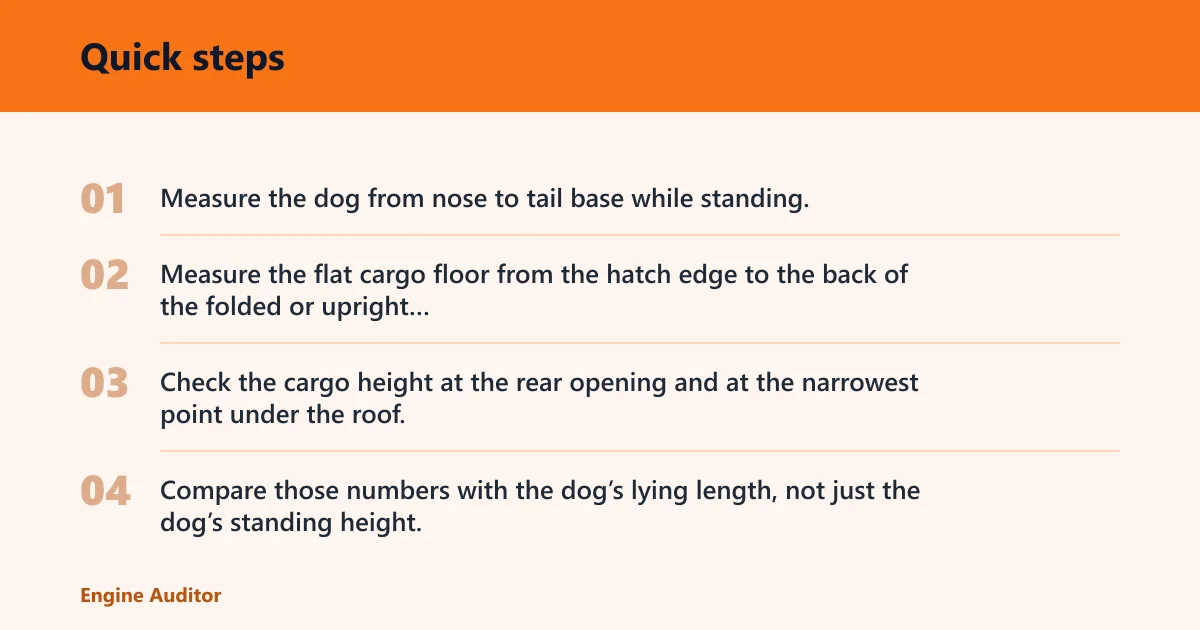
Measure usable cargo length and height
- Measure the dog from nose to tail base while standing.
- Measure the flat cargo floor from the hatch edge to the back of the folded or upright second row.
- Check the cargo height at the rear opening and at the narrowest point under the roof.
- Compare those numbers with the dog’s lying length, not just the dog’s standing height.
Check for a flat load floor
Flat matters because dogs need a stable place to lie down and shift position. Split-level floors, tall lips, and steep cargo ramps reduce usable space. A flat floor also improves crate stability and makes a dog bed more secure.
Confirm restraint and crate compatibility
Choose one of three setups: a crash-tested restraint, a secured crate, or a barrier used with another restraint. The barrier alone is not enough. Avoid extension tethers. If the dog is over 50 pounds, a crash-tested restraint is the safer default when a crate does not fit.
Look for rear vents and easy cleanup
Rear vents, washable mats, and simple cargo panels matter more than many shoppers expect. Heat builds quickly in a closed rear area, and fur sticks to complicated trim. If the dog often comes in muddy, skip layouts with deep carpet seams and complicated cargo wells.
Match the body style to your dog
Use a minivan for giant breeds, multiple dogs, and crate transport. Use a wagon for one large dog or two dogs that can share a flat, lower load floor. Use a boxy SUV when the rear opening is wide and the cargo floor is flat. Use a hatchback only if the measurements work. Avoid relying on a pickup bed for dog transport.
Frequently asked questions
What vehicle type is best for a large dog?
A minivan is usually the best body style for a large dog because it combines a flat floor, sliding doors, and square cargo space. A wagon is often the next-best choice when you want a lower ride height and easier access than many SUVs. A boxy SUV can work well if the rear area is flat.
What features should I look for in a dog-friendly vehicle?
Look for a low step-in height or liftgate, a flat cargo floor, wide rear doors, rear air vents, tie-down points, and easy-clean materials. Petful also calls out tether anchors or built-in pet barriers, but those should be used with a proper restraint or crate, not as the only restraint.
How much cargo space does a large dog need?
Enough usable space to lie down fully, turn around, and settle without hitting a sloped roof or a raised lip. That means measuring length and floor shape, not only cubic feet. A large dog may fit into 32.5 cubic feet or 39.2 cubic feet layouts only if the usable shape works.
Should I choose a crate, restraint, or barrier for a large dog?
For a dog over 50 pounds, a crash-tested restraint is a strong choice when you do not use a crate. A secured crate is ideal when it fits well and can be anchored. A barrier helps separate the cargo area from the cabin, but it should not replace a proper restraint.
Which vehicles are easiest for large dogs to get into?
Vehicles with a low step-in height are easiest: wagons, low-floor SUVs, and minivans with a manageable sill. High-riding SUVs and pickup cabs are harder because the dog has to climb up, then pivot into a limited space. A low rear opening is often the deciding factor.
Products related to this article
Sponsored / affiliate links. As an Amazon Associate I earn from qualifying purchases. I may earn additional commission from eligible campaigns.