Do Electric Cars Have Less Cabin Noise Than Gas Cars?
Electric cars are often quieter in the cabin at city speeds because they remove engine noise, but tyre and road noise often become the main source above about 30 to 40 mph. Miss that, and you may buy the wrong car for your commute; this guide shows how to judge cabin noise by speed, tyres, road surface, and real-world EV versus gas differences.
Are electric cars quieter than gas cars?
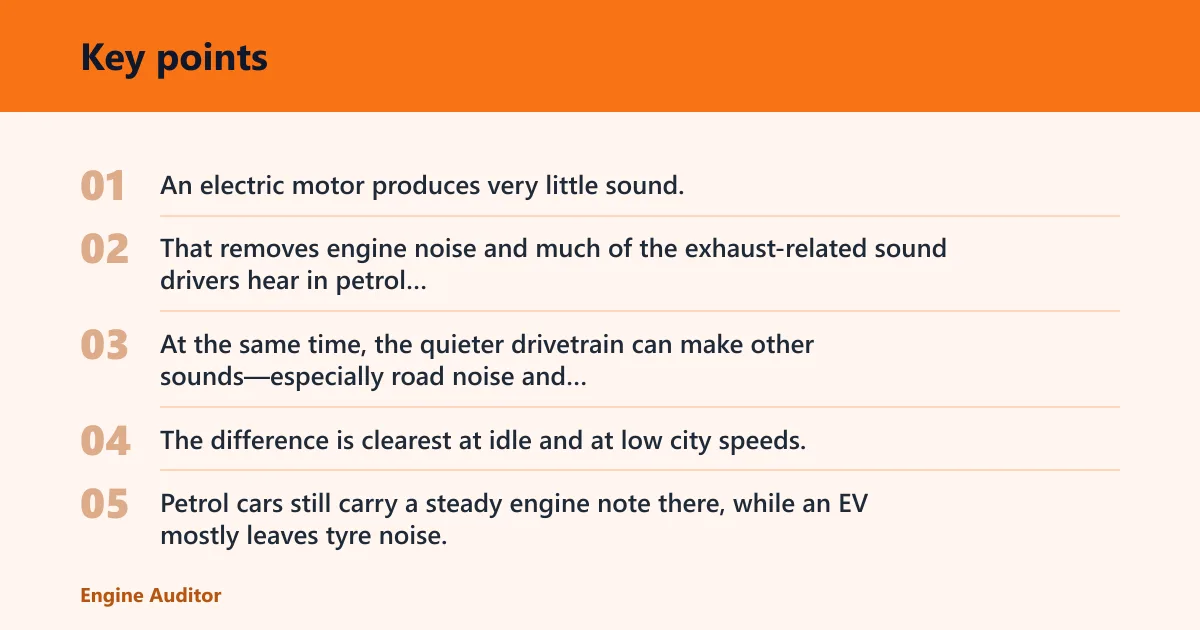

Yes, usually, but not in every situation. An electric motor produces very little sound, and EVs rely on a battery and motor system instead of a combustion engine. That removes engine noise and much of the exhaust-related sound drivers hear in petrol cars. At the same time, the quieter drivetrain can make other sounds—especially road noise and tyre noise—easier to notice.
Where the quiet advantage is strongest
The difference is clearest at idle and at low city speeds. Petrol cars still carry a steady engine note there, while an EV mostly leaves tyre noise, road noise, and a little wind noise. In that zone, the cabin can feel calmer and less mechanically busy.
When the answer starts to depend on tyres and road surface
Once speed rises, the powertrain matters less than the surface under the tyres. Tyre noise is the sound of tyres rolling over the road surface, and it depends on road condition and the vibrations it sends into the cabin. On coarse pavement, a quiet EV can lose part of its advantage fast.
Say your commute is a 12-mile run with smooth asphalt and traffic lights every few blocks. A compact EV may feel far quieter than a gas hatchback at 25 mph. Swap that same route to rough chip seal, and the remaining tyre and road noise becomes much easier to hear.
Cabin noise comparison table
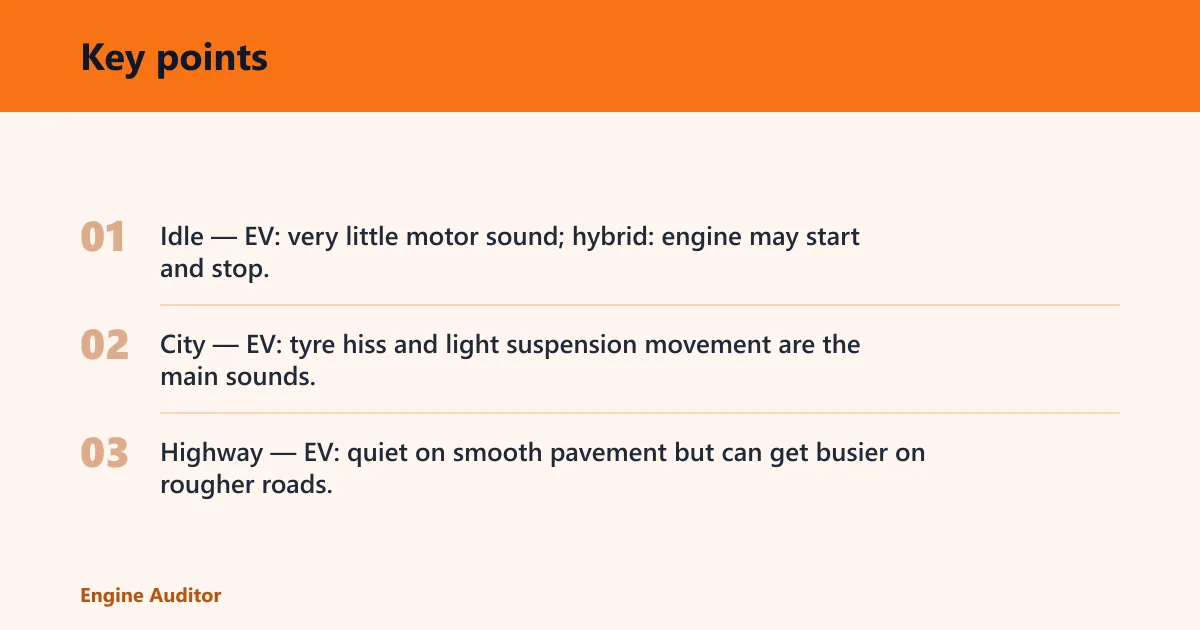
| Speed band | EV cabin noise | Hybrid cabin noise | Gas car cabin noise | What you will actually hear | Most likely culprit |
|---|---|---|---|---|---|
| Idle | Very low; motor sound is minimal | Engine may cycle on and off | Engine idle is usually obvious | EV: almost only ambient outside sound; gas: steady engine presence | Engine noise in gas cars |
| City speeds | Usually quietest here | Mixed, depending on engine use | Still louder than most EVs | Tyre hiss, small bumps, occasional wind, less mechanical drone in EVs | Tyre noise and road surface |
| Highway speeds | Quiet on smooth pavement; can lose advantage on coarse roads | Often close to EVs if the engine is calm | Engine can fade behind road and wind noise | Roar from tyres, air movement around mirrors and pillars, surface vibration | Tyres, wind, and road noise |
Plain-text diagnostic version
- Idle — EV: very little motor sound; hybrid: engine may start and stop; gas: steady idle is usually obvious. What you will actually hear: EVs are mostly quiet aside from ambient outside sound, while gas cars carry a constant engine presence. Most likely culprit: engine noise in gas cars; if any clatter is present at idle, check engine-related sources first, not road noise.
- City — EV: tyre hiss and light suspension movement are the main sounds; hybrid: it depends on how often the engine is running; gas: more mechanical background sound. What you will actually hear: tyre noise, road-surface texture, occasional wind noise, and small bumps. Most likely culprit: tyre noise and road surface, with motor/engine noise only when the powertrain is active.
- Highway — EV: quiet on smooth pavement but can get busier on rougher roads; hybrid: can match or beat a budget EV if the engine stays calm and the car is well insulated; gas: engine noise often fades behind airflow and road sounds. What you will actually hear: tyre roar, wind around mirrors and pillars, and vibration from coarse pavement. Most likely culprit: tyre noise, wind noise, and road-surface vibration; the drivetrain matters less than insulation and tyre choice.
The table separates what occupants hear from what the outside world hears. That matters because an EV may be required to make extra external sound at low speeds for pedestrian safety, yet that warning sound does not mean the cabin is noisy.
What noises do you hear in an EV cabin?
Electric vehicles still make cabin noise. The main sources are tyre noise, road noise, whistling noise, and wind noise. What changes is the balance: the engine is gone, so those remaining sounds stand out more clearly inside the car.
Tyre noise
Tyre noise often becomes the first sound people notice in an EV. It can sound like a low roaring background noise inside the car. With the motor quiet, tread pattern, tyre compound, and wheel size become easier to hear.
Road noise and vibration transfer
Road surface vibrations matter just as much. Coarse pavement, patchwork asphalt, and expansion joints can send vibration into the cabin, and that vibration becomes sound. Two EVs with the same badge can feel very different if one has softer suspension and more insulation.
Whistling noise and wind noise
The faster you drive, the more you hear a whistling sound from the car. That comes from air moving around mirrors, seals, pillars, and body edges. At highway speed, wind noise can join tyre noise and road noise as the main cabin sounds, even in a quiet EV.
Suppose you compare two midsize EVs on the same highway. One uses 19-inch wheels and low-profile tyres, while the other uses smaller wheels with more sidewall. The larger-wheel car often sends more tyre roar into the cabin, even though both have the same battery and motor layout.
Why petrol cars sound louder inside

Petrol cars usually sound louder because the combustion engine is the main noise source. Combustion creates mechanical and exhaust-related sound emission, and that sound reaches the cabin through the body structure, firewall, and floor. Even when cruising, that engine presence often remains the main sound drivers hear.
Combustion engine noise
At idle and under load, the engine adds a steady mechanical layer that EVs do not have. It masks some tyre and road noise, but it also raises the overall cabin sound level. That is why many gas cars feel more vocal even before road conditions change.
Exhaust-related sound transmission
Exhaust note is not always loud in the sports-car sense. More often, it is a low-frequency background sound that enters the cabin with engine vibration. On rough roads, the engine can still sit on top of tyre noise instead of disappearing behind it.
Why the drivetrain often masks tyre noise less than an EV does
In a gas car, the engine can dominate enough that the driver pays less attention to the tyres. In an EV, the motor’s near-quiet operation exposes the rest of the noise picture. The result is not a noisier car by default, but a car whose remaining sounds are easier to notice.
Do EVs get noisy at highway speed?
Yes, they can. Highway speed shifts the dominant cabin sounds away from the motor and toward tyre noise, road noise, and wind noise. On smooth surfaces, many EVs stay quiet. On coarse pavement, the EV advantage can shrink enough that a well-insulated gas car or hybrid can feel similar inside, and in some cases calmer.
How speed changes the dominant noise source
At low speed, the engine is often the biggest difference between EVs and gas cars. At highway speed, that difference matters less because rolling and air noise rise. The faster the vehicle moves, the more the cabin becomes a fight between tyres, road texture, and airflow.
Why coarse pavement can erase part of the EV advantage
Coarse pavement increases the vibration and noise generated at the contact patch. Since the powertrain is quieter in an EV, those tyre-generated sounds stand out more. That is why a quiet electric crossover on smooth concrete can turn noticeably busier on patched asphalt a few miles later.
When wind, tyres, and suspension become the main factors
At speed, suspension tuning and insulation matter as much as the badge on the grille. A luxury EV with more sound deadening can beat a bare-bones gas sedan, while a compact EV with firm suspension and wide tyres can sound busier than a refined hybrid.
Low-speed warning sounds and dB figures
EV low-speed warning systems are intended for pedestrian safety, not cabin comfort. In the EU, electric vehicles must emit a minimum external acoustic vehicle alerting sound of 56 dB(A) at low speeds under UNECE Regulation No. 138; that figure is an exterior requirement, not a cabin measurement. It should not be confused with what passengers hear inside the car. UNECE Regulation No. 138
What the low-speed warning system does
The low-speed acoustic warning system adds a minimum external sound at low speeds so pedestrians can detect the vehicle. It applies in regulatory contexts such as the EU at low speeds. It is a safety sound outside the car, not a measure of cabin quietness.
How to think about decibels without mixing up inside and outside
Combustion engine cars are often discussed in the mid-60s dB(A) range at pass-by or drive-by measurements, while the EU minimum for EV low-speed warning sound is 56 dB(A) outside the vehicle. Those numbers do not mean the cabin is that loud. They describe different measurements, and outside compliance is not a direct proxy for interior noise. EPA vehicle emissions and fuel economy information UNECE Regulation No. 138
What the numbers do and do not tell you
Those figures are useful for context. They show that EVs are not silent in the real world, and that gas cars carry more engine-related sound. But the actual cabin result still depends on road surface, tyres, wheel size, insulation, and speed.
- Separate outside sound rules from cabin comfort.
- Check the tyre size and tyre model first.
- Ask what wheel size the trim uses.
- Pay attention to suspension tuning and insulation.
- Compare the car on coarse pavement if possible.
Buyer and diagnosis checklist
If you are comparing cars for cabin quietness, focus on the variables that change the sound the most: tyre model, wheel diameter, tyre width, road surface, acoustic glass, seal quality, wind noise around mirrors and pillars, suspension tuning, and the speed where the noise appears. The key question is not just whether the car is quiet, but whether the sound shows up only at idle, around 30 to 40 mph, or mainly at highway speed.
- Tyre model: look for touring, EV-specific, or low-noise tyres if available.
- Wheel diameter: larger wheels and shorter sidewalls usually transmit more road texture.
- Tyre width: wider tyres can increase tyre roar on rough pavement.
- Road surface: smooth asphalt, concrete, and chip seal can sound very different.
- Acoustic glass: helps reduce wind and some high-frequency road noise.
- Seal and wind noise: check mirrors, door seals, and pillar areas at speed.
- Suspension tuning: firmer setups can pass more vibration into the cabin.
- Speed window: note whether the sound appears at idle, 30 to 40 mph, or highway speed.
What cabin noises are more noticeable in electric cars?
The most noticeable sounds are tyre noise, road noise, and whistling noise. Because the motor is almost quiet, those sounds are no longer buried under engine noise. That can make an EV feel calmer overall while also making certain noises easier to hear.
Why tyre-focused design matters
Tyre design can change the answer more than the powertrain does. Michelin Acoustic technology, for example, is marketed as reducing perceived interior noise by up to 20%. That claim refers to interior perceived noise reduction from tyre construction, not exterior pass-by sound, and it shows how much tyres can influence cabin quietness. Michelin Acoustic technology
Segment differences matter
Compact EVs, luxury EVs, hybrids, and trucks can differ a lot. A quiet premium EV may use more insulation, better glass, and more tuned suspension than a budget gas car. A truck, by contrast, can carry more road and wind noise regardless of powertrain.
A common mistake is assuming all electric cars are equally quiet, when tyre and wind noise can make one model sound noticeably louder than another on the highway. A small EV on 18-inch tyres is not the same as a luxury sedan on acoustic glass, and neither one behaves like a body-on-frame pickup.
Frequently asked questions
Are electric cars quieter than gas cars inside?
Usually, yes. EVs remove engine noise, so the cabin is generally quieter at idle and low city speeds. The gap narrows at higher speeds, where tyre noise, road noise, and wind noise become the main sounds in both EVs and gas cars.
At what speed do electric cars get noisy?
Many EVs start sounding more like other cars above about 30 to 40 mph, because tyre and wind noise often begin to dominate. The exact point depends on tyre type, wheel size, road surface, and how much sound insulation the vehicle has.
Why do I hear more tire noise in an EV?
You hear more tyre noise because the motor is almost quiet. With the engine noise removed, the sound of tyres rolling over the road surface stands out. Rough pavement, wide tyres, and large wheels can make that effect much stronger.
Do electric cars make less road noise than gas cars?
They usually make less cabin noise overall, but not always less road noise in a strict sense. Road noise depends heavily on the pavement, suspension, insulation, and tyres. On coarse surfaces, some EVs can sound as loud inside as gas cars.
Are EVs quieter at highway speed than at low speed?
Not necessarily. EVs are usually quieter at low speed because engine noise is absent, but at highway speed the cabin is often dominated by tyres, wind, and road surface. On smooth roads they can stay very quiet; on rough roads the advantage shrinks.
How many decibels is an electric car at low speed?
In the EU, the low-speed external acoustic warning requirement for EVs is a minimum of 56 dB(A). That is an outside sound requirement for pedestrian safety, not the cabin level. Interior noise depends on tyres, road surface, and vehicle design. UNECE Regulation No. 138
Sources
- UNECE Regulation No. 138
- Michelin Acoustic technology
- EPA vehicle emissions and fuel economy information
Products related to this article
Sponsored / affiliate links. As an Amazon Associate I earn from qualifying purchases. I may earn additional commission from eligible campaigns.