What Is the Best Time of Year to Replace a Car Battery?
Replace a weak car battery before the season that will stress it most, usually late summer in hot climates and early fall in cold climates, especially if the battery is 3–5 years old. Waiting can leave you with a no-start, slow cranking, or a tow at the worst possible time. This guide explains how age, climate, and driving pattern tell you when to replace now and when you can wait. Battery life varies by chemistry, state of charge, and vehicle electrical load, so the calendar is only a starting point (AAA; Interstate Batteries; Clarios).
Balancing battery age, symptoms, and climate for replacement
Replace a car battery when age, symptoms, and test results point the same way, and do it before the next harsh season. A battery that is about 3 to 5 years old, starts slowly, or tests weak should usually be replaced before winter cold or summer heat can push it into failure. Exact life depends on battery chemistry, state of charge, climate, and how much the vehicle draws when parked (AAA; Clarios).
When is the best replacement window?
For many drivers, the safest window is before seasonal stress peaks. In cold climates, that means early fall. In hot climates, late summer is often the smarter time, because heat shortens battery life and weak batteries often fail after months of thermal stress. If a battery is already near the end of its expected life, replacing it before that stress arrives is usually cheaper than waiting for a no-start.
Age alone is not enough. A 4-year-old battery in mild weather with strong test results may still be serviceable. A 2-year-old battery that has been jump-started repeatedly, lived through short trips, or failed a load test should move closer to replacement.
Why is age only part of the decision?
Most car batteries last about 3 to 5 years, but real-world life varies a lot. Heat, repeated undercharging, and stop-start driving can age a battery faster than the calendar suggests. That is why replacement timing should follow condition, not just the date stamped on the case. Hot under-hood temperatures accelerate chemical wear and water loss in conventional lead-acid batteries, which is why batteries often age out faster in hot regions (AAA; university extension sources).
How long do car batteries usually last?
Car batteries often last about 3 to 5 years, though useful life can be shorter in hot climates or on vehicles that see short, frequent trips. A battery that is already near that range deserves closer attention before the next season that will strain it. Lead-acid battery life also changes with chemistry and vehicle load, so AGM and EFB systems may behave differently than basic flooded batteries (Clarios; Interstate Batteries).
Typical service life and failure risk by age
| Battery age | Typical risk level | Common action |
|---|---|---|
| 0 to 2 years | Low, unless abused by heat or chronic undercharging | Monitor and test if symptoms appear |
| 3 years | Moderate, especially in hot climates or short-trip use | Test before the next season change |
| 4 years | High enough to justify proactive planning | Replace if weak, old, or unreliable |
| 5 years or more | High failure risk | Replace unless tests are clearly strong and use is mild |
Why do old batteries fail faster after summer heat?
Heat speeds internal wear, which can reduce reserve capacity before cold weather arrives. That is why a battery may survive summer driving and then fail when temperatures drop. The failure was building all along; winter only exposed it. AAA notes that heat is a major battery killer because it accelerates deterioration and can leave a battery weak before the first cold snap.
What are the signs my car battery is going bad?
Replace now if you see slow cranking, dim lights, clicking at start-up, or a battery warning light, especially when more than one shows up together. One symptom can be a charging-system issue, but several together usually mean the battery is losing usable capacity. A battery warning light can also indicate alternator or charging-system trouble, not just battery failure (NHTSA).
Which warning signs matter most?
Slow cranking means the starter turns the engine sluggishly, especially after the car sits overnight. Dim lights often show up when the engine is off or when accessories are running. Clicking starts suggest the battery cannot deliver enough current to turn the starter. A battery warning light can point to the charging system, the battery, or both (NHTSA).
Suppose a sedan cranks normally after a 20-minute highway drive but clicks after sitting two days in freezing weather. That pattern points to a battery with weak reserve capacity, not a healthy battery that merely dislikes one cold morning. A similar pattern can also reflect a parasitic drain if the battery tests better after charging but keeps losing power while parked.
When do symptoms mean replace instead of wait?
If the battery has already needed a jump start more than once, treat that as a strong replacement signal. One jump start can happen after lights are left on. Repeated jump starts often mean the battery can no longer hold enough charge for normal use, and they can also indicate an alternator or charging-system fault that needs diagnosis instead of another battery alone (AAA; NHTSA).
What is the best way to decide: replace now, test first, or monitor?
Use a decision matrix instead of a simple age rule. Score the battery by age, symptoms, driving pattern, climate, and jump-start history. A battery can be old but still passable, or relatively young but already worn down by heat, short trips, or repeated low charge. The threshold should reflect the whole pattern, not one clue.
Year replace car battery decision matrix
| Factor | 0 points | 1 point | 2 points | 3 points |
|---|---|---|---|---|
| Age | Under 3 years | 3 to 4 years | 4 to 5 years | 5+ years |
| Symptoms | No symptoms | One mild symptom | Two symptoms | Slow cranking + clicks, dim lights, or warning light together |
| Driving pattern | Regular longer drives | Mixed use | Frequent short trips | Short trips plus long sit times or stop-start use |
| Climate | Mild climate | Seasonal swings | Hot summers or cold winters | Extreme heat or extreme cold |
| Jump-start history | None | One isolated jump start | Two jump starts | Repeated jump starts |
How do you read the score?
8 to 15 points: replace now. The battery is showing enough age, stress, or symptom overlap that waiting is risky. 4 to 7 points: test first. A battery in this range may still be usable, but it needs a proper check. 0 to 3 points: monitor for 30 days, then retest if anything changes. This helps separate a truly weak battery from one that only needs a charge.
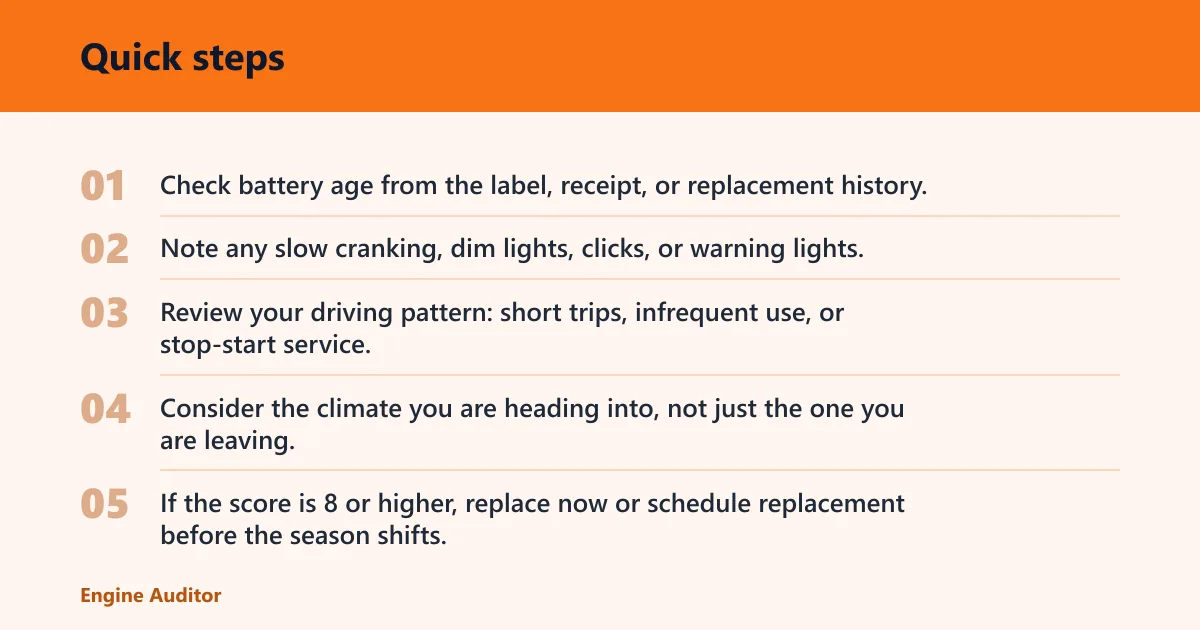
- Check battery age from the label, receipt, or replacement history.
- Note any slow cranking, dim lights, clicks, or warning lights.
- Review your driving pattern: short trips, infrequent use, or stop-start service.
- Consider the climate you are heading into, not just the one you are leaving.
- If the score is 8 or higher, replace now or schedule replacement before the season shifts.
Should you replace it before winter?
Yes, if the battery is old, has shown warning signs, or has a weak test result. Winter is often when a weak battery fails, but the better move is to replace it before cold weather makes that failure more likely and more inconvenient. In hot climates, pre-summer replacement can make more sense than waiting for winter.
When does pre-winter replacement make sense?
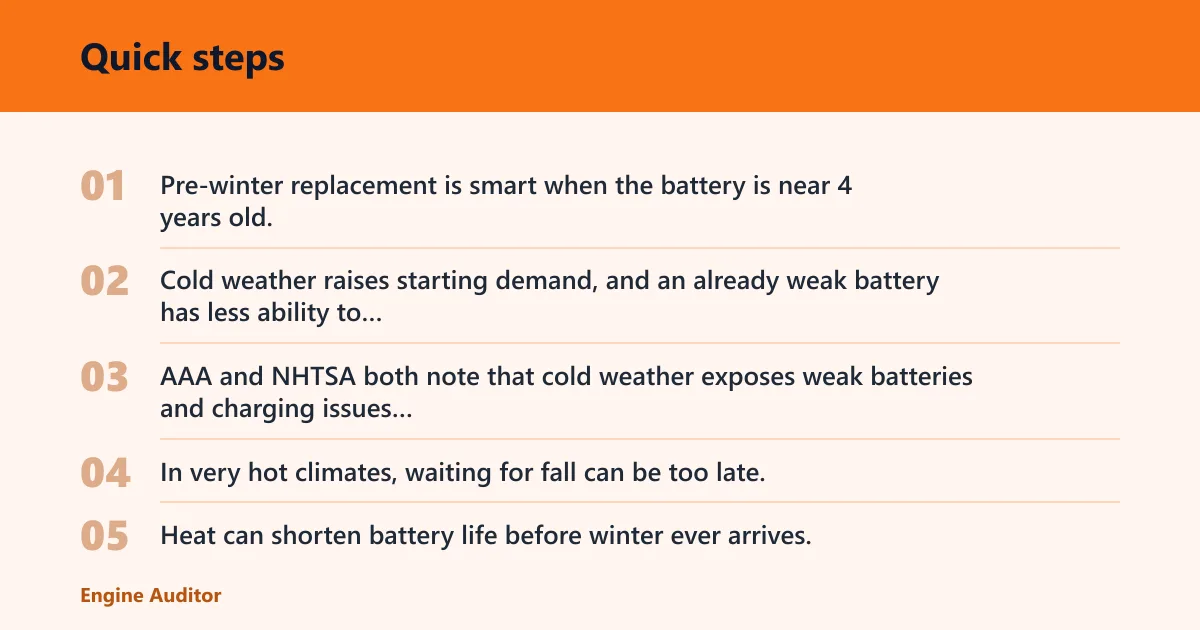
Pre-winter replacement is smart when the battery is near 4 years old, has been jump-started, or shows reduced reserve capacity. Cold weather raises starting demand, and an already weak battery has less ability to deliver high current when the engine oil is thicker and cranking load rises. AAA and NHTSA both note that cold weather exposes weak batteries and charging issues more quickly.
When is spring or summer replacement smarter?
In very hot climates, waiting for fall can be too late. Heat can shorten battery life before winter ever arrives. If the battery is already weak in late summer, replacing it then may prevent the early cold-weather no-start that often catches drivers off guard. Heat-related degradation is one reason warm-weather regions often see earlier battery replacement needs (AAA; university extension sources).
What if the battery needed a jump start?
If a battery needed a jump start and then tests weak, replace it rather than wait for a second failure. A weak resting voltage, poor state of charge, or low load test result means the battery is already struggling. Waiting increases the chance of being stranded and needing emergency labor or towing. Repeated jump starts can also point to charging-system faults that should be checked, not just battery wear (NHTSA).
A common first-timer mistake is assuming a successful jump start means the battery is fine. A jump only got the engine started. It did not prove the battery can survive another overnight sit, another cold morning, or another short commute.
How do driving habits affect battery life?
Short-trip and urban driving can wear a battery out faster because the alternator may not restore a full charge between starts. Repeated incomplete recharge cycles leave the battery chronically undercharged, which accelerates sulfation and reduces reserve capacity. Exact life depends on chemistry, state of charge, and electrical load, so two similar cars can age very differently (AAA; Clarios).
How do short trips and urban use hurt a battery?
Frequent 5- to 10-minute drives are hard on a battery. The engine starts use a large burst of current, but the drive may be too short to fully replenish it. Over time, that pattern can create a battery that seems fine one day and weak the next.
What should stop-start drivers know about AGM batteries?
Stop-start vehicles place higher cycling demand on the battery. Many stop-start vehicles require AGM or EFB batteries rather than a basic flooded type. If the original battery was AGM or EFB, replacement should match that specification unless the vehicle maker allows an approved alternative. Stop-start systems expect frequent engine restarts, so battery type and fitment matter as much as size.
AGM batteries tolerate higher cycle demand than many standard batteries and are common in vehicles with stop-start systems. They also need the correct fitment, because wrong type or wrong capacity can trigger charging issues or shorten service life. Some vehicles also need battery registration or a battery management system reset after replacement so the charging strategy matches the new battery (OEM service procedures; Clarios).
What battery tests should you trust?
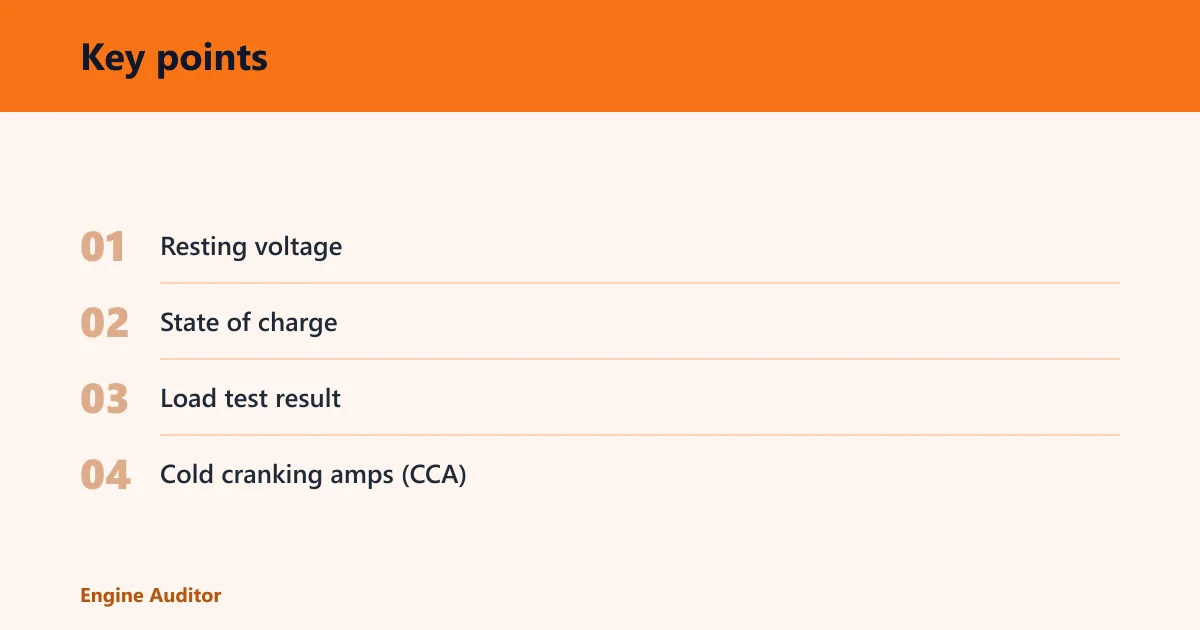
Use resting voltage, state of charge, load test results, and cold cranking amps to decide whether the battery is still reliable. These figures are more useful than guesswork because they show whether the battery can store charge and deliver power under load. A healthy 12-volt battery should usually rest near 12.6 volts when fully charged, though a surface charge can briefly skew readings after driving or charging (Interstate Batteries; Clarios).
Which test inputs matter most?
- Resting voltage: A fully charged 12-volt battery should usually read about 12.6 volts at rest. Lower readings suggest low charge or wear.
- State of charge: This shows how full the battery is. A low state of charge can sometimes be corrected, but repeated low readings often mean a deeper problem.
- Load test result: A battery can show decent voltage and still fail under starter load. That is why load testing matters.
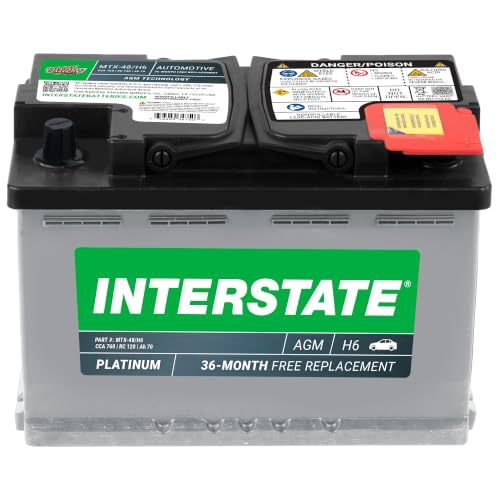
- Cold cranking amps (CCA): This is the battery’s cold-start rating. It should match the vehicle label requirement closely, especially in cold weather.
Why does CCA matter for fitment?
CCA affects starting performance in cold weather. The number on the battery label is part of the fitment decision, along with group size and terminal layout. A battery with the wrong CCA may fit physically but still start poorly when temperatures fall. Manufacturers and battery makers recommend matching the vehicle’s specified CCA and physical size because cold-start performance depends on both (Interstate Batteries; OEM service information).
Picture a compact SUV with a battery labeled for lower CCA than the vehicle plate specifies. It may start fine in mild weather, then struggle on the first freezing morning because the battery cannot supply enough current for cold cranking demand.
How do you choose the right replacement battery?
Choose a replacement that matches the vehicle’s battery group size, CCA rating, and technology type. Start-stop cars often need AGM or EFB batteries, and many vehicles also require a battery management system reset after replacement so the charging system can relearn the new battery’s condition. Use the vehicle specification first, then compare the label and terminal layout before buying.
How should fitment and compatibility be checked?
Match the original battery type if the vehicle was built for AGM or EFB. Using the wrong technology can create poor charging behavior or shorten battery life. The label matters, but so does the vehicle’s electrical setup. OEM procedures and battery makers caution that battery chemistry, size, and required charging profile all need to line up for best results (OEM service information; Clarios).
When does a battery management system reset matter?
Some vehicles track battery condition and charging behavior electronically. After replacement, the system may need a reset or registration step so it does not keep charging the new battery as if it were old. Check the vehicle procedure before the swap. If the vehicle uses battery monitoring or intelligent charging, skipping registration can affect charge control and battery life (OEM service information).
Frequently asked questions
How many years should you replace your car battery?
A common replacement window is 3 to 5 years, but that is only a starting point. Replace sooner if the battery is old for its climate, has weak test results, or shows starting symptoms. A 4-year-old battery in harsh use can be a better replacement candidate than a 5-year-old battery in mild use.
When should I replace the car battery?
Replace it before the season that will stress it most, not after it starts failing. That usually means early fall in cold regions or late summer in hot regions. If the battery is near 4 years old and shows slow cranking or weak testing, replacement should move up.
Is winter the best time to replace a car battery?
Winter is often when weak batteries fail, but it is not the best time to wait. The smarter move is to replace before winter if the battery is already weak, old, or unreliable. That reduces the chance of a no-start on a freezing morning.
Should I replace my car battery before it dies?
Yes, if it is near the end of its normal life or already showing warning signs. Waiting for complete failure can mean towing, jump starts, and emergency labor at the worst time. Proactive replacement is usually cheaper and easier than a roadside rescue.
Can hot weather shorten car battery life?
Yes. Heat speeds internal battery wear and can reduce service life before winter ever arrives. In hot climates, a battery may need replacement earlier than the calendar alone suggests. That is why late summer replacement can be the safer move for an older or weak battery.
Should I replace a battery after it has been jump-started a lot?
Usually, yes. One jump start can be situational, but repeated jump starts point to a battery that is no longer holding enough charge. If the battery also tests weak, or if the vehicle keeps needing assistance after normal driving, replacement is the better decision. Repeated jump starts can also mean the alternator or charging system should be checked.
Sources
- AAA. Battery life, heat effects, and seasonal failure guidance.
- Clarios. Battery chemistry, charge state, AGM/EFB usage, and battery life factors.
- Interstate Batteries. Resting voltage, CCA, and battery testing guidance.
- NHTSA. Charging-system warning light and electrical-system diagnostic guidance.
- OEM service information. Battery registration/reset procedures and vehicle-specific fitment requirements.
- University extension sources. Lead-acid battery aging and heat-related degradation basics.
Products related to this article
Sponsored / affiliate links. As an Amazon Associate I earn from qualifying purchases. I may earn additional commission from eligible campaigns.