Best Car Batteries for Cold Weather (2026): Research Shows
For cold weather, choose a battery that matches your vehicle’s required BCI group size and reserve capacity, then select the highest cold-cranking amps your fitment allows. The old “20% above factory CCA” rule is only a heuristic, not a standard; the right margin depends on vehicle class, engine size, starting load, and climate severity. In very cold climates, diesel engines, larger displacement engines, and accessory-heavy trucks generally benefit from more headroom than small gasoline cars, but the battery still has to fit and the charging system still has to support it. Cold-cranking amps are commonly rated at 0°F (-18°C) under SAE-style test conditions, while reserve capacity reflects how long a battery can sustain a defined load before voltage drops too low. For lithium, cold-weather charging is the limiting factor: many lithium chemistries should not be charged below 0°C without battery-management protection or low-temperature charging controls. This guide separates cranking power, fitment, and backup endurance so you can choose the right winter battery without overspending. (Sources: Battery Council International fitment guidance; SAE J537-style CCA testing; major battery makers’ low-temperature charging guidance for lithium.)
- Confirm BCI group size in the owner’s manual or on the original battery label.
- Match terminal orientation and terminal type before comparing CCA.
- Check tray length, width, and height against the battery case dimensions.
- Verify hold-down style and any venting requirements, especially on European and enclosed applications.
- For start-stop systems, use an AGM or an OEM-specified equivalent cycling battery.
- For very cold climates, prioritize higher CCA, then reserve capacity, then warranty and brand support.
Quick comparison
| Product | Badge | Best for | Price | ||
|---|---|---|---|---|---|
 |
Weize Platinum AGM Battery Group 35, 12V 55Ah 650CCAWEIZE | Our pick | Group 35 · 650 CCA · AGM | $159.99
Price as of 29 Oct 2026
|
View |
 |
OPTIMA® Batteries High Performance 25 REDTOP® Sealed AGMOPTIMA | Also great | 12V · 720 CCA · AGM | $249.99
Price as of 29 Oct 2026
|
View |
Use the comparison table to sort the batteries by winter start strength first, then by backup runtime and fitment. That order matters more than brand name when temperatures fall below freezing.
How we chose
We shortlisted batteries by comparing published specifications that matter in winter: BCI group size, cold-cranking amps, reserve capacity, terminal layout, case dimensions, warranty length, and whether the battery type is appropriate for start-stop or accessory-heavy use. The recommendations favor batteries with clear published fitment data and winter-oriented performance specs, not just high marketing claims.
Our methodology is spec-first rather than hands-on-test-first. This page does not claim instrumented install, load-bank, or long-term durability testing unless the manufacturer’s listed data or the product packaging explicitly provides it. Batteries were disqualified when the listing lacked enough fitment detail, when the type was mismatched to common winter use cases, or when the cranking spec was not competitive for the intended class.
AGM models received priority because they are generally better suited to cold starts, repeated cycling, and short-trip recovery than flooded lead-acid. Flooded batteries were kept only where they offer a clear budget case, and lithium was treated as a niche option because low-temperature charging constraints narrow its usefulness in ordinary winter commuting. (Sources: BCI, SAE J537-style CCA definition, and battery-maker low-temperature charging guidance.)
Fitment came next. BCI group size, terminal type, and physical dimensions have to match the vehicle, or a strong battery becomes a bad purchase. When two products were close on paper, the one with clearer fitment data and broader use-case support ranked higher.
AGM battery: best for most winter starts
AGM is the safer default for winter starting because it delivers strong cranking power, tolerates repeated charge and discharge better than flooded lead-acid, and recharges more readily in low temperatures. If you drive in freezing conditions, short trips, or a start-stop vehicle, AGM usually gives the best balance of starting strength and durability.
Why AGM usually beats flooded lead-acid in cold weather
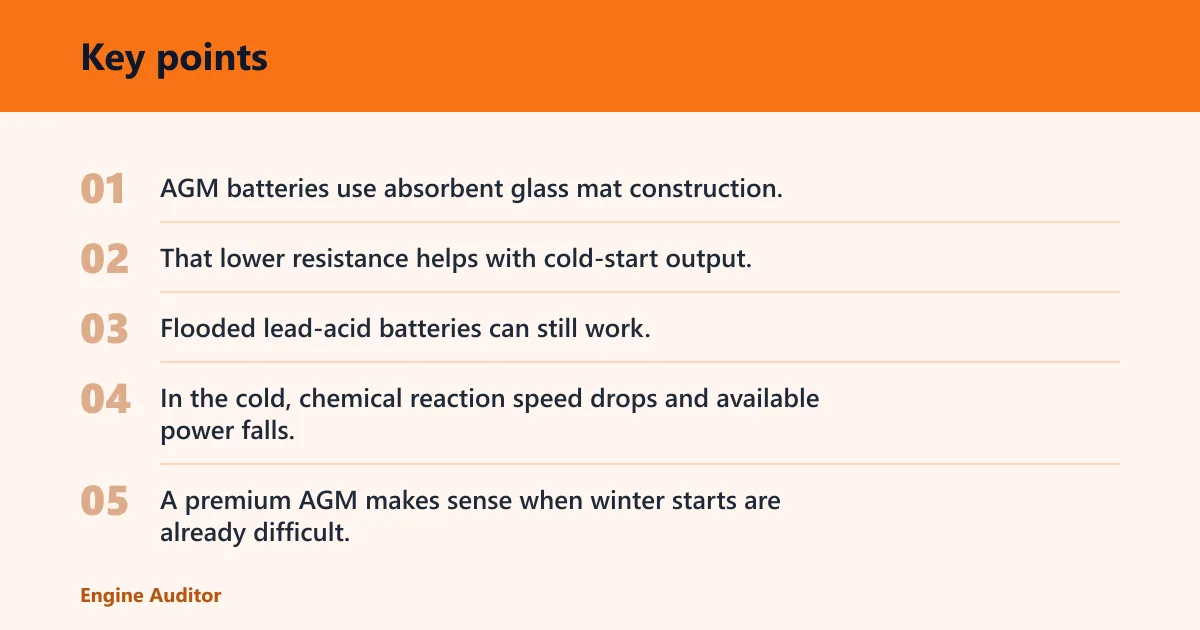
AGM batteries use absorbent glass mat construction, which keeps the electrolyte sealed and spill-proof while reducing internal resistance. That lower resistance helps with cold-start output, and the better recharge acceptance in low temperatures matters after a weak alternator charge or a series of short winter trips.
Flooded lead-acid batteries can still work, but their winter performance depends much more on CCA. In the cold, chemical reaction speed drops and available power falls, so a flooded battery that looks acceptable on paper may still struggle when the engine oil thickens and cranking load rises.
When a premium AGM is worth the extra cost
A premium AGM makes sense when winter starts are already difficult, when the vehicle carries heated seats, rear defrost, and other electrical loads, or when the battery has to recover quickly after short trips. It is also the better buy for start-stop vehicles, because those vehicles need a battery built for frequent charge-discharge cycles.
Paying more for AGM is harder to justify in a mild climate with long drives and light accessory use. In that case, fitment and warranty may matter more than chasing the biggest label number.
Where SpiralCell AGM fits into the comparison
Some AGM batteries use SpiralCell technology, which is generally positioned as vibration-resistant and strong on starting output. That design can be useful in trucks, SUVs, and rough-road use, but it still does not replace the basics: correct group size, enough CCA, and the right terminal layout.
Best overall AGM: OPTIMA RedTop 25
This battery suits drivers who want a strong starting-focused AGM with 720 CCA and a sealed maintenance-free design. Based on the listed specs and buyer feedback, it is a good fit for cold weather starting, especially when the vehicle wants a strong burst of cranking power rather than maximum accessory runtime.
What stands out is the combination of 720 CCA and 90-minute reserve capacity in a sealed AGM case with SAE terminal fitment. That makes it easier to justify for winter use than a basic flooded battery of similar size.
The drawback is price. At $249.99, it costs more than many mainstream flooded batteries, and it is still only a good choice if the group size and terminals match your vehicle.
Best Group 35 AGM: Weize Platinum AGM Group 35
This battery fits drivers who need a Group 35 AGM with listed dimensions, tapered terminals, and start-stop support. The 650 CCA rating is respectable for cold weather, and the 100RC figure gives it more backup endurance than many starting-only batteries in the same size.
What stands out is the fitment detail. The listed dimensions, about 9.06″ L x 6.89″ W x 8.82″ H, help reduce guesswork, and the 36-month warranty can be a useful buffer for a winter battery purchase.
The drawback is that 650 CCA is not the strongest number in this guide. In very cold climates, drivers who can fit a higher-CCA battery may want to step up if the tray and terminals allow it.
Best budget flooded battery: what to choose instead of AGM
Flooded lead-acid batteries can still be a reasonable low-cost choice in mild winters, but they are more vulnerable to cold weather and depend heavily on CCA. If the climate is only occasionally cold and the vehicle has light electrical loads, a correct-fit flooded battery can do the job.
What flooded lead-acid can do in mild winter climates
In a mild winter, a good flooded battery may start reliably if it has enough CCA and the charging system is healthy. It is the budget option when the vehicle is simple, the daily commute is long enough to recharge the battery, and accessory use is light.
That does not make it the strongest winter pick. It just makes it acceptable when the climate is less punishing and the owner is willing to trade some cold-weather margin for lower upfront cost.
Where it falls behind AGM
Flooded lead-acid usually has higher internal resistance and weaker recharge behavior in low temperatures than AGM. That means slower recovery after short trips and less confidence on the coldest morning of the week.
If the vehicle is a start-stop model, flooded lead-acid is usually the wrong type. The repeated cycling demand is why start-stop vehicles need AGM or equivalent durability.
When it is the wrong choice
Skip flooded lead-acid when the climate stays below freezing for long stretches, when the vehicle sits outside, or when the electrical load is high. It is also the wrong choice if the battery must recover quickly after repeated starts with little driving in between.
Best for start-stop vehicles: AGM first, vehicle spec second
For start-stop vehicles, AGM is usually the right starting point because those systems cycle the battery more often and rely on quicker recharge acceptance. But the OEM specification still wins if the manual calls for a particular EFB, AGM, or battery monitoring system compatibility.
The most important check is not just CCA. It is whether the battery’s construction matches how the vehicle manages idle-stop events, regenerative charging, and accessory loads.
Best for trucks and SUVs: higher CCA and stronger fitment data
Trucks and SUVs usually benefit from higher CCA because they can have larger engines, heavier accessories, and harsher under-hood conditions. In those vehicles, fitment data matters as much as output, especially if the battery tray, hold-down, or terminal clearance is tight.
When space allows, the stronger CCA option is usually the better winter buy. When space does not allow it, the correct group size and secure mounting matter more than a bigger sticker number.
Best Group 24F / 48 / H6 / 35 / 35-size replacement: what to look
Those popular BCI groups cover a wide range of sedans, crossovers, and light trucks, so the right pick depends on exact fitment and climate. For these sizes, a winter battery should be chosen by BCI group first, then by terminal position, then by the highest practical CCA and reserve capacity combination.
If your vehicle can accept multiple group sizes, the right move is to compare tray space and terminal layout before you compare brand names. A slightly larger case that fits securely can be a better winter choice than a smaller battery with a number advantage but less reserve.
What actually matters in winter?
Cold-weather battery shopping comes down to three separate jobs. CCA decides whether the engine turns over fast enough, reserve capacity helps when accessories and short trips drain charge, and fitment decides whether the battery actually works in the car without forcing adapters or unsafe mounting.
CCA vs RC: which one decides a cold start
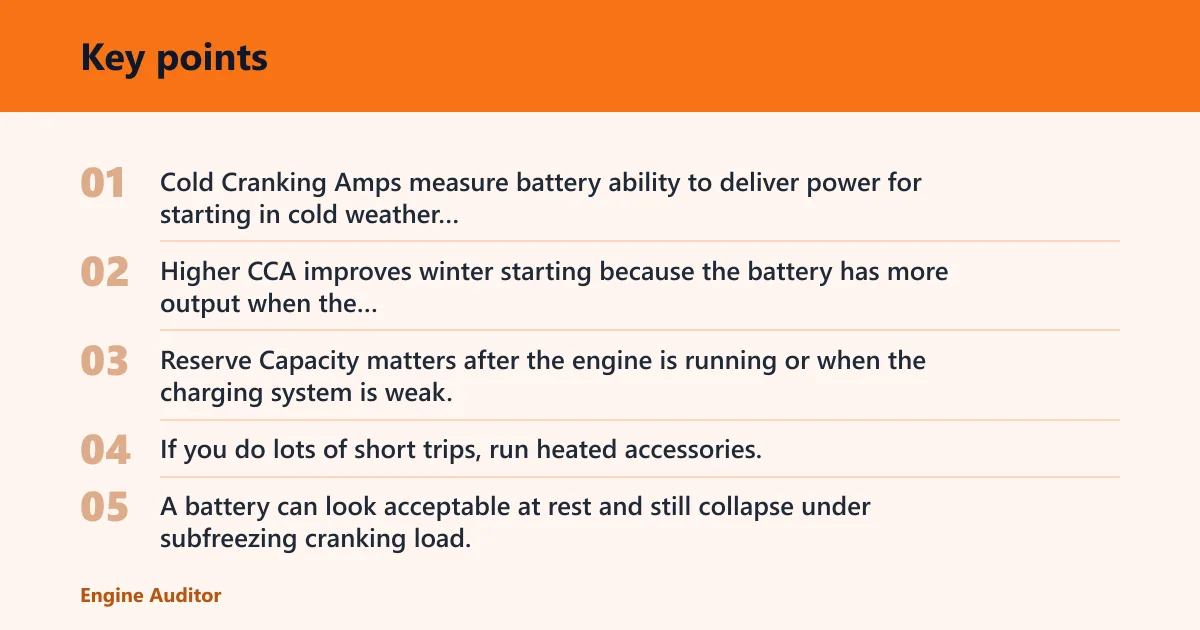
CCA decides the start. Reserve capacity does not. Cold Cranking Amps measure battery ability to deliver power for starting in cold weather under standard test conditions commonly associated with SAE J537-style definitions, and the rating is measured at 0°F / -18°C. Higher CCA improves winter starting because the battery has more output when the chemical reaction slows down.
Reserve Capacity matters after the engine is running or when the charging system is weak. If you do lots of short trips, run heated accessories, or worry about an alternator issue, RC becomes more important because it tells you how long the battery can deliver power if charging support is limited.
Why a battery can test fine and still fail in freezing weather
A battery can look acceptable at rest and still collapse under subfreezing cranking load. That happens because a resting test does not fully reveal how much voltage the battery can maintain when the starter demands a heavy burst of current in cold oil and low temperatures.
Say your sedan starts normally in the afternoon but turns slow at dawn when the temperature drops below freezing. The battery may still pass a basic static test, yet fail under load because its usable cranking output has fallen enough to make the starter drag.
Will a higher Ah battery start better in cold weather?
Not automatically. Higher amp-hours can mean more stored energy, but winter starting depends more on CCA than nominal capacity. A bigger Ah number helps only if the battery also has strong cold-cranking output and fits the vehicle’s charging and mounting requirements.
A common first-timer mistake is choosing the highest Ah label in the tray size and assuming that solves winter starting. It does not, especially if the battery’s CCA is modest or if the fitment is wrong for the vehicle’s terminals and tray.
Lithium-ion battery: when it fits and when it does not
Lithium-ion batteries are not the default answer for winter daily use. Cold-optimized versions exist, but charging below 0°C needs protection, and many standard lithium batteries are not winter-ready in the way drivers expect. Major battery makers typically warn against charging lithium cells below freezing unless the battery includes low-temperature charge protection or internal warming controls.
Cold-optimized lithium versus standard lithium
Cold-optimized lithium batteries can work in some applications, but the low-temperature charging limit changes the decision. A battery that can deliver power in the cold still may not accept charging safely below freezing without built-in protection or thermal management.
Standard lithium is a poor fit for many cold-climate cars because winter use is not only about discharge. It is also about whether the alternator can recharge the battery safely after a cold start and whether the battery management system is built for that job.
Why charging below 0°C changes the decision
Below 0°C, charging behavior becomes the main concern. If the battery cannot accept charge safely in that range, it may leave you with reduced performance even if the battery itself can power a brief start.
That is why lithium is usually a niche choice for winter driving rather than the safe default. It may suit special builds, but many drivers should skip it for ordinary cold-weather commuting.
Why many drivers should skip lithium for winter daily use
If the car spends nights outside and sees frequent short trips, AGM is the safer purchase. It has the winter-starting profile, the recharge behavior, and the cycle durability that most daily drivers need.
Lithium belongs in the conversation only when the vehicle and charger system are designed around it. Otherwise, it is a detour from the easier answer.
Winter battery decision table
| Use case | Minimum CCA range | When RC matters | AGM mandatory? | When lithium is unsuitable | Fitment checklist |
|---|---|---|---|---|---|
| Freezing-climate daily driver | At least 20% above factory spec when available | Useful if trips are short or accessories are heavy | Strongly preferred | Unsuitable if charging below 0°C is expected without protection | BCI group size, terminal type, tray length/width/height |
| Start-stop vehicle | Match or exceed OEM winter spec | Helpful for accessory loads and idle stop cycles | Yes, or equivalent cycle durability | Usually a poor fit unless the system is built for it | BCI group size, terminal layout, mounting style, sensor compatibility |
| Short-trip commuter | Moderate to high CCA, chosen for local lows | Important; short trips drain charge fast | Usually worth it | Often unsuitable because recharge constraints matter | BCI group size, terminal type, physical dimensions |
| Accessory-heavy truck or SUV | High CCA preferred | Very important for backup endurance | Usually yes | Unsuitable if load and cold charging are both concerns | BCI group size, terminal type, hold-down clearance |
Use the table as a filter, not a shopping list. First confirm group size and terminals, then choose the highest practical CCA, then look at RC if your driving pattern drains the battery between starts.
Which one should you buy?
If you live in a freezing climate and want the safest all-around answer, choose an AGM battery with the highest CCA your vehicle can fit. If the car is start-stop, AGM is the default unless the manual demands a specific equivalent standard.
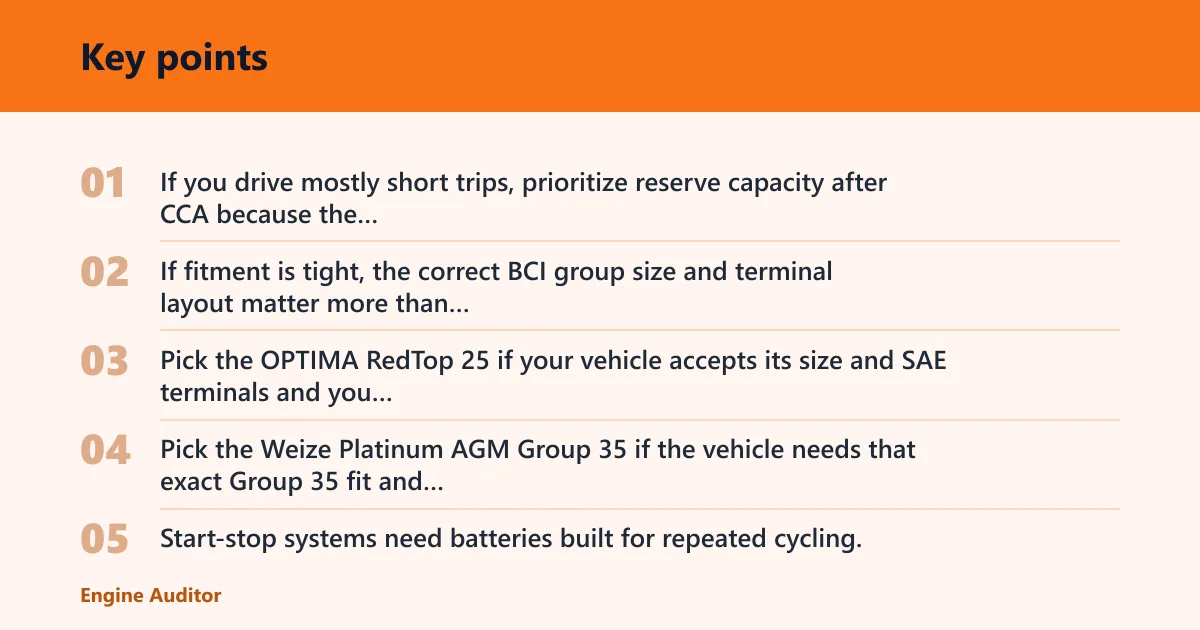
If you drive mostly short trips, prioritize reserve capacity after CCA because the battery needs enough backup endurance to recover from repeated starts and accessory use. If fitment is tight, the correct BCI group size and terminal layout matter more than chasing a slightly bigger number on the label.
Best pick for freezing climates
Pick the OPTIMA RedTop 25 if your vehicle accepts its size and SAE terminals and you want strong starting performance with 720 CCA.
Best pick for stop-start vehicles
Choose an AGM battery first. Start-stop systems need batteries built for repeated cycling, and the Weize Group 35 explicitly supports start-stop systems. That is more important than simply choosing the largest physical battery you can fit.
Best pick for short-trip drivers
Look at reserve capacity as a real buying metric. The Weize’s 100RC and the OPTIMA’s 90-minute reserve capacity both matter here because short trips and accessory loads can drain charge faster than a long highway drive can restore it.
Best pick when fitment is tight
Buy the battery with the exact BCI group size, terminal type, and dimensions your vehicle requires. The Weize listing gives explicit measurements and tapered terminals, which can reduce fitment surprises when space is limited.
Say your compact SUV needs a specific tray height and a narrow terminal layout. A battery with more CCA but the wrong case dimensions is a bad trade if it cannot mount securely or connect without strain.
Frequently asked questions
What car battery is best for cold weather starting?
An AGM battery is usually the best choice for cold weather starting because it delivers more reliable cold starts, has lower internal resistance, and accepts charge better in low temperatures. For the best result, match the vehicle’s group size first, then choose the highest CCA that fits.
Is AGM better than regular lead-acid in winter?
Yes, in most cases. AGM usually outperforms flooded lead-acid in winter because it keeps stronger cranking performance in the cold and recovers charge better after short trips. Flooded batteries can still work, but they depend much more on CCA and a healthy charging system.
How many cold cranking amps do I need in freezing weather?
There is no single number for every vehicle. A better rule is to start with the OEM spec, then add margin based on climate and engine load: small gasoline cars in moderate winter conditions may only need a modest cushion, while larger engines, diesels, short-trip use, and subzero climates often benefit from a higher-CCA battery if the vehicle’s charging system and fitment allow it. The old “20% above factory CCA” rule is a useful heuristic in harsh winter regions, not a universal requirement.
What matters more in winter: CCA or reserve capacity?
For starting the engine, CCA matters more. Reserve capacity becomes more important when you have short trips, heavy electrical loads, or alternator trouble. A good winter battery needs both, but CCA decides whether the engine turns over in the cold.
Which battery group size fits my car for winter use?
Use the owner’s manual, the old battery label, or the vehicle’s battery tray specs to confirm the BCI group size. The battery must match the tray, terminal type, and physical dimensions. A strong battery is useless if it does not mount safely or connect correctly.
Sources
- Battery Council International (BCI) group size guidance and battery fitment conventions.
- SAE-style cold-cranking amp definitions and test conditions commonly used at 0°F (-18°C).
- Major battery-maker guidance on lithium charging limits below 0°C and low-temperature protection requirements.
- Manufacturer-published product specifications for CCA, reserve capacity, dimensions, warranty, and start-stop suitability.
Products related to this article
Sponsored / affiliate links. As an Amazon Associate I earn from qualifying purchases. I may earn additional commission from eligible campaigns.