How to Choose Between Ceramic and Semi-Metallic Brake Pads
Choose ceramic pads for most daily-driven cars and crossovers; choose semi-metallic pads when you tow, drive mountain grades, carry heavy loads, or need stronger cold and hot bite. The right choice depends on vehicle weight, route, climate, and the maker’s brake-pad specification. Pick the wrong pad and you can get excess dust, more noise, longer stops, or brake fade under heat.
Ceramic vs. semi-metallic: the quick answer
Ceramic pads fit quiet daily driving, cleaner wheels, and gentler rotor wear. Semi-metallic pads fit towing, repeated hard stops, and performance use where the brakes take more heat, but the vehicle maker’s approved pad spec comes first.
Ceramic brake pads are made from a ceramic material embedded with copper fibers. Semi-metallic brake pads are 30% to 70% metal, often including steel, copper, iron, and other alloys. That higher metal content is why semi-metallic pads usually grip harder at the top of the pedal and move heat away faster, while ceramic pads are usually quieter and leave less visible dust.
| Comparison point | Ceramic pads | Semi-metallic pads |
|---|---|---|
| Noise | Usually quieter; often the quietest brake type in buyer guides | More likely to squeak or sound coarse |
| Brake dust | Less visible dust | Darker, heavier dust |
| Rotor wear | Generally gentler | Usually harder on rotors |
| Heat and fade | Good for normal commuting, but less margin in continuous hard braking | Better heat handling and more fade resistance |
| Initial bite | Consistent, but usually less aggressive | Stronger initial grip |
| Cost | Usually higher upfront cost | Usually lower upfront cost |
Brake pad
Use the table as a practical buyer guide for the usual feel differences in noise, dust, rotor wear, cold bite, heat fade, and price. It is not a lab result sheet, and the exact behavior still depends on the compound, the caliper, the rotor, and the vehicle maker’s approved specification.
- Start with the vehicle manual or parts listing.
- Check whether the pad shape and hardware match your caliper.
- Decide whether you care more about quiet, clean commuting or heat capacity under load.
- Choose the material that fits that duty cycle, not the one with the better marketing line.
Do not choose ceramic if… you regularly tow near the vehicle’s rated limit, drive long grades under load, or need the brakes to tolerate repeated hard stops with little fade margin.
Do not choose semi-metallic if… your main priorities are low dust, low noise, and the least rotor wear, and your vehicle maker does not require a higher-heat compound.
What ceramic brake pads are best
Ceramic pads are best when you want quiet operation, less visible dust, and calmer daily driving behavior. They suit normal commutes and family drives, and they are often the cleaner choice for people who dislike frequent wheel cleaning.
The trade-off is margin under repeated heat. Ceramic pads handle normal street use well, but they are not the first choice when the brakes spend long periods absorbing heat on downgrades, during towing, or in hard performance driving.
Quiet operation and lower visible dust
Ceramic pads are described as the quietest brake type in the supplied guidance. That matters when squeal, hiss, and wheel dust are more annoying than a slightly firmer pedal feel. If you clean wheels often or notice every bit of brake residue, ceramic is the easier maintenance choice.
Dust matters because it changes how fast wheels look dirty. Ceramic produces less visible dust than semi-metallic pads, while semi-metallic compounds usually leave darker residue that shows up quickly on light-colored wheels.
Gentler rotor wear
Ceramic pads are generally gentler on rotors. That does not mean rotors last forever, but it does mean the pad material is less likely to be the main reason for accelerated rotor wear. For an owner focused on longer service life and less brake noise, that is a real advantage.
Rotor wear is influenced by pad hardness and friction character. A harder, more aggressive pad can put more stress into the rotor surface over time, which is why semi-metallic pads often bring more rotor wear than ceramic pads.
Where ceramic can run short on margin
Ceramic pads are a weaker fit when the braking system is repeatedly asked to shed heat. That is the key limitation to remember on mountain descents, towing days, and heavy vehicles that stop from higher loads more often than a typical commuter car.
Say your crossover spends weekdays on a 15-mile commute and weekends on errands. Ceramic is the cleaner, quieter match. Say the same crossover is loaded with passengers, gear, and a trailer on a long grade. The decision changes, and the vehicle maker’s approved pad spec becomes the first filter.
What semi-metallic brake pads are best
Semi-metallic pads are best when the brakes need stronger initial grip and better heat handling. They are often recommended for towing, trucks, repeated hard stops, and performance use, and they work great in cold weather and on the track in many applications. The exact fit still depends on the vehicle and pad formula.
The trade-off is obvious. Semi-metallic pads usually make more dust, are more likely to squeak, and can be harder on rotors. If those penalties matter to you more than heat capacity, ceramic may be the better ownership choice.
Stronger initial grip
Semi-metallic pads often feel more assertive at the top of the pedal. That stronger initial bite can help in heavier vehicles or in driving that asks for quick repeated stops. It is one reason they are common in towing and severe-duty applications.
That said, stronger bite is not the same as universal superiority. If your vehicle maker specifies a ceramic compound for your brake system, follow that guidance first.
Heat dissipation and fade resistance
Brake fade is reduced braking performance under heat. It matters most on long downhill grades, repeated hard stops, towing, and performance driving, which are commonly cited as situations that put more heat into the brakes. In those conditions, semi-metallic pads often make more sense because their metal content helps move heat away and preserve pedal feel longer.
This is where wrong-pad selection becomes a safety issue. A pad that feels fine in town can fade sooner on a grade when the load changes. For that reason, “good enough for daily driving” is not the same as “right for towing.”
Trade-offs in dust, noise, and rotor wear
Semi-metallic pads usually create heavier dust and more squeal than ceramic pads. That dust is often darker, so wheels look dirty faster, especially on light paint or bright wheels. The material also tends to be rougher on rotors, which can raise service costs over time.
If low noise and easy wheel cleaning matter most, semi-metallic is usually the harder sell. If brake temperature and heavy load matter most, those comfort trade-offs may be acceptable.
Choose ceramic if… / Choose semi-metallic if…
Choose ceramic when the vehicle is used mainly for normal commuting, errands, and family driving, and when quiet operation and low dust matter more than maximum heat tolerance. Choose semi-metallic when the vehicle regularly sees higher brake temperatures, heavier loads, or repeated hard stops, but only if the vehicle maker approves that compound for your exact setup.
Choose ceramic if…
Choose ceramic if you want a quieter brake, less visible dust, and gentler rotor wear. It is the stronger fit for a daily-driven sedan, crossover, or light-duty SUV that rarely sees towing or downhill brake abuse. It is also the easier choice for owners who dislike wheel cleaning.
Are ceramic brake pads better for daily driving? Usually yes, when the vehicle is used for normal commuting and the manufacturer does not require a more aggressive compound. They suit quiet, clean daily driving better than semi-metallic pads in most light-duty cases.
Choose semi-metallic if…
Choose semi-metallic if the vehicle regularly carries heavy loads, tows within its rated limit, or sees mountain grades and repeated hard stops. That applies to many trucks, some SUVs, and performance-oriented setups, but only when the brake system and manufacturer listing call for that kind of pad.
Are semi-metallic brake pads better than ceramic? They are better for some jobs, not all. Their stronger bite and heat handling can be the right answer for load and fade control, while ceramic remains the better answer for many ordinary drivers.
Our picks by need
Quiet daily driving: HYFTJYZ ceramic front pad set

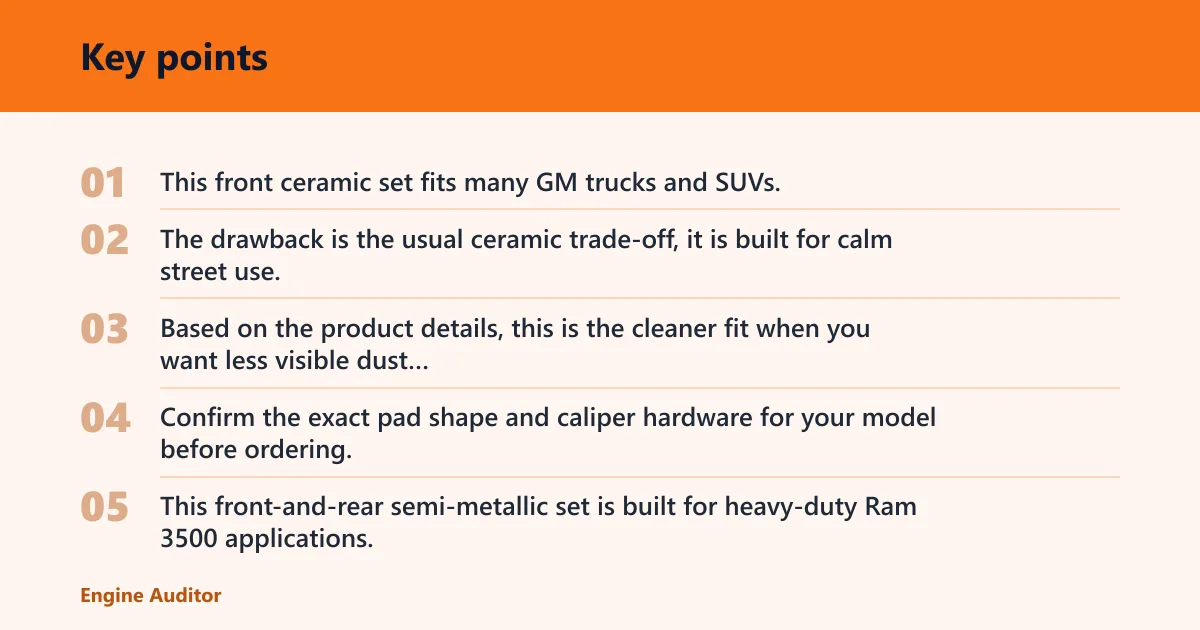
This front ceramic set fits many GM trucks and SUVs, and its published pros line up with the daily-driving case: ceramic friction material and a design aimed at performance and reliability. The listed price is $24.99. The drawback is the usual ceramic trade-off, it is built for calm street use, not for the highest heat margin.
Based on the product details, this is the cleaner fit when you want less visible dust and quieter braking on a normal commute. Confirm the exact pad shape and caliper hardware for your model before ordering.
Towing and heavy-duty use: Doc’s Diesel severe-duty semi-metallic pads

This front-and-rear semi-metallic set is built for heavy-duty Ram 3500 applications, includes hardware, and is described for towing and hauling. The listed price is $199.99. The drawback is the same one that usually follows semi-metallic compounds: more dust and more noise than a ceramic setup.
For a truck that works hard, this is the clearest match in the group because it is aimed at high-heat braking and severe-duty service. Still, the vehicle’s approved pad specification and axle fit come before the material label.
Mixed front-and-rear ceramic replacement: CCTECHMASS ceramic pad set

This front-and-rear ceramic set is aimed at GM SUV and pickup fitments and includes noise-dampening shims. The listed price is $27.99. Its drawback is the normal ceramic limit: it favors quiet, low-dust use more than repeated heavy thermal loading.
For owners who want a full-vehicle ceramic replacement and value quieter operation, it matches the commuting side of this comparison well. Check the listing carefully for your exact year, axle, and brake package before switching compounds.
Rear heavy-load replacement: Bendix Premium SBM1068 semi-metallic pads

This rear semi-metallic pad set is listed for specific Ford Super Duty applications and is designed for high-temperature resistance and OE replacement fit and function. The listed price is $33.78. The drawback is the expected semi-metallic side effect: more dust and more noise than ceramic.
For an axle that sees serious load and heat, this is the type of pad that matches the duty cycle better than a quiet commuter compound. Verify rear fitment and the vehicle maker’s recommendation before installing it.
Mistakes to avoid
Do not choose by material alone. The vehicle manufacturer recommendation overrides generic material preference, and pad-to-caliper compatibility must match before you switch compounds.
Do not assume semi-metallic is automatically the right answer for towing, mountain driving, or performance use. The approved pad spec for your exact model and braking system comes first.
Do not mix pad types on the same axle. One competitor warns never to mix pad types on the same axle, and that caution is sound because uneven friction behavior can create imbalance, noise, and uneven wear.
Do not swap compounds without checking the rotors. Inspect the rotor surface for thickness variation, uneven deposits, scoring, or other wear signs before installing a different pad type. If the rotors are already compromised, the new pads may not feel right.
Do not skip bedding guidance. Follow the vehicle or pad manufacturer’s bedding procedure so the pad and rotor can seat correctly. If the manual says anything different, follow the manual.
Suppose a driver changes from ceramic to semi-metallic on an SUV that tows. If the caliper hardware is wrong or the rotors are already uneven, the result can be more noise, a weaker pedal feel, or faster wear than expected. The fix is not guesswork; it is correct fit, correct axle pairing, and the right procedure.
Brake pad comparison matrix
Use this matrix as a practical buyer guide based on the usual trade-offs of each material. It is not a lab score, and it is not a substitute for the vehicle maker’s approved pad listing.
| Driving profile | Ceramic score | Semi-metallic score | Noise | Dust | Rotor wear | Cold bite | Heat fade | Cost | Do not choose this if… |
|---|---|---|---|---|---|---|---|---|---|
| Daily commute | 5 | 3 | Ceramic quieter | Ceramic cleaner | Ceramic gentler | Both can be fine; check the approved spec | Ceramic usually enough | Ceramic higher | You want the lowest upfront cost above comfort |
| City stop-and-go | 4 | 4 | Ceramic usually quieter | Ceramic cleaner | Ceramic gentler | Check the listing and vehicle spec | Either may fit; heat build-up is moderate | Ceramic higher | You hate dust or squeal and do not need extra heat margin |
| Unloaded SUV | 4 | 4 | Ceramic quieter | Ceramic cleaner | Ceramic gentler | Match the OEM spec first | Depends on route and load | Ceramic higher | The SUV is regularly loaded near capacity |
| Towing | 2 | 5 | Semi-metallic noisier | Ceramic cleaner | Ceramic gentler | Check vehicle-specific approval | Semi-metallic stronger | Semi-metallic lower | The trailer load and grade keep brake temperatures high |
| Mountain driving | 2 | 5 | Semi-metallic noisier | Ceramic cleaner | Ceramic gentler | Check the manual and rotor condition | Semi-metallic stronger | Semi-metallic lower | You need the quietest pad more than fade margin |
| Performance use | 2 | 5 | Semi-metallic noisier | Ceramic cleaner | Ceramic gentler | Use the approved performance pad spec | Semi-metallic stronger | Semi-metallic lower | You prioritize low dust and low noise over heat control |
What happens if you pick the wrong pad type?
The wrong pad choice usually shows up as comfort problems first and service costs later. If you pick a semi-metallic pad where you wanted a quiet commuter setup, expect more noise, more dust, and more rotor wear. If you choose a ceramic pad for heat-heavy work, expect less fade margin when the brakes are working hard.
That mismatch becomes most noticeable on long downhill grades, while towing, or during repeated hard stops. In those cases, brake fade can lengthen stopping distances and make the pedal feel less consistent. That is why material choice should track the actual route and load, not just the vehicle class.
Switching pad types: fitment, rotors, and bedding
Before you change from ceramic to semi-metallic, or the other way around, check pad shape, backing plate hardware, and caliper compatibility. The same material does not guarantee fit. The part has to match the exact brake package.
Check pad shape and caliper hardware
Pad design varies by vehicle, trim, axle, and brake package. If the shape or hardware does not match, the pad may not seat correctly even if the material sounds right on paper. That is why the product listing and the owner’s manual matter more than a generic material preference.
Inspect rotors before changing compounds
Before a compound switch, inspect the rotors for thickness variation, uneven pad deposits, scoring, or other wear. A new pad cannot fix an old rotor problem. If the rotor surface is uneven, the new pad may inherit noise or vibration.
Match the axle and follow the manual
Use the same material on both sides of the axle unless the manufacturer says otherwise. Then follow the bedding steps in the pad or vehicle manual. Do not invent a procedure. If the manual has a specific sequence, that sequence wins.
Picture a truck with worn rear pads that were ceramic and a front axle that is still healthy. If the rear replacement is changed to a different compound without checking the rotor and hardware, the owner may blame the material when the real issue is fitment or surface condition.
Frequently asked questions
How do I tell the difference between ceramic and semi metallic brake pads?
Ceramic pads are usually described as ceramic-based friction material with embedded copper fibers, while semi-metallic pads contain a higher metal mix. In practice, the packaging and the manufacturer listing are the safest way to identify the compound. If the listing is unclear, confirm the exact part number before buying.
Are semi metallic brake pads better than ceramic?
Not overall. Semi-metallic pads are better for some higher-heat jobs because they usually handle heat and repeated hard stops better, while ceramic pads are better for quieter, cleaner daily driving. The right answer depends on vehicle weight, route, and the manufacturer’s approved pad spec.
Ceramic vs semi metallic brake pads for towing: which should I choose?
For towing, choose the pad type that your vehicle maker approves for the load, then favor the compound that best handles heat. In many heavy-duty setups that means semi-metallic, because brake fade matters more under load, but the manual and exact brake package still come first.
Ceramic vs semi metallic brake pads for SUV: which is better?
For an unloaded SUV used like a commuter, ceramic is often the better fit because it is quieter and cleaner. For a loaded SUV that hauls passengers, gear, or a trailer, semi-metallic may be the better match if the vehicle specification allows it and heat capacity matters more.
Can you mix ceramic and semi metallic brake pads?
Do not mix pad types on the same axle unless the vehicle manufacturer explicitly allows it. Mixed compounds can create uneven friction behavior, different noise levels, and uneven wear. If you are switching materials, replace pads in matched axle pairs and confirm the rotor condition first.
Do semi metallic brake pads squeak more than ceramic?
Usually yes. Semi-metallic pads are more likely to squeak because compound density and vibration behavior can make them noisier, especially as they wear. Ceramic pads are usually quieter, which is why they are commonly chosen when noise is a top concern.
Products related to this article
Sponsored / affiliate links. As an Amazon Associate I earn from qualifying purchases. I may earn additional commission from eligible campaigns.
 Fitcamx Front 4K+Rear 1080P Dash Cam Adapts for Toyota Tacoma 2018-2023 (3rd Gen/N300), OEM Factory Look, 2 Channel HD Video, Built-in WiFi & APP, Loop Recording, G-Sensor, Easy to Use, 128GB Card
 Fitcamx Front 4K+Rear 1080P Dash Cam Adapts for Lexus RX 2023-2026 RX350 450h 350h 500h, OEM Factory Look, 2 Way HD Video, WiFi & APP, Loop Recording, Gravity Sensor, Easy to Use, 128GB Card