Can Worn Piston Rings Cause Oil Loss?
Yes. Worn piston rings can cause oil loss by burning oil in the cylinders, but they can also appear alongside leaks or low oil pressure, so verify the failure path before replacing parts. Skip that split and you can miss the real fault, waste money, or run the engine low on oil. This guide separates oil consumption, external leaks, and pressure loss, then shows how to prove which one a worn-ring engine is actually doing.
Can worn piston rings cause oil loss?
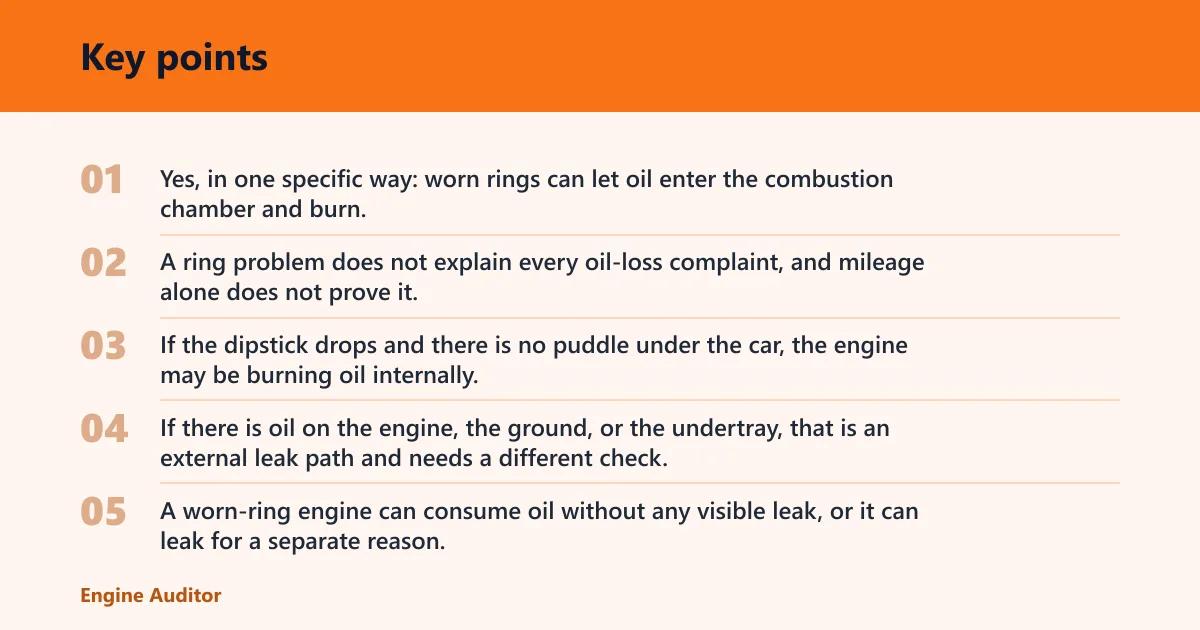


Yes, in one specific way: worn rings can let oil enter the combustion chamber and burn. That is oil consumption, not an external leak. A ring problem does not explain every oil-loss complaint, and mileage alone does not prove it.
What matters is where the oil goes. If the dipstick drops and there is no puddle under the car, the engine may be burning oil internally. If there is oil on the engine, the ground, or the undertray, that is an external leak path and needs a different check.
What counts as oil loss
Oil loss usually falls into three specific paths: oil burned in the cylinders, oil leaking out of the engine, or oil level falling far enough that pressure suffers. Those paths can overlap, but they are not the same fault. A worn-ring engine can consume oil without any visible leak, or it can leak for a separate reason.
Why ring wear causes oil consumption
Piston rings seal combustion gases against the cylinder wall and control oil on the cylinder walls. The oil control ring scrapes excess oil back down, which limits oil entering the combustion chamber. When the rings wear, oil can slip past the ring pack and burn.
That wear also lets combustion gases leak into the crankcase. This blow-by can increase crankcase pressure, which may make seals weep and can worsen oil use. In a high-mileage engine, that pattern is more likely, but mileage is only a clue, not proof.
What ring wear does not explain
Ring wear does not explain a drip at the oil pan, valve cover, timing cover, or drain plug. It also does not guarantee blue smoke, because light oil use may show up with little visible exhaust smoke. Low oil pressure is a separate question and should not be treated as an automatic ring failure.
Piston rings and oil control
In normal operation, the ring pack has two jobs that matter here: seal pressure and manage oil film. The compression rings help keep combustion gases in the cylinder. The oil control ring limits how much oil remains on the cylinder wall after the piston moves.
When the ring pack wears, that balance changes. Oil can be pulled into the chamber on the intake and compression strokes, then burned on the power stroke. If the cylinder wall is worn or scored, the rings may not seal well even after replacement, which is why cylinder condition matters.
What blow-by means in a worn engine
Blow-by is combustion gas leaking past the rings into the crankcase. It can raise crankcase pressure, push oil mist through the PCV system, and sometimes make gaskets seep. A little blow-by exists in many engines, but a strong hiss at the oil filler cap or repeated dipstick movement points toward a sealing problem that deserves testing.
Oil burning, leaks, and low pressure
Oil burning, oil leaks, and low oil pressure are separate failure paths. A worn-ring engine can cause the first one directly and the third one indirectly, but it does not cause every leak. Treat them as different diagnostics so you do not replace the wrong parts.
External leak symptoms
An external leak leaves oil where it exits the engine: wet gasket edges, a stained bellhousing, oil on the subframe, or drops on the floor. The oil level falls because oil is leaving the engine case, not because it is being burned. If the leak is heavy, low oil pressure can follow simply because the sump is low.
Internal oil consumption symptoms
Internal consumption usually shows up as a falling dipstick level with little or no outside wetness. Blue-gray exhaust smoke, oily plugs, and a burned-oil smell can follow. The smoke may be faint, and some engines may use a quart before obvious tailpipe evidence appears.
How low oil pressure can follow low oil level
Bad rings do not directly create low oil pressure in the oil pump. The indirect path is more common: the engine burns or leaks enough oil that the sump level drops, the pickup can draw air, and pressure falls. Aeration can also happen if the engine is badly blow-by loaded or the oil is foamed after overfilling.
A common rule of thumb is that some engines known to consume oil may use about one quart every 1,000 miles or less; many modern engines should do much better, so a sudden change or repeated top-offs should be diagnosed. A steady rise in consumption matters more than the number alone.
How to tell rings from valve seals
Worn rings and worn valve seals can both burn oil, but the smoke pattern often differs. Ring wear tends to show under load, during acceleration, or as a more constant oil-use problem. Valve seals more often leave a puff at cold start or after an extended idle, then improve once the engine is running.
Suppose an engine leaves a brief blue puff after an overnight sit, then runs clean for the rest of the drive. That pattern leans toward valve seals. If the same engine smokes under hard throttle and keeps using oil between changes, ring wear becomes more likely.
Compression and leak-down clues
Compression and leak-down testing are the key pair. Low compression can suggest ring wear, but it can also come from valves or head gasket faults. Leak-down testing helps separate ring wear from other sealing problems by showing where the air escapes.
When compression is low and a wet compression test makes it rise, that points toward rings. If leak-down loss is heard mainly through the oil filler, crankcase breathing points toward ring leakage. If the air comes through the intake or exhaust, valve sealing deserves more attention.
When PCV problems belong in the diagnosis
PCV faults can mimic oil consumption complaints. A stuck valve, clogged hose, or wrong valve can pull too much oil mist into the intake and make the engine look like it is burning oil. Because of that, PCV inspection belongs before a full teardown diagnosis.
-
Check the oil level first. Verify the dipstick reading on level ground and with the engine off long enough for the sump to drain back. Low oil changes the rest of the diagnosis because it can create pressure loss and worsen blow-by symptoms.
-
Inspect for external leaks. Look at the valve covers, oil pan, timing cover, drain plug, filter, and underbody shielding. If oil is leaving the engine visibly, that is a leak path, even if the engine also burns some oil.
-
Check the PCV system. Remove and inspect hoses, the valve, and any breather passages for sludge or collapse. A PCV fault can move oil mist into the intake and mimic ring wear, so it should be ruled out before more invasive testing.
-
Run compression and leak-down tests. Use both tests together, because the key diagnostic pairing is compression and leak-down testing. Compression shows how well each cylinder seals during cranking, while leak-down helps identify where the sealing fault is happening.
-
Use a wet compression test. Add about a small amount of oil to the cylinder and repeat the compression test. A pressure rise supports ring wear because the oil temporarily improves cylinder sealing; no meaningful rise pushes attention toward valves or other faults.
Piston ring decision table
Use this table as a text-only sorting tool. It does not replace testing, but it helps you match symptom patterns to the next best check.
| Symptom pattern | External leak visible | Blue smoke timing | Compression result | Wet test result | Likely culprit | Next action |
|---|---|---|---|---|---|---|
| Oil level falls, underbody is wet, no exhaust smoke | Yes | None | Normal | No change | External oil leak | Trace the leak source, then repair the gasket, seal, or filter issue. |
| Oil use rises, no puddles, smoke under hard acceleration | No | Under load | Low on one or more cylinders | Rises | Worn piston rings | Confirm with leak-down and inspect cylinder walls. |
| Brief puff after overnight sit, then clears | No | Cold start | Normal or near normal | No meaningful change | Valve seals | Check valve guide and seal condition before ring work. |
| Oil use rises, idle rough, crankcase vapor heavy | No | Mixed or faint | Low and uneven | Rises | Worn rings with blow-by | Perform leak-down and inspect for cylinder wear or scoring. |
| Oil use rises, intake tract oily, PCV hose wet | No | Little or none | Normal | No change | PCV issue | Test PCV valve, hose routing, and breather restriction. |
| Oil level drops, smoke appears after long idle, no leak | No | After idle | Normal | No change | Valve seals | Check seals and guides before opening the short block. |
| Oil pressure warning at hot idle, oil level low | Maybe | Possible smoke | Varies | Varies | Low oil level from leak or burn | Top off safely, then find whether the loss is external or internal. |
| Compression low, wet test helps, leak-down noisy at oil filler | No | Often under load | Low | Rises | Worn piston rings | Inspect cylinder wall wear; ring replacement alone may not be enough. |
How to confirm ring wear
Confirming ring wear takes a sequence, not a single clue. Start with simple checks, then move to compression, wet compression, and leak-down. If the engine has high mileage, that raises suspicion, but test results decide the case.
-
Record the symptom pattern. Note when the smoke appears, how often the oil level drops, and whether there is any outside wetness. Pattern matters because rings, valve seals, PCV faults, and leaks tend to behave differently.
-
Test compression first. Compare cylinders, not just the absolute number. A low cylinder points to a sealing problem, but it does not say whether the fault is rings, valves, or both.
-
Repeat with a wet test. Add a small amount of oil to the cylinder and retest. If pressure improves with oil, that supports ring wear because the oil helps the rings seal for the moment.
-
Run a leak-down test. Listen for air at the crankcase, intake, and exhaust. Air heard through the oil fill points toward ring leakage; air at the intake or tailpipe points more toward valves.
-
Inspect cylinder walls. Severe wear or scoring can keep new rings from sealing well. At that point, ring replacement alone may be insufficient, and the block may need machining or a rebuild.
The repair path can be major. Piston ring replacement is described as an advanced DIY job taking about 20 hours, with parts-only DIY cost at about $800. A shop may charge about $80–$150 for compression and leak-down testing, while typical shop pricing for the repair is $3,000 parts plus labor, with a fair price band of $2,250 to $3,750.
That spread is why diagnosis comes first. If the cylinders, valve seals, or PCV system are the real problem, the ring job may not fix the oil use. And if the cylinder walls are worn or scored, replacing rings alone can leave you with the same complaint after a large bill.
Picture a high-mileage sedan that uses about a quart between changes, shows no floor stains, and has low compression on two cylinders. If the wet test lifts compression and leak-down leaks into the crankcase, rings move to the top of the list. If compression stays normal and smoke shows only after a long idle, valve seals or PCV issues fit better.
For ring wear, the question is not simply whether the engine uses oil. It is whether the oil is being burned, leaked, or lost to pressure-related side effects, and the tests have to separate those paths before repair decisions are made.
Frequently asked questions
Can bad piston rings cause oil consumption?
Yes. Oil control ring wear lets more oil stay on the cylinder wall, and that oil can be burned during engine operation. The result is higher oil consumption, often with blue-gray exhaust smoke, although some engines consume oil with very little visible smoke.
What causes worn piston rings?
Heat, high mileage, cylinder wall wear, poor lubrication, contaminated oil, and scoring can all contribute to ring wear. Mileage alone is not proof, but a high-mileage engine is more likely to show ring sealing problems. If the cylinder walls are worn, new rings may not seal properly without further work.
Can worn piston rings cause low oil pressure?
Not directly in the usual sense. Bad rings do not automatically make the oil pump produce low pressure, but they can lead to oil loss that drops the sump level, or to aeration from heavy blow-by. That indirect path can trigger low pressure at idle or when cornering.
How do I know if my oil loss is from piston rings or valve seals?
Look at the smoke timing and the test results. Ring wear often shows under load or with steady oil use, while valve seals more often smoke at cold start or after long idle. Compression, wet compression, and leak-down testing help separate the two instead of guessing.
Will a wet compression test show bad rings?
Often, yes. If compression rises after a small amount of oil is added to the cylinder, that supports ring wear because the oil briefly helps seal the cylinder. A flat result does not rule out every ring problem, but it pushes the diagnosis toward valves or another sealing fault.
Products related to this article
Sponsored / affiliate links. As an Amazon Associate I earn from qualifying purchases. I may earn additional commission from eligible campaigns.
 RVS Technology G6 Engine oil Treatment; For Gasoline Engines with a Motor oil capacity up to 6 quarts; Save fuel, Boost Power and Safely Restore and protect your Car, Truck, and all other engines
 ACROPIX Engine Oil Level Indicator Dipstick for Ford Fusion 2010-2012 for Ford Escape 2010-2012 for Ford Fusion 2006-2007 No.6E5Z6750AC Car Parts