Can Synthetic Oil Reduce Oil Consumption?
Synthetic oil can cut oil consumption when the loss comes from evaporation, heat stress, or oxidation, but it will not fix worn rings, seals, or a faulty PCV system. Ignore the fault, and you can keep burning oil, foul plugs and catalysts, and end up topping off all the time. This guide explains when synthetic oil helps, when it will not, and how to trace the cause of oil loss.
Benefits and limits of synthetic oil for oil consumption
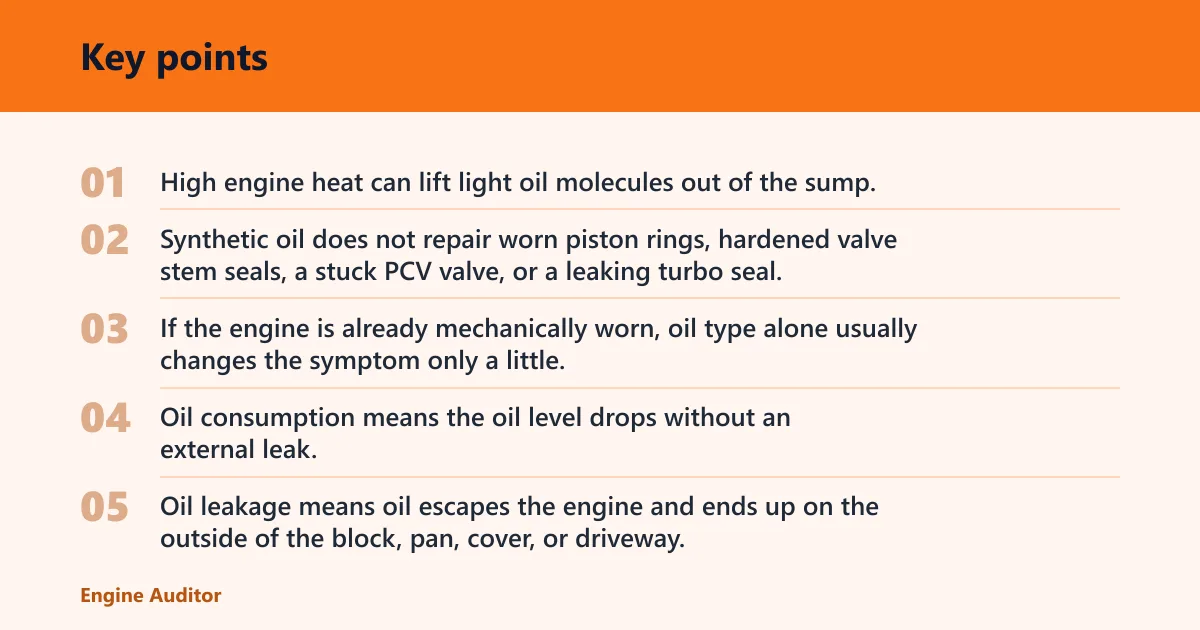


Yes, in some engines. Synthetic oil can help reduce oil use when the loss comes from evaporation, heat stress, or oxidation, since it is often more stable at high temperature and tends to have lower volatility than many conventional oils. It cannot stop mechanical oil burning from worn piston rings, valve stem seals, turbo seal leakage, or a bad PCV system.
What synthetic oil can help
Synthetic oil resists heat better than conventional oil, and that matters in engines that run hot or spend a lot of time under load. High engine heat can lift light oil molecules out of the sump.
That makes synthetic oil a sensible first change when the engine is consuming oil but shows no external leak. It can also help when the issue is mild top-off frequency rather than heavy smoke or a puddle under the car.
What it cannot fix
Synthetic oil does not repair worn piston rings, hardened valve stem seals, a stuck PCV valve, or a leaking turbo seal. Those faults let oil enter the combustion chamber or intake tract, where it burns instead of staying in the crankcase. If the engine is already mechanically worn, oil type alone usually changes the symptom only a little.
That is why you should separate oil consumption from oil leakage.
Oil consumption vs oil leakage
Oil consumption means the oil level drops without an external leak. Oil leakage means oil escapes the engine and ends up on the outside of the block, pan, cover, or driveway. The two problems can happen together, but they need different fixes.
Burning oil often shows up through the exhaust as blue smoke, oily odor, or fouled plugs. In older engines, the exhaust may be the only visible clue if the oil is entering the chambers in small amounts.
Why synthetic oil burns off less
Noack volatility is a measure of how much oil can evaporate under heat. Lower numbers generally mean less evaporative loss, so oils with lower volatility are better at resisting burn-off in hot-running engines.
Synthetic oil also keeps its properties better at high operating temperature. Higher heat accelerates oil breakdown and oxidation, and that can lead to deposits that make rings, PCV passages, and turbo drains work less well.
Synthetic oil can move more predictably through cold starts and heat soak.
Will thicker oil help?
Sometimes, but only within the viscosity grade your owner’s manual allows. A slightly thicker oil can slow consumption in a worn engine by reducing how easily it passes rings or seals, but too-thick oil can hurt flow, cold-start protection, and overall lubrication. It is a symptom management tool, not a mechanical repair.
When a higher viscosity can slow consumption
A worn high-mileage engine may use less oil on a slightly thicker grade if the wear is mild and the manual allows that grade. That can help when thin oil slips past worn clearances, or when hot operation makes a borderline engine consume more than usual.
Use the viscosity grade approved in the owner’s manual first. If the manual lists more than one grade for your climate, choose the one that fits the temperature range and the engine’s condition. Do not jump to a much thicker oil just to chase a lower dipstick reading.
When thicker oil creates new problems
Too-thick oil can slow flow on cold starts, delay oil delivery, and create extra drag. That matters in modern engines that already run hotter and tighter than older designs. It can also mask a failing ring, seal, or PCV problem long enough to delay real diagnosis.
A common first-timer mistake is to assume a quart of usage after a long highway trip means the synthetic oil is failing, when the real issue may be a worn valve cover gasket. Suppose a 2.0L turbo engine uses a quart every 1,000 miles and leaves blue smoke after idling. A thicker oil may slightly reduce the top-off rate, but it will not fix a leaking turbo seal.
High-mileage engine oil choices
High-mileage formulas can help older engines with minor seepage or light consumption. These oils often include seal-conditioning additives that may reduce seepage around hardened seals. They are most useful when the engine is worn, but not badly damaged.
Oil can be sold in common grades such as 0W-20 and 5W-30. Pick the correct viscosity first, then choose a formulation that fits the symptoms.
-
Confirm the symptom. Check the dipstick on level ground after the engine has sat long enough for drainback to settle, then look for smoke, odor, or spots under the car. This separates true consumption from leakage and prevents the wrong repair path.
-
Check for external leaks. Inspect the valve cover, oil pan, drain plug, filter, and front and rear main seal area with a light. If oil is wet on the outside of the engine, fix the leak before blaming the oil choice.
-
Inspect PCV operation. A stuck or restricted PCV system can pull oil mist into the intake or raise crankcase pressure. Replace the faulty valve or hose if it is clogged, stuck, or does not pass a basic shake-and-flow check.
-
Evaluate combustion clues. Blue smoke, oily tailpipe residue, and fouled plugs point toward ring, seal, or turbo issues. If the engine smokes more after idling or deceleration, valve stem seals or turbo seals move higher on the list.
-
Choose the correct oil. Stay within the viscosity grades listed in the owner’s manual, then consider full synthetic or a high-mileage formula if the engine is older or runs hot. If the engine is mechanically sound, a lower-volatility synthetic can reduce top-off frequency.
-
Track the result. Recheck the level after several hundred miles and note how much oil you add. If consumption stays high, the engine needs diagnosis, not another oil swap.
Will synthetic oil actually reduce my oil consumption?
Synthetic oil can help reduce oil consumption when the engine loses oil mainly because of heat, volatility, or long service in hot conditions. Use diagnosis when the engine shows smoke, repeated top-off needs, or evidence of worn rings, seals, turbo leakage, or PCV faults. The oil type may help the symptom, but it will not erase a mechanical cause.
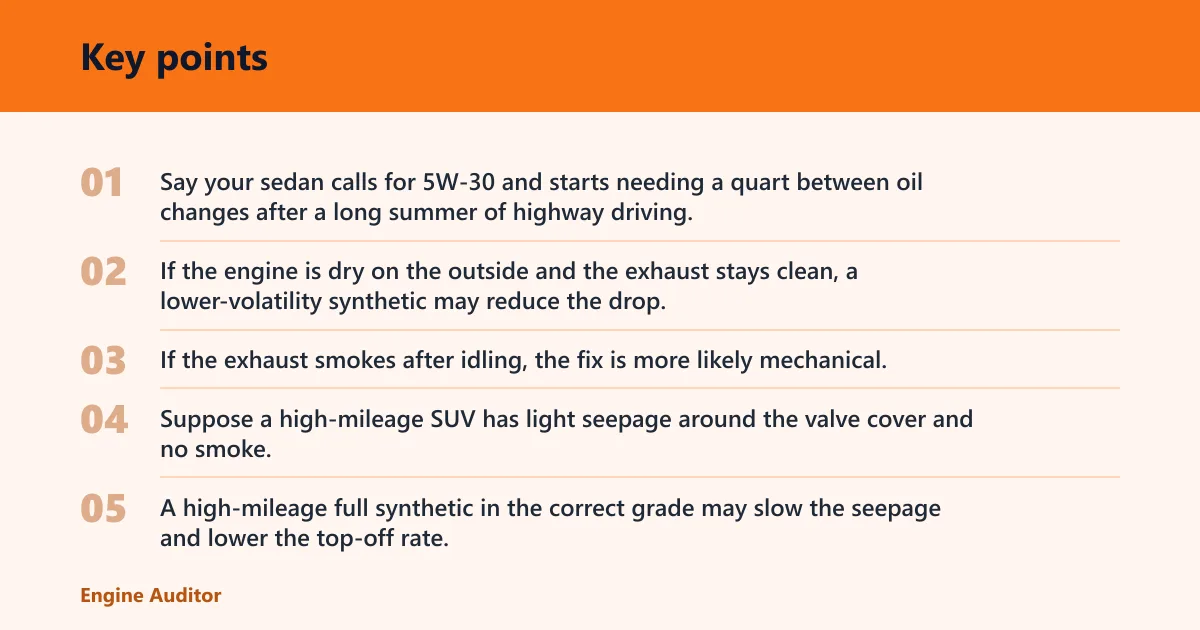
Say your sedan calls for 5W-30 and starts needing a quart between oil changes after a long summer of highway driving. If the engine is dry on the outside and the exhaust stays clean, a lower-volatility synthetic may reduce the drop. If the exhaust smokes after idling, the fix is more likely mechanical.
Suppose a high-mileage SUV has light seepage around the valve cover and no smoke. A high-mileage full synthetic in the correct grade may slow the seepage and lower the top-off rate. If oil is dripping on the driveway, though, the gasket still needs attention.
Frequently asked questions
Does synthetic oil reduce oil consumption?
It can, especially when the engine loses oil through heat-driven evaporation rather than through a worn mechanical part. Synthetic oil resists heat better than conventional oil and generally has lower volatility, so it can reduce top-off frequency in some engines. It will not stop oil burning from worn rings or seals.
Does synthetic oil stop oil burning?
No. Synthetic oil may reduce some burn-off, but it does not stop oil from entering the combustion chamber through worn piston rings, valve stem seals, or turbo seals. If the engine is smoking or fouling plugs, the root cause needs diagnosis. Oil type alone is not the cure.
Can thicker oil reduce oil consumption?
Sometimes, if the owner’s manual allows that viscosity and the engine is only mildly worn. A thicker oil can slow seepage past clearances and reduce consumption a little. Too much thickness can hurt cold flow and protection, so do not go outside the approved grade just to chase a lower dipstick reading.
Why is my oil level dropping without a leak?
Oil can leave the engine through the exhaust when it burns in the cylinders, or it can evaporate under heat and vent out as emissions. That points to consumption, not leakage. Common causes include worn rings, valve stem seals, PCV problems, and turbo seal leakage.
Will synthetic oil cause leaks in an older engine?
Synthetic oil does not create leaks in a healthy seal, but an older engine with hardened gaskets or seals may start leaking after the oil change simply because the old parts were already worn. In that case, the oil exposed an existing problem. A high-mileage formula may help minor seepage, but damaged seals still need repair.
What viscosity oil should I use if my engine consumes oil?
Start with the viscosity listed in the owner’s manual. If the manual allows more than one grade, a slightly thicker approved grade can sometimes reduce consumption in a worn engine. Avoid overthickening, because oil flow, start-up lubrication, and protection can suffer if the grade is too far off.
Products related to this article
Sponsored / affiliate links. As an Amazon Associate I earn from qualifying purchases. I may earn additional commission from eligible campaigns.