How to Protect Engine Oil During Polar Vortex
Use the thinnest oil your manual allows for winter, keep the battery fully charged, and pre-warm the engine with a block heater for about 2 to 4 hours before a subzero start. In cold weather, the key issue is not just oil “thickness,” but whether the specific formulation still flows fast enough for the starter and pump to move it. Bad cold starts can starve bearings, slow oil flow, and leave you with a no-start or expensive wear. This guide covers viscosity choice, preheating, parking habits, and startup steps that protect oil before the first crank.
How cold thickens oil and delays lubrication
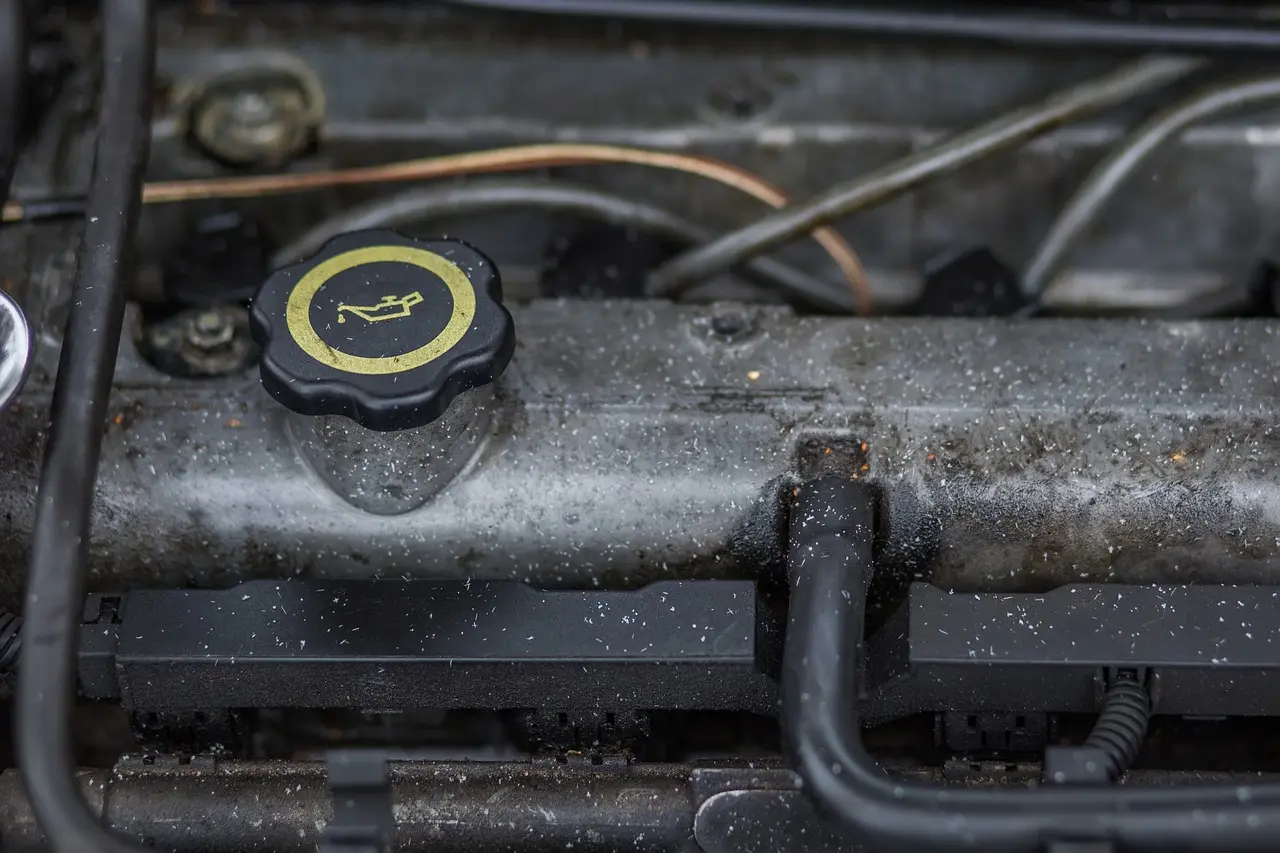


Engine oil gets thicker as temperature drops, so it resists flow and reaches moving parts more slowly. In a severe cold snap, that higher resistance raises starter load, delays oil pressure, and increases first-start wear. The right winter grade, a strong battery, and pre-warming are the main defenses.
Viscosity, pour point, and cold cranking
Engine oil viscosity is its resistance to flow. SAE winter ratings use lower W numbers for better cold flow, which matters because cold oil moves more slowly through the pickup, pump, galleries, and bearings. Pour point is the lowest temperature where a formulation still flows when tilted, and it varies by product.
Cold cranking performance matters even more at the first key turn. It reflects how hard the starter must work in low temperatures and how quickly oil can begin circulating. A lower winter rating helps, but only if the oil is approved for your engine and matches the cold-weather data on the product label or data sheet.
Why oil pump load rises
The oil pump must pull thick fluid through its pickup during cold starts. If the oil is heavily thickened, the pump can struggle and pressure builds late. That delay is one reason a cold start can be harder on an engine than many short trips in mild weather.
Conventional motor oil typically thickens sooner in cold weather than many synthetic formulations, and some conventional products can reach their practical cold-flow limit in the lower end of winter temperatures. Synthetic motor oil generally stays more pumpable at low temperatures, but the real limit depends on the exact formulation and the product data sheet rather than a generic label alone.
Which winter oil grade should you use?
Use the lowest winter grade your owner’s manual approves for the forecast low. For severe cold flow, 0W is generally the lowest winter rating in common passenger-car oils. 5W is common for winter use and flows better than 10W, while 10W can be too thick for deep freezes unless the manual and local conditions still support it.
0W motor oil for severe cold
A 0W oil must meet stricter low-temperature cranking and pumping requirements than a higher winter grade, so it is generally the better choice for very low starts when the manual allows it. The right 0W product can be the safer winter pick when the vehicle will sit outside and the forecast low is well below normal winter temperatures.
5W motor oil for common winter use
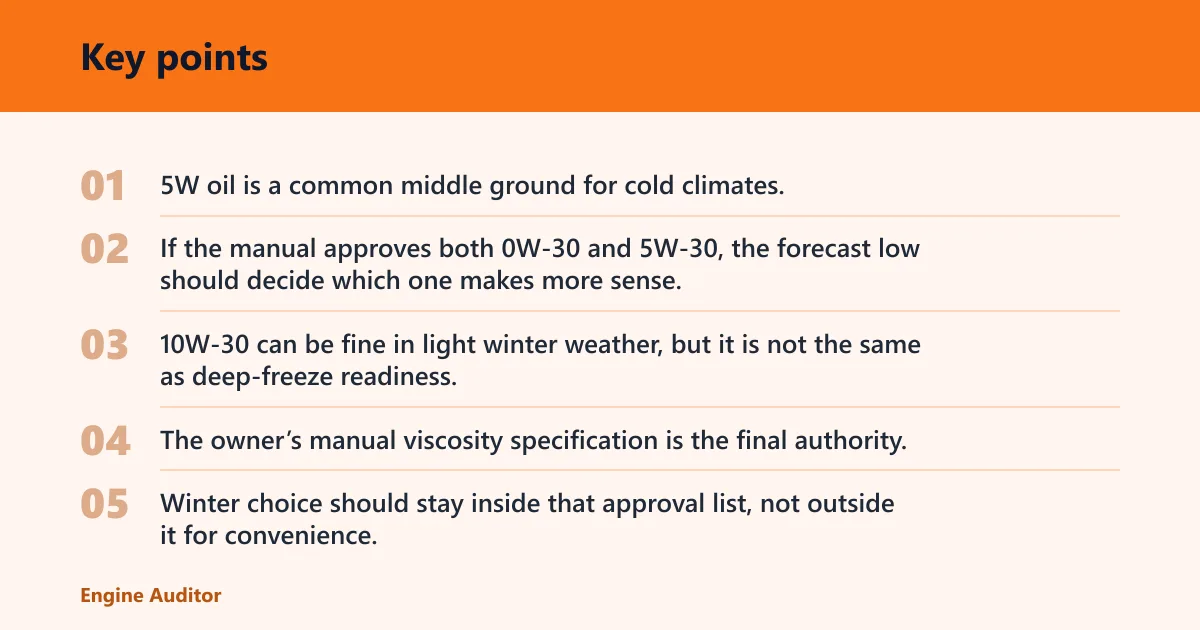
5W oil is a common middle ground for cold climates. It is often used where winters are cold but not extreme, and it can still provide solid cold-start performance when the forecast low stays within the product’s winter range. If the manual approves both 0W-30 and 5W-30, the forecast low should decide which one makes more sense.
When 10W oil is too thick
10W-30 can be fine in light winter weather, but it is not the same as deep-freeze readiness. If a polar vortex pushes the forecast below the product’s practical cold-flow range, 10W oil may leave the pump fighting thicker fluid and delay oil pressure. That is especially true when the car sits outside overnight.
Owner’s manual viscosity specification
The owner’s manual viscosity specification is the final authority. It tells you which grades the engine was designed to use, and those approvals can vary by engine design even within the same vehicle line. Winter choice should stay inside that approval list, not outside it for convenience.
Pre-warm the engine before the first crank
Pre-warming lowers starter load and reduces the chance that thick oil will delay circulation. If the car must sit outside in subzero weather, use a block heater before trying to start it. If there is no block heater and the forecast is severe, the safer choice may be to avoid starting until conditions improve.
-
Check the forecast low. Use the overnight low, not the afternoon high, because overnight parking is what hardens the oil and battery. A short exposure while running errands is different from sitting through a full subzero night.
-
Match the oil grade. Confirm the current oil grade against the manual and the forecast. If the engine is on 10W-30 and the cold snap will fall into deep-freeze territory, that is a warning to change the plan before the next morning.
-
Plug in the heater. Give the engine block heater at least 2 to 4 hours before start-up. A block heater helps keep engine metal warmer, which lowers stress on the pump and starter by reducing how stiff the oil becomes before the first crank.
-
Protect the battery. Weak batteries slow cranking and can look like an oil problem. If the battery is old or already sluggish, cold oil plus weak cranking is a bad combination, because the engine spends longer without steady pressure.
-
Start without extra load. Turn off accessories before the key or start button. That gives the starter more available power and reduces the chance of a slow crank that keeps the oil pump behind.
Polar vortex readiness checklist
Use this as a quick pre-start decision table. A single weak factor can change the answer, especially when the car has sat outside overnight rather than sitting for a short cold exposure. If the setup is marginal, the right choice is often to pre-warm first or avoid starting until conditions improve.
| Forecast low | Overnight parking | Block-heater availability | Battery age | Current oil grade | Owner-manual approval | Recommended action |
|---|---|---|---|---|---|---|
| Above 15°F | Garage or sheltered | No | Under 4 years | 5W-30 or 0W-30 | Approved | Drive |
| 5°F to 15°F | Outside overnight | No | 4 years or older | 10W-30 | Approved only if listed | Pre-warm if possible; otherwise avoid starting |
| -5°F to 5°F | Outside overnight | Yes | Under 4 years | 5W-30 | Approved | Pre-warm |
| -20°F to -5°F | Outside overnight | Yes | 4 years or older | 0W-30 or 0W-40 | Approved | Pre-warm |
| Below -20°F | Outside overnight | No | Any | 10W-30 | Not approved or unknown | Avoid starting |
Switch to extreme-cold precautions now?
| Yes if any of these are true | Forecast low is below 15°F; the car must sit outside overnight; the battery is weak or old; or the oil grade is not clearly approved for cold use. |
|---|---|
| No if all of these are true | The car is sheltered, the battery is strong, the oil grade is approved, and the forecast low stays within the winter range listed for that oil. |
Can synthetic oil and a block heater help?
Yes. Synthetic oil generally protects better in extreme cold because it stays more pumpable than conventional oil, and a block heater reduces startup stress by warming the engine before the first crank. Together, they can change a borderline no-start into a reasonable winter start, provided the oil grade is approved.
Synthetic motor oil in extreme cold
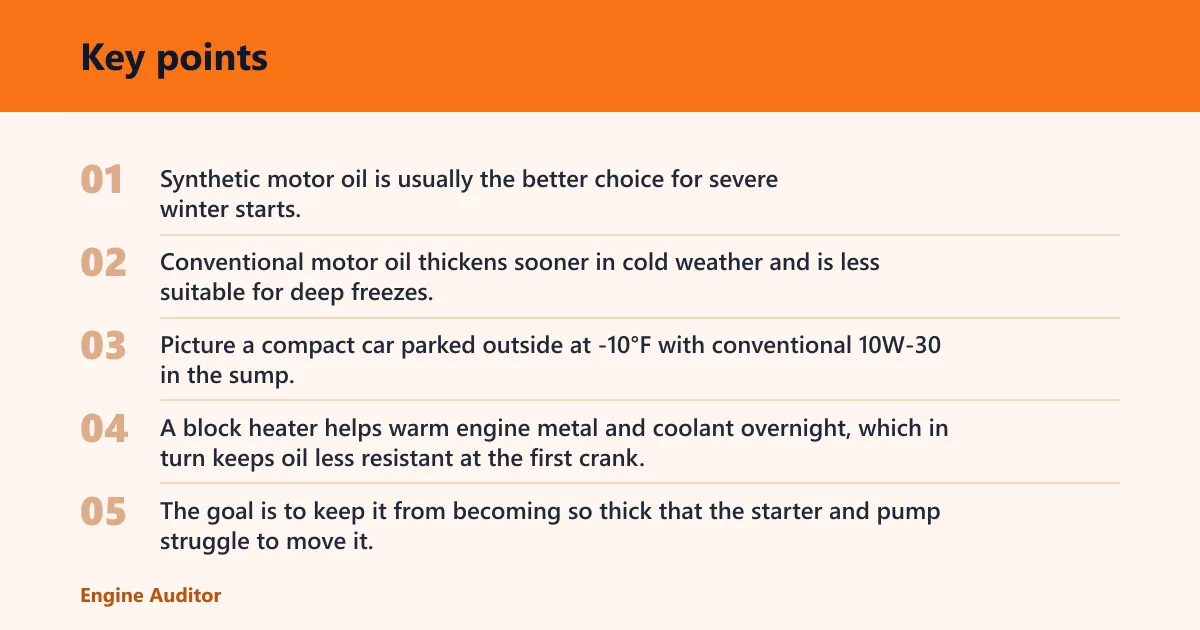
Synthetic motor oil is usually the better choice for severe winter starts. Some synthetic 0W-30 or 0W-40 oils are formulated for very low-temperature use, but the exact cold-flow performance depends on the product’s data sheet rather than the word synthetic alone. That gives the pump a better chance of moving oil quickly at startup.
Say your manual allows both 0W-30 and 5W-30. If the forecast low is -25°F and the car will sit outside overnight, the 0W grade is the safer winter pick because it keeps cold flow better while still staying inside the approval list.
Conventional motor oil in deep freezes
Conventional motor oil thickens sooner in cold weather and is less suitable for deep freezes. Some conventional engine oils can become impractical for easy cranking in the lower winter range, so a night below that range can put the pump and starter under more strain than a synthetic grade would.
Picture a compact car parked outside at -10°F with conventional 10W-30 in the sump. The engine may still start, but the pump has to fight thicker oil, pressure may rise late, and first-start wear increases while the oil reaches the top end of the engine.
How a block heater changes startup stress
A block heater helps warm engine metal and coolant overnight, which in turn keeps oil less resistant at the first crank. The goal is not to make the oil hot. The goal is to keep it from becoming so thick that the starter and pump struggle to move it.
If the vehicle has no garage access, the block heater matters more, not less. It is one of the few tools that can change the starting conditions when parking shelter is unavailable.
What if the oil light stays on after start-up?
Shut the engine off if the oil pressure light stays on after a cold start for more than a brief moment, or if it flickers with loud valvetrain noise or rough cranking. Thick oil can delay pressure, but a persistent light can also point to low oil level, a failing pump, or a blocked pickup. Do not rev the engine to force pressure up.
When thick oil may be the cause
If the temperature is far below the oil’s cold-flow range, the pump may need extra time to pull oil through the pickup and fill the galleries. That delay can leave the oil light on longer than normal. In that case, the correct response is to shut down and reassess, not to keep running.
Battery weakness and other failure cases
A weak battery can slow cranking so much that the oil system has little chance to build pressure fast enough. A history of wrong oil, extended oil change intervals, or sludge can make the problem worse because the pump is trying to move thicker, dirtier fluid. Those failures often appear together in extreme cold.
Suppose the car starts after a long crank, the oil light stays on, and the engine sounds harsher than usual. That combination points to a shutdown, then a check of oil level, battery health, and whether the installed oil matches the manual before any second attempt.
When is conventional oil too risky?
Conventional oil becomes too risky when the overnight low is below its cold-flow range, the car must sit outside, or the battery is already weak. Short exposure during a daytime errand is different from a full night at subzero temperatures. If the car has to start after an overnight freeze, the risk rises fast.
Short cold exposure versus overnight parking
A short stop in cold air may not push the oil to its lowest temperature. Overnight parking does. That is why a driver can sometimes get by with a borderline grade after a brief cold soak, yet still need extreme-cold precautions after the same car sits outside until dawn.
Choosing between 0W-20, 0W-30, 5W-30, and 10W-30
Start with the manual, then choose the lowest approved winter grade that matches the forecast low. In broad terms, 0W-20 and 0W-30 tend to give the best cold flow among the grades listed here, 5W-30 is commonly used in winter, and 10W-30 is the least suitable for deep freezes. Approval comes first; temperature comes second.
When to switch to extreme-cold precautions
Switch when the forecast low moves below the oil’s comfort range, or when the car must sit outside overnight without a garage. At that point, the plan should move from normal winter use to block-heater use, battery checks, and a possible “do not start” decision if the setup is marginal.
Frequently asked questions
How do I keep engine oil from thickening in a polar vortex?
Use the lowest winter grade your manual approves, keep the battery fully charged, and plug in a block heater before the coldest night. Sheltered parking helps, but if the car must stay outside, the combination of approved low-W oil and pre-warming is what most directly limits thickening at startup.
Will motor oil freeze in subzero weather?
Motor oil usually does not freeze solid like water, but it can thicken enough to flow very poorly. That is why pour point and cold cranking performance matter. At severe lows, the problem is often slow circulation, delayed pressure, and starter strain rather than a truly frozen sump.
Should I use 0W or 5W oil before a cold snap?
Use the thinnest oil your owner’s manual allows. If both are approved, 0W is the better pick for deeper cold because it is designed for better low-temperature cranking and pumping performance than 5W. For milder winter weather, 5W can still be the right choice.
Does synthetic oil protect better in extreme cold?
Yes. Synthetic oil generally flows better at low temperatures than conventional oil and may remain usable in much colder conditions, depending on the exact formulation. That does not make every synthetic grade right for every engine, though. The manual still decides which viscosity and approval are acceptable for your vehicle.
Can a block heater help prevent cold-start oil problems?
Yes. A block heater can keep engine metal warmer overnight, which lowers starter load and helps the pump move oil sooner at the first crank. It matters most when the vehicle sits outside in severe cold and cannot be parked in a garage.
What should I do if my oil pressure light stays on after a cold start?
Shut the engine off if the light does not go out quickly, or if the engine sounds rough and the crank was slow. Cold oil can delay pressure briefly, but a persistent light may also signal low oil, sludge, or pump trouble. Do not rev the engine to force pressure up.
Can thick oil damage the engine during a cold start?
Yes. Thick oil can delay lubrication at exactly the moment metal parts are moving with little protection. That increases wear on bearings, cams, and other parts before full pressure arrives. The risk is highest when the oil is outside its cold-flow range and the vehicle must start after an overnight freeze.
Products related to this article
Sponsored / affiliate links. As an Amazon Associate I earn from qualifying purchases. I may earn additional commission from eligible campaigns.
 4.5V Engine Oil Pump, Electric Oil Change Fluid Evacuators,Electric Fluid Transfer Pump for Engine Oil, Equipped With 3 Pipes-Low Noise(no batteries included)
 ECOGARD X10023 Cartridge Engine Oil Filter for Conventional Oil - Premium Replacement | Fits 2018-2023 Volkswagen Atlas 3.6L; 2020-2023 Atlas Cross Sport 3.6L