Why Does EV Range Drop in Cold Weather?
EV range drops in cold weather because a cold battery delivers less power, cabin heat uses energy, and charging slows. Short trips can lose 30% or more. Ignore it and you may arrive with less buffer, longer charging stops, and fewer winter miles. This guide breaks down the separate losses and shows what matters on commutes versus road trips.
Four distinct factors that shrink usable winter range
Cold weather cuts range through four separate penalties, battery chemistry, cabin heating, road conditions, and cold charging. On a short commute, cabin heat and battery warm-up can dominate. On a highway trip, speed, wind, and rolling resistance usually matter more than the heater.
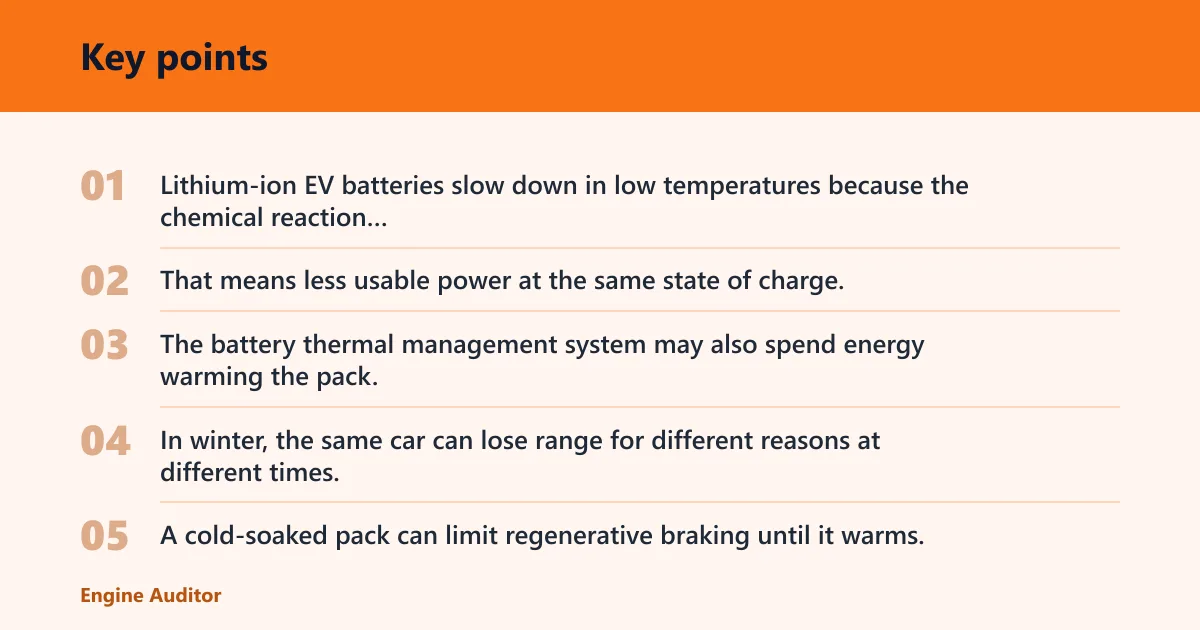
Lithium-ion EV batteries slow down in low temperatures because the chemical reaction rate drops and internal resistance rises. That means less usable power at the same state of charge. The battery thermal management system may also spend energy warming the pack, which protects the battery but reduces driving range and can slow charging.
In winter, the same car can lose range for different reasons at different times. A cold-soaked pack can limit regenerative braking until it warms, so fewer miles are recovered in stop-and-go traffic. A cold battery can also charge more slowly, which matters more on road trips than on local errands.
Why the answer changes by trip type
Short trips are hit hardest because the cabin and battery spend a larger share of the drive warming up. A 10-mile run to the store may include most of the heating penalty, then end before the car has fully stabilized. On a longer drive, that warm-up cost gets spread across more miles.
Say your morning commute is 8 miles with a frosty windshield and a cold-soaked pack. The heater may draw hard for the first several miles, while regenerative braking stays limited at stop signs. That same car on a 120-mile road trip may still lose range, but the heater becomes a smaller share of total energy use.
📊 Car and Driver found a 19 percent drop in range in cold weather testing. Source: Caranddriver.
Battery cold-soak and thermal management

How does cold weather affect EV range at the pack level? The battery itself is less efficient. Chemical reactions slow, internal resistance rises, and the vehicle may divert stored energy to heat the battery before it can deliver normal power or accept fast charging. That warming load can appear even before the wheels move.
Cold operation can trigger battery warming because the pack needs to stay within its operating temperature window. The thermal management system may use the high-voltage battery to run heaters or pumps. That protects the cells, but it is not free energy, and the driver sees it as reduced available range.
This is also where temporary cold-soak loss differs from degradation. Cold-soak loss means the battery performs worse until it warms. Permanent degradation means the battery has lost capacity over time, regardless of weather. If range returns after the pack warms, that points to temperature, not lasting damage.
| Winter penalty | What it changes | Where it hurts most | Planning cue |
|---|---|---|---|
| Battery temperature penalty | Less usable power, more internal resistance, slower regen | Cold starts, short trips, first miles of a road trip | Add reserve when the pack starts cold |
| Cabin heat penalty | HVAC draw from the high-voltage battery | Short commutes, defrost-heavy drives | Expect a larger hit on trips under 20 miles |
| Road-condition penalty | Snow, slush, ice, wind, rolling resistance, drag | Highway driving, windy routes, deep snow | Reduce speed and add margin |
| Charging penalty | Lower charging speed until the pack warms | Cold-weather fast charging | Precondition before arriving at a charger |
Published results vary by vehicle and climate. Top Gear says cold weather can cause as much as 20 per cent less range, though some car makers have reduced the figure to as low as 10 per cent. Top Gear also uses a 300-mile claimed range example to show how winter loss changes planning. Recurrent reports an average of 78% of maximum range at 32F and 70% at 20F.
Does cabin heat cut range?
Yes. Cabin heat is a separate winter load, and it can be a major source of range loss. EV cabin heaters draw from the high-voltage battery, so every degree of cabin warm-up competes with driving miles. Resistive heaters use more energy than heat pumps, though even heat pumps lose some advantage in very low temperatures.
Cabin heating hurts short trips most because the car may spend a large fraction of the drive warming the interior, not cruising. That is why a commute can feel worse in winter than a longer highway run, even if the longer trip uses more total energy. The heater draw is front-loaded.
Picture a 15-mile suburban trip with two cold starts and frequent defrost use. The heater may dominate the energy budget. The same vehicle on a 90-mile trip still uses cabin heat, but the loss is spread out, so the percentage hit is smaller.
Heat pumps and their limits
Heat pump technology can preserve more winter range than a resistive heater because it moves heat more efficiently. The same source says heat pump technology can extend EV range by 10% at 32F in its testing, though the benefit varies a lot by model and test method. That benefit is real, but it shrinks in very low temperatures, where the system has less outside heat to work with.
That is why some EVs still feel range loss in deep cold even with a heat pump. The heater does less work per mile, but it does not erase the need to warm the cabin, clear the glass, and keep occupants comfortable.
Why road conditions make winter range worse
Snow, ice, slush, wind, and higher highway speed all raise energy use. Rolling resistance rises when tires push through snow or slush, and aerodynamic drag climbs quickly with speed. That combination can matter more than cabin heat on a long highway drive, especially in strong headwinds.
Regenerative braking may be reduced when the battery is cold, so stop-and-go winter driving recovers less energy than usual. That makes city traffic less efficient than it looks on paper. At the same time, highway driving avoids some braking loss but pays more in drag and wind.
Car and Driver found a 19 percent drop in range in cold weather testing, and reported a Bolt EV result of 140 miles in the cold versus 180 miles in autumn. Car and Driver also says the Bolt’s battery heater turns on below 37 degrees Fahrenheit and can draw 1.8 kW. That is the kind of hidden load owners miss.
Why charging slows in the cold
Cold batteries accept power more slowly, and vehicles may limit charging to protect the battery. That can lengthen fast-charging stops even when the charger itself is working normally. The pack often has to warm first before it can take higher power safely.
Navigation-based preconditioning can help by warming the battery before arrival at a fast charger. When route guidance knows a charger is ahead, the vehicle can begin conditioning the pack en route. That improves charging readiness, but only if the car supports the feature and the system has enough time to warm the battery.
Cold-weather fast charging can still stay limited if the pack starts too cold, the drive to the charger is too short, or the vehicle has no route-based preconditioning. A weak 120V supply may also be too slow to help much before departure, especially after an overnight cold soak.
Winter range worksheet

Use this as a text-only planning sheet. Start with your normal warm-weather range, then subtract a reserve for each factor that applies. The point is not to predict an exact winter number. It is to keep enough margin for the conditions you actually face.
| Factor | Short commute | Mixed driving | Highway road trip |
|---|---|---|---|
| Battery temperature penalty | High if the car is parked outside | Medium if the pack warms during the drive | Medium at departure, lower after warm-up |
| Cabin heat penalty | High | Medium | Low to medium after the cabin stabilizes |
| Road-condition penalty | Low to medium | Medium | High if speed, wind, or snow are present |
| Charging penalty | Usually low | Low unless fast charging is needed | High if you must DC fast charge in the cold |
Ev range drop checklist
- Assume the cabin heat penalty is the largest share of the loss.
- Count the first 5 to 10 miles as the least efficient miles of the day.
- Expect weaker regenerative braking until the battery warms.
- Use preconditioning while plugged in if the vehicle supports it.
- Add extra reserve if the car sits outside overnight.
Ev range drop checklist
- Split the trip into cold-start miles and warmed-up miles.
- Plan for both cabin heat and some road-condition penalty.
- Assume regen will improve later in the drive, not immediately.
- If charging during the day, expect slower power at a cold station arrival.
- Keep a larger buffer if traffic includes repeated stop-and-go segments.
Highway road-trip reserve formula
Use this simple reserve-planning formula:
Winter reserve = about a 20% base buffer + extra for cold start + extra for wind/snow + extra if you must fast charge cold
A practical version is this: if your usual trip plan uses about 80% of the displayed range in mild weather, reduce the usable plan to about 65% to 70% when temperatures are near freezing and the route includes highway speeds or weather exposure. Recurrent’s averages of 78% at 32F and 70% at 20F are a useful planning anchor, not a promise.
For a long trip, add reserve in layers. Start with your normal safety margin, then add one more layer if the battery starts cold, another if the route is windy or snowy, and another if you must rely on a DC fast charger before the pack has warmed.
Frequently asked questions
Why does ev range drop in cold weather?
EV range drops in cold weather because the battery chemistry slows, internal resistance rises, cabin heat draws energy, and cold road conditions increase drag. The battery may also spend energy warming itself, and regenerative braking may be reduced until the pack heats up. Those penalties stack differently by trip type.
How does cold weather affect ev range?
Cold weather affects EV range in four main ways: less battery efficiency, more HVAC use, worse road resistance, and slower charging. The pack can deliver less usable power at low temperature, while the vehicle may use stored energy to protect or warm the battery. That is why winter losses vary so much.
Do electric cars lose range in cold weather?
Yes. The same source says cold weather can cause as much as 20 per cent less range, and some car makers have reduced the figure to as low as 10 per cent. The same source reports 78% of maximum range at 32F and 70% at 20F. The exact loss depends on model and driving pattern.
Do ev work in cold weather?
Yes, EVs work in cold weather, but they may work differently until the pack warms. The battery can limit power, regenerative braking may be reduced, and charging can slow. Cabin heat still works, but it uses battery energy, so range planning matters more in winter than in mild weather.
How much range do electric cars lose in winter?
That depends on the vehicle, temperature, trip length, and charging needs. The exact loss depends on model and driving pattern.
Does preconditioning help ev range in cold weather?
Yes, preconditioning can help, especially when the vehicle is plugged in. It can warm the cabin and battery before departure, which reduces the first-mile penalty and can improve charging readiness. It is less effective when the car is not plugged in, and it depends on whether the vehicle supports the feature.
Products related to this article
Sponsored / affiliate links. As an Amazon Associate I earn from qualifying purchases. I may earn additional commission from eligible campaigns.