Why Is My Car Smoking Blue? Oil Burning Causes
Blue exhaust smoke usually means oil is burning in the engine or exhaust path. If it keeps smoking after the engine warms, treat it as a fault, not normal startup haze. Ignoring it can foul plugs, clog catalytic converters or DPFs, and turn a small leak into engine damage. This guide separates true oil burning from oil spill burn-off and diesel cold-start smoke, then points you to the most likely failed part. Safe to drive or not: brief smoke after an oil spill or overfill may be low risk; heavy constant smoke, fast oil loss, misfire, or a low-oil warning means stop driving and diagnose it.
Why is my car smoking blue?
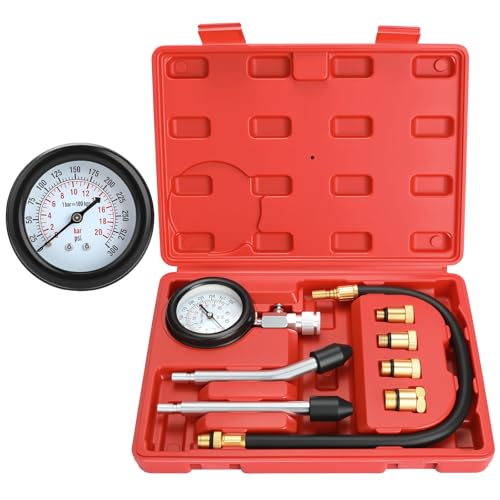

Blue or gray smoke points to oil entering the combustion path or the exhaust stream. Timing matters. Smoke only after startup may point to something different from smoke under load, smoke after service, or smoke that clears as the engine warms. In practical terms, the question is where the oil is getting in: oil entering the combustion chamber, the intake, or the exhaust side of the system.
What blue exhaust smoke usually means
Blue smoke from the exhaust is usually oil burning in the engine. It can happen after idling or during acceleration, and it may show up as a brief puff or as a steady haze. The timing tells you where to look first. Service manuals from major automakers and compression-test guidance from organizations such as the AERA and SAE-based training materials consistently use smoke pattern, oil use, and cylinder sealing to separate the cause.
Why timing changes the diagnosis
Startup-only smoke, smoke after a long idle, smoke under acceleration, and smoke that never stops are different clues. Valve stem seals often leak after the engine sits. Piston ring wear is commonly associated with continuous smoke and rising oil use. Turbo seals and PCV faults fit other patterns. Oil-consumption thresholds vary by engine family, so always compare the rate against the manufacturer specification rather than a single universal number.
When blue smoke is a service-related false alarm
Blue smoke is not always a worn engine. Oil spilled on a hot exhaust pipe or manifold after service can smoke hard, then clear within a short distance. Overfilled oil after an oil change can also send oil where it should not go and create a brief bluish plume. If the smoke fades quickly and the level is corrected, the problem may be cleanup rather than engine damage.
Blue smoke by symptom and cause
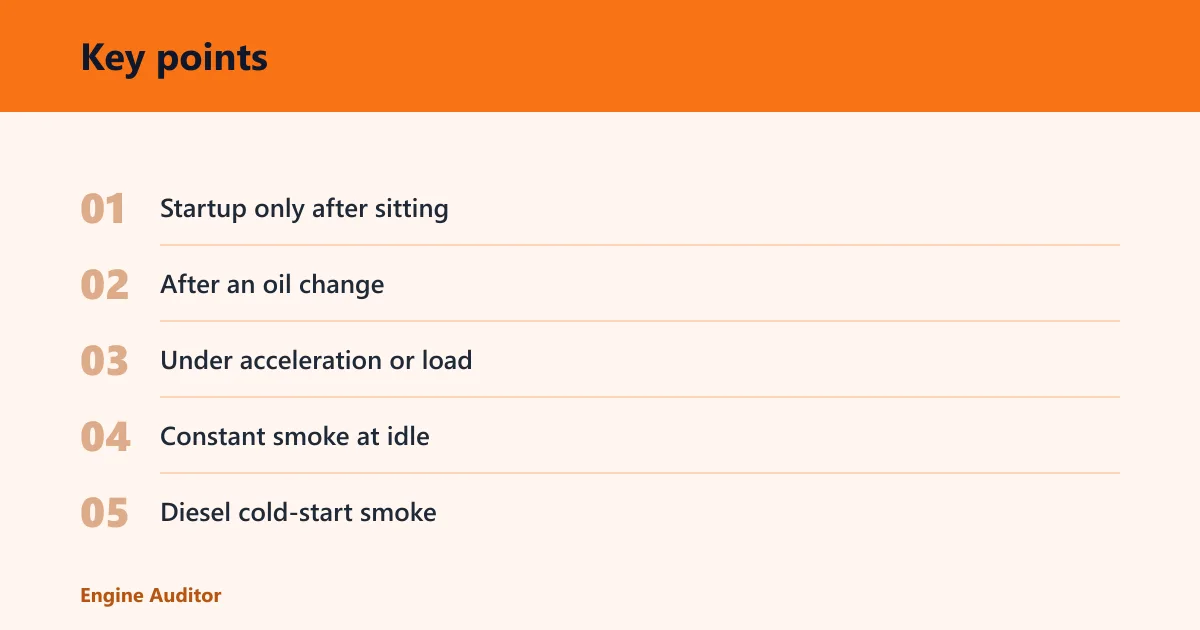
- Startup only after sitting: Often valve stem seals let oil leak down into the cylinders while parked.
- After an oil change: Overfilled oil or spilled oil on hot parts is the first thing to check.
- Under acceleration or load: Turbocharger seals or ring wear move higher on the list.
- Constant smoke at idle: PCV faults or worn rings are common suspects.
- Diesel cold-start smoke: Glow plug trouble can make blue-looking smoke that is unburned diesel, not oil.
- Smoke with rising oil use: Ring wear, turbo seals, or a persistent oil leak into the intake become more likely.
Blue smoke diagnosis table
| Smoke timing | Smell and oil level change | Likely cause | Quickest test | Stop-driving risk |
|---|---|---|---|---|
| Startup only after sitting overnight | Oily smell; oil level may slowly drop | Valve stem seals leaking after parking | Check whether smoke is worse after a slope park; inspect plugs for oil fouling | Medium if it is brief; higher if oil use is rising |
| Startup only after parking on a slope | Short puff, then clears | Valve stem seals | Repark level and compare the next cold start | Medium |
| Smoke right after an oil change | Oil smell; oil level may read above full | Oil overfill or spilled oil on hot parts | Check the dipstick against the full mark and inspect the exhaust area | Low to medium if it clears quickly |
| Under acceleration or hard load | Blue or gray smoke; oil level may fall | Turbocharger seal failure or ring wear | Inspect boost plumbing and check for oil in intercooler hoses | High if smoke is heavy or oil loss is fast |
| Constant smoke at idle | Oil smell; oil consumption may be steady | Stuck open PCV valve or worn rings | Inspect PCV operation and run compression testing | Medium to high |
| Smoke after a long idle | Brief puff when pulling away | Valve seals or PCV oil mist carryover | Observe whether the puff happens after stop-and-go traffic only | Medium |
| Diesel cold start, then clears warm | Blue-looking smoke; fuel smell is common | Glow plug problem or incomplete cold combustion | Scan for glow plug faults and compare cold-start behavior cylinder by cylinder | Low to medium, but do not ignore repeated hard starting |
| Smoke with more than a quart every 1,000 miles | Oil level drops between checks | Worn rings, turbo seal failure, or severe seal wear | Compression test each cylinder and inspect plugs | High |
Could the PCV valve be the cause?
A bad PCV valve can send oil mist into the intake or leave crankcase pressure uncontrolled, and that can make a car smoke blue. A stuck open PCV valve can create blue smoke all the time. A clogged one can also upset crankcase ventilation and push oil where it does not belong. The PCV system’s job is to route blow-by gases out of the crankcase, and when that flow is wrong, oil mist contamination becomes much more likely.
How the crankcase ventilation path moves oil mist
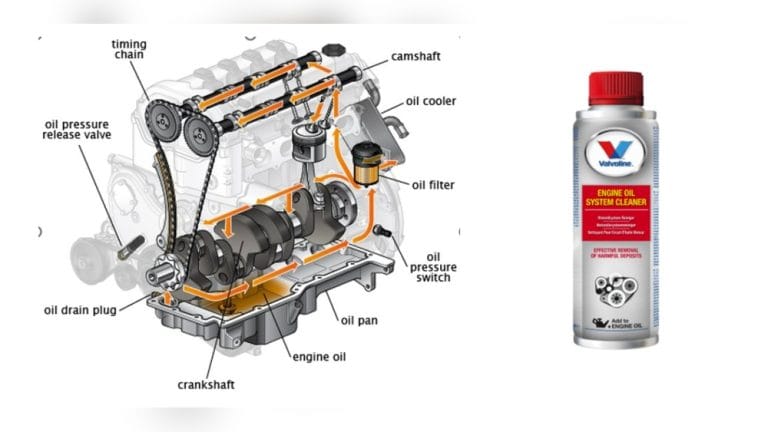
The PCV system routes blow-by gases out of the crankcase and back into the intake. If the valve sticks open, oil mist can be drawn in. If it clogs, pressure rises and oil may escape past seals or be pulled into the intake by abnormal flow paths. That is why PCV faults can create smoke, oil leaks, or both at the same time.
Why this is a cheap first check
This is one of the easiest faults to inspect and often one of the least costly to replace. If the valve rattles incorrectly, is oily inside, or is blocked, it deserves attention before you suspect deeper engine wear. It is not always the cause, but it is fast to rule out. Factory service information for many engines treats PCV inspection as an early diagnostic step because it can mimic ring or seal failure.
Could valve seals or rings be worn?
Yes. Valve stem seals and piston rings are two different failures, and the smoke pattern helps separate them. Valve seals usually smoke after the car has been parked. Ring wear more often causes continuous blue smoke and higher oil use because oil keeps entering the combustion chamber. Compression and leak-down tests are the standard way to separate a sealing problem from a ventilation issue.
Valve stem seals and startup smoke after sitting
Valve seals can leak oil into a cylinder while the engine sits. The next startup burns that oil in a short puff, then the smoke may fade. A slope can make startup smoke worse by letting more oil reach the seals on the downhill side of the engine. If the smoke is brief and mostly limited to the first start after parking, valve seals are a strong candidate.
Picture a sedan that sits nose-down in a driveway overnight. The next morning it gives a blue puff for a few seconds, then clears. If the same car parks level and the puff shrinks, valve seals move higher on the list than rings.
Piston rings and continuous smoke
Piston rings control how much oil stays out of the combustion chamber. When rings wear, oil can pass continuously and the smoke may show up at idle, under load, or all the time. That is also where oil consumption rises enough to matter. Manufacturer oil-use limits vary, but a recurring top-off pattern or a quart-per-1,000-mile rate is a strong warning sign that deserves testing, not guesswork.
More than a quart every 1,000 miles is a clear oil-burning warning sign. That does not prove ring wear by itself, but it makes the problem serious enough to stop guessing and start testing. Some engines have tighter or looser published limits, so the service manual should always have the final word on what is acceptable.
How compression testing helps separate them
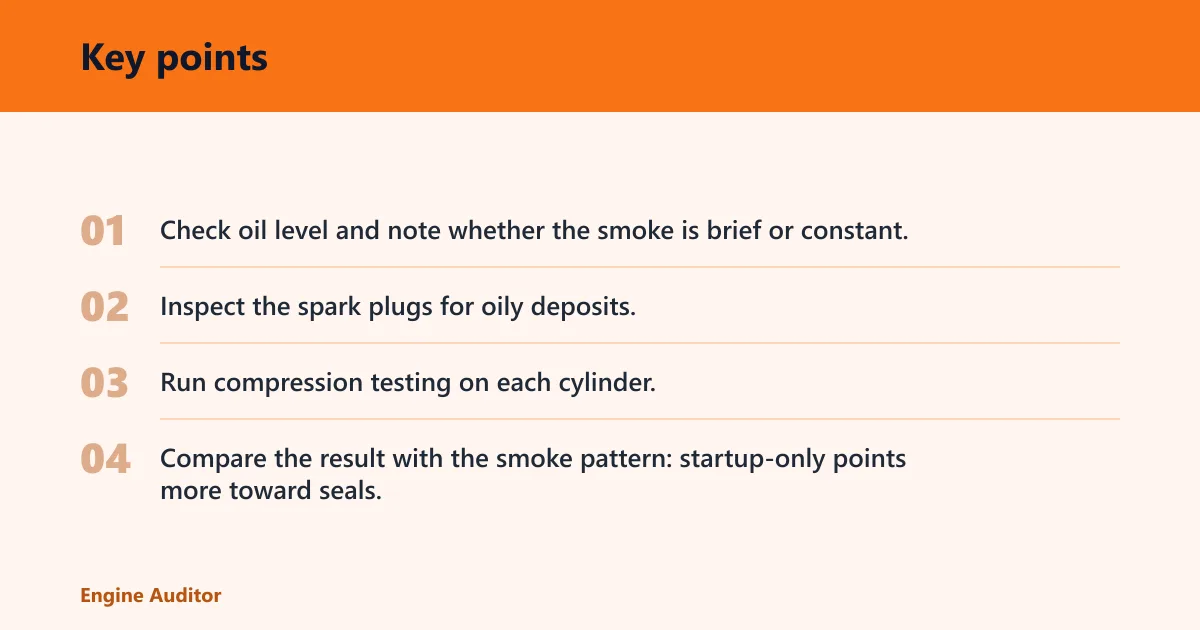
Compression testing is done cylinder by cylinder after removing the spark plugs. It helps separate ring wear from seal issues by showing whether a cylinder has weak sealing. A healthy compression pattern does not rule out every oil-burning fault, but it helps narrow the repair path. A leak-down test adds detail by showing whether air escapes past the rings, valves, or head gasket.
- Check oil level and note whether the smoke is brief or constant.
- Inspect the spark plugs for oily deposits.
- Run compression testing on each cylinder.
- Compare the result with the smoke pattern: startup-only points more toward seals; low compression across a cylinder points more toward wear.
What about turbo seals and diesel glow plugs?
Turbocharger seal failure matters more on turbocharged engines, where oil can enter the intake or exhaust side and burn under load. Diesel engines need a separate check, because blue-looking startup smoke can be unburned diesel from a cold-start problem, not engine oil. On turbocharged gas engines, factory-style diagnostics usually look for oil in charge pipes, intercooler hoses, and compressor or turbine housings.
Turbocharger seal failure on boosted engines
A turbocharger spins fast and depends on good oil control. If the seals fail, oil can burn and make blue or gray smoke that often gets worse during acceleration or boost. Oil in charge pipes or the intercooler is a useful clue that the turbo path is involved. A persistent oil trail on the compressor side or exhaust side is a stronger sign than a single oily film.
Glow plugs and unburned diesel on startup
On diesel engines, weak glow plugs can cause a cold-start cloud that looks blue. That smoke often clears as the engine warms. The guide recommendation is to replace glow plugs together if one is bad, because uneven cold starting can keep the problem going. Diesel smoke that improves quickly with heat usually points away from oil burning and toward incomplete combustion during the first few moments after startup.
Why diesel smoke may clear as the engine warms
Cold diesel combustion is less complete, so the exhaust can look blue-gray for a short time. That is different from oil burning, which may continue after warm-up. If the smoke disappears as soon as the engine reaches operating temperature, fuel-related causes move up the list. If it returns under load or continues when hot, look again for oil entry or fuel-system faults.
Could it be a head gasket?
A head gasket usually causes white steam and coolant loss rather than true blue smoke. It can still overlap with oil-burning symptoms in rare cases, especially if the failure affects both coolant and oil sealing paths. The quickest differentiators are coolant drop, sweet exhaust odor, overheating, milky oil, and persistent white vapor that does not behave like a brief oil burn-off.
Fast ways to separate a head gasket from oil burning
Check whether the coolant level is falling, whether the exhaust smells sweet, and whether the smoke looks more white than blue. A head gasket issue often shows overheating, pressure in the cooling system, or cross-contamination in the oil or coolant. Blue smoke by itself is still more often oil-related, but a mixed symptom set deserves a gasket check right away.
When smoke follows an oil change
Smoke right after service often means a simple mistake, not internal engine damage. Overfilled oil is a likely cause of smoking after an oil change. Oil spilled on the exhaust or hot engine parts can also burn off and clear within a short distance. When the smoke starts immediately after service, the fastest path is usually to verify the oil level and inspect the work area before chasing deeper engine faults.
Oil overfill and dipstick check
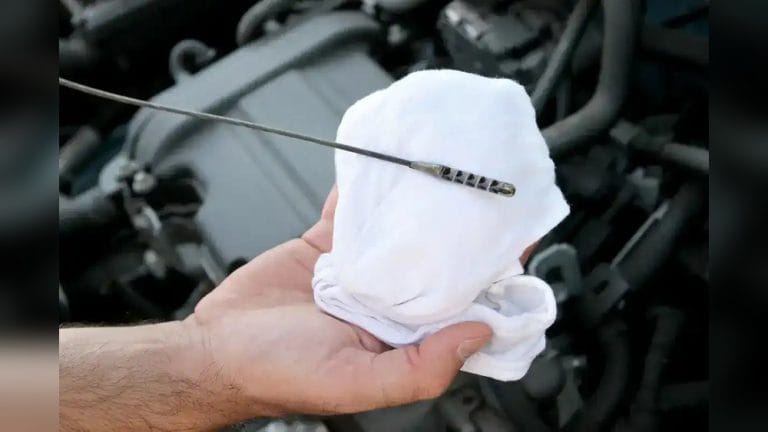
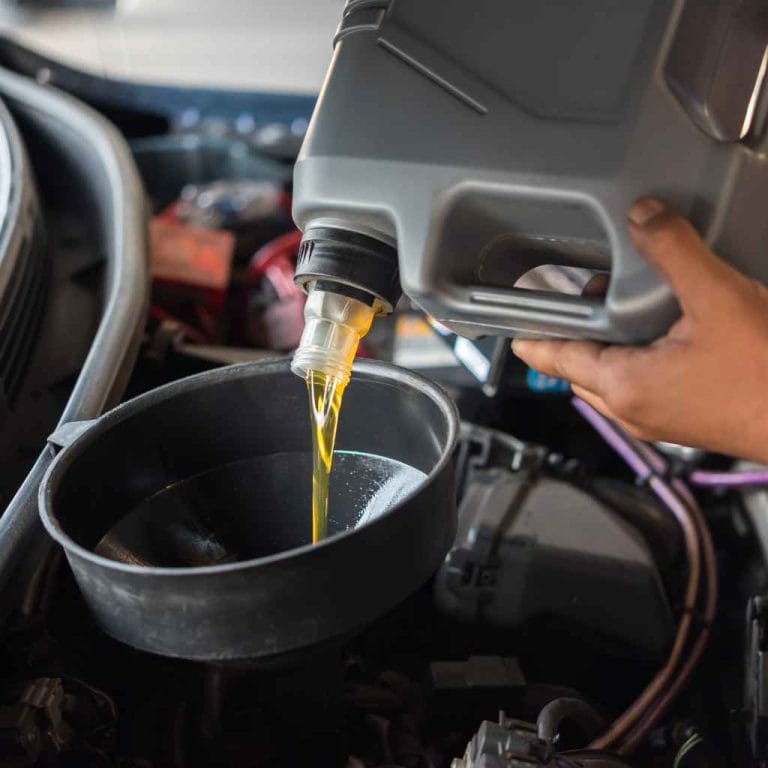
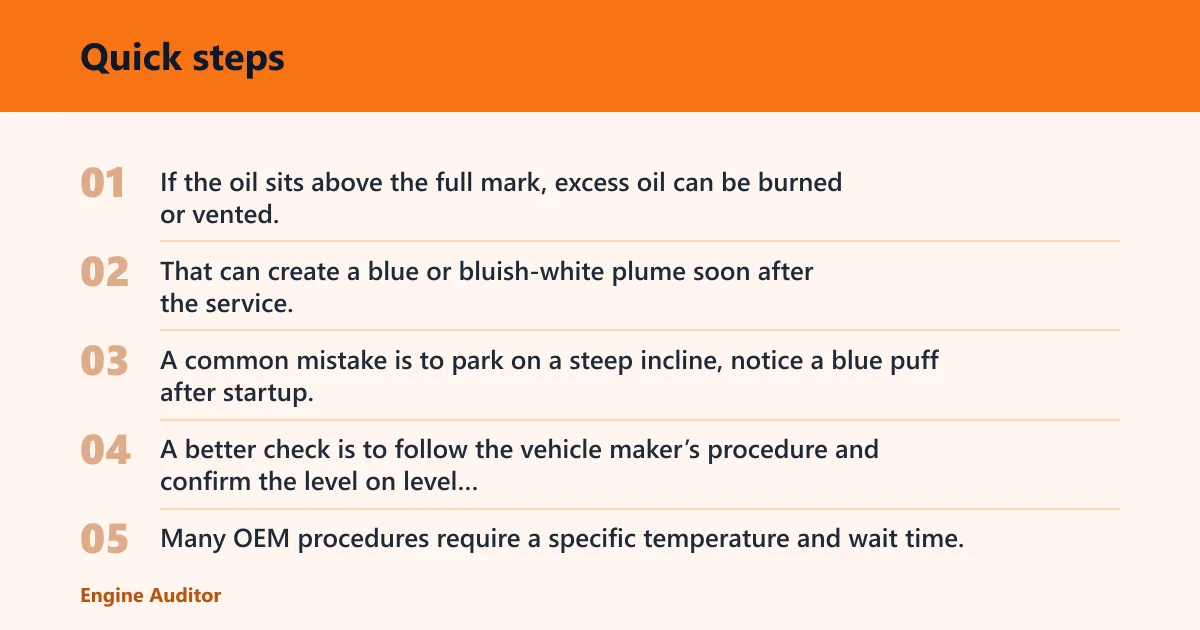
Start with the dipstick. If the oil sits above the full mark, excess oil can be burned or vented. That can create a blue or bluish-white plume soon after the service, and the fix may be as simple as correcting the level.
A common mistake is to park on a steep incline, notice a blue puff after startup, and assume the engine is burning oil when the smoke is actually from oil that seeped into the intake. A better check is to follow the vehicle maker’s procedure and confirm the level on level ground after the recommended wait. Many OEM procedures require a specific temperature and wait time, because inaccurate checking can make a normal fill look overfull.
Oil on the exhaust or hot engine parts
Spilled oil on hot parts usually smells sharp and clears fairly fast. If the smoke fades within a short distance and the oil level is correct, the service area is the more likely source. If it keeps smoking after the spill burns away, look deeper. This kind of burn-off usually produces a hot-oil smell more than a continuous engine-oil haze.
How long a service-related smoke event should last?
Smoke from spilled oil should usually drop off quickly once the residue burns off. Smoke that lasts through normal driving, returns at idle, or grows worse under load is not a spill issue anymore. That is the point to switch from cleanup to diagnosis. If the smoke does not taper after the first few heat cycles, treat it like a real oil-entry problem.
What happens if you keep driving?
Ongoing oil burning is not only messy. It can lower oil level enough to damage the engine, and it can damage the catalytic converter over time. If the smoke is heavy, oil use is fast, or the engine starts running rough, the risk moves from nuisance to repair escalation. Catalytic converters are especially vulnerable because oil ash coats the substrate and reduces efficiency.
Oil consumption and low-oil damage
If the engine is using more than a quart every 1,000 miles, keep checking the oil frequently and top it off before it falls low. Do not treat repeated top-offs as a solution. They are a short-term safety step while you find the cause. In service literature, the key issue is not just the number but whether the consumption is trending worse or accompanied by smoke, fouling, or loss of power.
Catalytic converter risk
Burning oil can contaminate the catalytic converter and may shorten its life. That is why a small oil-burning fault can become a larger exhaust-system repair. If the smoke is ongoing, the converter is part of the severity picture even when it is not the original fault. Once the converter is coated or overheated, the repair bill can climb even if the original oil leak is later fixed.
When to stop driving and get help
Stop driving if the smoke is heavy and constant, the oil pressure warning appears, the engine misfires badly, or the oil level drops quickly after topping off. If the smoke is brief and clearly tied to an oil spill or overfill, correct the level or clean the spill first, then recheck. If it returns, treat it as a real engine problem. Heavy smoke plus a falling oil level is the clearest do-not-ignore combination.
Frequently asked questions
Why is my car blowing blue smoke?
Blue smoke usually means oil is burning somewhere in the engine or exhaust path. The most useful clue is timing: startup, idle, acceleration, or after service. That pattern points you toward valve seals, PCV issues, rings, turbo seals, or an oil spill near hot parts. The sooner the smoke pattern is matched to the condition, the less likely you are to replace the wrong part.
Why is my car burning oil?
Your car may be burning oil because oil is leaking past valve stem seals, piston rings, turbo seals, or through a PCV problem. A steady oil-level drop and repeated blue smoke are the best signs that this is more than a one-time spill or brief cold-start event. If the rate is outside the manufacturer’s spec, the condition is no longer normal wear.
What causes blue smoke from the engine?
Blue smoke from the engine usually comes from oil entering the combustion chamber or exhaust stream. Common causes include valve seals, worn rings, a failing PCV valve, turbocharger seal failure, and overfilled oil after service. Diesel startup smoke can look blue but be fuel-related instead. When in doubt, separate smoke color, odor, and oil-loss trend before choosing the repair path.
Why does my car smoke blue when I start it?
Startup-only blue smoke often points to valve stem seals, especially if the car sat overnight or parked on a slope. Oil leaks down while parked, then burns on the next start. If the smoke clears quickly and oil use is mild, seals move near the top of the list. If the smoke persists once the engine is warm, the cause is less likely to be just a startup seal seep.
Is blue smoke always an engine oil problem?
No. On diesel engines, blue-looking startup smoke can be unburned diesel from a glow plug problem, especially when the engine is cold and the smoke fades as it warms. Blue smoke after an oil change can also be spill burn-off or overfill, not internal engine wear. Coolant-related problems, especially a head gasket, are more often white steam than true blue smoke.
Why is my truck blowing blue smoke?
Trucks often show the same causes as cars, but load can make the pattern more obvious. Under acceleration or towing, turbocharger seals and worn rings become more likely. If the smoke happens only at startup, valve seals or a service issue are still worth checking first. Diesel trucks also need glow plug and cold-combustion checks before assuming engine wear.
How do you diagnose blue smoke step by step?
Use the smoke pattern, oil level, and operating conditions together. The fastest diagnosis is usually a simple sequence: confirm the symptom, rule out service spill or overfill, check for oil use, then test the engine’s sealing and ventilation systems. This keeps the repair focused on the most likely source instead of swapping parts blindly.
Final diagnostic checklist
- Confirm when the smoke happens: startup, idle, acceleration, after service, or cold diesel start.
- Check the oil level on level ground using the manufacturer’s procedure.
- Look for spilled oil on hot parts and verify whether the smoke clears quickly.
- Inspect the PCV system for blockage, stuck valves, or excessive oil mist.
- Check spark plugs or glow plugs for fouling or cylinder-to-cylinder differences.
- Run compression testing, and if needed leak-down testing, to separate ring wear from valve sealing problems.
- Inspect turbo plumbing and intercooler hoses if the vehicle is turbocharged.
- Watch the oil-consumption rate against the vehicle maker’s published limit.
- If smoke is heavy, oil loss is fast, or warning lights appear, stop driving and get the fault diagnosed.
Products related to this article
Sponsored / affiliate links. As an Amazon Associate I earn from qualifying purchases. I may earn additional commission from eligible campaigns.
 DongJinK Engine Oil Level Gage Dipstick Compatible with Toyota 4Runner 1984-1995 for Toyota Celica 1984-1985 for Toyota Pickup 1984-1995 Replace# 15301-35020 1530135020
 ACROPIX Engine Oil Level Indicator Dipstick for Ford Fusion 2010-2012 for Ford Escape 2010-2012 for Ford Fusion 2006-2007 No.6E5Z6750AC Car Parts