Honda Civic Brake Fluid Change: How Often Is It Needed?
Many Honda Civic owners should plan brake-fluid replacement by the owner’s manual or maintenance minder first, then use a broad 2-year or 24,000-mile rule only as a fallback when records are missing. Brake fluid tends to absorb moisture from the air over time, which can lower its boiling point and increase corrosion risk in the hydraulic system. This guide shows when to replace it now, inspect it first, or follow the manual interval.
Honda Civic brake fluid decision table


Use this table to separate routine service from a real warning sign. The right call depends on age, records, pedal feel, and what the reservoir shows, not on mileage alone.
| Model age group | Service history known or unknown | Brake pedal feel | Reservoir color and level | Likely next step | Urgency |
|---|---|---|---|---|---|
| 0-3 years | Known and on schedule | Firm, consistent | Clear to light amber, between MIN and MAX | Follow the owner’s manual or maintenance minder | Schedule at next service |
| 0-3 years | Unknown | Normal but not recently checked | Color unknown or slightly dark | Inspect soon and verify records | Inspect soon |
| 4-7 years | Known but overdue by time | Still firm | Dark or brownish, level normal | Replace now | Replace now |
| 4-7 years | Unknown | Soft or spongy | Low, dark, or both | Inspect for leaks, air, or worn components, then replace fluid | Replace now |
| 8+ years | Unknown or incomplete | Any change in feel | Anything but clear/light amber and full between marks | Do not wait on generic mileage alone; inspect and service | Replace now |
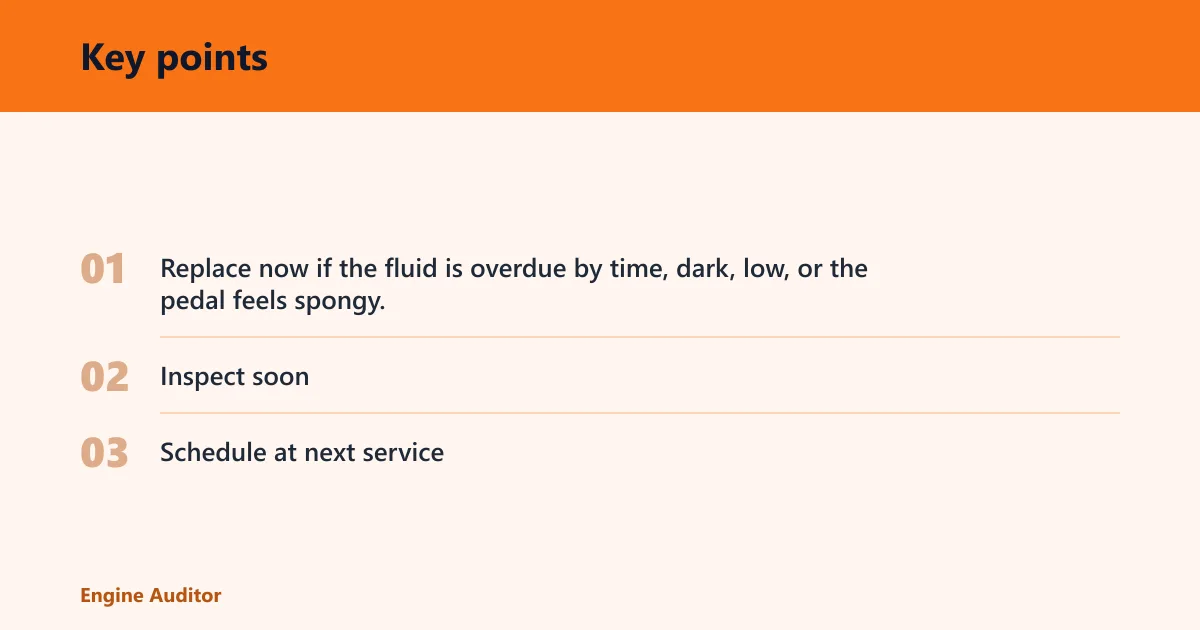
- Replace now if the fluid is overdue by time, dark, low, or the pedal feels spongy.
- Inspect soon if the car drives normally but records are missing or the reservoir color is questionable.
- Schedule at next service if the manual interval is current, the pedal feels firm, and the reservoir looks clean.
When should you change Honda Civic brake fluid?
Start with the owner’s manual or maintenance minder, because Civic service timing changes by model year, brake setup, and service history. A common fallback interval is about every 2 years or 24,000 miles, but it is only a general rule of thumb. On a used Civic with unknown records, a careful inspection beats assuming the fluid is fine.
How the generic interval fits
Many manufacturers recommend replacing brake fluid every 2 years, and FixMyCar gives roughly every 2 years or 24,000 miles as a common interval. Use that as a broad benchmark, not as a Honda-specific rule. If your manual gives a different schedule, the manual wins.
Why unknown records change the decision
Brake fluid can age without obvious symptoms. A Civic may stop normally while the fluid still pulls in moisture and loses boiling margin. If the service history is missing, age and appearance matter more, and a fresh replacement is often the safer choice than waiting for a problem.
Say your 2016 Civic has 68,000 miles, no brake-fluid record, and a reservoir that looks tea-colored. Even if the pedal still feels firm, that combination points to a replace-now decision, because the fluid condition and history both lean the same way.
What does brake fluid do in a Civic?
Brake fluid is the hydraulic fluid that makes the brakes work when you press the pedal. In a Honda Civic, it carries pedal force through the brake system, so the car can clamp the pads against the rotors and slow down. Fresh fluid is usually clear or light amber.
Why moisture matters
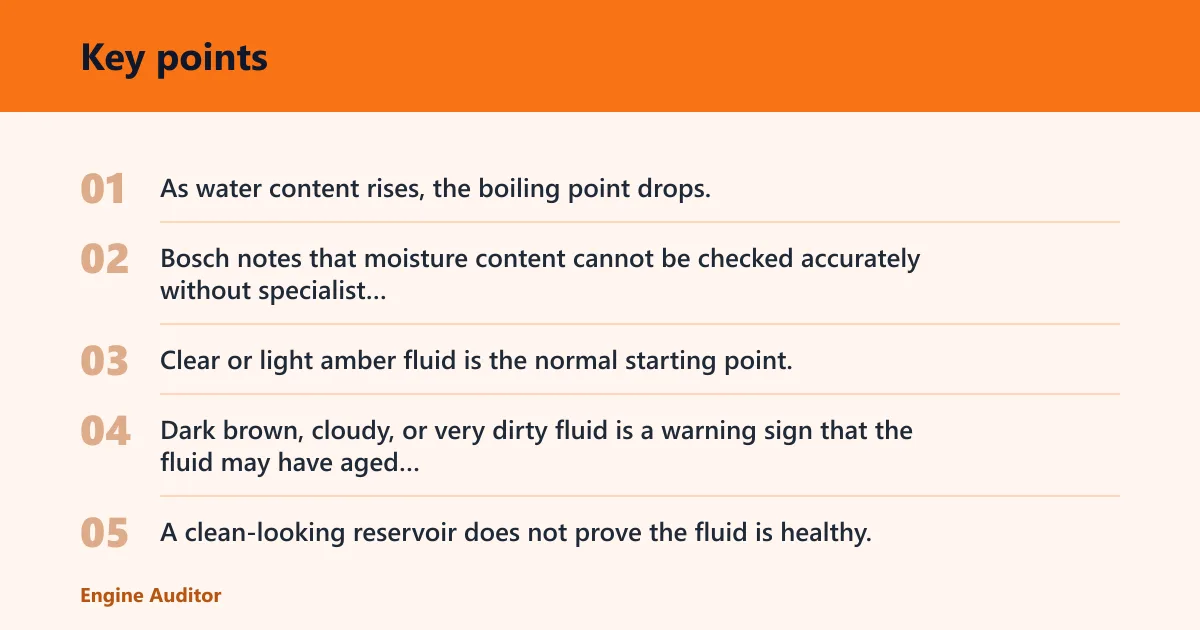
Brake fluid absorbs moisture over time. As water content rises, the boiling point drops, and the fluid is less able to handle heat from repeated braking. Bosch notes that moisture content cannot be checked accurately without specialist equipment, so appearance and service age matter, but they do not tell the full story.
What fresh fluid should look like
Clear or light amber fluid is the normal starting point. Dark brown, cloudy, or very dirty fluid is a warning sign that the fluid may have aged or picked up contamination. A clean-looking reservoir does not prove the fluid is healthy, but it does make an overdue-service call less urgent if the records are current.
How do you tell if your Civic needs service?
Look at pedal feel, reservoir level, and service history together. A soft or spongy brake pedal, low fluid, or dark fluid can suggest old fluid, air in the lines, a leak, or a worn hydraulic part. If the pedal feel changes, inspect first rather than assuming a simple top-up will solve it.
Brake pedal feel
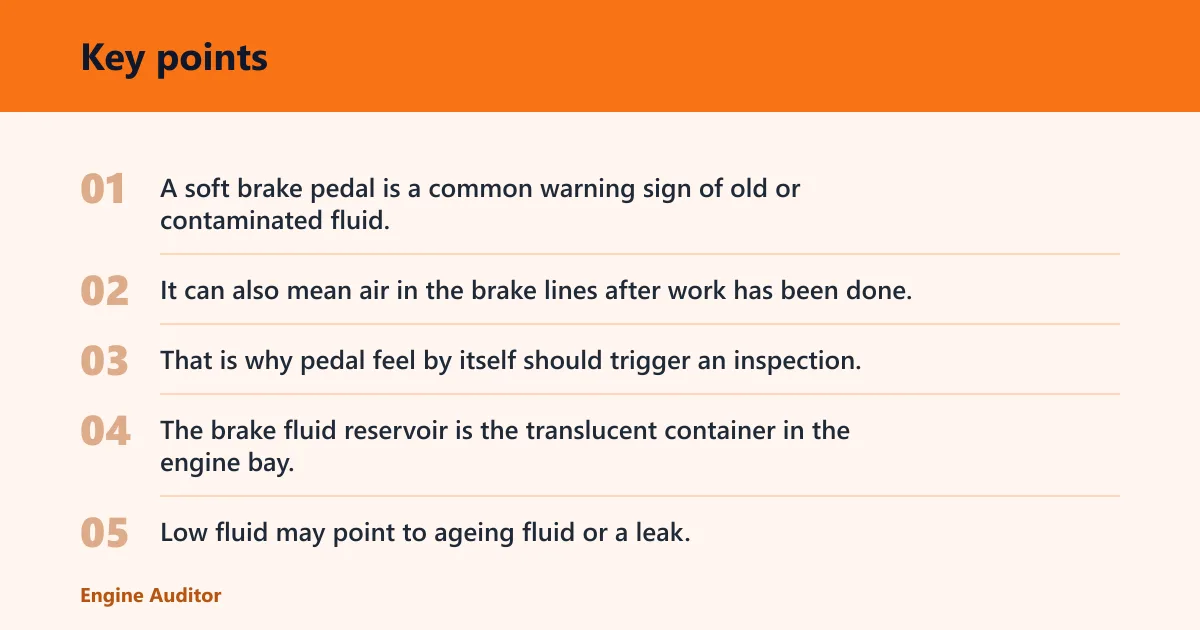
A soft brake pedal is a common warning sign of old or contaminated fluid. It can also mean air in the brake lines after work has been done. That is why pedal feel by itself should trigger an inspection, not an automatic guess about the cause.
Reservoir color and level
The brake fluid reservoir is the translucent container in the engine bay, and the MIN and MAX marks show the safe range. Low fluid may point to ageing fluid or a leak. It can also drop as pads wear thinner, because the caliper pistons sit farther out.
Leak signs and warning lights
Wet spots near a wheel, a sinking pedal, or a warning light deserve fast attention. Brake fluid loss is different from routine aging. If the level is low and the pedal feels soft, do not treat that as a simple maintenance item; inspect the system for leaks, trapped air, or worn components.
Suppose a Civic comes in with a firm pedal, but the reservoir is just above MIN and the fluid is dark. That points to overdue fluid replacement, not an emergency leak repair. The right next step is service soon, then a careful check for any seepage while the system is open.
Brake fluid flush, bleed, or top-up?
A brake fluid flush is a full fluid replacement in the brake system, and it includes a bleeding step. Brake bleeding removes air bubbles from the brake lines, but it is not the same as replacing old fluid. Topping up only restores level; it does not remove contaminated fluid.
Flush versus bleed
Use a flush when the fluid is old, dark, or overdue. Use bleeding when air has entered the lines after brake work or a repair. A Civic with a soft pedal after service may need bleeding, while one with old fluid and no pedal complaint may need a full fluid change.
Why topping up is not a full fix
Topping up can hide a low level for a moment, but it leaves the old fluid in the system. If the fluid has pulled in moisture or picked up contamination, adding more fluid does not reset the condition. It also does not solve a leak or fix worn hydraulic parts.
ABS system concerns
The ABS system can be affected by contaminated brake fluid, and some vehicles need the correct bleeding or purge procedure after service. That is one reason brake-fluid work is usually handled by a workshop. Incorrect bleeding can leave air in the system and make the pedal feel worse, not better.
What brake fluid does a Civic use?
Honda Civic brake-fluid spec can vary by model year and trim, so the exact requirement should be checked in the owner’s manual. Do not mix unknown fluids or guess based on another Honda. If the manual calls for a specific DOT grade, use that grade and avoid combining it with an unknown leftover fluid.
Why model-year variation matters
Honda Civics do not all share the same service details. Older Civics may use conventional automatic or manual fluids in other systems, while modern non-Si Civics commonly use CVT fluid in the transmission. That is separate from brake fluid, which still needs the correct brake-system specification for the car.
What to do when the spec is unclear
Check the owner’s manual before buying fluid. If the car is used and records are thin, matching the right brake-fluid spec matters more than buying the cheapest bottle. Mixing unknown fluid is a bad idea because compatibility and boiling behavior are not something to guess at.
How long does a brake fluid change take?
The same source says a brake fluid change usually takes around 30 to 90 minutes. A flush on a Civic is often in that range when the system bleeds normally and no extra repairs are needed. If the car needs additional brake work, the visit can take longer.
What affects the time
Access, corrosion, and whether the system needs extra bleeding all affect time. A routine fluid exchange is faster than a repair that also needs caliper work, hose replacement, or ABS-related bleeding. That is another reason a soft pedal should be inspected before service is scheduled.
Frequently asked questions
How often should a Honda Civic brake fluid change be done?
Use the owner’s manual or maintenance minder first. If you need a broad fallback rule, many manufacturers recommend about every 2 years, and FixMyCar gives roughly every 2 years or 24,000 miles. A used Civic with missing records should be judged by age, pedal feel, and fluid condition, not mileage alone.
Does brake fluid really need changing every 2 years?
As a broad maintenance rule, yes, many makers use a 2-year interval because brake fluid absorbs moisture over time. But that is not a universal Civic mandate. If your manual gives a different interval, follow it. If the fluid is dark or the history is unknown, a sooner change is reasonable.
What happens if you don’t change brake fluid on time?
Old fluid can pull in moisture, which lowers boiling point and can hurt braking performance. In practical terms, that can mean longer stopping distances, more fade under heat, and more corrosion risk inside the hydraulic system. The problem often builds slowly, so waiting for a symptom can be a bad strategy.
How do I know if my Civic needs brake fluid service?
Check the reservoir color and level, then note pedal feel and service history. Dark fluid, a soft pedal, low level, or missing records all justify inspection. If the fluid is clear or light amber and the manual interval is current, you can usually schedule the next service rather than rush it.
Is a brake fluid flush the same as a brake fluid change?
In practical service terms, they usually point to the same job: replacing old fluid in the system and bleeding the lines. Bleeding by itself only removes air. A flush or exchange replaces the fluid, which is what you need when the fluid is aged, contaminated, or overdue.
Can I just top up brake fluid instead of replacing it?
No. Topping up only raises the level; it does not remove moisture, contamination, or aged fluid. It can also hide a leak for a short time. If the reservoir is low, dark, or the pedal feels soft, inspect the system and replace the fluid if the condition or schedule calls for it.
Products related to this article
Sponsored / affiliate links. As an Amazon Associate I earn from qualifying purchases. I may earn additional commission from eligible campaigns.