How Much Does a Radiator Replacement Cost?
A full cooling-system repair can sometimes reach about $1,500 to $2,500. Let a leak run, and the engine can overheat, warp parts, and push the repair far beyond a radiator swap. This guide breaks down what drives the quote, what should be included, and how to tell radiator-only work from a wider cooling-system job.
Radiator replacement cost at a glance
For most passenger vehicles, a radiator job falls into two buckets: parts-only and installed cost. A replacement radiator may be a few hundred dollars by itself, while the installed price rises once labor, coolant refill, bleed time, and any extra diagnosis are added. Bigger engines, tight engine bays, and integrated cooler lines push the total higher.
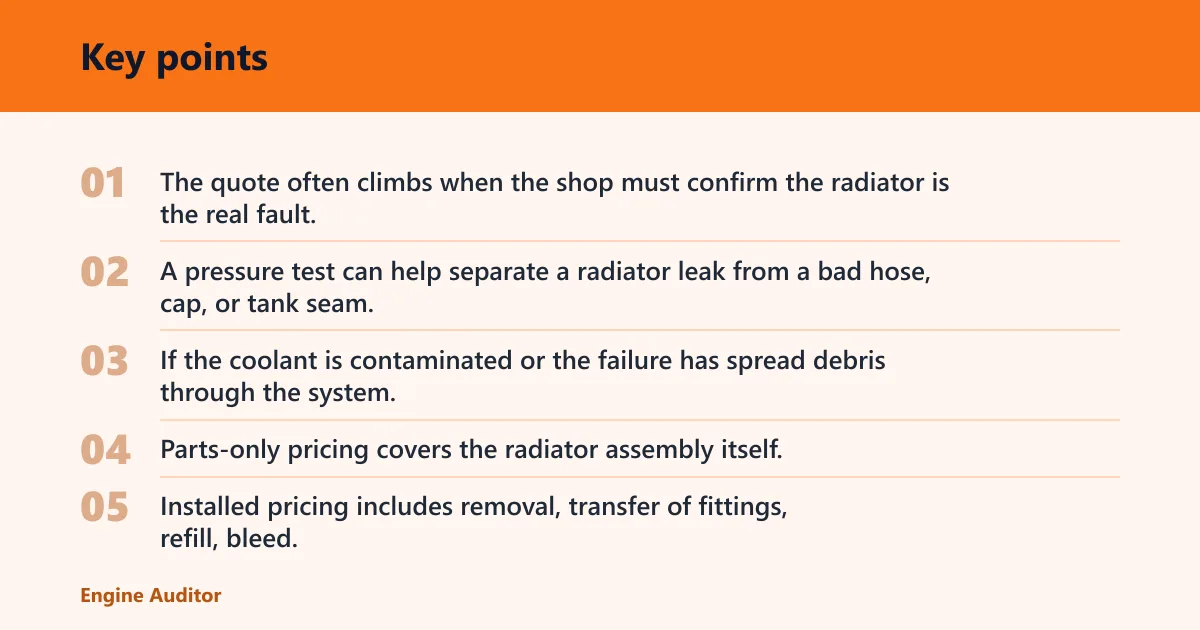
The quote often climbs when the shop must confirm the radiator is the real fault. A pressure test can help separate a radiator leak from a bad hose, cap, or tank seam. If the coolant is contaminated or the failure has spread debris through the system, a flush may be added too.
Parts-only vs installed cost
Parts-only pricing covers the radiator assembly itself. Installed pricing includes removal, transfer of fittings, refill, bleed, and road test time. On some vehicles, the radiator is easy to reach and the labor is modest. On others, the bumper cover, fan shroud, or transmission cooler lines add time fast.
Typical cost drivers
Labor rate matters. So does vehicle layout. Shops in high-cost areas usually charge more per hour, and a transverse engine with tight front-end packaging often takes longer than a simple rear-drive layout. Transmission cooler integration, hybrid cooling hardware, and stacked heat exchangers also add complexity.
When the quote is higher than expected
The total rises when a leak is not the only issue. Swollen hoses, a sticky thermostat, a failed fan relay, or coolant contamination can turn a radiator quote into a broader cooling-system repair. Corrosion inside the core can also point away from a small repair and toward full replacement.
📊 Boiler replacement costs $4,500–$10,000 in most cases, including equipment and labor. Source: Thisoldhouse.
What a radiator replacement quote includes
A complete quote should separate the radiator part, labor, coolant service, and any related repair or diagnosis. If those items are lumped together, ask for a line-by-line estimate before approving work. That makes it easier to compare shops and see what is actually moving the bill.
Radiator part price
The radiator itself may be priced as an aftermarket part, an OE-style part, or a dealer unit. Material quality, tank design, and whether the unit includes cooler fittings or brackets all affect cost. A simple aluminum-and-plastic unit is usually cheaper than a heavier, vehicle-specific assembly with extra ports.
Labor hours and shop rate
Labor is billed by time and difficulty. A straightforward replacement may take only a few hours, while a cramped engine bay, hidden fasteners, or front-end disassembly pushes the labor total up. Diagnostic time can be billed separately if the shop must confirm the source of the leak or overheating.
Coolant refill, bleed, and flush
After the radiator is replaced, the system needs the correct coolant type, refill, and bleed procedure. Air pockets can cause hot spots, poor cabin heat, and false overheating symptoms. If the old coolant is rusty, oily, or contaminated, a flush may be recommended and can add to the bill.
What is driving the bill?
The biggest price swings come from access, part integration, and whether the cooling system has more than one problem. A radiator in a simple engine bay is one job. A radiator buried behind fans, shrouds, coolers, and crash structure is another. That is why two similar-sounding quotes can be far apart.
Vehicle layout and access
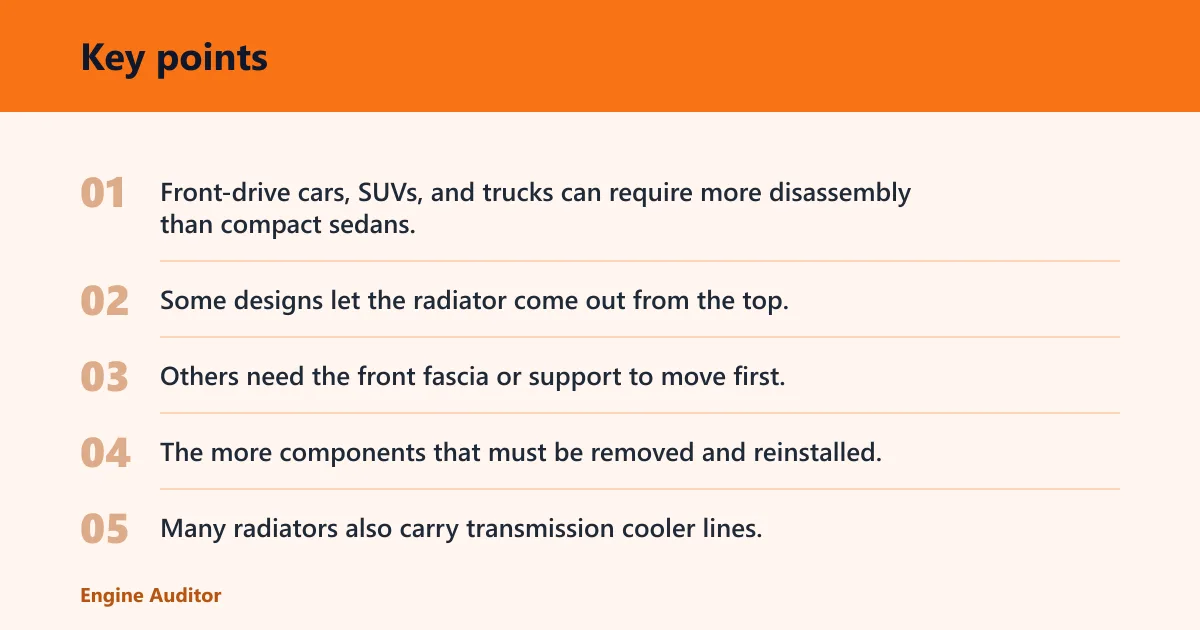
Front-drive cars, SUVs, and trucks can require more disassembly than compact sedans. Some designs let the radiator come out from the top. Others need the front fascia or support to move first. The more components that must be removed and reinstalled, the more labor the quote absorbs.
Transmission cooler integration
Many radiators also carry transmission cooler lines. That adds fittings, seals, and leak points that must be handled carefully. If a line or connection is damaged during removal, the repair can expand beyond the radiator itself. A quote should note whether those lines are part of the job.
Corrosion, clogging, and impact damage
Corrosion can thin the core until it leaks under pressure. Internal clogging can reduce cooling even if the radiator does not visibly drip. Impact damage from road debris or a front-end hit can crack the tank or fins. A cracked tank may sometimes be repaired cheaply, but core corrosion usually points to replacement.
Say your compact sedan develops a small drip at one plastic end tank and the rest of the radiator is clean. That may be a repair or replacement call based on age and parts availability. If the core shows white crust, bent fins, and repeated seepage, replacement usually makes more sense.
Radiator cost worksheet
Use this as a quick estimate tool before you approve repairs. It is not a fixed price. It is a way to separate the radiator itself from the rest of the cooling-system bill.
| Line item | Example estimate | What moves the number |
|---|---|---|
| Part price | $120 to $600 | Aftermarket vs OE-style part, cooler fittings, vehicle-specific design |
| Labor hours | 2 to 6 hours | Access, front-end disassembly, fan and shroud removal, line complexity |
| Coolant and bleed | $40 to $180 | Coolant type, refill volume, bleed procedure, flush if contamination is found |
| Related parts and diagnostics | $80 to $450 | Pressure test, hoses, thermostat, fan relay or motor, clamps, caps |
Decision box: Repair is more reasonable when the leak is small, limited to a tank seam, and the rest of the radiator is clean. Replace when corrosion is widespread, the core is clogged, or impact damage has distorted the assembly. If the car is overheating or losing coolant quickly, tow and diagnose instead of driving it farther.
When does repair make more sense than replacement?
Repair can make sense when the problem is narrow and early. A small seep at a tank seam, a loose fitting, or a single cracked hose connection may not justify a full radiator swap. Once the core is corroded, clogged, or repeatedly leaking, replacement is usually the better call.
Small leaks and tank damage
A minor crack in a plastic tank may be repairable on some vehicles if the damage is limited and the rest of the unit is sound. A shop may also find that the apparent radiator leak is actually a hose, clamp, or cap issue. That is why a pressure test matters before authorizing major work.
Core corrosion and clogging
If the core is corroded or internally restricted, patching the leak does not restore cooling capacity. Overheating can return, especially in traffic or under load. In that case, replacement is often a better use of money than paying for a short-lived repair.
Tow-and-diagnose decisions
If the temperature gauge climbs fast, the engine is steaming, or coolant is pouring out, keep driving to a minimum. A tow and diagnosis can be cheaper than a second repair caused by overheating. That is especially true if the car already showed signs of repeated coolant loss.
How much do related cooling parts add?
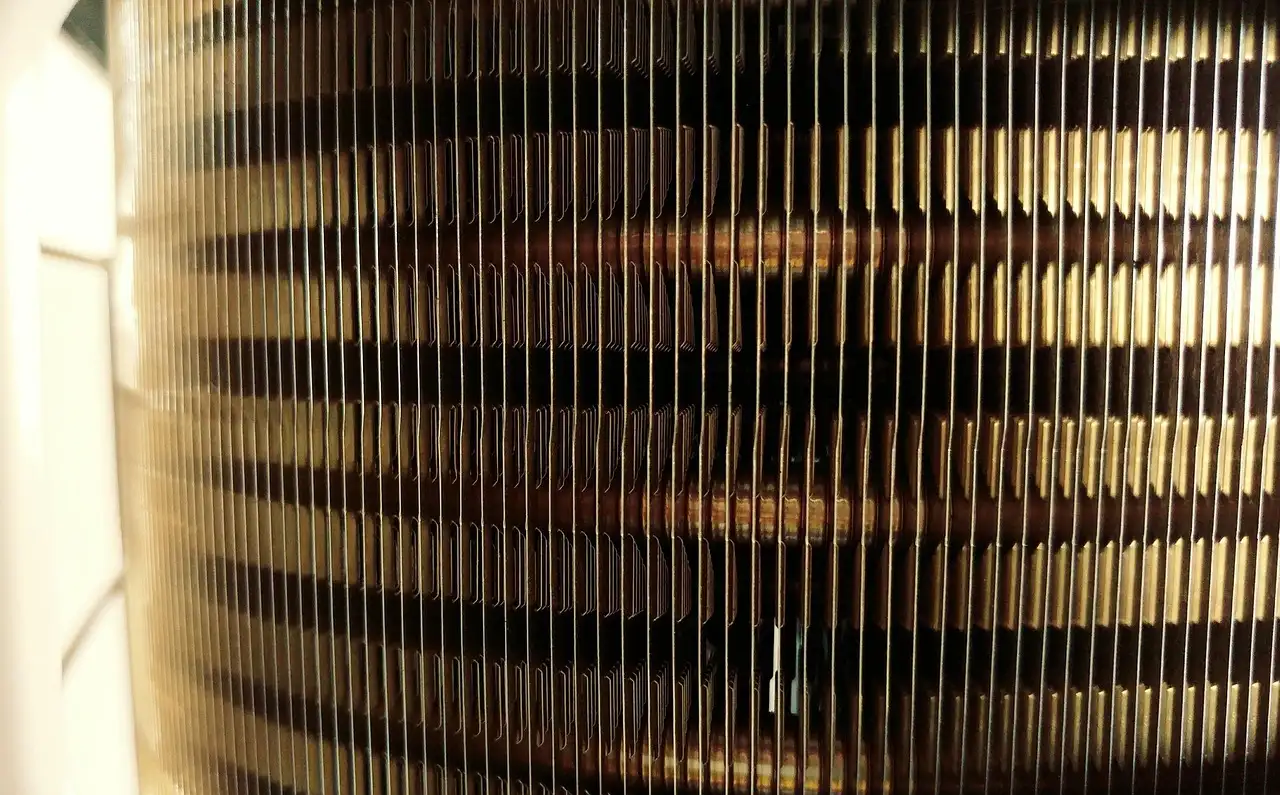
Related parts often explain why a “radiator” quote turns into a cooling-system bill. Hoses age, thermostats stick, fans fail, and each issue can mimic the same overheating symptoms. A good estimate should note which parts are being replaced because of wear and which are being replaced because access is already open.
Radiator hoses
Upper and lower radiator hoses are common add-ons when the cooling system is apart. Swollen, cracked, soft, or oil-soaked rubber should be replaced rather than reused. Hose replacement usually adds modest parts cost, but it can increase labor if clamps or routing are hard to reach.
Thermostat
A thermostat can mimic radiator failure by causing overheating, poor warm-up, or temperature swings. If the shop confirms it is sticking, replacing it during the same repair can save duplicate labor. If it is only being guessed at, ask for the diagnostic reason before approving the extra charge.
Cooling fan
A fan motor, fan relay, or control issue can drive overheating at idle even when the radiator is fine. Because the symptoms overlap, shops may bundle fan diagnosis into the estimate. Fan repairs can add a noticeable amount when the shroud or fan module is difficult to reach.
Pressure test and diagnostics
A pressure test is one of the most useful checks because it can reveal leaks at the radiator, hose joints, tank seams, or cap area. Diagnostic charges are usually smaller than the cost of guessing. If the quote includes testing, that is often money well spent before parts are ordered.
Suppose a midsize SUV overheats only in traffic. The radiator may not be the first part to blame. A fan relay, a weak fan motor, or a restricted coolant path can create the same symptom, so the diagnostic step matters before replacing the wrong part.
How much does a radiator replacement cost by vehicle type?
Vehicle type changes the bill more than many owners expect. A small car with clear access may stay near the lower end of the range, while a truck, luxury model, hybrid, or EV can cost far more because the cooling system is packed tighter and may cool several components at once.
Small cars and simple layouts
Simple layouts usually mean fewer labor hours and fewer parts to remove. The radiator may be accessible from the front with limited disassembly, and the hose routing is often easier to handle. These jobs are usually the closest to the lower end of the common estimate.
Larger vehicles and tighter engine bays
Full-size SUVs and trucks often need more labor because of bigger shrouds, added cooler lines, and crowded front-end packaging. That extra time raises the labor portion even if the radiator part itself is not unusually expensive. Access difficulty is often the hidden cost driver.
Hybrids and EV cooling packaging
Hybrids and electric vehicles can use more than one cooling loop, with separate control modules, pumps, or heat exchangers. That does not mean every cooling problem is expensive, but it does mean diagnosis and replacement can be more involved than on a basic gasoline car. Ask the shop to identify which loop is failing.
Frequently asked questions
How much does a radiator replacement cost?
A radiator replacement usually costs $450 to $1,200 at an independent shop, with higher totals when labor, coolant, and related parts are needed. The part alone is only one piece of the bill. Access, vehicle layout, and diagnostic time can push the job well above a simple parts price.
How much does a radiator replacement cost for a car?
For a car, the usual installed range is about $450 to $1,200, with compact cars sometimes lower and tightly packaged models sometimes higher. If the quote includes hoses, a thermostat, or a fan issue, the total can move into the $1,500-plus range quickly.
How much does a car radiator repair cost?
Minor radiator repair can be cheaper than replacement when the problem is a small tank leak, a loose connection, or a limited seep that does not involve a corroded core. Once the core is damaged or clogged, repair may be poor value, and replacement becomes the more practical option.
How much does it cost to remove and replace a radiator?
Removal and replacement cost depends on labor time, shop rate, and how much front-end disassembly the vehicle needs. Many radiator jobs take about 2 to 6 labor hours before coolant and related parts are added. A pressure test and bleed procedure can increase the final invoice.
How much does a radiator hose replacement cost?
Radiator hose replacement is usually an add-on rather than the main expense, but it matters because cracked, swollen, or oil-soaked hoses often fail soon after the radiator does. The cost depends on hose type and access. If both upper and lower hoses are due, the labor savings from doing them together can help.
How much does a radiator fan replacement cost?
A radiator fan replacement can add a meaningful amount because fan motors, relays, and shrouds are often harder to reach than they look. The symptom may be overheating at idle or in traffic, even with a sound radiator. Diagnosis is important so you do not replace the wrong cooling part.
How much does a radiator change cost?
A radiator change is another way shops describe radiator replacement. The installed cost usually depends on part price, labor hours, coolant refill, and whether other cooling components are replaced at the same time. A simple job costs less than one that also needs hoses, thermostat work, or pressure testing.
Products related to this article
Sponsored / affiliate links. As an Amazon Associate I earn from qualifying purchases. I may earn additional commission from eligible campaigns.