Why Is My Temperature Gauge Pegged on Hot?
A temperature gauge pegged on hot usually means either true overheating or a failed temperature signal. The first rule is simple: if you see steam, coolant loss, or a rising coolant smell, treat it as a real overheat and shut the engine down. Mistaking one fault path for the other can cook the engine, waste time, and send you after the wrong part. This guide shows how to separate a real overheating event from a false hot reading, then test the likely fault in order.
What you’ll need

- OBD2 scan tool
- Multimeter
- Vehicle wiring diagram for the coolant temperature signal path
- Basic hand tools for connectors, sensor access, and trim removal
- Electronic cleaner for corroded plugs
- Coolant-safe bleed supplies, including a funnel or bleed kit if the vehicle uses one
Is the engine really overheating?
If the gauge is on hot, check for a real overheat first. Look for steam, coolant loss, a boiling overflow tank, or a red warning light. If any of those are present, shut the engine off and let it cool before chasing sensors, because a false gauge and a true overheat need opposite responses.
Start with the fastest safety check
- Pull over and leave the engine running only if the temperature is stable and no steam is present.
- Open the hood carefully and look for boiling coolant, wet hoses, or a fresh coolant smell.
- Check the reservoir level after the engine cools enough to inspect it safely.
- If the needle is in the red and coolant is boiling, do not keep driving.
Suppose the needle is pegged, the cabin heat still blows normally, and there is no steam. That pattern points more toward a signal fault than a true overheat, so the next checks should focus on the sensor, wiring, and cluster rather than the cooling hardware first.
Why is my temperature gauge stuck on hot?
A hot peg often starts with the coolant temperature sensor, because a faulty sensor can send the wrong temperature information to the ECU or gauge. On some cars there is one sensor for both the gauge and ECU; on others there are two, so you need to identify which sensor feeds the dash before replacing anything.
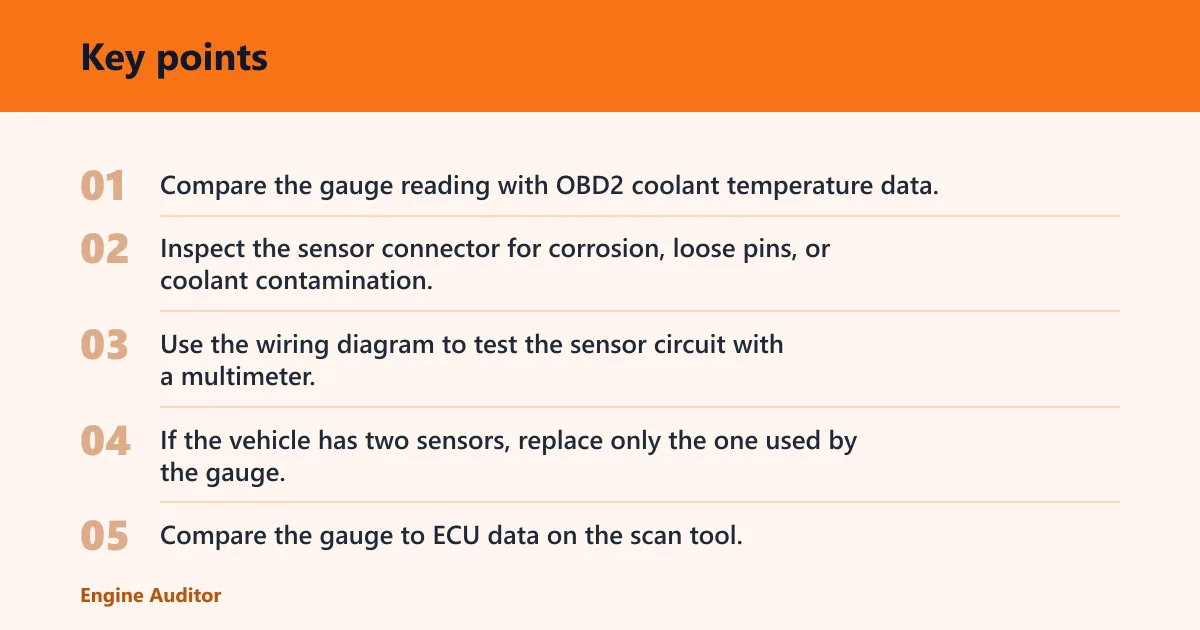
Test the signal source first
- Compare the gauge reading with OBD2 coolant temperature data.
- Inspect the sensor connector for corrosion, loose pins, or coolant contamination.
- Use the wiring diagram to test the sensor circuit with a multimeter.
- If the vehicle has two sensors, replace only the one used by the gauge.
The instrument cluster is the next likely stop on modern cars, because many of them integrate the temperature gauge into the cluster. If the sensor and wiring check out, the cluster may need solder repair, replacement, or programming.
Check the cluster and ECU path
- Compare the gauge to ECU data on the scan tool.
- Inspect the cluster connector for heat damage or corrosion.
- Check for cluster faults or missing gauge response on the scan tool, if available.
- If the cluster is faulty, confirm whether replacement needs coding or programming before installation.
Can a bad sensor make the gauge read hot when the engine is not overheating? Yes. That is one of the most common failure patterns, and it is why the gauge should never be treated as proof of a hot engine without checking coolant level, scan data, and the signal path first.
Why is my temperature gauge going down?
A falling or wandering gauge usually points to air in the cooling system, low coolant, or a thermostat that is not letting the engine reach normal temperature. A stuck-open thermostat can hold engine temperature too low, so the gauge may dip after highway driving or sit lower than expected during warm-up.
Look for low coolant or trapped air
- Check the reservoir and radiator level only when the engine is cool.
- Bleed the cooling system using the vehicle’s bleed point or service procedure.
- Top up with the correct coolant in 250 mL increments, then recheck the level and gauge behavior.
- Watch for a fluctuating needle, which can be a sign of air in the system.
Confirm thermostat behavior
- Use the scan tool to watch coolant temperature during warm-up.
- Check upper radiator hose temperature after the engine begins warming.
- If the engine stays too cool, test the thermostat and replace it if it sticks wide open.
- If the engine truly overheats, a stuck-closed thermostat is one possible cause.
Why Car Temperature Gauges Goes Up And Down While Driving usually comes down to air, low coolant, a sensor that sends unstable data, or thermostat behavior that does not match the engine load. The key is to tell a real temperature swing from a signal problem before replacing parts.
Temperature gauge decision table
This table maps the symptom pattern to the first test, the likely fault, and whether you should keep driving. Use it as a quick triage tool before replacing parts.
| Symptom pattern | First test | Likely fault | Safe to drive? |
|---|---|---|---|
| Hot peg at key-on | Scan ECU temperature and inspect cluster self-check behavior | Cluster fault, wiring fault, or sensor circuit fault | No, until the reading is verified |
| Hot peg after startup | Compare scan data with actual warm-up behavior | Bad coolant temperature sensor or wiring | Only if there is no real overheat |
| Hot peg with normal heater output | Check for gauge-ECU mismatch and connector corrosion | Instrument cluster or signal wiring | Maybe, if coolant level and temperature are normal |
| Hot peg with boiling coolant | Stop, cool down, then inspect coolant level and thermostat function | Real overheat, stuck thermostat, low coolant, or air pocket | No |
| Hot peg with no engine overheat | Check sensor resistance and connector condition | Sensor, wiring, cluster, or ECU signal fault | Only after the gauge is confirmed wrong |
| Hot peg with DTCs | Read OBD2 codes and compare live data | ECU input fault, sensor circuit fault, or wiring damage | Depends on actual coolant temperature |
If that didn’t work, try this next
If the sensor, coolant level, and cluster checks do not explain the reading, move down the path. Broken wiring between the sensor, ECU, and cluster can cause temperature gauge problems, and measuring resistance with a multimeter is often the fastest way to prove a break or high resistance.
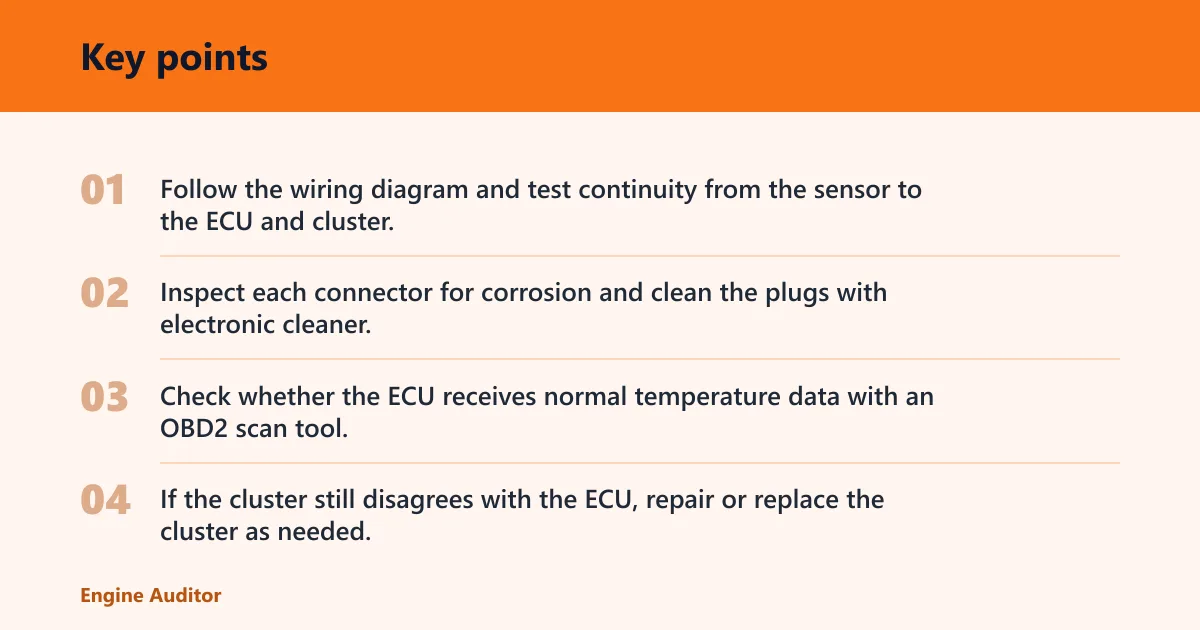
- Follow the wiring diagram and test continuity from the sensor to the ECU and cluster.
- Inspect each connector for corrosion and clean the plugs with electronic cleaner.
- Check whether the ECU receives normal temperature data with an OBD2 scan tool.
- If the cluster still disagrees with the ECU, repair or replace the cluster as needed.
A common first-timer mistake is replacing the sensor before checking which sensor the dash actually uses. On a two-sensor vehicle, that can leave the gauge pegged hot while the wrong part was replaced, and the real fault stays in place.
Common mistakes
Most bad diagnoses come from skipping the order. Start with the overheat check, then move to the signal path, then the cluster. That sequence avoids replacing a thermostat when the problem is actually a corroded connector or a failed gauge module.
- Replacing the wrong sensor on a two-sensor system
- Ignoring the instrument cluster on a modern car
- Skipping the wiring diagram before multimeter testing
- Driving past a true overheat because the dash might be wrong
- Leaving corroded connectors uncleaned at the sensor, ECU, or cluster
If diagnosis is still unclear, a mechanic with the right scan tool and wiring diagrams should inspect the vehicle. Cluster replacement may need programming, and that is not always obvious from the dash symptoms alone.
Frequently asked questions
Where should the needle be on the temperature gauge?
Most gauges settle near the middle once the engine warms up. A needle that stays low can point to a stuck-open thermostat, while a needle that climbs toward hot needs a real overheat check first. Compare the gauge with scan data instead of relying on the needle alone.
Can a bad sensor make the gauge read hot when the engine is not overheating?
Yes. A faulty coolant temperature sensor can send the wrong temperature information to the ECU or gauge, and some cars use one sensor while others use two. Check the wiring diagram, test the circuit with a multimeter, and replace the sensor that actually feeds the gauge.
Could air in the cooling system cause the gauge to peg hot?
Yes. Air in the cooling system can make the gauge behave incorrectly, and a fluctuating gauge is one common clue. Bleed the system with the correct procedure, then recheck coolant level and scan data before blaming the sensor or cluster.
Is a stuck thermostat a reason the temperature gauge reads hot?
Yes, but the direction matters. A thermostat stuck wide open can keep the engine from reaching optimal temperature, while a stuck-closed thermostat can cause a true overheat. The scan tool and the upper radiator hose temperature help separate those two cases.
Products related to this article
Sponsored / affiliate links. As an Amazon Associate I earn from qualifying purchases. I may earn additional commission from eligible campaigns.
 Car Fuel Pressure Gauge - Auto Repair Tester with 6.3, 7.89, and 9.49 Connectors for Gasoline Injection Testing
 Car A/C Repair Kit, 270PCS Rubber O-Ring Seal Kit + 40PCS Car Air Conditioner Valve Core Kit for R12 R134a A/C with Remover & Install Tool+10pcs R134a AC Valve Caps, Fix Refrigeration System