Which Vehicle Type Is Best for Large Families?
For most large families, a three-row minivan is the best all-around choice. Pick an SUV only if you need higher ground clearance or tow more than about 3,500 pounds. Choosing the wrong type means cramped third rows, hard-to-install child seats, and cargo space that disappears after one stroller. This guide matches family size, car-seat stage, luggage, and parking limits to the vehicle type that fits best.
Best family vehicle types
Minivans and three-row SUVs fit most large families because they mix passenger room with cargo space. A full-size SUV fits families that need maximum seating, higher ride height, or towing. A three-row midsize SUV is often a middle-ground choice when parking and maneuverability matter more than total space.
Minivan: best for easy access and daily family loading
A minivan usually makes the easiest daily family vehicle because sliding doors simplify school pickup, grocery loading, and curbside buckling. Sliding second-row seats help with third-row access, especially when child seats are installed, and family-focused packaging often leaves more usable cargo space than a similarly sized SUV. Features such as Stow ‘n Go or Magic Slide seats make the cabin easier to reconfigure.
Three-row midsize SUV: best compromise for many families
A three-row midsize SUV suits families that want a usable third row without the bulk of a full-size SUV. In some models, the third row is adult-friendly for shorter trips, and the footprint is easier to park in tight garages or city spaces. It is often the default choice when you want one vehicle that does a bit of everything.
Full-size SUV: best for maximum seating and towing
A full-size SUV is the strongest fit when you need eight seats, higher ground clearance, or towing capability. The 2025 Chevrolet Tahoe seats 8 passengers and has maximum cargo space of 122.9 cubic feet, while the 2025 Toyota Sequoia has passenger capacity for 8 and maximum cargo space of 86.9 cubic feet. The tradeoff is size, fuel use, and parking difficulty.
Which vehicle type is best for large families?
For most large families, a minivan is the best vehicle type, with a three-row SUV close behind if you want a higher seating position or more ground clearance. The right answer depends less on seat count than on how easily you can reach the third row, install child seats, and load cargo after the family is aboard.
Match body type to family size and child-seat stage
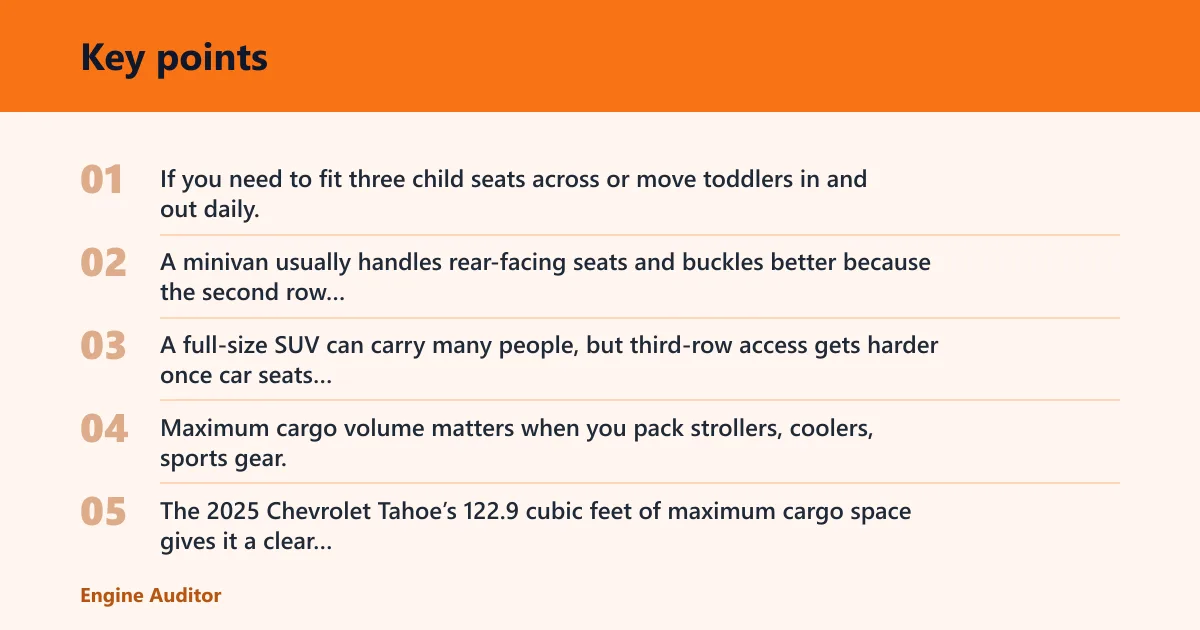
If you need to fit three child seats across or move toddlers in and out daily, the easiest access matters more than a brochure seat count. A minivan usually handles rear-facing seats and buckles better because the second row slides and the doors open wide. A full-size SUV can carry many people, but third-row access gets harder once car seats occupy the middle row.
Match body type to cargo needs and road-trip gear
Maximum cargo volume matters when you pack strollers, coolers, sports gear, and luggage at the same time. The 2025 Chevrolet Tahoe’s 122.9 cubic feet of maximum cargo space gives it a clear packaging advantage over many three-row vehicles, while the 2025 Toyota Sequoia’s 86.9 cubic feet shows how much this number can vary even within the same class. A minivan often uses its space more efficiently because the floor is lower and boxier.
Match body type to parking space and towing needs
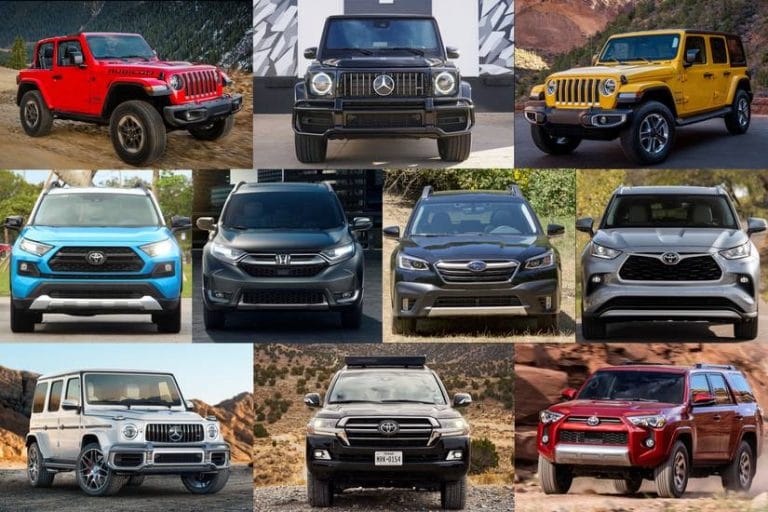
Garage fit and street parking can be the deciding factor in dense neighborhoods. A three-row midsize SUV is the easiest large-family choice when you want less bulk, while a full-size SUV makes sense if you regularly tow a camper or trailer and need available AWD for snow or rough roads. Families who never tow should not pay a size penalty just to sit higher.
Family vehicle decision matrix
This table turns the decision into a practical filter. Use it to match family size, child-seat count, cargo demand, and parking or towing needs to the body type that fits best. The goal is not to crown one winner. The goal is to avoid the wrong shape for your daily life.
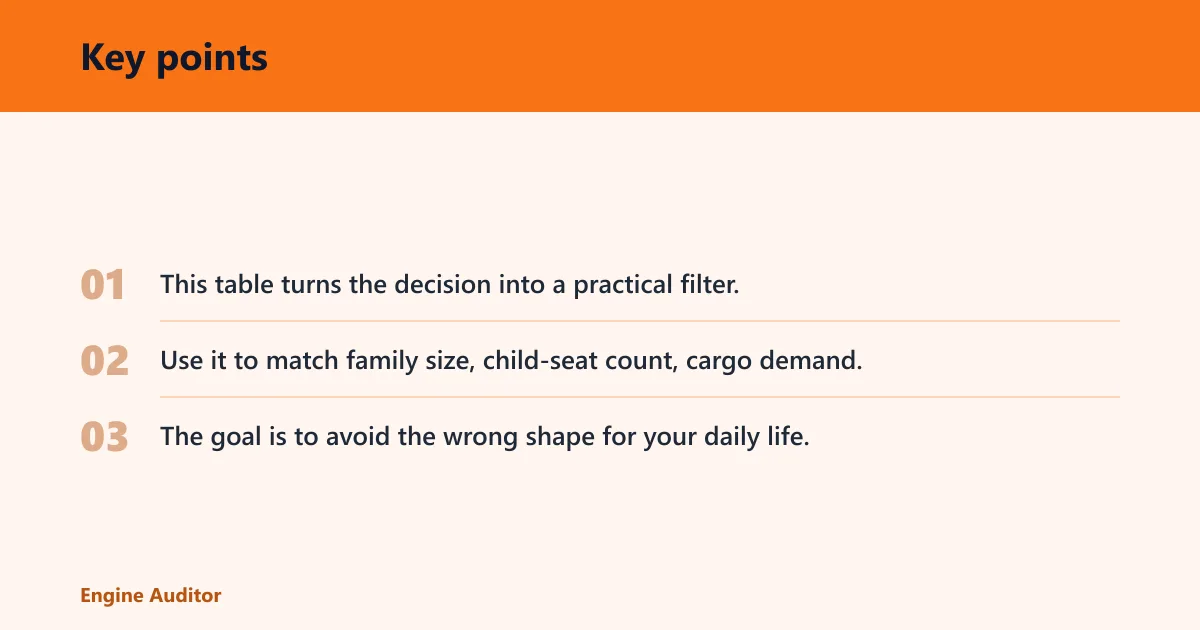
| Body type | Family size and child seats | Cargo and stroller needs | Parking, garage fit, towing needs | Best for / avoid if |
|---|---|---|---|---|
| Minivan | Best for 5 to 8 passengers, especially with multiple child seats and frequent third-row use. | Best for strollers, luggage, sports bags, and bulk shopping because the boxy shape and low floor make loading easier. | Best if parking space is moderate and towing needs are light. | Best for: families with toddlers, car seats, and daily loading. Avoid if: you need high ground clearance or frequent heavy towing. |
| Three-row midsize SUV | Best for 5 to 7 passengers, or 8 in some models, when the third row is occasional use. | Best for moderate cargo loads; works well for school runs and weekend trips, but cargo shrinks fast when the third row stays up. | Best if you need easier parking and a smaller footprint than a full-size SUV. | Best for: families that want a compromise between space and maneuverability. Avoid if: you need a truly roomy third row every day. |
| Full-size SUV | Best for 8 passengers and families that want a higher seating position. | Best for large luggage loads and gear-heavy trips; some models provide up to 122.9 cubic feet of cargo space. | Best if you tow, drive in snow, or want a tall stance and available AWD. | Best for: campers, trailers, and families who need maximum seating. Avoid if: parking space is tight or fuel cost matters most. |
Is a minivan or SUV better for a large family?
A minivan is usually better for a large family because it gives you easier access, smarter packaging, and less hassle with child seats. An SUV becomes the better pick when you want higher ground clearance, stronger towing, or a more truck-like driving position. The answer changes when the family’s daily routine includes parking constraints or heavy gear.
Why minivans usually win on access and packaging
Sliding doors are not a luxury feature for large families; they are a daily convenience feature. They reduce door dings in tight lots and make buckling children easier. Sliding second-row seats also help passengers reach the third row without folding and wrestling seats around car seats, which is where many SUVs lose practical points.
Where SUVs make more sense
A full-size SUV makes sense when the family needs more than space alone. Some buyers want a higher ride height, available AWD, or a tow rating that works for camping trailers and boats. Many large SUVs also offer hands-free liftgates, which help when your hands are full of groceries, sports gear, or a sleeping child.
When a hybrid version matters more than body style
If you drive a lot of miles each year, the powertrain can matter as much as the body type. The 2026 Toyota Sienna Hybrid gets 35–36 combined mpg, and the 2026 Kia Carnival Hybrid gets 32 combined mpg. Those numbers can shift the ownership equation for high-mileage households more than the difference between van and SUV alone.
What should you prioritize first?
Start with seating and access, then cargo, then fuel economy. A vehicle with a nominally large seat count can still fail a family if the third row is hard to reach with child seats installed. After that, weigh cargo volume and convenience features against the fuel and towing tradeoff you are willing to live with.
Seating capacity versus real third-row comfort
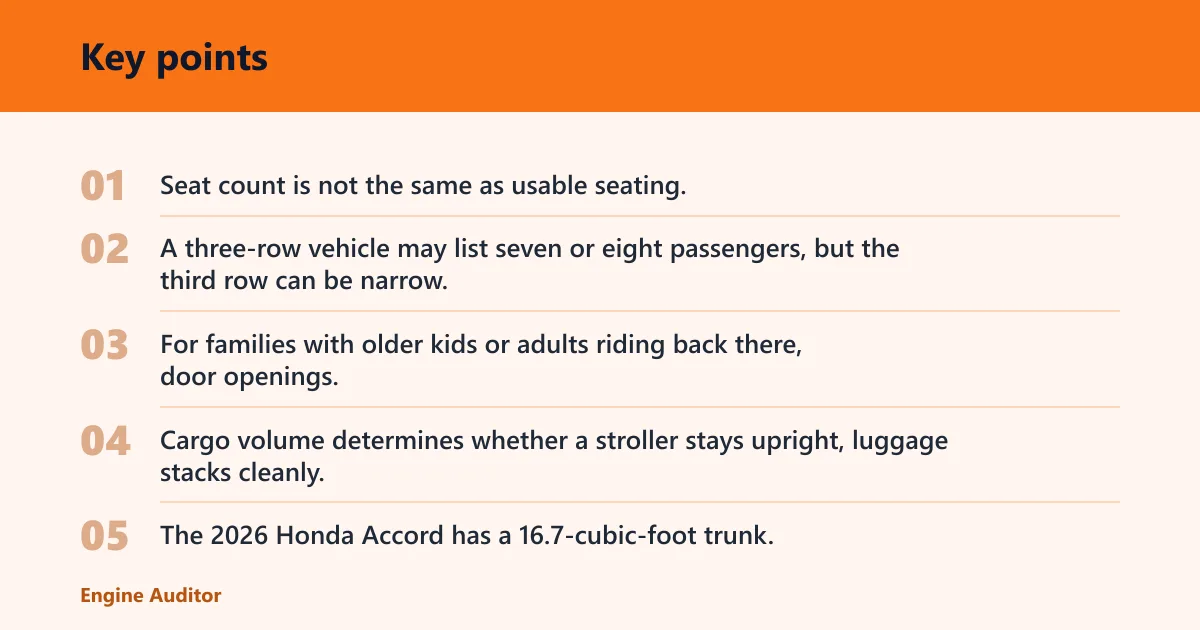
Seat count is not the same as usable seating. A three-row vehicle may list seven or eight passengers, but the third row can be narrow, low, or awkward to enter. For families with older kids or adults riding back there, door openings, seat slide range, and headroom matter more than a brochure total.
Cargo volume versus daily convenience
Cargo volume determines whether a stroller stays upright, luggage stacks cleanly, and sports gear fits without removing a seat. The 2026 Honda Accord has a 16.7-cubic-foot trunk, which can work for a lighter family load, but it is not the right tool for a large family’s all-day hauling needs. If the cargo load is modest, a sedan or wagon can still work.
Picture a family of five with one rear-facing seat, one booster, and a compact stroller. A three-row SUV might still work, but the rear-facing seat can block access to the third row. In that case, a minivan’s sliding doors and easier second-row movement usually save time every day.
Fuel economy versus towing and AWD needs
Fuel economy matters more the more you drive, and hybrid options help. The 2026 Honda CR-V Hybrid is rated at 35–40 combined mpg by Car and Driver, and the 2026 Honda Accord Hybrid can deliver up to 48 mpg combined city and highway driving. But if you tow or drive in snow often, a more capable SUV with AWD can outweigh the fuel penalty. (Caranddriver)
Safety and ownership costs
Safety should be judged by more than size. NHTSA ratings, IIHS ratings, driver-assistance systems, crash-test results, and predicted reliability data all shape family value. Ownership costs also matter: bigger vehicles can mean higher fuel use, more expensive tires, and heavier brake wear, and insurance often tracks vehicle size and repair cost.
NHTSA and IIHS ratings
U.S. News says it evaluates family vehicles using crash test data and predicted reliability ratings, and it says the best family vehicles combine safety, reliability, space, comfort, convenience and connectivity. That approach is sensible for shoppers because a family vehicle needs to protect passengers and work well every day, not only score well in one category.
Driver-assistance systems and family-use features
Look for automatic emergency braking, blind-spot monitoring, rear cross-traffic alerts, and lane-keeping support. For family use, features such as a hands-free liftgate, Wi-Fi, Apple CarPlay, Android Auto, and sliding second-row seats can matter as much as horsepower. They reduce small frictions that pile up on school mornings and road trips.
Fuel, tires, brakes, and insurance considerations
Full-size SUVs tend to use more fuel and wear through tires faster because they are heavier. Minivans often cost less to fuel and can be easier to live with, but hybrid versions can narrow that gap further. Insurance and repair costs depend on the model, but bigger vehicles usually carry more mass and more expensive body panels.
Suppose you need to tow a small trailer twice a month and still carry three kids to school. A full-size SUV is the better fit if towing matters more than fuel savings. If towing is rare, a minivan or three-row midsize SUV is usually the more practical family choice.
Frequently asked questions
How many seats does a full-size SUV usually have?
Many full-size SUVs have 8 seats, though some trims or seating layouts offer 7. The extra seat count helps with car pools and extended family trips, but you should still check third-row comfort and cargo space because a full cabin can reduce usable luggage room quickly.
What is the most family-friendly vehicle type for road trips?
A minivan is often the most family-friendly road-trip choice because it balances comfort, cargo space, and easy access at rest stops. Three-row SUVs are close behind, especially if you need AWD or a higher driving position. For long drives, USB ports, Wi-Fi, and a hands-free liftgate also matter.
Which vehicle type has the most cargo space for families?
Full-size SUVs often have the most maximum cargo space, especially when the third row folds flat. The 2025 Chevrolet Tahoe has maximum cargo space of 122.9 cubic feet, which is more than many competitors. Still, minivans can be easier to load because of their lower floors and square cargo areas.
Are minivans safer or more practical than large SUVs?
Safety depends on the specific model’s NHTSA and IIHS results, not the shape alone. Practicality is where minivans usually win because of sliding doors, easier third-row access, and better family packaging. Large SUVs can match or exceed them for towing and ride height, but they are often less convenient day to day.
Products related to this article
Sponsored / affiliate links. As an Amazon Associate I earn from qualifying purchases. I may earn additional commission from eligible campaigns.