What Are the Signs of a Clogged Radiator?
A clogged radiator usually causes overheating with uneven radiator temperatures: a hot inlet tank and a noticeably cooler outlet, or cold spots across the core. Repeated overheat events can lead to coolant loss, weak cabin heat, and engine damage. This guide shows the symptom pattern, how to separate a radiator clog from thermostat, water pump, or air-bleed problems, and a simple yes/no triage flow.
What changes when a radiator clogs?



A clogged radiator slows coolant flow through the core, so hot coolant cannot shed heat normally as it passes through the tubes and fins. The result is less heat transfer, a hotter engine, and temperature differences between the inlet tank, outlet tank, and the rest of the core. Partial clogs can show up only under load or in traffic.
The radiator is a front-mounted heat exchanger. Hot coolant enters the inlet tank, moves through narrow tubes, and gives off heat through fins before it exits the outlet tank. If scale, sludge, stop-leak residue, or corrosion narrows the tubes, flow restriction rises and cooling drops.
A total blockage is easier to spot than a partial one. A partially clogged radiator may still cool enough on the highway, then struggle at idle, in traffic, or on hills when heat load rises and airflow or coolant flow cannot keep up.
Radiator triage table
| Symptom | Likely cause | Confidence | Next check | Likely not a radiator clog |
|---|---|---|---|---|
| Overheating at idle, traffic, or hills | Partial radiator clog or airflow problem | Medium | Check fan operation, fin blockage, and hose temperatures | No, but fan or airflow faults can look the same |
| Overheating mostly on the highway | Thermostat, water pump, low coolant, or pressure loss | Medium | Inspect thermostat behavior and cap pressure retention | Usually yes if airflow is strong at speed |
| Upper hose hot, lower hose cool | Restricted coolant flow through the radiator | High | Compare inlet and outlet tank temperature after warmup | No, this pattern fits a clog better than a fan issue |
| One cold radiator section | Internal tube blockage or uneven flow | High | Look for a cold band across the core after the thermostat opens | No, fan and thermostat faults do not usually create one cold section |
| Weak heater output | Limited hot coolant flow through the heater core | Medium | Check coolant level and whether both heater hoses get hot | Yes, air trapped in the system or a thermostat can also do this |
| Low coolant level or frequent top-up | Leak, pressure loss, or boil-off from overheating | Low to medium | Inspect hoses, cap, tanks, and the ground under the car | Yes, low coolant is not proof of a clog |
| Rusty, brown, sludgy, or oily coolant | Contamination, corrosion, or debris buildup inside the system | High | Inspect coolant condition and plan a pressure test | No, but the radiator may be only one part of the problem |
Say your compact sedan runs normal on open roads, then creeps into the danger zone after five minutes in line at a drive-through. That pattern points more toward airflow loss or a partial clog than a dead radiator. If the lower hose stays cool while the upper hose is hot, suspicion rises.
What does a clogged radiator look like?
A clogged radiator can show signs inside and outside. Inside, you may see rusty scale, brown sludge, thickened fluid, or oily contamination in the inlet or outlet tanks. Outside, bent, blocked, or packed fins can cut airflow through the core and reduce cooling even if coolant flow is still acceptable.
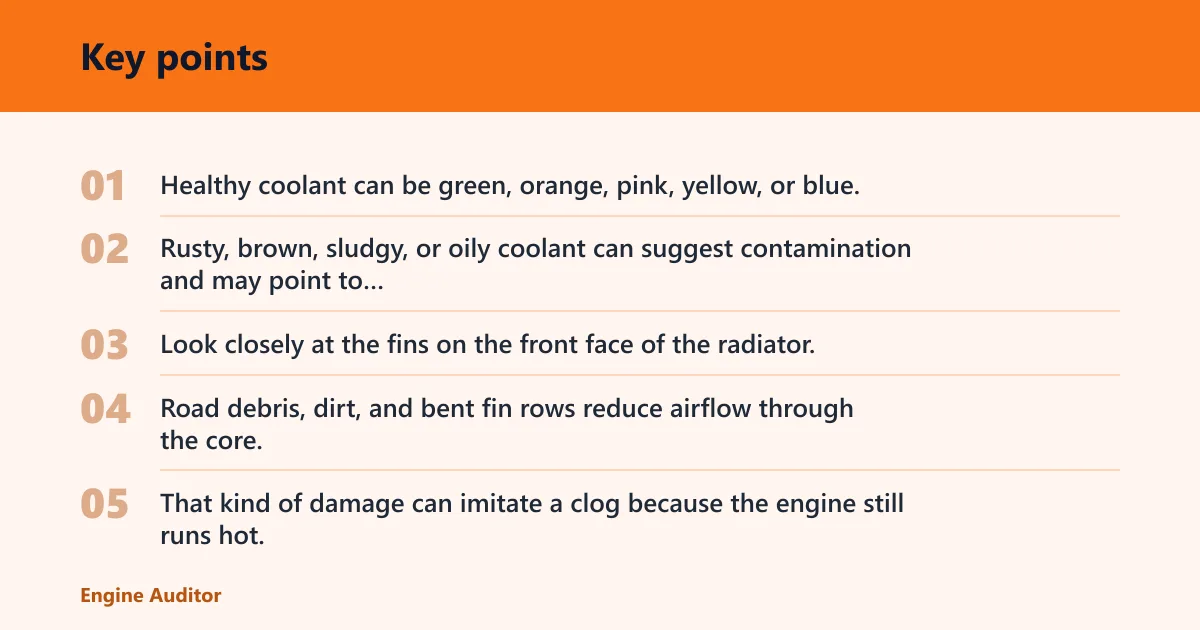
Healthy coolant can be green, orange, pink, yellow, or blue. Color alone does not tell the whole story. Rusty, brown, sludgy, or oily coolant can suggest contamination and may point to internal corrosion or debris buildup inside the cooling system.
Look closely at the fins on the front face of the radiator. Road debris, dirt, and bent fin rows reduce airflow through the core. That kind of damage can imitate a clog because the engine still runs hot, but the restriction is on the air side rather than the coolant side.
What sludge means
Sludge is not one single condition. Rust scale points to corrosion. Oily contamination suggests mixing that should not be happening in a healthy cooling system. Stop-leak residue can thicken fluid and coat passages. Any of these can narrow tubes and reduce flow.
Why does it overheat at idle or in traffic?
Overheating at idle or in traffic often points to an airflow problem, but a clogged radiator can also cause it. At low road speed, the fan has more work to do. If the fan is weak, the fins are blocked, or the radiator is internally restricted, temperature climbs when vehicle speed drops.
Highway cooling can still look normal with a partial clog because airflow through the fins improves at speed. That is why a car may run fine on the open road and still overheat in stop-and-go conditions. The symptom pattern matters more than the word “overheating” alone.
A fan fault can mimic a clogged radiator. If the electric fan does not switch on, the clutch fan freewheels too much, or airflow through the core is blocked by debris, the engine may act as if the radiator has failed even when the coolant passages are open.
What to watch on the gauge
The engine coolant temperature gauge should sit in its normal range after warmup. Higher-than-normal readings, swings that come and go, or a gauge that pegs in the danger zone all raise concern. A fluctuating gauge often means the system is losing control of heat, flow, or pressure.
Can a clogged radiator cause weak heater output?
Yes. A clogged radiator can reduce cabin heat because the heater core depends on hot coolant flow. If flow through the cooling system is restricted, the heater core may get less hot coolant, which can leave the vents weak or cold even while the engine runs hot.
Weak cabin heat does not prove a clog by itself. Low coolant, air trapped in the system, a stuck thermostat, or a circulation problem can also reduce heater output. Still, when weak heater air appears together with overheating and a hot upper hose, radiator restriction moves higher on the list.
Picture a minivan that blows lukewarm air at idle and warms up only slightly at road speed. If coolant level is correct, the radiator tanks show a big temperature split, and the heater hoses feel uneven, the system deserves a deeper look for flow restriction or air pockets.
What points away from the radiator?
Some symptoms fit other faults better than a clogged radiator. A thermostat can stick closed or open late. A water pump can lose circulation. Air trapped in the system can cause temperature swings and poor heater output. A weak radiator cap can let pressure escape and lower the boiling point of the coolant.
Thermostat symptoms
A thermostat problem often changes how quickly the engine warms up. If it stays closed, the upper hose may stay cool for too long, then suddenly heat up. If it opens late or inconsistently, the gauge can swing. That pattern is not the same as one cold section in the radiator core.
Water pump symptoms
A failing water pump can reduce circulation through the whole system. That often brings broad overheating, poor heater performance, and little change in radiator temperature spread. If the pump cannot move coolant well, both the radiator and heater core may underperform without a clear single cold zone.
Air trapped in the system
Air pockets can block flow and create erratic heat. The gauge may rise and fall, the heater may blow cold, and the upper hose may feel hot while the lower hose changes unpredictably. Bleed the system by the factory service manual before you blame the radiator.
Pressure cap problems
The radiator cap, or pressure cap, helps hold cooling-system pressure. Remove it only on a cool engine. If it cannot retain pressure, coolant can boil sooner, coolant loss can follow, and the system may act weak even when the radiator core is not clogged.
How to check radiator flow safely
Check the radiator only after the engine cools enough to avoid pressure spray. Start with hose temperatures, then look for an uneven heat spread across the tank and core. If the pattern still points to a restriction, a cooling-system pressure test is the best next diagnostic step.
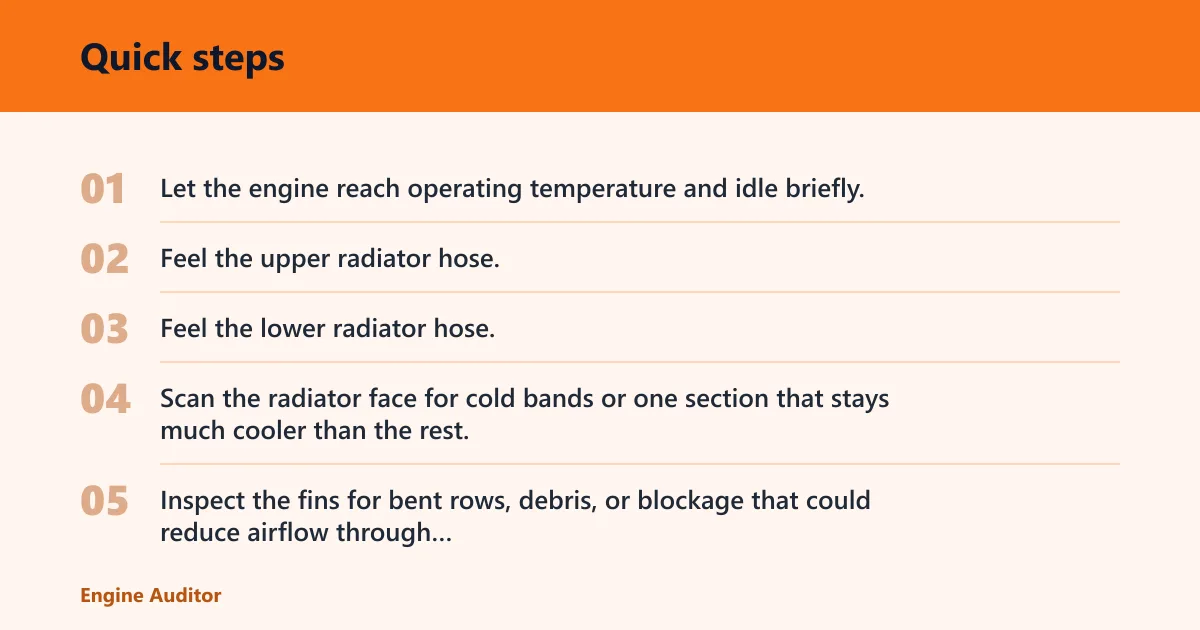
- Let the engine reach operating temperature and idle briefly, or follow the factory service manual procedure for warmup and bleed steps.
- Feel the upper radiator hose. It should usually get hot first as coolant leaves the engine.
- Feel the lower radiator hose. If it stays noticeably cooler than the upper hose after warmup, flow through the radiator may be restricted.
- Scan the radiator face for cold bands or one section that stays much cooler than the rest.
- Inspect the fins for bent rows, debris, or blockage that could reduce airflow through the core.
- Check coolant color and condition for rust, oil, sludge, or thickened fluid.
- Use a cooling-system pressure test and compare the result with the factory service manual.
A pressure test or visual inspection is the best way to check a radiator. It helps separate a flow issue from a pressure loss problem. A pressure-cap problem, an external leak, or a damaged tank can create symptoms that look like a clog, so the test matters before parts are swapped.
Suppose a midsize SUV overheats only while climbing a grade, the gauge returns toward normal on flat roads, and the lower hose stays cooler than expected. That combination points more toward a partial restriction than a totally failed cooling system, but a thermostat or cap still belongs on the checklist.
Frequently asked questions
What are the signs of a clogged radiator?
The main signs are overheating, a hotter-than-normal gauge, uneven radiator temperatures, weak cabin heat, and coolant that looks rusty, sludgy, or oily. A hot upper hose with a cool lower hose is a strong clue. Low coolant may appear too, but it can also come from a leak elsewhere.
What are the symptoms of a stopped up radiator?
A stopped up radiator usually shows the same pattern as a clogged one: overheating, temperature swings, poor heat from the vents, and a cold spot or cooler outlet side. If the problem appears mostly at idle or in traffic, airflow faults and fan problems should stay in the diagnosis.
What are the symptoms of a blocked car radiator?
A blocked car radiator can cause the engine coolant temperature gauge to climb into the danger zone, coolant loss from boil-off or leaks, and a heater that blows weak or cold air. Rusty or sludgy coolant supports the diagnosis, especially if the radiator tanks feel uneven after the thermostat opens.
How do you check if a radiator is clogged?
Check the upper and lower hose temperatures after warmup, look for one cold section across the core, and inspect the coolant for rust, sludge, or oil. A cooling-system pressure test is the next serious step. If airflow through the fins is blocked, clear that before blaming internal clogging.
Can a radiator be partially clogged and still work?
Yes. A partially clogged radiator may still cool enough on the highway, then overheat at idle, in traffic, or on hills. That is why symptom pattern matters. Partial restriction often creates uneven heat distribution rather than a complete loss of cooling across the whole radiator.
What coolant or sludge symptoms point to radiator blockage?
Rusty, brown, sludgy, or oily coolant points to contamination and possible internal debris buildup. Healthy coolant can be green, orange, pink, yellow, or blue, so color alone is not enough. Thick fluid, repeated top-ups, and a dirty overflow bottle make a radiator flow problem more likely.
Products related to this article
Sponsored / affiliate links. As an Amazon Associate I earn from qualifying purchases. I may earn additional commission from eligible campaigns.