How Do I Know If My Radiator Cap Is Bad?
A bad radiator cap usually shows up as coolant overflow, overheating after warm-up, or no pressure in the system; if symptoms happen only after shutdown, suspect the cap first. Ignoring it can drop coolant level, leave air pockets in the system, trigger boil-over, and overheat the engine enough to damage parts. This guide shows how to separate a cap fault from radiator, hose, thermostat, or head-gasket problems by matching symptoms to cold, warm, and hot conditions.
Can a radiator cap go bad?
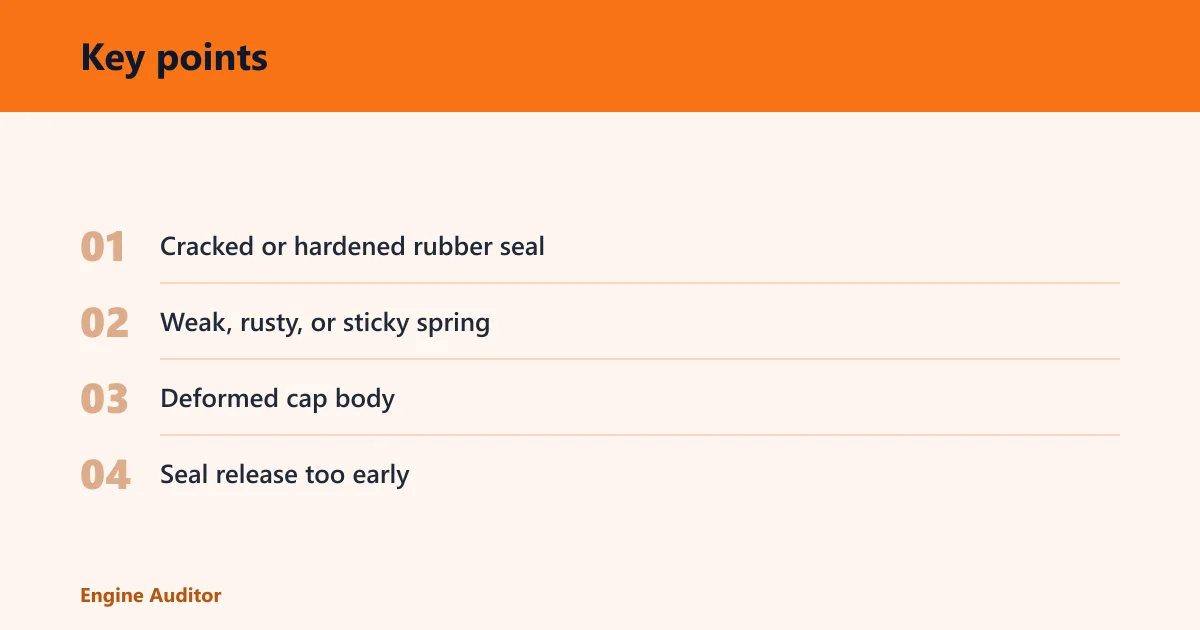

Yes. A radiator cap can fail when its rubber seal cracks or hardens, its internal spring weakens or rusts, or the cap body warps and no longer seals. That failure can let pressure escape too early or let pressure build in the wrong places, which changes how the cooling system behaves.
The cap is not a simple cover. It holds cooling-system pressure, and that pressure helps raise the coolant boiling point. When pressure drops, coolant can boil sooner. When pressure climbs too high, hoses can bulge and coolant can be forced toward the overflow path.
Common cap failure modes
- Cracked or hardened rubber seal: the cap may look normal at a glance, but it no longer seals tightly.
- Weak, rusty, or sticky spring: the cap may release pressure too early or fail to hold it at all.
- Deformed cap body: dents, warping, or heat damage can keep the cap from seating on the radiator neck.
- Seal release too early: pressure escapes before the system reaches its designed working range.
Bad radiator cap symptoms by timing
Timing matters more than most symptom lists admit. A fault that shows up cold points somewhere else more often than not. A fault that appears while hot points more toward sealing, pressure control, or boil-over. A fault that appears after shutdown often points back to the cap first.
Symptoms at cold start
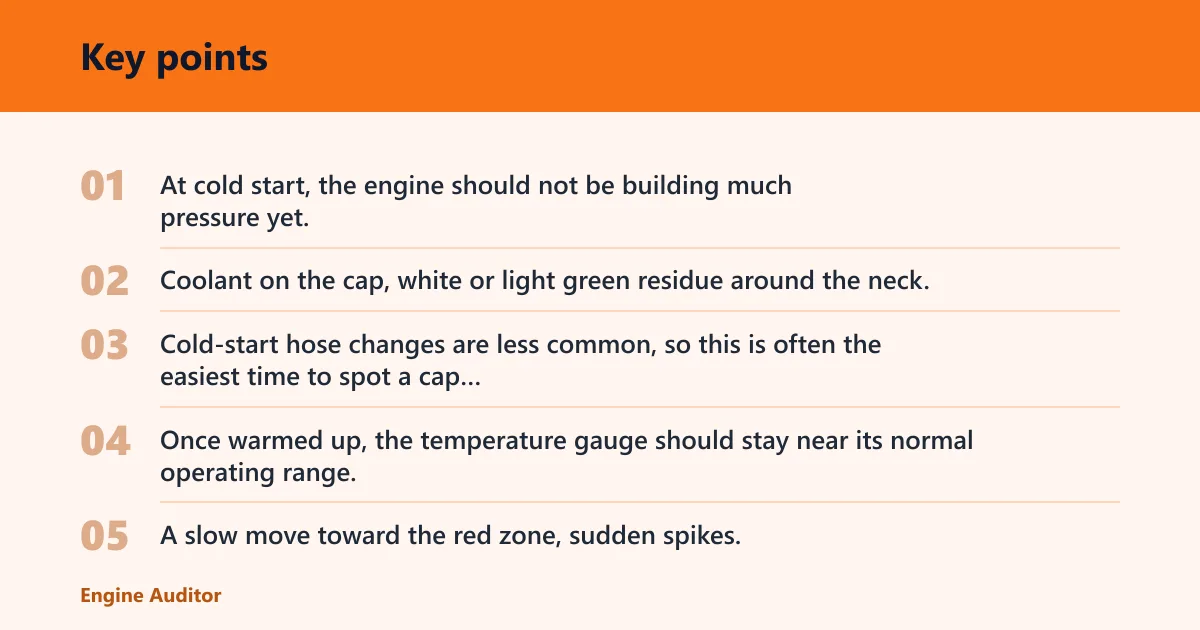
At cold start, the engine should not be building much pressure yet. Coolant on the cap, white or light green residue around the neck, or visible seepage before full warm-up suggests a poor seal, a damaged neck, or a cap that is already leaking. Cold-start hose changes are less common, so this is often the easiest time to spot a cap problem.
Symptoms when the engine is warm
Once warmed up, the temperature gauge should stay near its normal operating range. A slow move toward the red zone, sudden spikes, or steam point to a pressure problem or another cooling fault. A bad cap can let pressure escape early, which lowers the boiling point and makes overheating more likely.
Symptoms after shutdown and cooldown
After shutdown, a failing cap may allow coolant to push into the reservoir or overflow from the neck as the system heat-soaks and then cools. If the reservoir rises too far or coolant appears where it should not be, the cap is a strong suspect. Steam after shutdown is a serious warning sign.
Say your sedan idles normally for about 15 minutes, then the gauge may creep upward only after you park it and switch it off. If the reservoir then pushes coolant out or you see fresh residue around the filler neck, that pattern fits a cap that is not controlling pressure well.
Radiator cap diagnosis matrix
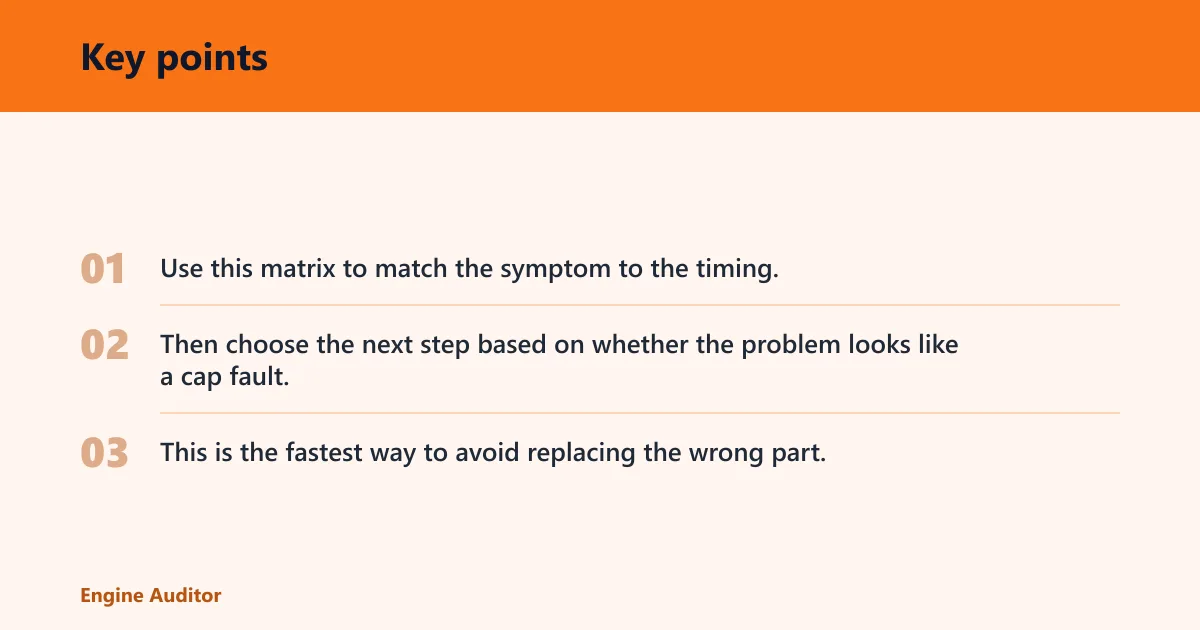
Use this matrix to match the symptom to the timing. Then choose the next step based on whether the problem looks like a cap fault, a broader cooling-system issue, or an unsafe overheating condition. This is the fastest way to avoid replacing the wrong part.
| Symptom | When it appears | Likely cause | Next step |
|---|---|---|---|
| Coolant residue, white streaks, or light green crust around the cap or neck | Cold or after shutdown | Cap seal leak, damaged radiator neck, or poor seating | Replace cap if the seal is damaged; inspect the neck closely |
| Temperature gauge creeps toward the red zone after warm-up | Warm | Loss of cooling-system pressure, thermostat fault, radiator restriction, or low coolant | Inspect elsewhere first if the cap and neck look clean and intact |
| Coolant overflow or reservoir level rises after shutdown | After shutdown | Cap releases pressure too early or does not recover correctly | Replace cap and recheck the reservoir behavior |
| Bulging radiator hoses or hoses that feel unusually hard | Warm | Pressure problem, blocked flow, or cap that is not controlling pressure correctly | Inspect cap, hoses, and possible blockage elsewhere |
| Steam from the engine bay | Warm or after shutdown | Boiling coolant escaping the system | Stop driving, let it cool, then inspect before restarting |
| Coolant loss with no obvious hose split | Cold, warm, or after shutdown | Faulty cap, leaking neck, or another cooling-system leak | Inspect cap and neck first; if dry, inspect elsewhere |
What a bad radiator cap does
A bad cap changes pressure control. That matters because pressure raises coolant boiling point. If the cap fails to hold pressure, coolant can boil sooner, the temperature gauge can climb, and steam can form. If the cap releases pressure too soon, coolant can spill into the overflow path or push past weak points in the system.
Excess pressure is not harmless either. Bulging hoses, hard hoses, or coolant forced into the reservoir can point to pressure imbalance. That pattern does not prove the cap is the only problem, but it does tell you the system is not regulating pressure the way it should.
Overheating from lost pressure
When pressure drops, the coolant boils at a lower temperature. The result can be a gauge that looks normal for a while, then climbs quickly once the engine is under load or heat-soaked. A bad cap can cause that pattern, but a thermostat stuck closed or a clogged radiator can do it too.
Overflow, hose swelling, and seal leakage
Coolant leak around the cap or radiator neck is a direct clue. So is dried residue that leaves white, light green, or chalky streaks near the filler neck. Those traces often point to a sealing problem rather than a random spill. Hoses that bulge or harden during warm running strengthen the pressure clue.
How to inspect the cap and neck
Inspect the cap and the radiator neck together. A cap that looks fine can still fail if the neck is dented, corroded, or warped. The sealing surface must be clean and undamaged, or the cap cannot hold pressure reliably.
Check the rubber seal and spring
Remove the cap only when the engine is fully cool. The rubber seal should be intact and flexible, not cracked, brittle, flattened, or deformed. The spring should move smoothly and return with firm resistance. Rust, weakness, or an unresponsive spring can stop the cap from holding pressure.
Inspect the radiator neck for residue, corrosion, or damage
Look at the sealing surface on the radiator neck. It should not have pitting, dents, heavy corrosion, or warping. Dried residue around the neck is a warning sign, and a faulty radiator cap can cause coolant leaks around that area. If the neck is damaged, a new cap alone may not solve the problem.
Picture a small SUV with no visible hose split but a crusty ring around the filler neck and a seal that feels hard, almost plastic-like. In that case, the cap and neck inspection comes before any deeper guesswork, because both parts can create the same leak trace.
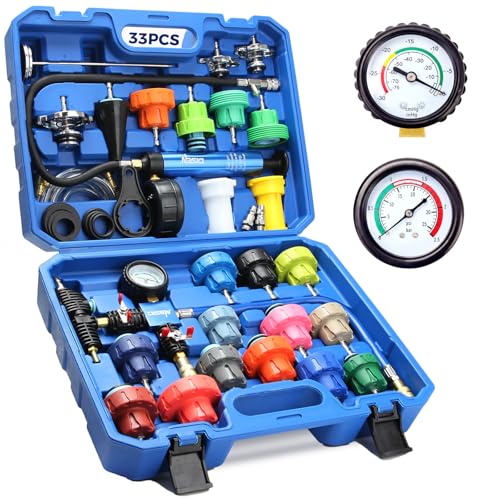
You can do a basic at-home check by looking for physical damage, but a pressure test tells you more. If the cap cannot hold pressure to its rated point, it should be replaced. If the cap passes but the system still overheats, the fault is more likely elsewhere.
Visual test you can do at home
- Wait until the engine is completely cool.
- Remove the cap and inspect the rubber seal for cracks, brittleness, flattening, or deformation.
- Check the spring for rust, sticking, or weak return force.
- Look at the cap body for dents, warping, or cracked plastic or metal.
- Inspect the radiator neck for residue, corrosion, damage, or uneven seating.
When a pressure test points to cap replacement
A pressure test that shows the cap cannot hold the system near its rated pressure points to replacement, not guesswork. If the cap fails the test and the neck is sound, the cap is the likely cause. If the cap passes, look harder at the thermostat, radiator flow, hose collapse, low coolant, or a head-gasket fault.
When the problem is not the cap
Do not blame the cap for every overheating complaint. If the gauge rises before the engine is fully warm, the thermostat may be slow or stuck. If the upper and lower hoses behave oddly, the radiator may be restricted. If coolant disappears with no visible leak and the system keeps pressurizing too much, a head-gasket fault needs attention.
Thermostat signs
A thermostat problem often shows as an engine that stays cold too long, then suddenly overheats, or as a gauge that swings unpredictably. That pattern is different from a cap problem that appears mainly after shutdown or shows residue around the neck.
Radiator, hose, or head-gasket clues
A radiator problem can show up as chronic overheating at speed, poor heat transfer, or a hose that stays cool when it should not. A hose can crack, collapse, harden, or bulge. A head-gasket issue may cause persistent coolant loss, bubbles in the reservoir, or repeated overheating even after the cap is replaced.
A common first-timer mistake is replacing the cap after seeing steam, then driving again without checking coolant level or the neck seal. Steam can mean boiling coolant is escaping the system. Shut the engine off, let it cool, and inspect before restarting.
Frequently asked questions
How do I know if my radiator cap is bad?
Look for coolant residue around the cap or neck, a cracked or hardened rubber seal, a rusty or weak spring, and pressure-related symptoms that appear after warm-up or shutdown. If the engine overheats, the reservoir overflows, or the hoses bulge and the cap looks damaged, replacement is a strong first move.
How do I test a radiator cap?
Start with a cool engine and inspect the seal, spring, and cap body. Then check the radiator neck for dents, corrosion, or dried residue. If the cap fails a pressure test, replace it. If it passes and the engine still overheats, the fault is more likely in the thermostat, radiator, hose system, or head gasket.
What happens when a radiator cap fails?
Pressure control gets lost. Coolant can boil sooner, hoses can bulge, steam can appear, and coolant may overflow into the reservoir or leak around the cap and neck. If the failure is severe, the engine can overheat fast enough to damage parts, so repeated boil-over should not be ignored.
Will a bad radiator cap cause overheating?
Yes, a bad cap can cause overheating by letting pressure escape too early. That lowers the coolant boiling point and can push the gauge toward the red zone. But overheating can also come from low coolant, a stuck thermostat, a clogged radiator, or a head-gasket problem, so timing matters.
Products related to this article
Sponsored / affiliate links. As an Amazon Associate I earn from qualifying purchases. I may earn additional commission from eligible campaigns.