What Are the Symptoms of Air in the Cooling System?
Trapped air in the cooling system often causes overheating, gurgling coolant, fluctuating temperature, and weak cabin heat. If the gauge climbs fast or heat vanishes, stop driving. Ignore it, and you can warp a head, crack a tank, or chase the wrong repair. These symptom patterns point to a small air pocket, a bad bleed, or a deeper cooling-system fault.
How air disrupts coolant flow
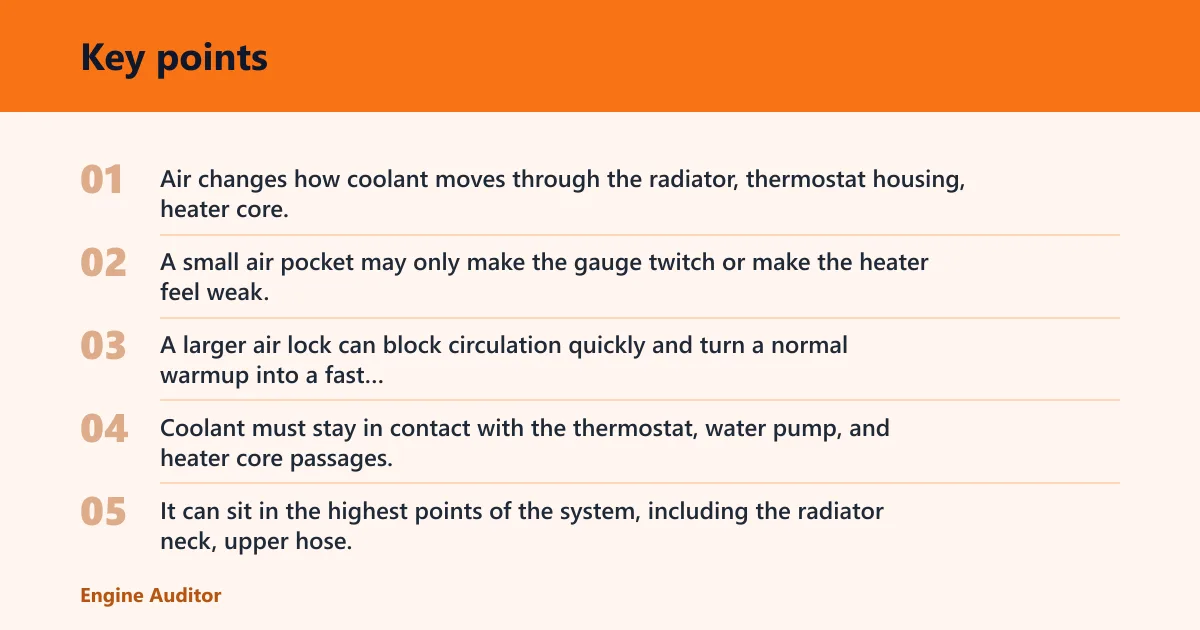


Air changes how coolant moves through the radiator, thermostat housing, heater core, and upper hoses. A small air pocket may only make the gauge twitch or make the heater feel weak. A larger air lock can block circulation quickly and turn a normal warmup into a fast overheat.
What trapped air does to coolant flow
Coolant must stay in contact with the thermostat, water pump, and heater core passages. Air breaks that contact. It can sit in the highest points of the system, including the radiator neck, upper hose, heater core, and thermostat housing, then keep liquid from flowing where it should.
That is why the same fault can cause different symptoms at different engine speeds. At idle, flow is lower and an air pocket can stay put. At higher RPM, more pump speed may move enough coolant to hide the problem for a short time.
Small air pocket vs air lock
A small air pocket often causes a fluctuating gauge, weak heat at idle, or a brief gurgle after startup. A serious air lock can be more dangerous, as it may shut off coolant circulation through part of the system and lead to overheating, boilover, or warning lights. It can shut off coolant circulation through a major section of the system and trigger rapid overheating, boilover, or repeated warning lights.
Do not treat every symptom as proof of trapped air. A bad thermostat, slipping fan, weak water pump, leaking cap, or head gasket fault can look similar. The cold-engine checks below help separate them.
Symptoms that can look similar to other faults
Air can mimic thermostat delay, low coolant, or a partial heater-core blockage. It can also hide a fan problem by making the gauge climb mainly at idle. One symptom is not enough. Use the whole pattern.
Say your temperature gauge sits near normal on the road, then climbs at a long stoplight and drops again when you start moving. That pattern can fit trapped air, but it can also fit poor fan operation or a thermostat that opens late. The cold checks decide which path to follow.
What symptoms point to trapped air?
Trapped air usually shows up as uneven cooling, not a single constant fault. Common signs include overheating at idle, a gauge that moves up and down, weak cabin heat, and gurgling from the dash or radiator area. Those signs are strongest when they improve at higher RPM or after repeated warmup cycles.
Overheating at idle
Overheating that shows up mainly at idle often points to air in the system or a fan issue. Air can prevent steady coolant flow through the radiator and heater circuit when pump speed is low. If the engine cools down once driving begins, trapped air moves higher on the suspect list.
Fluctuating temperature gauge
A needle that rises, falls, then rises again can mean the thermostat is seeing steam or air instead of solid coolant. That creates false-normal readings for a while, then a sudden jump when the hot pocket reaches the sensor. A thermostat that sticks open or closed can also create swings.
Weak or missing cabin heat
No cabin heat, or heat that comes and goes, often means air is sitting in the heater core. Coolant cannot fill the core fully, so the blower pushes lukewarm air or cold air instead of steady heat. A partially blocked heater core can do the same thing.
Gurgling, bubbling, or sloshing noises
Gurgling from behind the dash, bubbling near the radiator cap, or sloshing after shutdown often points to air moving through passages. Those noises are most useful when they appear after a recent coolant service, hose change, or top-off. A loose cap or low coolant can produce similar sounds.
What symptoms point to a serious air lock?
A serious air lock behaves more like a circulation failure than a nuisance. The engine can heat up fast, cabin heat may disappear at low RPM, and the reservoir can surge or overflow after shutdown. Steam, boilover, or repeated warnings mean you should stop driving until the cause is found.
Rapid temperature rise
If the gauge climbs quickly after startup, especially before the engine has fully warmed, air may be blocking circulation near the thermostat or water pump inlet. A bad thermostat can do this too, but a rapid climb with poor heat is a stronger warning sign than a slow drift upward.
Heat drops out at low RPM
If the cabin heat only returns when the engine is revved, coolant may be moving just enough at higher pump speed to push air through the heater core. At idle, the pocket can sit in place and cut flow again. A weak water pump can create a similar pattern.
Reservoir surging or overflow after shutoff
When trapped air expands, it can push coolant into the reservoir and then pull it back incorrectly as the engine cools. A bad radiator cap can also fail the vacuum return function, leaving the reservoir high one moment and low the next. Watch the pattern across a full cool-down cycle.
Steam, boilover, or repeated warning lights
Steam from the reservoir, boilover after shutoff, or a warning light that returns after each top-off means the system is not holding or moving coolant correctly. That can be air, but it can also be a cap, leak, thermostat, or pump fault. Do not keep driving if the engine is boiling.
Cold-engine checks that confirm air
Start with a cold engine. That is the safest time to compare the reservoir and radiator levels, look for recent coolant loss, and inspect the cap and hoses. A warm check can mislead you, because expansion changes both level and pressure.
Check reservoir and radiator levels
On a cold engine, the reservoir should sit at its marked cold line, and the radiator should be full if the design allows a direct cap check. If the reservoir is low but the radiator is full, the cap or return path may be at fault. If both are low, suspect a leak or recent air ingestion.
Look for recent coolant loss
Fresh wetness at hose ends, a dried crust around fittings, or pink, green, orange, or yellow residue near the cap points to coolant loss. Low coolant is the most common way air gets in, because the system can pull in air where liquid used to be.
Inspect the cap, hoses, and visible leaks
A radiator cap can lose pressure seal or fail to pull coolant back from the reservoir as the engine cools. Cracked hoses, loose clamps, and seepage at the water pump weep hole can all let coolant out and air in. A weak cap can create symptoms that look like trapped air.
Compare heat output before and after warmup
Turn the heater to hot after startup and note whether cabin heat arrives smoothly or only after revving. If heat is weak at idle but improves on the throttle, that pattern supports air in the heater core or low circulation. If heat never comes back, a heater-core blockage or thermostat fault becomes more likely.
A common first-timer mistake is topping off the reservoir only, then driving away after a recent hose swap. If the radiator still contains an air pocket, the reservoir can look fine while the engine overheats again on the road.
What causes air in the cooling system?
Air enters when coolant leaves or when service work leaves the system unfilled. Common causes include a leak, low coolant after a repair, a bad radiator cap, or a component fault that stops normal circulation and lets pockets form. A flush, thermostat change, or hose replacement can leave air behind if the system is not bled.
Low coolant from a leak
A leak creates space that air fills. Small leaks may show only after a hot soak or pressure rise, so the level seems fine one day and low the next. Check hose joints, the radiator tanks, the water pump, heater hoses, and the cap area.
Recent coolant flush or hose repair
After a flush, hose replacement, thermostat change, or radiator swap, trapped air is common if the bleed point was missed or the fill was rushed. Symptoms often start right after the repair, which makes the timing a clue. A small pocket may clear after a correct bleed; a stubborn air lock often points to a leak or bad fill procedure.
Bad radiator cap or weak seal
A cap that cannot hold pressure lowers the coolant boiling point. A cap with a weak vacuum return can also fail to pull coolant back from the reservoir as the engine cools, which leaves room for air. If the cap cannot seal, the system can act low even when the reservoir looks full.
Water pump or thermostat issues
A worn water pump impeller can move less coolant, which lets hot spots and vapor pockets form. A failing bearing or leak around the pump can also lower coolant level. A thermostat that sticks closed delays circulation, while one that opens late can make the gauge swing and mimic an air problem.
| Symptom | Likely air-related cause | Likely non-air cause | Cold-engine check | Stop-driving threshold |
|---|---|---|---|---|
| Overheating at idle | Air pocket near thermostat or radiator inlet | Fan not coming on, weak water pump | Check coolant level, fan operation, and hose warmth after a cold start | Stop if the gauge enters the red or steam appears |
| Fluctuating gauge | Air moving past the sensor or thermostat | Thermostat sticking, bad sender | Note whether the gauge swings while heat output also changes | Stop if swings are wide or repeated warning lights appear |
| No cabin heat | Air trapped in the heater core | Heater-core blockage, blend door fault | Check if both heater hoses warm unevenly after warmup | Stop if engine temperature rises while heat stays cold |
| Gurgling or bubbling | Air moving through the radiator or dash heater core | Low coolant, cap leak | Listen after cold start and again after shutdown | Stop if bubbling turns into boilover |
| Reservoir surging | Air expansion and poor return flow | Bad radiator cap, head gasket leak | Mark cold level, then recheck after full cool-down | Stop if coolant pushes out of the reservoir repeatedly |
| Reservoir empty, radiator full | Air pulled into the reservoir return path | Cap failure, cracked reservoir hose | Inspect cap seal and return hose on a cold engine | Stop if the reservoir level keeps dropping after refill |
| Heater only warm at high RPM | Air pocket in heater core or upper hose | Weak water pump, partially blocked heater core | Compare heat at idle and at 2,000 rpm from cold start | Stop if idle heat disappears and temperature climbs |
| Steam or overflow after shutoff | Air pocket boiling out of a hot spot | Cap not holding pressure, overheating from another fault | Check for coolant smell, residue, or wetness after cooldown | Stop if overflow repeats or the engine overheats again soon after restart |
How to bleed trapped air
Bleeding works only if the system is otherwise intact. Start with a cold engine, open the bleed point or cap-safe fill point if the design has one, then fill slowly with the correct coolant mix. Set the heater to hot, idle the engine, and watch for steady coolant flow and stable heat before you seal it up.
Start with a cold engine
Never open a hot cooling system. Pressure can spray scalding coolant. With the engine fully cool, confirm the level first. If the reservoir or radiator is empty again, look for a leak before you chase air.
Use the bleeder valve or fill point
Many systems include a bleeder screw or a high fill point near the thermostat housing or upper hose. Open it according to the service design and fill until coolant flows without bubbles. If the system has no bleeder, fill slowly and let the trapped air migrate upward.
Idle with heat on high
Run the engine at idle with the heater set to hot and the blower on low or medium. Watch the temperature gauge and listen for gurgling. As the thermostat opens, coolant level may drop, so top off as needed. The cabin vents should begin to blow steady hot air if flow is restored.
Recheck coolant after cooldown
After the engine cools fully, recheck the reservoir and radiator level. Air often clears during the first heat cycle and leaves room for the level to fall later. If the level drops again, or if the gauge still swings, inspect for a leak, cap fault, thermostat issue, or pump problem before driving far.
Frequently asked questions
What are the symptoms of air in the cooling system?
The usual symptoms are overheating at idle, a gauge that rises and falls, weak cabin heat, and gurgling or bubbling sounds. A small pocket may only cause one of these. A larger air lock can make the engine overheat quickly or lose heat at low RPM.
What are signs of air in coolant system?
Signs include inconsistent heater output, a reservoir that surges or empties oddly, and a temperature gauge that does not stay steady. A cold-engine check may show low coolant in the radiator or a reservoir level that does not match the radiator level after shutdown.
What causes trapped air in the cooling system?
Trapped air usually comes from low coolant, a recent flush, a hose or thermostat job, or a leak that let the system pull in air. A bad radiator cap or weak vacuum return can keep air in the system after cooldown and make the level act wrong.
How does air get into cooling system?
Air gets in when coolant escapes through a leak, seep, or bad cap seal, or when service work leaves the system partially filled. It can also enter if a component such as a water pump, hose connection, or reservoir line does not hold pressure or return coolant correctly.
What happens if there is air in the coolant system?
Air can stop coolant from reaching the thermostat, heater core, or radiator the way it should. That can cause hot spots, weak cabin heat, gauge swings, steam, and boilover. If the engine overheats repeatedly, stop driving and inspect the system before more damage occurs.
What can cause air in the coolant system?
Common causes are a low coolant level, a failed radiator cap, a leak at a hose or tank, a water pump leak, or air left behind after a repair. A sticking thermostat can also mimic trapped air by delaying circulation and creating temperature swings.
Products related to this article
Sponsored / affiliate links. As an Amazon Associate I earn from qualifying purchases. I may earn additional commission from eligible campaigns.
 Car A/C Repair Kit, 270PCS Rubber O-Ring Seal Kit + 40PCS Car Air Conditioner Valve Core Kit for R12 R134a A/C with Remover & Install Tool+10pcs R134a AC Valve Caps, Fix Refrigeration System
 RAGBUSCLE Car Cooling Air Fan Blower, 360 Degree Rotate Strong Wind Double Head Air Circulator, Fit for for sedan suv/rv/boat/truck/auto vehicles, Dual-Head Design, usb powered