What Are the Signs of a Blown Head Gasket?
A blown head gasket is commonly suggested when two or more of these symptoms appear: unexplained coolant loss, white exhaust smoke after warm-up, overheating, bubbles in the coolant tank, milky oil, or repeated misfires. One clue by itself does not prove a gasket failure. Ignore it and you can overheat the engine, warp the head, or contaminate bearings. This guide sorts symptoms by failure mode, then tells you what to test next.
Head gasket signs decision table
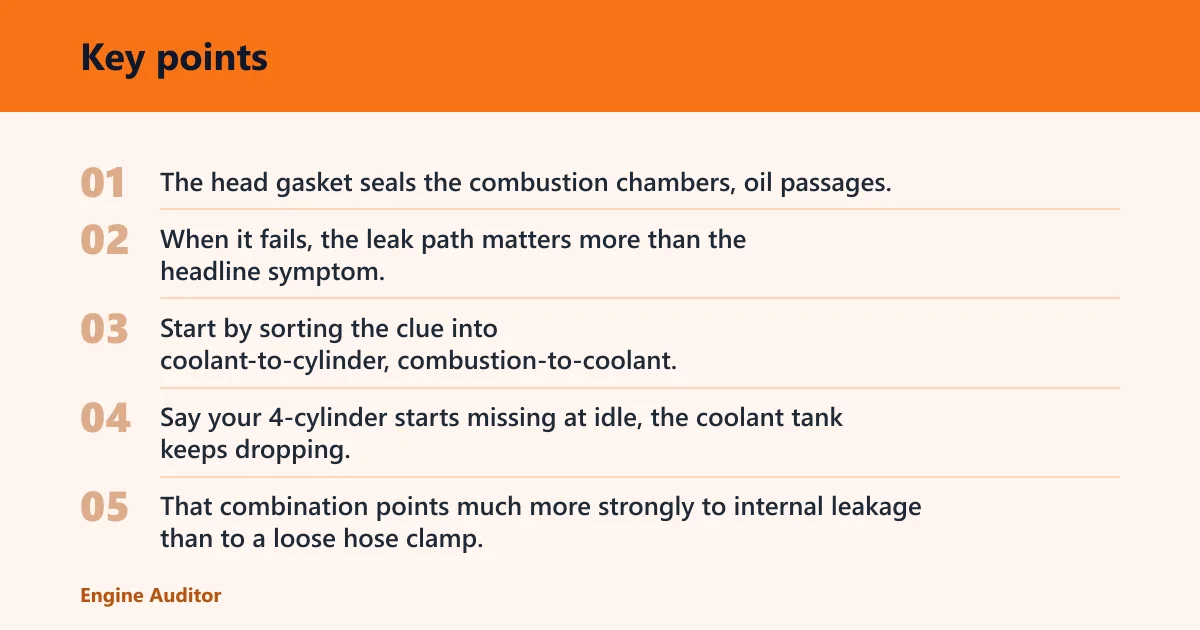


The head gasket seals the combustion chambers, oil passages, and coolant passages between the engine block and cylinder head. When it fails, the leak path matters more than the headline symptom. Start by sorting the clue into coolant-to-cylinder, combustion-to-coolant, or oil contamination, then pick the next test from there.
| Sign | Most likely failure path | Top false positives | Safest next test | Drive or stop? |
|---|---|---|---|---|
| Coolant dropping with no visible leak | Internal coolant loss or slow seep that evaporates | Bad cap, overflow bottle behavior, tiny external seep onto hot parts | Cooling-system pressure test, then combustion-gas test if pressure loss remains unexplained | Usually do not keep driving until checked |
| White exhaust smoke after warm-up | Coolant-to-cylinder | Cold-start steam, short-trip condensation, rich running on some engines | Observe after full warm-up, then do a combustion-gas block test | Stop driving if it is persistent and thick |
| Milky oil on dipstick or oil cap | Coolant-to-oil | Condensation from repeated short trips, wrong oil color judgment in poor light, sludge from neglected service | Stop running the engine and confirm with compression or leak-down testing | Urgent stop-driving symptom |
| Bubbles in the coolant reservoir | Combustion gas entering the cooling system | Low coolant, trapped air after service, boiling from overheating | Combustion-gas block test while the engine warms | Do not push a hot engine farther |
| Repeated overheating | May be gasket-related or a cooling-system fault | Thermostat, fan, water pump, low coolant, bad gauge | Check coolant level, fan operation, hose temperature, then test for exhaust gas in coolant | Stop if the gauge climbs fast or enters the red |
| Misfire or rough idle | Coolant-to-cylinder or cylinder-to-cylinder leakage | Ignition coil, plug, injector, vacuum leak | Compression test, then leak-down test | Safe only for the shortest necessary move if it runs poorly |
Say your 4-cylinder starts missing at idle, the coolant tank keeps dropping, and the exhaust leaves a sweet smell after the needle reaches normal. That combination points much more strongly to internal leakage than to a loose hose clamp. The pattern matters more than any single clue.
What symptoms matter first
The strongest pattern is a cluster, not a lone symptom. A head gasket can fail internally or externally, so you are looking for whether coolant is entering a cylinder, combustion gas is entering the cooling system, or oil is getting contaminated.
A combustion-to-coolant leak often shows up as bubbles in the reservoir, repeated overheating, and a test that finds exhaust gases in coolant. A coolant-to-cylinder leak more often gives white smoke, a sweet smell, coolant loss, and a rough idle. Oil contamination points to coolant moving into the crankcase.
When one symptom is enough to stop driving
Milky oil is often treated as one of the clearest stop-driving signs on this list. Coolant in the oil can strip lubrication from bearings fast, so do not keep running the engine to “see what happens.” Persistent overheating is also a hard stop, especially if the gauge keeps climbing or the warning light comes on.
White vapor on a cold morning is not enough by itself. Thin vapor that fades quickly is often normal; thick smoke that stays after warm-up is different. The same rule applies to coolant loss: one low tank does not prove a gasket, but repeated loss with no visible leak needs testing before you drive much farther.
What needs testing versus what only points to the problem
Symptoms point to the path. Tests confirm the fault. A combustion-gas block test helps confirm exhaust gas in the cooling system. Compression testing checks whether each cylinder seals properly. Leak-down testing shows where cylinder pressure escapes and can point to coolant-path leakage or leakage between cylinders.
These tests are often used together because one can miss what the other catches. A cylinder may still show acceptable compression and still leak under pressure, especially early in the failure.
Why is my coolant dropping with no visible leak?
Coolant loss with no visible leak often means the coolant is either being burned in a cylinder or escaping through a slow external seep that flashes off on hot engine parts. Start with the cooling system itself, then decide whether the loss is internal or external. A pressure test and combustion-gas test separate those two paths fastest.
Internal coolant loss through the cylinders
When coolant enters a combustion chamber, it may leave no puddle under the car. Instead, the engine may burn it, push it into the exhaust, or foul one cylinder enough to cause a misfire. That is why coolant loss and white smoke often appear together.
External seepage that evaporates before you see it
A small seep at a hose, radiator tank, water pump, or thermostat housing may drip onto a hot surface and vanish before it reaches the ground. The coolant level still drops, but the driveway stays clean. That is one reason a visible leak can be absent even when the system is losing fluid.
Pressure test clues that separate the two
A cooling-system pressure test can expose a seep that only opens under pressure. If the system will not hold pressure and you still cannot see an external wet spot, the next step is a combustion-gas block test. A pressure drop with no visible leak is a warning sign, not a final diagnosis.
Suppose the reservoir is down every few days, yet the underside of the car stays dry. If a pressure test finds slow pressure loss and the block test turns positive, the likely path is internal. If the pressure test shows a hose clamp seep, that is a different repair path entirely.
Is white smoke from the exhaust always a blown head gasket?
No. Thin vapor right after a cold start is often just condensation, especially on a cold morning, and it should fade as the engine warms. White smoke that stays after warm-up, comes back under load, or carries a sweet smell is much more concerning and often points to coolant entering the combustion chamber.
Cold-start vapor versus persistent smoke
Cold-start vapor is usually lighter and disappears quickly. Persistent smoke remains visible after the engine reaches operating temperature. That distinction matters because many drivers see steam once and assume the worst. The better rule is simple: warm engine, steady idle, smoke that does not fade.
Sweet smell and coolant burn clues
The coolant inside many systems uses ethylene glycol, which has a sweet taste and can create a sweet odor when it burns. That smell together with white smoke raises suspicion for a head gasket leak into a cylinder. It is not proof on its own, but it is a strong clue.
What to check before blaming the gasket
- Confirm the engine is fully warm before judging the smoke.
- Check whether the smoke fades after a few minutes or stays thick.
- Look for coolant loss, rough idle, or bubbles in the reservoir.
- If the pattern persists, run a combustion-gas block test.
A common first-timer mistake is calling every plume “head gasket smoke.” On a cool morning, steam from short-trip condensation can look dramatic. The giveaway is what happens after the engine is fully hot.
What does milky oil mean?
Milky oil usually means coolant has mixed with the oil, and that is an urgent warning. Check the dipstick and the oil cap. Frothy, creamy contamination suggests the sealing between a coolant passage and an oil passage has failed, and the engine should not keep running if that is present.
Dipstick and oil-cap signs
Look for tan, frothy, or creamy sludge on the dipstick or under the oil cap. Small amounts of condensation can make a cap look stained, but a true emulsion on the dipstick is more serious. If the oil level also seems higher than expected, suspect coolant contamination.
Why coolant in the oil is urgent
Oil mixed with coolant loses the film strength bearings need. That raises the risk of rapid internal wear. If the oil looks contaminated, the safest move is to stop driving and confirm the fault with compression or leak-down testing before any more operation.
What else can make oil look abnormal
Short trips in cold weather can create condensation under the cap. Neglected oil changes can also leave sludge that looks creamy or dirty. But those causes usually do not make the dipstick itself look like an emulsion. The dipstick is the better clue.
How do bubbles and overheating fit together?
Bubbles in the coolant reservoir can mean combustion gas is entering the cooling system. Repeated overheating can come from that leak path, but it can also come from a thermostat, fan, water pump, or low coolant. The gauge pattern helps you sort a gasket problem from a cooling-system fault.
Reservoir bubbles as combustion-gas evidence
If the reservoir starts bubbling as the engine warms, especially before the system is near full operating temperature, gas intrusion is often suspected. A combustion-gas block test is the best next step. This is one of the clearest signs that cylinder pressure may be entering the coolant circuit.
Gauge behavior that points to a cooling-system fault
A gauge that rises quickly and then falls when the heater is turned on may point to low coolant or air in the system. A gauge that climbs steadily in traffic may point to fan or airflow trouble. A sudden spike after highway load can point to coolant flow issues. Those patterns are not gasket proof by themselves.
Thermostat, fan, and water-pump lookalikes
Many overheating complaints are caused by parts other than the gasket. A stuck thermostat can block flow. A dead fan can let temperatures rise in traffic. A weak water pump can reduce circulation. Low coolant can mimic all of them. That is why overheating alone should be treated as a warning sign, not a verdict.
How do you confirm a blown head gasket?
Use tests, not guesswork. A combustion-gas block test checks the cooling system for exhaust gases. A compression test checks how well each cylinder seals. A leak-down test shows where pressure escapes, which can reveal coolant-path leakage or leakage between cylinders. Together, they give a much clearer answer than symptoms alone.
Combustion-gas block test
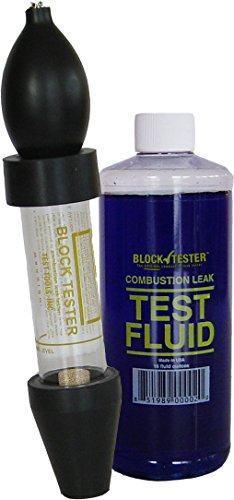
This test uses fluid that changes color when exhaust gases are present in the coolant. It is performed on the cooling system and is one of the best first confirmation steps when you see bubbles, unexplained coolant loss, or overheating with no visible leak. It can confirm internal gasket failure before major overheating occurs.
Compression test basics
A compression test checks cylinder sealing. Low or uneven readings can point to a head gasket issue, but they can also point to rings, valves, or timing faults. That is why compression testing is often paired with another test rather than used alone.
Leak-down test clues that point to the leak path
A leak-down test puts pressure into the cylinder and shows where air escapes. If air moves into the cooling system, that supports a coolant-path leak. If it escapes into an adjacent cylinder, that suggests inter-cylinder leakage. This test is usually a deeper diagnostic step, and it is especially useful when the symptom pattern is mixed.
- Check coolant level and look for obvious external leaks.
- Inspect the oil dipstick and oil cap for creamy contamination.
- Watch for bubbles in the reservoir as the engine warms.
- Notice whether white exhaust smoke persists after warm-up.
- Stop driving if the engine overheats repeatedly or the oil looks milky.
- Use a combustion-gas block test, then compression or leak-down testing if needed.
GM service bulletin 22-NA-030 was issued in February 2022 and applies to 2021 Buick Enclave and Chevrolet Traverse. That kind of bulletin is a reminder that some cooling complaints need model-specific checks, not a generic guess.
One source gives an example replacement cost of $1,400 on a four-cylinder, and another says a delayed diagnosis after overheating twice cost $2,400. Those figures vary by engine and damage, but they show why early confirmation matters.
Frequently asked questions
What are the signs of a blown head gasket?
The main signs are unexplained coolant loss, white exhaust smoke after warm-up, overheating, bubbles in the coolant reservoir, milky oil, and repeated misfires or rough idle. One clue by itself does not prove a gasket failure. The stronger the combination, the more likely the gasket is leaking internally.
How do I diagnose a blown head gasket?
Start with symptom pattern, then move to tests. Check coolant level, inspect the oil, watch the reservoir for bubbles, and note whether smoke persists after warm-up. A combustion-gas block test is the best early confirmation, followed by compression or leak-down testing if needed.
How can I tell if my head gasket is blown?
You usually cannot tell from one clue. A blown gasket is more likely when two or more symptoms appear together, such as coolant loss plus white smoke, or overheating plus reservoir bubbles, or milky oil plus rough idle. The failure path tells you which test to run next.
How do I check for a blown head gasket at home?
At home, check the dipstick and oil cap, watch the coolant tank as the engine warms, and look for persistent white smoke after the engine reaches temperature. If the evidence points inward, a block test kit is the next logical step. Do not keep driving if the oil looks milky.
What does a blown head gasket look like on the dipstick?
It often looks creamy, tan, or frothy instead of clean oil. That pattern suggests coolant in the oil. A little discoloration at the oil cap can come from condensation, but a true emulsion on the dipstick is the more serious sign and should be treated as urgent.
When should I stop driving if I suspect a blown head gasket?
Stop driving if the engine is overheating repeatedly, if the oil looks milky, or if the smoke is thick and persistent after warm-up. Those signs can mean active internal leakage. Short, careful movement to a repair spot is sometimes possible, but pushing a hot engine farther is the riskier choice.
Products related to this article
Sponsored / affiliate links. As an Amazon Associate I earn from qualifying purchases. I may earn additional commission from eligible campaigns.