What Is a Midsize Car? Who Should Buy One?
A midsize car is a passenger car between a compact and a full-size model. It usually seats five and tends to offer more room than a compact. Choose the wrong size and you can end up with tight rear seats, extra fuel use, or parking trouble. This guide explains what a midsize car is and when it beats a compact, full-size car, or SUV. (Wikipedia)
What is a midsize car?
A midsize car is a vehicle class, and on many shopping sites it usually points to a sedan-sized passenger car between compact and full-size models. It gives you more cabin space than a compact car, yet it stays easier to park and use in traffic than a larger car.
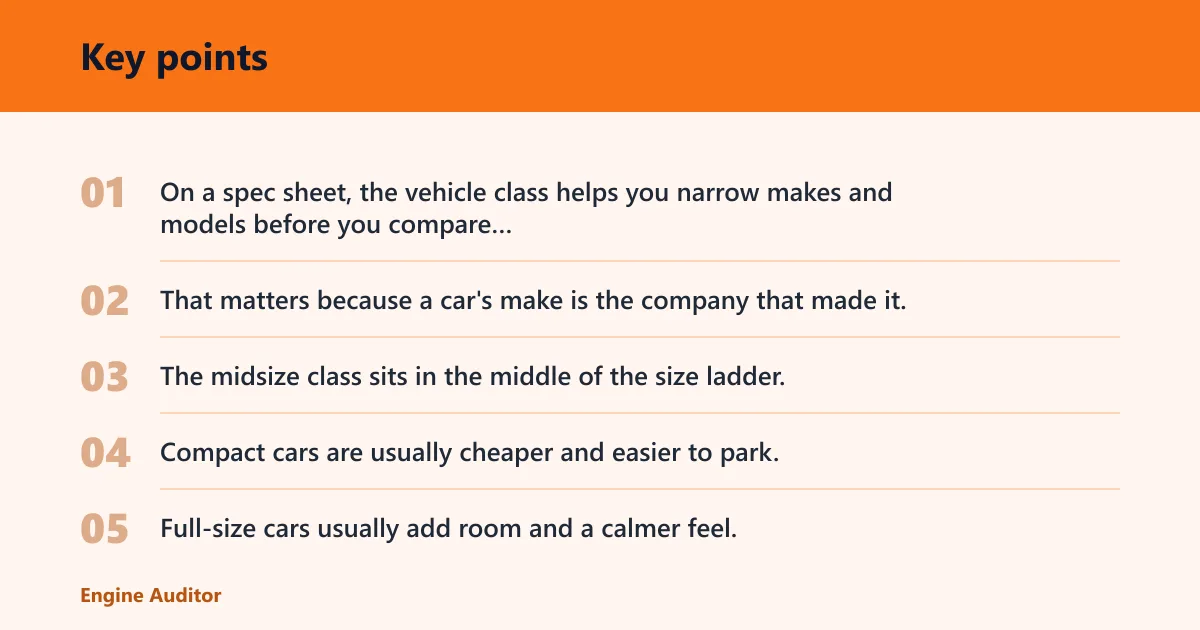
On a spec sheet, the vehicle class helps you narrow makes and models before you compare trim level or model year. That matters because a car’s make is the company that made it, a car’s model is the car’s specific name, trim refers to the specific configuration of a vehicle model, and a car’s model year is used to date and classify a model.
Where it fits between compact and full-size cars
The midsize class sits in the middle of the size ladder. Compact cars are usually cheaper and easier to park, but they can give up rear-seat room and cargo space. Full-size cars usually add room and a calmer feel, but they can be harder to move through tight streets and parking lots.
That middle position is the whole point. A midsize car is for shoppers who want enough space for adults in the back seat without moving to a larger footprint than daily life really needs.
Why sedan shoppers hear this term first
When people say “midsize car,” they often mean a midsize sedan. Progressive gives “midsize sedan” as a vehicle class example, and that body style is the common reference point for this size class. A midsize sedan is often easier to park than a larger car while still offering more room than a compact.
Other body styles can sit near this class, but the sedan is the standard comparison point for most shoppers. That is why the question is less about a label and more about whether the size works for your trips, passengers, and parking.
What vehicle class means on a spec sheet
When shopping for a car, determine the vehicle class you’d like first. Vehicle class is the shopping category used to compare space, price, insurance, and overall fit. It helps you sort what kind of car can work before you compare the details that separate one listing from another.
Vehicle class alone does not tell the full story, though. A base model and a higher trim can feel very different, and the model year can also change equipment from year to year.
📊 Certified pre-owned cars had about 14 percent fewer problems than other used cars. Source: Consumerreports.
Is a midsize car bigger than a compact car?
A midsize car is generally larger than a compact car in cabin room, rear-seat space, and trunk volume. The trade-off is that the compact is usually easier to park and may be cheaper to run, while the midsize gives you more breathing room for adults and baggage.
Cabin room and rear-seat space
The biggest gain is usually in the second row. If you often carry adult passengers or child seats, the midsize class typically gives you more usable legroom and shoulder room than a compact sedan. That extra space can make a long commute feel far less cramped.
Say your week includes two adults up front, a child seat in back, and a grocery run after work. In a compact car, the rear seat and trunk may feel tight at the same time. In a midsize car, both areas usually leave more margin.
Parking ease and city driving
Compact cars still win when parking space is tight. A midsize car is manageable for most drivers, but it is less convenient in narrow garage spots, crowded curb parking, and dense downtown blocks. If your day is mostly short urban trips, the smaller class may fit better.
That difference matters more than the badge on the trunk. In city use, a few extra inches can affect how often you circle for parking, how easy parallel parking feels, and how much you worry about door dings.
What you give up for the extra space
You usually give up some parking ease and, in many cases, lower running costs. A compact car often has lower fuel costs because it is smaller and lighter. A midsize car asks for a little more space in exchange for a better balance of passenger comfort and daily flexibility.
Midsize car decision matrix
This table turns the size-class choice into a practical comparison. Use it as a guide, not a rule. A specific make, model, trim level, and model year can move a car up or down within its class, but the size class still shapes the basic fit.
| Buyer need | Compact car | Midsize car | Full-size car | Recommended size outcome |
|---|---|---|---|---|
| Parking ease | Best | Good | Hardest | Compact if parking is tight; midsize if you want balance |
| Rear-seat room | Least | Strong middle ground | Most | Midsize for adults or child seats; full-size for frequent rear passengers |
| Cargo flexibility | Limited | Useful | Largest trunk area | Midsize for weekly errands; full-size for larger luggage loads |
| Ride comfort | Varies, often firmer | Balanced | Often most relaxed | Midsize for mixed driving; full-size for maximum comfort bias |
| Fuel cost | Usually lowest | Middle | Usually highest | Compact if running cost is the top priority |
| City driving | Best fit | Good fit | Least convenient | Compact for dense urban use; midsize for mixed city and suburban driving |
| Road-trip comfort | Acceptable for some trips | Very good | Very good, often best space | Midsize for frequent highway miles without going large |
| Family fit | Best for small or child-light households | Best all-around for small families | Best for bigger passenger loads | Midsize for most small families; full-size for frequent full-cabin use |
Recommended size for common buyer profiles
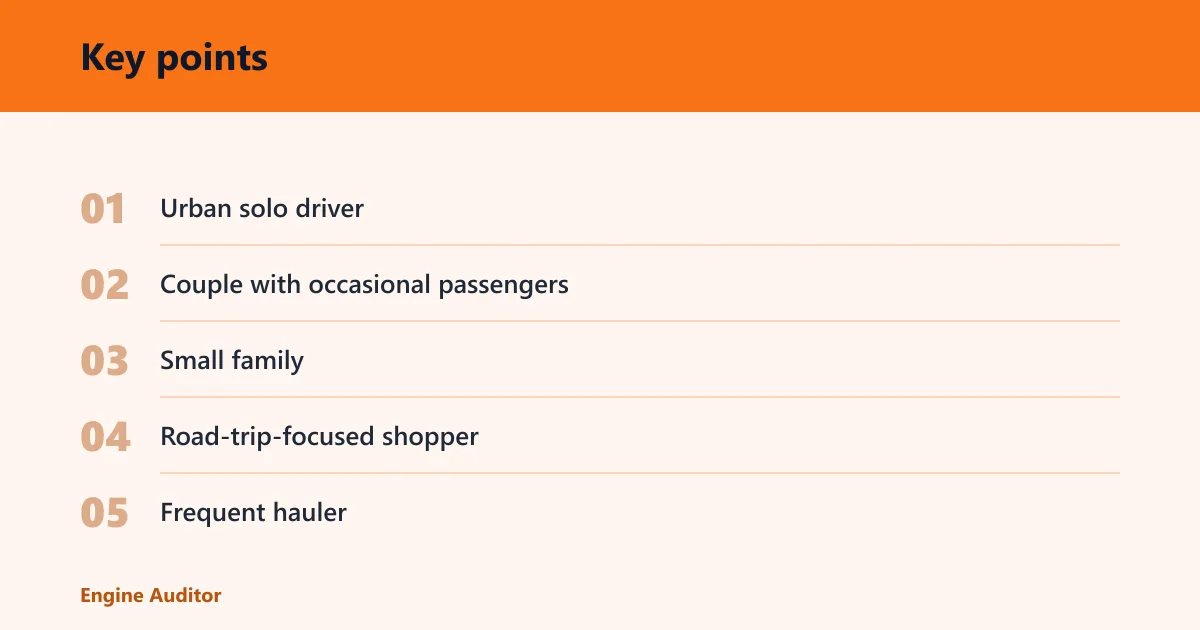
- Urban solo driver: choose a compact car if parking and fuel cost matter most.
- Couple with occasional passengers: choose a midsize car for better rear-seat room without a large footprint.
- Small family: choose a midsize car if you need usable back-seat space and a reasonable trunk.
- Road-trip-focused shopper: choose a midsize or full-size car, with full-size favored when rear-seat adults ride often.
- Frequent hauler: choose a full-size car or SUV if cargo room matters more than parking ease.
Who should buy a midsize car?

A midsize car suits shoppers looking for a balanced daily driver. It fits commuters, small families, and anyone who wants more space than a compact without moving into a larger, less handy class. If your driving is split between city errands, suburban commuting, and occasional highway trips, this size is often the practical middle ground.
Commuters who want a balanced daily driver
Long commutes often make seat comfort and cabin room more important. A midsize car can reduce the squeeze of a compact while staying easier to live with than a full-size car. That combination works well when your car needs to do many jobs in one week.
Small families that need usable back-seat room
Is a midsize car good for families? Yes, for many small families. The class often gives you enough rear-seat room for child seats, growing kids, and occasional adults, plus a trunk that can handle everyday bags and strollers better than many compact cars.
A common first-timer mistake is choosing a compact sedan because the front seats feel fine on the lot. Then the second row becomes the problem after a child seat goes in or a taller passenger rides along. A midsize car lowers that risk.
Buyers cross-shopping a sedan with an SUV
Should I buy a midsize sedan or an SUV? Choose the sedan if you want lower ride height, simpler parking, and a more car-like feel. Choose the SUV if you want a higher seating position, easier cargo loading, or a body style that better fits larger items and changing family needs.
An SUV can be the better fit when cargo access and ride height matter more than sedan efficiency. A midsize sedan makes more sense when you still want room, but you do not want the bulk of a larger vehicle.
When a compact car makes more sense
A compact car is the better pick when tight parking, heavy city use, or lower running cost matter more than extra rear-seat room. If you rarely carry passengers in back, the midsize premium in space may not repay its added footprint.
Tight parking and heavy city use
If your routine includes cramped garages, narrow curb spots, and lots of parallel parking, compact cars are easier to fit. They also tend to feel less stressful in stop-and-go traffic because there is less vehicle to manage in close quarters.
Lower running-cost priorities
For shoppers who put fuel cost near the top of the list, compact cars often have an edge. The exact difference depends on the make, model, trim, engine, and model year, but size class still matters because lighter vehicles often need less fuel to move.
Drivers who rarely carry rear passengers
If the back seat is mostly empty, a midsize car may be more car than you need. In that case, a compact can free up budget and simplify parking without giving up much that you actually use.
When a full-size car or SUV is the better fit
A full-size car or SUV makes more sense when your needs go beyond the middle ground. Pick a larger class if you regularly carry several passengers, need maximum cargo room, or want a higher seating position and easier loading for bulky items. A midsize car can feel too small once those needs become routine.
Maximum rear-seat and trunk needs
If adults ride in the back seat often, full-size cars usually offer more legroom and a less crowded feel. They can also provide a larger trunk, which helps when luggage, sports gear, or large strollers become frequent cargo.
Frequent long trips with several passengers
Road-trip comfort is where midsize cars do very well, but a full-size car can be better when you regularly travel with a full cabin. The extra space can reduce friction on long drives, especially for rear-seat passengers.
Cargo, towing, or higher ride-height needs
If your needs lean toward cargo loading, frequent towing, or an easier climb in and out, an SUV may be the better choice. A midsize sedan cannot match the cargo access or ride height that many SUV shoppers want, even if the sedan is quieter or more efficient in some trims.
How make, model, trim level, and model year change the answer
Vehicle class is only the first filter. A midsize car from one make may hold its value differently than a midsize car from another make, and the model you choose can change safety ratings, equipment, and insurance costs. That is why class should narrow the search, not finish it.
Why class alone does not tell you everything
A car’s make is the company that made it, and a car’s model is the car’s specific name. Those choices matter because value and safety ratings can vary from one brand and model to another, even within the same size class.
Trim level changes the vehicle you actually buy. A trim can differ in features, materials, and engine size, and those differences can change price and insurance rate. A standard-trim SUV may have lower insurance rates on average than an off-road trim, which is a reminder that equipment level matters as much as body style.
Why model year comparisons matter
A car’s model year is used to date and classify a model, and manufacturers make changes to car models from year to year. That means a midsize sedan from one model year can have a different cabin, tech package, or engine setup than the same nameplate from the next year.
When you compare listings, match the vehicle class first, then the make and model, then the trim and model year. That order keeps you from comparing a base car with a loaded one and drawing the wrong conclusion about space or value.
How do midsize cars compare on fuel economy and comfort?
Midsize cars usually sit in the middle here as well. A compact car often has the lowest fuel cost, a full-size car often offers more room, and a midsize car aims for a practical middle point between those two. Comfort is similar: it is usually better than a compact’s, while remaining easier to handle than a larger car.
That middle position is why midsize cars are such common commuter picks. They give up some efficiency to gain a calmer ride, more rear-seat room, and better road-trip comfort than many small cars.
Frequently asked questions
Is a midsize car good for families?
Yes, especially for small families. A midsize car usually offers enough back-seat space for child seats and growing kids, plus a trunk that works well for everyday family gear. If you need maximum rear-seat room or very large cargo space, a full-size car or SUV may fit better.
What is the difference between a midsize sedan and a full-size car?
A midsize sedan is smaller and usually easier to park. A full-size car offers more rear-seat room and often a larger trunk, but it can feel less convenient in city driving and tight spaces. Choose midsize for balance, full-size for maximum space and comfort.
What does vehicle class mean when shopping for a car?
Vehicle class is the shopping category used to compare cars by size and use case. It helps you narrow space, price, insurance, and overall fit before you compare make, model, trim level, and model year. Start there, then move to the details that separate one car from another.
Products related to this article
Sponsored / affiliate links. As an Amazon Associate I earn from qualifying purchases. I may earn additional commission from eligible campaigns.