What Is a Rally Car Type? Street vs Performance Differences
A rally car is generally set up for timed stages on loose roads, where suspension travel, protection, tire choice, and usable grip matter more than cabin comfort. Choose the wrong mix and you end up with poor legality, broken parts, and a car that is slow on dirt and pavement. This guide explains rally-car types, the street-versus-performance tradeoffs, and which parts matter for daily driving versus actual rally use.
This guide is part of our Vehicle types guide: body styles and categories series.
| Factor | What is a rally car type? Street | performance differences | Winner |
|---|---|---|---|
| Legality | Road-legal production vehicle built for public-road compliance. | May be road-legal, but many competition cars lose street equipment and can become difficult to register, inspect, or insure. | What is a rally car type? Street |
| Suspension travel and ground clearance | Limited by comfort, handling, and ride-height targets. | Raised and tuned for rough surfaces, bumps, landings, and terrain clearance. | performance differences |
| Tire sidewall and wheel setup | Larger wheels and shorter sidewalls, with a more pavement-focused setup. | More sidewall protection and impact tolerance against gravel, ruts, punctures, and pinch flats. | performance differences |
| Daily-use burden | Quieter, easier to inspect, and cheaper to live with. | Noisier, harsher, and more maintenance-heavy. | What is a rally car type? Street |
| Stage rally suitability | Poor without major changes. | Built for speed tests and special stages. | performance differences |
| Maintenance burden and ownership cost | Lower, with longer service intervals and less inspection after hard use. | Higher, with more frequent checks on bushings, bearings, brakes, suspension joints, and driveline parts, plus more cleaning and crack/leak inspection after events. | What is a rally car type? Street |
| Performance and control on rough surfaces | Better suited to comfort and grip on pavement. | Modified for stage speed, traction, survival over rough terrain, and usable grip on broken surfaces. | performance differences |
| Best-fit use | Better for commuting, errands, and road use. | Best when the goal is timed runs on closed or loose-surface stages. | performance differences |
What is a rally car type?
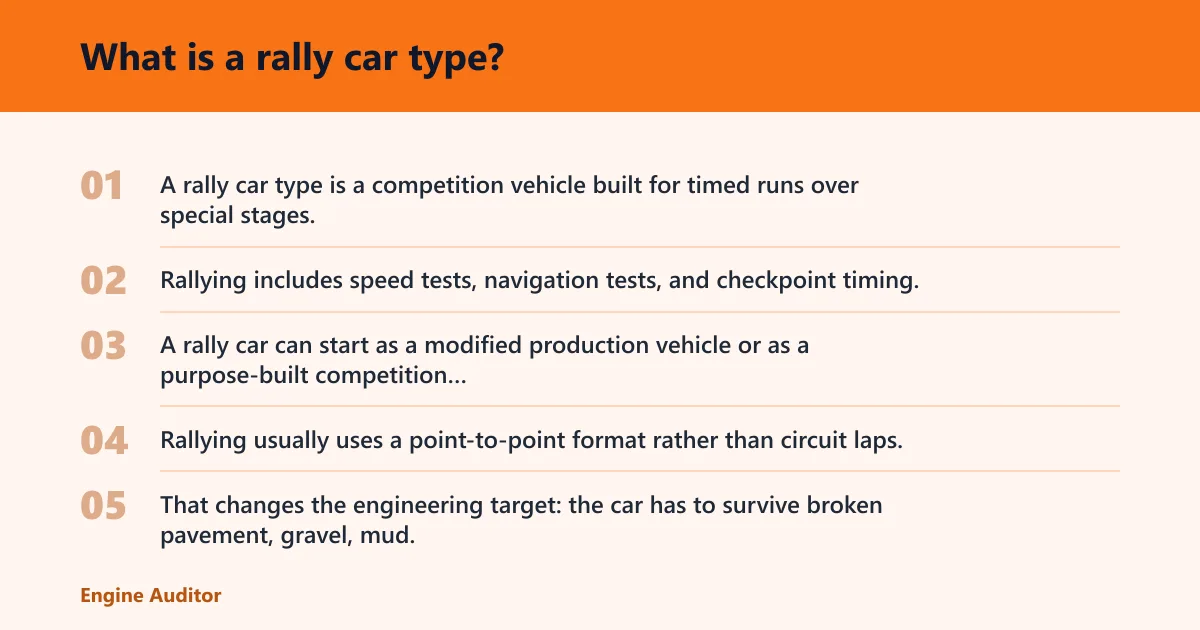
A rally car type is a competition vehicle built for timed runs over special stages, not for lap racing. Rallying includes speed tests, navigation tests, and checkpoint timing, and it may use public roads, closed roads, or off-road terrain. A rally car can start as a modified production vehicle or as a purpose-built competition car.
How rally use differs from circuit racing
Rallying usually uses a point-to-point format rather than circuit laps. That changes the engineering target: the car has to survive broken pavement, gravel, mud, snow, ice, and repeated direction changes without the benefit of smooth track surfaces or long pit windows.
Which surfaces rally cars are built to handle
Rally cars are built around grip and durability on rougher surfaces. A car that feels sharp on asphalt can still be poor on gravel if it has little suspension travel, low sidewall tires, weak underbody protection, or too little clearance for ruts and rocks.
How is a rally car different from a street car?
A street car is a road-legal production vehicle usually tuned for comfort, emissions, safety, and daily drivability. A rally car is modified for stage speed, traction, and survival over rough terrain, so it often gives up noise control, ride quality, and convenience equipment to gain control and durability.
Road-legal production car versus competition setup
Competitors can use road-legal production vehicles in some rally formats, but the car changes fast once it becomes a serious rally build. Suspension, protection, seats, harnesses, communication gear, lighting, and often the drivetrain setup all move away from normal street-car priorities.
Why comfort, emissions, and safety gear matter on the street
Street cars must pass road rules and remain tolerable in traffic. That means emissions equipment, quiet exhaust tuning, airbags or equivalent safety systems where required, and ride quality that does not punish the driver on every commute.
Why rally parts often trade comfort for control and durability
Rally parts are chosen to keep the car alive and usable at speed. Stiffer mounts, larger brakes, skid protection, rally tires, and stronger suspension parts can improve control, but they usually add noise, vibration, and higher maintenance needs.

What makes a car good for rally driving?
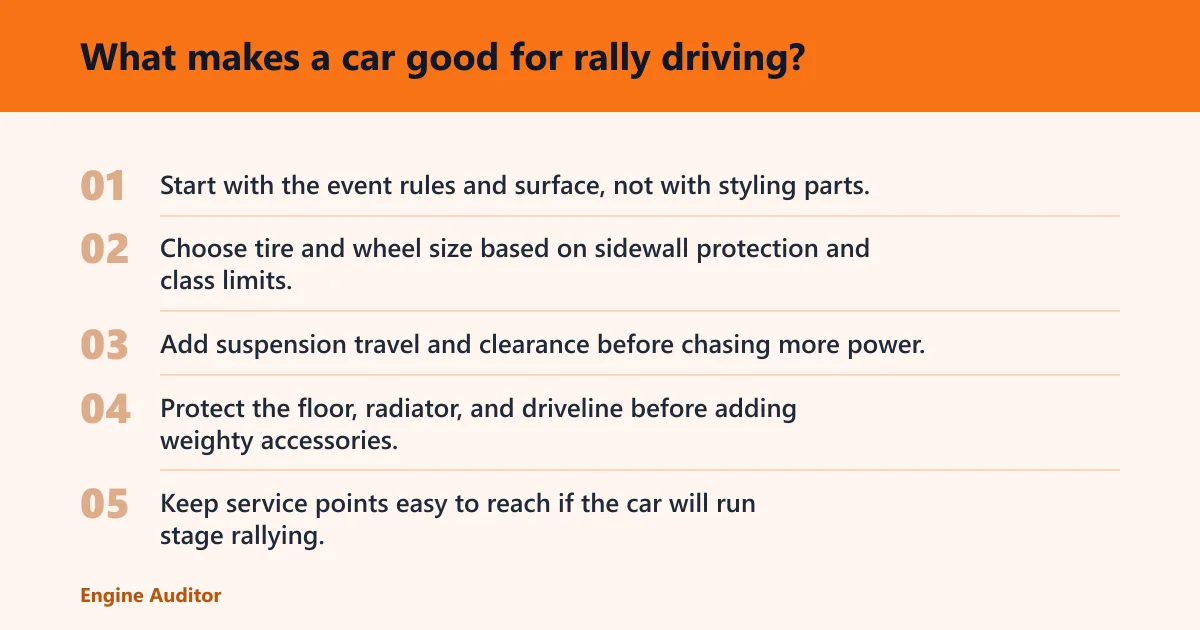
A good rally car has usable grip, suspension travel, ground clearance, durability, and easy service access. Power helps, but it sits behind keeping the car stable on loose surfaces, protecting the underside, and finishing stages without avoidable damage.
Suspension travel and ground clearance
Rally surfaces throw up holes, ruts, crests, and rocks. More travel can help the tires stay in contact with the ground, while extra clearance can help the car avoid scraping the floor, breaking splitters, or damaging exhaust and drivetrain parts.
Tire sidewall, wheel size, and puncture resistance
Tire sidewall matters because it acts like a cushion between the wheel and the terrain. Short sidewalls and large wheels can work on smooth pavement, but they leave less protection on gravel, where impacts and pinch flats can be a problem.
Drivetrain choice and traction on loose surfaces
AWD is often used in rally because it spreads traction across four wheels, but FWD and RWD can still be workable depending on class, surface, and budget. The right drivetrain is the one that matches the event format and surface, not the one with the biggest brochure number.
Cooling, protection, and service access
Rally cars need better cooling margins, underbody protection, and fast access to filters, fluids, and wear items. Stage rallying rewards a car that can be checked and repaired quickly between sections, because a small fault can end the day if it is buried under trim or fragile aero parts.
- Start with the event rules and surface, not with styling parts.
- Choose tire and wheel size based on sidewall protection and class limits.
- Add suspension travel and clearance before chasing more power.
- Protect the floor, radiator, and driveline before adding weighty accessories.
- Keep service points easy to reach if the car will run stage rallying.
Street vs rally: the parts that change the car

Suspension, springs, dampers, and ride height
Street suspension aims for predictable handling and comfort. Rally suspension is usually longer-travel and more compliant over sharp impacts, with ride height set to clear terrain instead of looking low and planted.
Tires, wheels, brakes, and underbody protection
Street builds often prioritize road noise, tread life, and steering feel. Rally builds lean toward sidewall protection, puncture resistance, skid plates, mud clearance, and brake setups that cope with repeated abuse rather than just brief high-speed stops.
Seats, harnesses, cages, lighting, and communication gear
Competition cars often add fixed seats, harnesses, roll cages, auxiliary lighting, and driver-to-co-driver communication gear. Those parts improve safety and function on special stages, but they can make the car tiring and inconvenient for daily use.
| Attribute | Street car | Rally car | Real-world effect |
|---|---|---|---|
| Legality | Built to stay road-legal | May be road-legal, or may be stage-only | Street cars are easier to register, insure, and inspect |
| Suspension travel | Moderate, tuned for comfort and grip on pavement | Greater travel for rough roads and landings | More travel helps keep tires in contact on broken surfaces |
| Tire sidewall | Usually shorter sidewall, larger wheel emphasis | More sidewall protection and impact tolerance | A taller sidewall better shields the wheel on gravel and ruts |
| Drivetrain | Any layout can work for road use | AWD is common, with FWD and RWD used in some classes | Traction matters most when the surface is loose or uneven |
| Ground clearance | Limited by ride quality and handling targets | Raised to avoid contact with terrain | More clearance reduces damage risk on rough stages |
| Maintenance burden | Lower, with longer service intervals | Higher, with more inspection after hard use | Rally ownership costs more time and more parts |
| Daily use | Usually better for commuting and errands | Usually worse because of noise, heat, and wear | Street cars win if the car must work every day |
| Stage rally suitability | Poor without major changes | Purpose-built for special stages | Rally cars win where timing on closed roads matters |
Legality and inspection implications
Street legality is the first major divider. A rally car may still be road-legal if it keeps the required equipment, but a stripped competition car often becomes difficult to register, pass inspection, or insure for normal use.
Suspension and clearance versus comfort
Street cars are usually tuned to absorb small road imperfections without feeling vague. Rally setups accept a firmer, more controlled ride because the job is to survive bigger hits and keep traction on unpredictable surfaces.
Maintenance and ownership cost
Rally parts wear faster. Expect more frequent checks on bushings, wheel bearings, brakes, suspension joints, and driveline parts, plus more time spent cleaning mud and inspecting for cracks, leaks, or bent components after events.
Daily-use suitability
Suppose a car sits on stiff springs, loud tires, and a cage with fixed buckets. It may be impressive for a stage, but it can become annoying on pothole-filled streets, especially if the exhaust drone, cabin heat, and limited visibility show up every drive.
What is the difference between rally and racing?
Rally and circuit racing are different because the venue, timing, and vehicle setup priorities are different. Rallying is point-to-point and often run on special stages, while circuit racing happens side by side on a closed course with repeated laps.
Stage rallying versus circuit racing
Stage rallying is the most common professional rally format. Cars leave at regular intervals, and the clock decides the result over special stages, not wheel-to-wheel position at the end of a lap.
Why point-to-point timing changes vehicle setup
Because stages vary in surface and distance, rally teams must balance speed with survival. Circuit cars can be optimized more narrowly for smooth pavement, but rally cars need broader compliance across dirt, tarmac, snow, and rough transition roads.
Why rough terrain changes reliability priorities
A fast pavement car can fail in rally if its cooling, wheel protection, suspension, or underside cannot take repeated impacts. A common first-timer mistake is chasing horsepower and visual mods first, then discovering that the car cannot survive the road surface.
What are road rallies and cross-country rallies?
Road rallies and cross-country rallies are different rally categories with different priorities. Road rallies are usually tied to average-speed rules and can run on open roads, while cross-country rallies push far beyond that into rough terrain where durability and navigation matter just as much as speed.
Road rally and average-speed rules
The FIA defines rally as a road competition with an imposed average speed run. Road rallies may include special stages and road sections, and open-road sections are scored by timing and compliance rather than outright speed.
Cross-country rally over desert, forest, snow, or ice
Cross-country rally covers longer, harsher events that can run over desert, forest tracks, snow, ice, or other rough terrain. The format places a premium on navigation, endurance, and mechanical toughness because events can stretch for several-thousand-mile distances.
Where production vehicles fit in each format
A production vehicle can be a rally base, especially where rules allow road-legal vehicles. That said, the base car is only the starting point; once the build is serious, the suspension, protection, tires, and safety gear move far beyond a normal performance package.
Choose a street car if…
Choose a street car if you need daily drivability, easier inspection, lower noise, and a simpler ownership experience. It is the better pick when the car spends most of its life on public roads and only needs occasional spirited driving.
Choose a rally performance build if…
Choose a rally performance build if the car will run special stages, rough roads, or cross-country events where clearance, suspension travel, traction, and durability matter more than comfort. That choice makes sense only if you accept higher maintenance and a harsher ride.
Frequently asked questions
What is a rally car type?
A rally car type is a competition car built for timed events on closed roads, open roads, or off-road terrain. It may start as a road-legal production vehicle or a specially built competition car, but the key traits are durability, traction, clearance, and control on rough surfaces.
How is a rally car different from a street car?
A street car is built for comfort, emissions, safety, and commuting. A rally car is built for speed tests and special stages, so it usually adds more suspension travel, protection, and rally-specific hardware while giving up some comfort, quietness, and convenience.
Can a rally car be street legal?
Yes, some can. Competitors can use road-legal production vehicles in some rally formats, and a rally build may keep enough factory equipment to remain legal. But many competition cars lose trim, noise control, or other required items and no longer work well on public roads.
What makes a car good for rally driving?
Good rally cars manage grip, suspension travel, ground clearance, durability, and serviceability. AWD helps in many cases, but it is not the whole story. Tire sidewall, underbody protection, cooling, and fast inspection access often matter as much as engine output.
What is the difference between rally and racing?
Rally is usually point-to-point, with timing over special stages and road sections, while circuit racing uses laps on a closed track. That difference changes the setup: rally cars need broader terrain tolerance, and racing cars can focus more narrowly on smooth-surface speed.
Are rally cars AWD or FWD?
AWD is common because it helps on loose and uneven surfaces, but rally cars are not limited to AWD. FWD and RWD can be valid depending on class, surface, and budget, and the right drivetrain depends on the event rather than a single rule.
Products related to this article
Sponsored / affiliate links. As an Amazon Associate I earn from qualifying purchases. I may earn additional commission from eligible campaigns.