Best Vehicle Type for Long-Distance Commuting
For most long-distance commuters, a hybrid sedan is the best vehicle type. It usually delivers a quiet highway ride, low fuel cost, and enough cabin space without crossover drag; choose a wagon or hatchback only if you need more cargo access. Pick the wrong body style, and you pay more in fuel, noise, and fatigue over thousands of highway miles. This guide compares sedans, hatchbacks, wagons, crossovers, and hybrid sedans for highway-heavy commuting.
Highway commuting rewards clean aerodynamics, supportive seats, and useful assist features more than tall ride height or extra ground clearance. For a daily interstate drive, you want the body style that cuts drag and road noise first, then adds winter confidence or cargo room only where needed.
Best commuter body style
Why hybrid sedans lead on highway use
Hybrid sedans sit in the sweet spot for commuters. They usually return strong highway fuel economy, can be quieter than taller vehicles in many models, and avoid the mileage penalty that often comes with a crossover or SUV shape. That makes them the default answer for drivers who rack up long, repeat highway miles.
Among the best-known examples, the Toyota Prius delivers up to 57 MPG combined and has an estimated driving range of 644 miles, with available AWD and a hybrid powertrain with eCVT. The Toyota Camry Hybrid returns up to 51 MPG combined. The Hyundai Elantra Hybrid is reported at up to about 54 MPG combined, while the Honda Civic Hybrid is commonly reported at around 49-51 MPG combined, depending on source and model.
Quick picks by commute need
If you want the shortest answer, start here. The right body style depends on what your commute asks of the car every day, not on a single spec sheet number.
- Best for solo highway commuters: Hybrid sedan. Strong highway MPG, quieter cabin, and easier fuel budgeting.
- Best for winter and rough roads: Crossover/SUV, but only if the added ride height or AWD matters to you more than fuel economy.
- Best for cargo and flexibility: Hatchback or wagon. You give up some efficiency, but gain easier loading and more useful space.
- Best for budget buyers: Hyundai Elantra Hybrid. It is a commuter value choice with up to 54 MPG combined.
Suppose your commute is 42 highway miles each way, five days a week, with only a backpack and lunch bag. A hybrid sedan usually makes more sense than an SUV, because the extra size and drag buy little in return. If the same driver also needs ski gear and a dog crate, a hatchback or wagon may be the better fit.
A common first-timer mistake is choosing an SUV for a long commute because the higher seat feels safer. That can help visibility, but it can also raise fuel use and noise without fixing the real problem, which is seat support and highway fatigue.
Commuter decision matrix

This table compares body styles first, then the hybrid sedan option that usually leads for highway-heavy use. Scores are relative for commuting, not a substitute for a specific trim check.
| Vehicle type | Highway MPG | Seat comfort | Cabin noise | Ride quality | Visibility | Winter confidence | Best for | Avoid if |
|---|---|---|---|---|---|---|---|---|
| Sedan | Good to very good | Good | Good | Good | Average | Average | Drivers who want a balanced highway commuter with lower drag and fewer compromises. | You need tall loading height, max cargo access, or snow-day ground clearance. |
| Hatchback | Good | Good | Good to average | Good | Average | Average | Solo commuters who want easier cargo loading and compact parking. | You want the quietest possible cabin or the best highway mileage. |
| Wagon | Good to very good | Good | Good | Very good | Good | Average to good | Drivers who need sedan-like manners with better cargo space and a lower load floor than an SUV. | Price and trim choice are limited, or you want the highest ride position. |
| Crossover/SUV | Average to poor | Good | Average | Average | Good | Good | Winter commuters, poor-road drivers, or people who need cargo space and a higher seating position. | Fuel economy matters most, or your route is mostly steady highway miles. |
| Hybrid sedan | Very good to excellent | Good to very good | Very good | Very good | Average to good | Average to good | Most long-distance commuters, especially those who want the best fuel cost and low fatigue. | You need SUV ground clearance or maximum cargo height. |
Hybrid sedan shortlist
The Toyota Prius is still the efficiency benchmark for many commuters. It reaches up to 57 MPG combined, has an estimated range of 644 miles, and is available with AWD. The hybrid powertrain with eCVT is part of why it stays smooth and efficient in steady highway use.
The Toyota Camry Hybrid is the midsize comfort pick. It returns up to 51 MPG combined, and front-drive trims keep the package simple, with cited trims available under $30,000, which matters if you want comfort without stepping far into luxury pricing.
The Hyundai Elantra Hybrid is the budget-friendly commuter value choice. It offers up to 54 MPG combined, which keeps fuel cost down without forcing you into a small, noisy economy car. For many buyers, it is the cleanest path to high efficiency at a lower entry price.
The Honda Civic Hybrid is the balanced choice. Depending on source and model, it returns about 49-51 MPG combined, and it is available as a sedan or hatchback. Its refined interior and strong balance of performance and efficiency make it a smart middle ground for drivers who want a more engaging commute.
Is a sedan or SUV better for a long commute?
For efficiency and fatigue control, a sedan is usually better for a long commute. A crossover or SUV can help with ride height, winter confidence, and cargo needs, but it often gives back highway MPG at the exact speeds commuters cover every day. If the route is mostly pavement, sedan wins more often.
Highway efficiency tradeoff
For highway-heavy commuting, the highway MPG figure is the more relevant one to compare. Air drag grows quickly at speed, so a taller, blunter vehicle body usually pays a bigger fuel penalty on the interstate than it does around town. That is why SUV owners often see weaker highway results than the brochure average suggests.
Ride height and visibility tradeoff
An SUV can feel easier to place in traffic because the seating position is higher. That does help visibility in some cases. But a higher seat does not automatically mean a more comfortable commute, because seat shape, lumbar support, wind noise, and tire noise matter more over an hour of steady driving.
When an SUV makes sense anyway
Choose a crossover or SUV if winter confidence, rough-road clearance, or cargo volume is a real daily requirement. If your route includes unplowed roads, steep driveway grades, or bulky gear, the body style tradeoff can be worth it. Just do not buy one for highway comfort alone.
Are hybrids better for long highway commutes?
Yes, for most highway-heavy commuters, hybrids are the better default because they lower fuel cost without forcing you into a harsher or louder car. The benefit is strongest when you compare the exact trim and drivetrain, since highway MPG varies widely by model and configuration.
Why highway MPG matters more than combined MPG
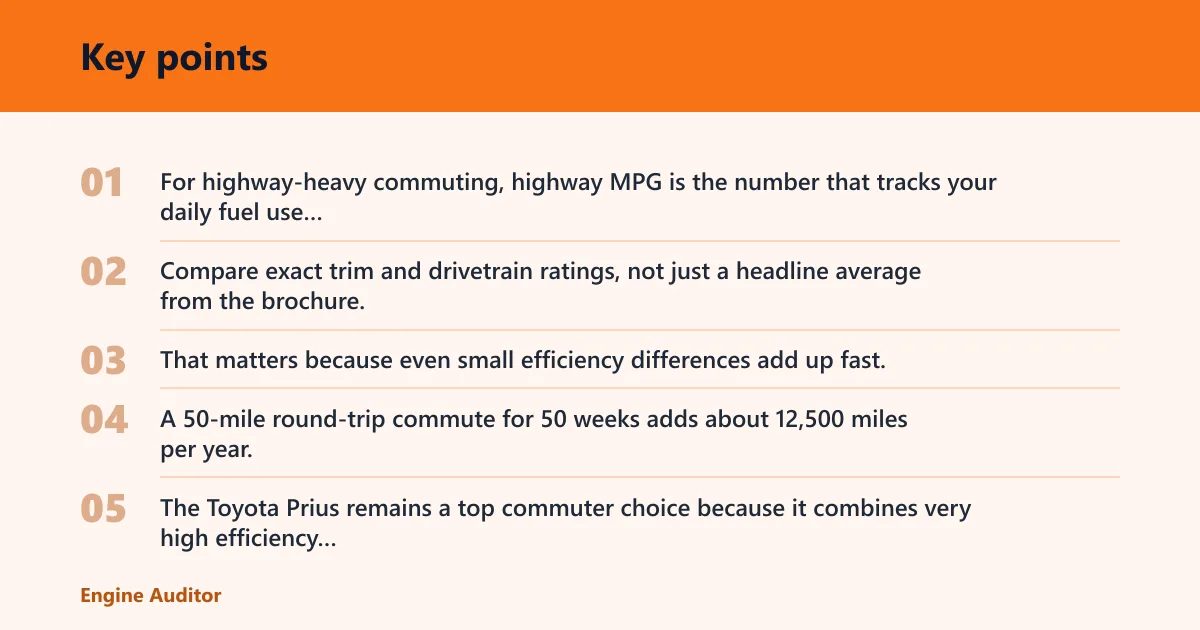
For highway-heavy commuting, highway MPG is the number that tracks your daily fuel use more closely. Compare exact trim and drivetrain ratings, not just a headline average from the brochure.
That matters because even small efficiency differences add up fast. A 50-mile round-trip commute for 50 weeks adds about 12,500 miles per year, which turns a one or two MPG gap into real money over time.
Why these hybrid sedans stand out
The Toyota Prius remains a top commuter choice because it combines very high efficiency with long range. The Toyota Camry Hybrid adds midsize comfort and strong fuel economy. The Hyundai Elantra Hybrid sets a practical value benchmark, and the Honda Civic Hybrid offers a refined cabin with sedan or hatchback flexibility.
The Toyota Prius LE FWD is rated at 57 mpg combined. Those trim-specific numbers are exactly why you should compare the precise model, not the nameplate alone.
When a non-hybrid still makes sense
A non-hybrid sedan still makes sense if your purchase budget is tight, your annual mileage is modest, or you care more about upfront price than fuel savings. If your commute is short enough that fuel cost stays manageable, a conventional sedan with the right seats and quiet cabin can still be the better buy.
What matters most in a highway commuter?
Seat support, cabin noise, and ride quality matter most. If the seat is flat, the cabin whistles at speed, or the suspension feels busy over patched pavement, a car can be efficient on paper and still wear you out. A good commuter should feel calm at 65 to 75 mph for long stretches.
Cabin noise and seat support
Wind noise and tire noise are the first fatigue triggers many commuters notice. They make a car feel busier than it is, especially on coarse asphalt. Supportive front seats matter just as much, because a well-shaped cushion and backrest reduce constant micro-adjustments during long highway drives.
Ride quality and fatigue reduction
Ride quality is not about softness alone. A commuter car should settle bumps without bouncing, floaty body motion, or sharp impacts through the seat. Sedans and wagons often do this better than taller vehicles because their lower center of gravity helps them stay composed.
Adaptive cruise control and lane-centering
Adaptive cruise control and lane-centering reduce repetitive highway workload. They are assistance systems, not self-driving tech, but they can cut the small corrections and speed changes that make long drives tiring. For a highway commuter, those features are worth prioritizing after the body style choice.
How to choose by commute length and weather

Use commute length, road type, weather, and cargo needs to narrow the body style. If you drive mostly highway miles, choose the quietest and most efficient shape that still fits your life. Annual mileage changes the math quickly, so do not buy for the occasional errand only.
- Estimate annual mileage. A 50-mile round-trip for 50 weeks is about 12,500 miles per year. More than that pushes fuel savings higher on your priority list.
- Check road type. Mostly pavement favors a sedan or hybrid sedan. Broken roads and winter slush push you toward more ride height.
- Match cargo needs. If you carry a stroller, tools, sports gear, or a large dog crate, a hatchback or wagon may be worth the extra bulk.
- Review winter demands. Snow belt drivers may want AWD or a taller body, but do not confuse winter confidence with highway efficiency.
- Compare exact trims. Highway MPG, assist features, and seats can change by trim and drivetrain.
Say your commute is 70 miles a day on a freeway with little traffic, and you park in a heated garage. A hybrid sedan is the cleanest choice because the commute is fuel-heavy but weather-light. Now change only one variable: you move to a rural route with deep snow and an unplowed lot. At that point, a crossover with AWD can become the practical answer, even if it costs more in fuel.
Picture a driver who carries a laptop bag most days but needs to haul two bicycles on weekends. A hatchback or wagon may beat a sedan, because the added cargo access matters more than the last few MPG. If cargo space stays unused most days, though, the commuter penalty is hard to justify.
Frequently asked questions
What is the best vehicle type for long-distance commuting?
For most drivers, a hybrid sedan is the best vehicle type for long-distance commuting. It balances highway MPG, seat support, cabin quietness, and ride quality better than most SUVs. If you need more cargo access, a wagon or hatchback can be the next-best fit.
What matters most for a car used every day on the highway?
Cabin noise, seat support, and ride quality matter most. A commuter car should stay quiet, keep the seat comfortable over long stints, and absorb rough pavement without shaking the driver around. Driver-assist features help too, but they come after the basic comfort package.
Which body style is most comfortable for a long commute?
A hybrid sedan is often the most comfortable body style for a long commute because it combines a lower, calmer stance with efficient highway operation. If you need more cargo flexibility, a wagon can come close. SUVs may feel tall and airy, but not always more comfortable.
Does highway MPG matter more than combined MPG for commuting?
Yes, if most of your trip is on the highway. Combined MPG blends city and highway use, so it can mislead commuters who drive at a steady speed every day. For a highway-heavy route, compare the highway figure first, then check the trim and drivetrain that produce it.
Products related to this article
Sponsored / affiliate links. As an Amazon Associate I earn from qualifying purchases. I may earn additional commission from eligible campaigns.