What Is EV Battery Preconditioning?
EV battery preconditioning heats or cools the traction battery before driving or DC fast charging. It matters most in cold weather, and it can cut charging time when the pack would otherwise arrive too cold. Skip it, and you can lose charging speed, burn more energy in winter, or see little change at the fast charger. This guide separates cabin preconditioning from battery preconditioning and shows when each one helps, when it does nothing, and how to tell whether your car is doing it.
How temperature and state of charge affect charging speed
Battery preconditioning means heating or cooling the traction battery before a charging session or a hard drive so the pack reaches a temperature window that supports better charging. The point is simple: a battery near the right temperature can accept power more readily than one that is very cold or very hot. That matters most before DC fast charging.
Battery temperature and the charging window
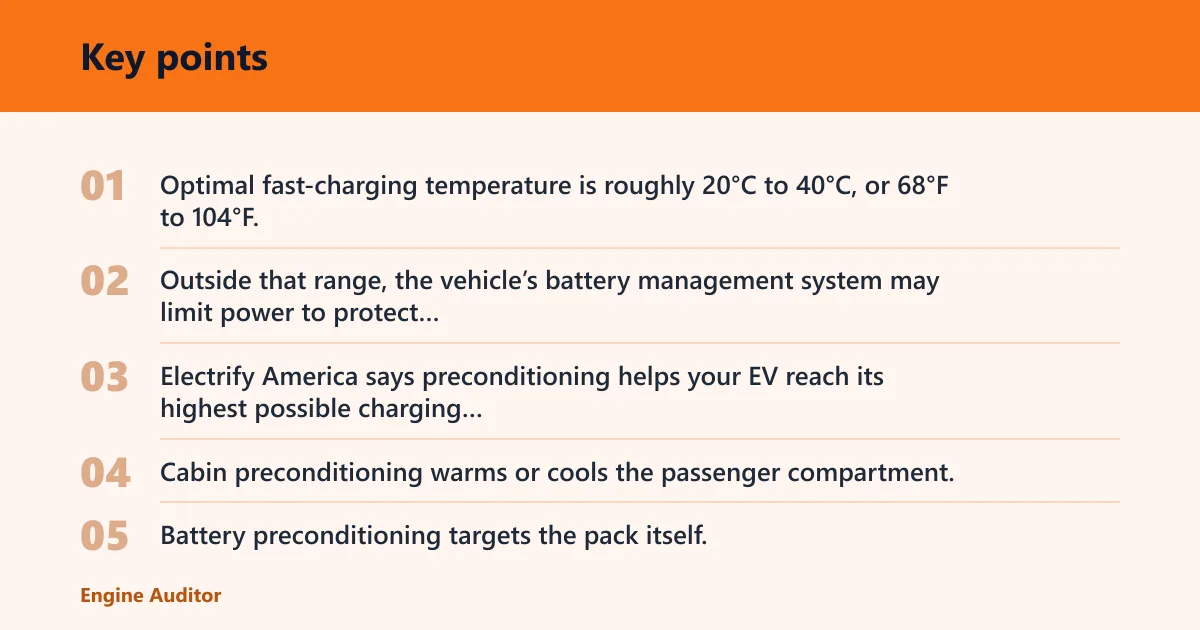
Optimal fast-charging temperature is roughly 20°C to 40°C, or 68°F to 104°F. Outside that range, the vehicle’s battery management system may limit power to protect the pack. Electrify America says preconditioning helps your EV reach its highest possible charging speed, and it also notes that extreme temperatures can hurt charging efficiency.
How this differs from cabin preconditioning
Cabin preconditioning warms or cools the passenger compartment. Battery preconditioning targets the pack itself. Recurrent separates the two this way too: cabin comfort and battery temperature management are related, but they are not the same job. A warm cabin can feel nice while the battery still charges slowly.
Heat pumps and thermal management systems can do both jobs with coolant loops and refrigerant-based cooling. That means one vehicle may be conditioning the cabin, the battery, or both at once, depending on the design and the setting the driver selected.
Why state of charge also matters
State of charge, or SOC, is the battery fullness level. It affects charging speed even when the pack is at a good temperature. Many EVs slow charging as they reach about 80% SOC, so a warm battery does not stop tapering at higher charge levels. Temperature helps; SOC still sets the ceiling.
Picture a winter arrival at a 150 kW charger with 12% SOC and a cold pack. Preconditioning can help the car accept more power at the start. Picture the same stop at 82% SOC. The battery may still be warm, but charging will usually taper because the pack is nearly full.
Why cold batteries charge slowly
Cold batteries charge slowly because the battery management system, or BMS, limits charging power when the pack is too cold or too hot. That protects the battery from damage and controls the charge power request sent to the charger. The effect shows up first at DC fast chargers, where power is high enough for temperature limits to matter.
How the BMS limits charge power
The BMS watches battery temperature and SOC, then decides how much current the pack can accept. If the battery is cold, the system may request less power than the charger can provide. If the pack is hot, it may do the same in the other direction. A charger may be rated around 350 kW, but a vehicle may not reach that level.
Why DC fast charging feels the effect first
DC fast charging is the setting where preconditioning pays off most because the current is high and the battery temperature window matters right away. Slow AC home charging usually leaves enough time for a cold pack to warm up, so preconditioning often changes little there. It may still help with efficiency, but it usually does not change session speed much.
Why speed tapers as the pack fills
Charging speed also tapers as SOC rises. Many vehicles begin to slow near 80% SOC, then slow more as the pack gets fuller. That is normal behavior, not a sign that preconditioning failed. A battery can be in the right temperature band and still charge more slowly near the top of the pack.
Say your EV arrives at a highway charger at 15% SOC after 40 minutes of cold driving. If preconditioning ran correctly, the battery should be warmer on arrival and the session should begin at a stronger rate than it would with a cold pack. If it still starts slowly, the charger choice, the car’s settings, or the battery state may be the reason.
How automakers trigger preconditioning
Many EVs trigger battery preconditioning automatically when you navigate to a DC Fast Charger or Tesla Supercharger. Some models also let you start it manually in the car or through the app. Others need a supported charger location selected in the native navigation system before the car will prepare the battery.
Navigation-based activation
Native navigation is common because the vehicle can estimate arrival time and battery temperature, then begin conditioning at the right point. Tesla may begin warming the battery 30–45 minutes before arrival at a Supercharger. EV Tips says preconditioning often starts about 30 or 40 km from the charger on highways, but timing varies by model and weather.
Manual or app-based activation
Some vehicles let you request preconditioning directly from the climate or charging menu. Others expose it through the brand app. If your vehicle offers both cabin and battery controls, make sure you are selecting the battery option. A cabin-only command will not warm the traction battery enough for a faster DC session.
Why some route apps do not trigger it
Many third-party route apps can send a destination to the car, but that does not always activate battery conditioning. Some EVs require their own navigation system to recognize a compatible fast charger. If the car does not know the stop is a supported charger, it may route you there without preparing the battery.
Battery preconditioning checklist
Use this checklist to decide whether preconditioning is worth the energy and effort. The same feature can be useful in one case and pointless in another. The key questions are charger type, battery temperature, and SOC on arrival.
| Situation | What to do | What result to expect | Common reasons it fails |
|---|---|---|---|
| Winter road trip to DC fast charger | Set the charger as the destination in the vehicle’s native navigation, then drive long enough for the car to heat the pack before arrival. | The battery should arrive closer to the optimal charging temperature, which can improve the initial charge rate. | Wrong charger type selected, route not set in native nav, short approach, disabled conditioning, or a very warm start that makes heating unnecessary. |
| Normal home AC charging | Plug in as usual. Use preconditioning only if the car offers it for cabin comfort or a very cold pack. | Little or no charging-speed change. Cabin comfort may improve, and winter range can improve if the cabin uses less battery energy. | AC charging is already slow enough that battery temperature often does not limit speed, and some cars do not condition the pack for home charging. |
| High-SOC stop | Arrive earlier in the charge window if you need the fastest possible stop. Do not expect preconditioning to fix taper above about 80% SOC. | You may get a stronger start only if the battery is cold. The session will still taper as SOC rises. | High SOC is the limiter, not battery temperature. A warm pack cannot hold peak power near the top of the charge curve. |
Should I precondition?
- Winter road trip to DC fast charger: Use it if your car supports it and the charger is in the vehicle nav. Expect a faster start to the session if the battery would otherwise be cold.
- Normal home AC charging: Usually skip it unless your model uses the feature for cabin comfort or battery protection in severe weather.
- High-SOC stop: Skip it if you plan to arrive near 80% SOC or above. The battery may already taper because it is nearly full, not because it is cold.
Which EV systems support it?
Support depends on the vehicle, the software, and the charger type. Hyundai/Kia E-GMP models and newer GM Ultium vehicles are commonly cited examples of battery conditioning tied to fast-charging workflows. Even then, the feature is model-specific and may depend on navigation, charger selection, or software updates.
Tesla Supercharger navigation preconditioning
Tesla’s navigation-based preconditioning is tied to in-car routing to a Supercharger. The system may begin warming the battery 30–45 minutes before arrival. That lead time helps the pack approach the right temperature by the time you plug in, though the exact timing varies by model, weather, and starting battery temperature.
Hyundai/Kia E-GMP battery conditioning
Hyundai and Kia E-GMP vehicles are reported to support battery conditioning for compatible ultra-fast chargers. That includes models such as IONIQ 5, EV6, and EV9 when the vehicle and software support the feature. The car usually needs navigation to a compatible DC fast charger to trigger the routine.
GM Ultium battery conditioning
Newer GM EVs use Ultium battery conditioning to support more consistent fast charging and cold-weather performance. This can apply to vehicles such as Blazer EV, Equinox EV, Silverado EV, and Lyriq, but support can vary by trim, software, and model year. Check the owner’s manual for the exact behavior on your vehicle.
Heat pumps and thermal management
Heat pumps and thermal management systems can condition both the cabin and the battery. They use coolant loops and refrigerant-based cooling to move heat where the car needs it. That can help charging consistency in cold weather and can reduce the battery drain needed to heat the cabin.
When preconditioning helps and when it will not
Preconditioning tends to help most when heading to a DC fast charger with a cold battery and enough drive time to warm the pack first. It changes little on short drives, at home AC charging, or when the battery is already warm. It also cannot overcome a high SOC taper or a charger that the vehicle does not recognize.
Best use cases on winter road trips
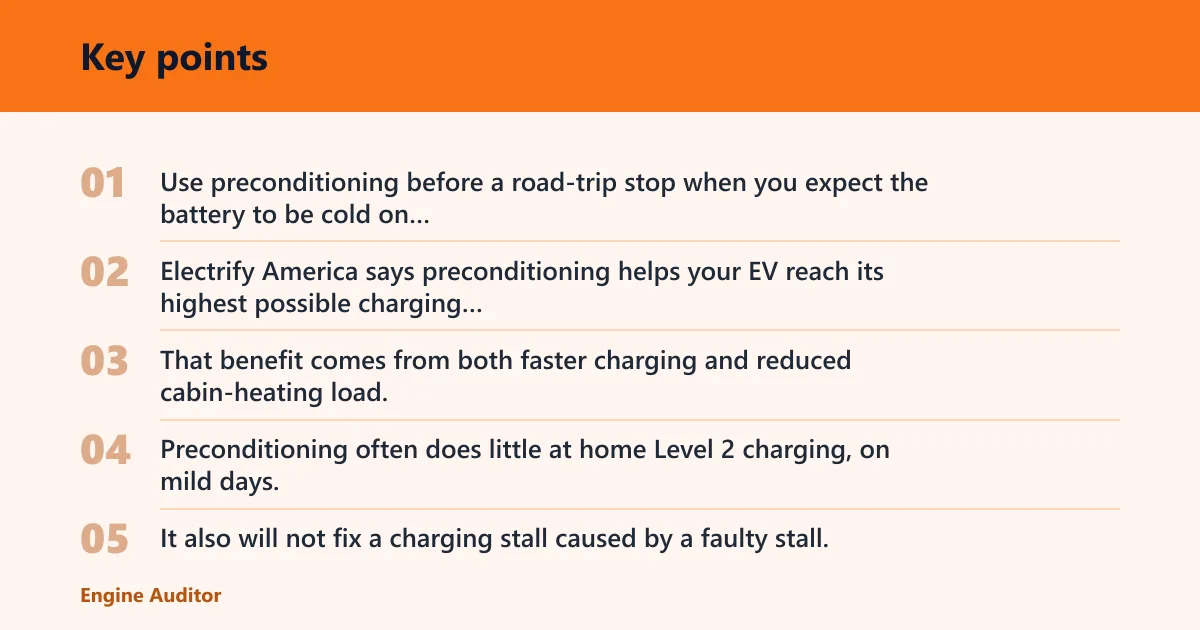
Use preconditioning before a road-trip stop when you expect the battery to be cold on arrival. The same source says preconditioning helps your EV reach its highest possible charging speed, and Motoring Electric notes that it can help preserve EV range in winter. That benefit comes from both faster charging and reduced cabin-heating load.
Cases where it changes little or nothing
Preconditioning often does little at home Level 2 charging, on mild days, or on short drives where the pack never gets very cold. It also will not fix a charging stall caused by a faulty stall, a charging limit set in the car, or a charger that is not compatible with the feature.
Why charger choice and arrival SOC can cancel the benefit
If the wrong charger is selected, the vehicle may never start conditioning. If SOC is already high, charging will taper anyway. If the settings disable battery conditioning, the car will arrive cold even though the route is long enough. That is why the charging stop should be planned in the vehicle’s own navigation when possible.
A common first-timer mistake is assuming a 10-minute stop at a nearby charger will be enough to warm the battery on the way. It usually will not. The car may need a much longer lead time, and the exact distance varies by model, weather, and starting battery temperature.
How to turn it on or troubleshoot it
Start with the vehicle menu or app, then confirm that the charger is supported. If preconditioning still does not appear to work, check for software settings, route selection, and manual overrides. When in doubt, use the owner’s manual for the exact steps on your model.
- Open the charging or climate menu and look for battery preconditioning, battery conditioning, or a charger-routing prompt.
- Set a compatible DC fast charger as the destination in the vehicle’s native navigation.
- Confirm the vehicle is not in a low-power mode that disables battery heating or cooling.
- Check for software updates if the feature is missing or inconsistent.
- Use the owner’s manual or vehicle app for model-specific steps.
If your EV still charges slowly in mild weather, the issue may be something other than temperature. Look for a charger limit, a low-power session, a high arrival SOC, or a vehicle setting that caps charging power. A pack that is already warm does not need preconditioning, so no change at the charger can be normal.
Frequently asked questions
What is EV battery preconditioning?
It is the process of heating or cooling the traction battery before driving or charging so the pack is closer to its preferred temperature window. The goal is faster DC fast charging and better cold-weather efficiency. It is not the same as warming the cabin, though some vehicles can do both.
What does EV battery preconditioning do?
It prepares the battery so the BMS can allow higher charge power sooner, especially at a DC fast charger. A warm pack can accept energy more readily than a cold one. It can also help winter range by reducing the energy the car must spend warming the cabin and battery.
Does battery preconditioning help fast charging?
Yes, especially on cold batteries and high-power DC chargers. The same source says it helps your EV reach its highest possible charging speed. It will not eliminate taper near higher SOC, and it will not fix a charger limit or a car that does not support the feature.
How do I turn on battery preconditioning?
Use the vehicle’s native navigation to route to a compatible DC fast charger if your model supports automatic activation. Some cars also allow a manual command in the car or app. If you do not see the feature, check the owner’s manual or look for a software update.
Does preconditioning work at home charging?
Usually it makes little difference for normal home AC charging. The lower power level gives the pack more time to warm naturally, so battery temperature is rarely the main limit. Some vehicles may still use preconditioning for cabin comfort, but that does not change charging speed much.
What does preconditioning Tesla battery mean?
It means Tesla is heating the battery before arrival at a Supercharger so the pack is ready for faster charging. Tesla may begin warming the battery 30–45 minutes before arrival. The feature works through in-car navigation, and the exact timing still depends on weather and starting battery temperature.
What is battery preconditioning in a Kia Niro EV?
For a Kia Niro EV, check the owner’s manual and software menu because support can vary by model year and trim. If the car supports battery conditioning, it will usually be tied to a compatible charger or a battery-conditioning setting in the vehicle’s system, not a generic phone app alone.
Products related to this article
Sponsored / affiliate links. As an Amazon Associate I earn from qualifying purchases. I may earn additional commission from eligible campaigns.