Reserved Capacity vs Cold Cranking Amps: What Matters More?
Choose Cold Cranking Amps for winter starts and Reserved Capacity for accessory loads or alternator-failure backup; if your driving is short-trip or you run accessories, prioritize reserve capacity, but never let CCA fall below the vehicle’s minimum. Pick the wrong spec and you can get hard starts, repeated jump-starts, or a battery that fails before the car does. This guide compares both ratings and gives a scenario-based rule for each driving need.
Which spec matters more for your car?
For most drivers, start with use case, then climate. Cold Cranking Amps matters most when weak winter starts are the main risk. Reserved Capacity matters most when the car must run accessories, or when the charging system fails and you need backup time before the battery drops too low.
| Decision factor | Reserved Capacity | Cold Cranking Amps | Winner |
|---|---|---|---|
| Cold-weather start reliability | Secondary | Primary | Cold Cranking Amps |
| Accessory runtime with engine off | Primary | Secondary | Reserved Capacity |
| Alternator-failure backup | Primary | Secondary | Reserved Capacity |
| Short-trip and city use | Primary | Secondary | Reserved Capacity |
| Towing and added electrical load | Primary | Secondary | Reserved Capacity |
| Winter-only starting margin | Secondary | Primary | Cold Cranking Amps |
Cold-weather start reliability
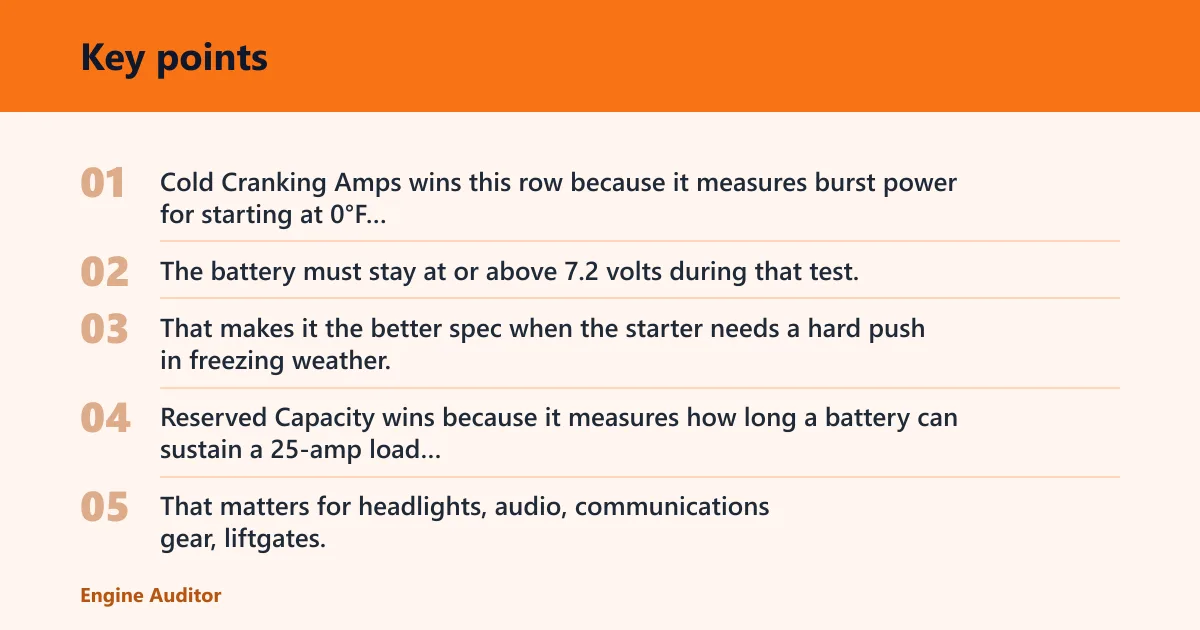
Cold Cranking Amps wins this row because it measures burst power for starting at 0°F (-18°C) over a 30-second test on a 12V battery. The battery must stay at or above 7.2 volts during that test. That makes it the better spec when the starter needs a hard push in freezing weather.
Accessory runtime with engine off
Reserved Capacity wins because it measures how long a battery can sustain a 25-amp load at 80°F (27°C) before voltage falls below 10.5 volts. That matters for headlights, audio, communications gear, liftgates, and other hotel loads when the engine is off. If the alternator quits, runtime becomes the whole problem.
Alternator-failure backup
Reserved Capacity wins again for the same reason. Once charging stops, the question is no longer whether the engine cranks well in the morning. It is how long essential systems can keep running before voltage falls out of range and the vehicle begins to shut down accessories or stall.
Short-trip and city use
Reserved Capacity usually matters more on short trips because the battery gets asked to start the car often while spending less time on charge. Frequent stop-and-go use can leave the battery near partial state of charge, which makes backup time and cycling tolerance more useful than a large cranking number alone.
Towing and added electrical load
Reserved Capacity is the better fit when towing adds draw from trailer equipment, cooling demand, and accessories. A higher CCA battery may still start the engine well, but it does less for a long electrical load when the engine is idling or when charging falls behind demand.
Winter-only starting margin
Cold Cranking Amps is the clear winner when cold starts are the main concern and electrical load is modest. At low temperature, chemical reactions slow and engine oil thickens, so a battery’s ability to deliver a strong burst matters more than how long it can keep lights on later.
Cold cranking amps explained
Cold Cranking Amps measures engine-start burst power at 0°F (-18°C) over 30 seconds on a 12V battery. The battery must stay at or above 7.2 volts during that test. That is why CCA is the start-button spec: it tells you whether the battery can deliver a hard crank when the engine is cold and the starter needs the most help.
Why the 7.2-volt floor matters
The 7.2-volt minimum is not a casual label detail. It marks the point where the battery can still deliver useful starting power under a cold-load test. If voltage sags below that level, the battery may still have some charge left, but it is no longer meeting the starting standard being measured.
What CCA does and does not tell you
CCA tells you little about how long the battery can support the car after the engine is off. A battery can have strong cranking performance and still have weak backup runtime. That is why a high CCA label should never be treated as proof of strong reserve capacity.
Reserve capacity explained
Reserve Capacity measures how long a battery can sustain a 25-amp load at 80°F (27°C) before voltage falls below 10.5 volts on a 12V battery. That makes RC the survival-timer spec. It shows how long the battery can keep essential systems alive when charging stops or accessory demand stays high.
Why the 10.5-volt cutoff matters
At 10.5 volts, the battery has reached the standard end point for this test. That does not mean every electrical device fails at exactly that instant, but it does mean the battery has reached the industry cutoff used to describe backup time. The number is useful because it turns vague runtime into a measurable figure.
Why RC is tied to real-world backup
RC matters most when the alternator is off or failing. Headlights, electronics, pumps, and control modules keep drawing power, and the battery becomes the only source left. In that situation, the strongest question is not “Will it start?” It is “How long can it keep running?”
CCA vs reserve capacity decision matrix
The right spec changes with the job. Use this matrix when a battery listing gives you one number that looks good but leaves the other one weaker than you expect. The recommended profile tells you which balance makes sense, while the rationale shows why the choice changes by scenario.
| Driving scenario | CCA priority | RC priority | Recommended battery profile | Rationale |
|---|---|---|---|---|
| Cold winters | High | Medium | Higher CCA with adequate RC | Cold starts are harder, so burst power matters most. |
| Short trips | Medium | High | Stronger RC, solid baseline CCA | Frequent starts and limited recharge make backup time more useful. |
| Stop-start traffic | Medium | High | AGM-style balance or higher RC spec | Repeated restarts and accessory draw reward better cycling and reserve. |
| Accessory-heavy use | Medium | High | Higher RC than the minimum | Hotel loads can drain the battery faster than starting ever will. |
| Infrequent driving | Medium | High | Higher RC, low self-discharge setup if possible | Long sitting periods make backup margin more valuable than extra crank burst. |
| Towing | Medium | High | Higher RC with durable construction | Trailer gear and extra electrical load favor longer runtime. |
| Hot-climate commuting | Medium | Medium | Balanced spec, with RC slightly favored if accessories are heavy | Cold-start demand is lower, so reserve time often matters more than peak burst. |
Cold winters
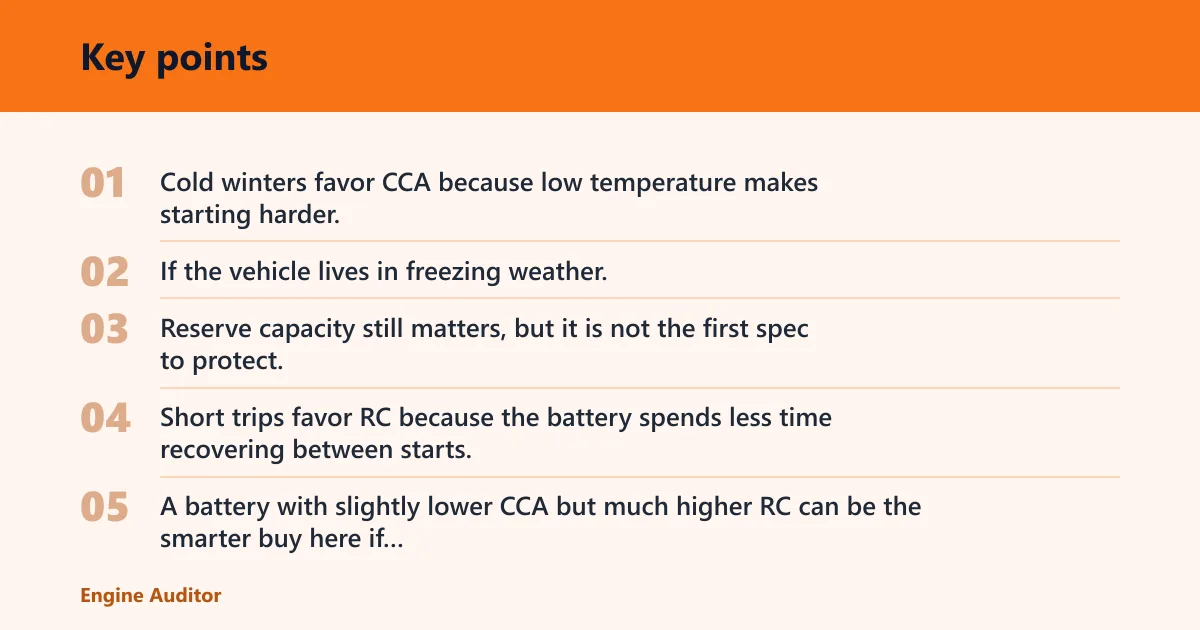
Cold winters favor CCA because low temperature makes starting harder. If the vehicle lives in freezing weather, a weak cranking number can show up as slow cranks, repeated starts, or a no-start morning. Reserve capacity still matters, but it is not the first spec to protect.
Short trips
Short trips favor RC because the battery spends less time recovering between starts. A battery with slightly lower CCA but much higher RC can be the smarter buy here if winter is not severe. The practical goal is to keep the vehicle from falling behind on charge.
Stop-start traffic
Stop-start use raises the value of reserve time and cycling tolerance. Many modern batteries in this role do better when the chemistry handles repeated partial discharge more gracefully. AGM often fits this middle ground because it bridges starting and reserve needs better than a basic flooded battery.
Accessory-heavy use
Accessory-heavy use clearly favors RC. If the vehicle powers a GPS, liftgate, communications gear, or camping loads while parked, the battery has to sustain demand after the engine shuts off. High CCA alone does not help much once the starter is done.
Infrequent driving
Infrequent driving often favors RC because the battery has more chance to sit than to recharge. A battery that can support essential loads longer gives more margin if the vehicle sits for days or weeks. The key is still to stay above the vehicle’s minimum CCA requirement.
Towing
Towing adds electrical strain, so reserve time becomes more important than a cranking number that only helps at startup. This is where a battery can have high CCA and still be the weaker choice if its RC is poor. The engine may start fine, then the electrical system runs short of headroom.
Hot-climate commuting
Hot-climate commuting often reduces the need for extreme CCA, since cold starting is less of a burden. That shifts attention toward RC if the commute includes traffic, idling, and accessories. A balanced battery is usually the right target unless the vehicle has unusual electrical demand.
How battery chemistry changes the trade-off
Battery chemistry changes how much the pack can tolerate cycling, vibration, and partial discharge. It does not erase the CCA-versus-RC trade-off. It changes where the battery can sit within that trade-off while still meeting the vehicle’s needs.
AGM batteries
AGM batteries are often reported to offer better cycling capability and vibration resistance than traditional flooded lead-acid batteries. That makes them useful when the battery has to bridge starting and reserve needs at the same time. They are not universal upgrades, but they are often the better middle ground for demanding vehicles.
Flooded lead-acid batteries
Flooded lead-acid batteries are the traditional lower-cost starter option. They are common because they do the basic job well enough for many vehicles, but they usually need more maintenance than sealed options. If the use case is simple and cost matters most, they remain a practical choice.
LiFePO4 batteries
LiFePO4 is relevant in some reserve-focused use cases because it supports higher cycling than traditional flooded lead-acid. That said, fitment and charging compatibility still matter, and not every vehicle is ready for it. Treat it as a targeted option, not a default replacement for every 12V lead-acid battery.
Choose Reserved Capacity if… / Choose Cold Cranking Amps if…
Choose Reserved Capacity if your car sees short trips, stop-start traffic, accessory-heavy use, towing, or long periods where the engine may be off but the electrical load stays on. Choose it if alternator failure would leave you stranded by dead headlights, dead electronics, or a battery that cannot carry the car far enough to get help.
Choose Cold Cranking Amps if winter starting is the main risk, especially in cold climates where the engine needs a strong burst to turn over. Choose it if the vehicle has modest accessory demand and the battery’s main job is to get the engine started cleanly on cold mornings.
If both conditions matter, pick a mixed-spec battery with enough CCA to meet the vehicle minimum and the strongest RC you can reasonably buy within that class. That is the smart compromise for many daily drivers.
How do you compare battery labels?
Read the label as two separate promises. CCA tells you cold-start burst power, while RC tells you backup runtime. If you are comparing two batteries online, check both numbers side by side and treat the lower one as the limiting factor for its job.
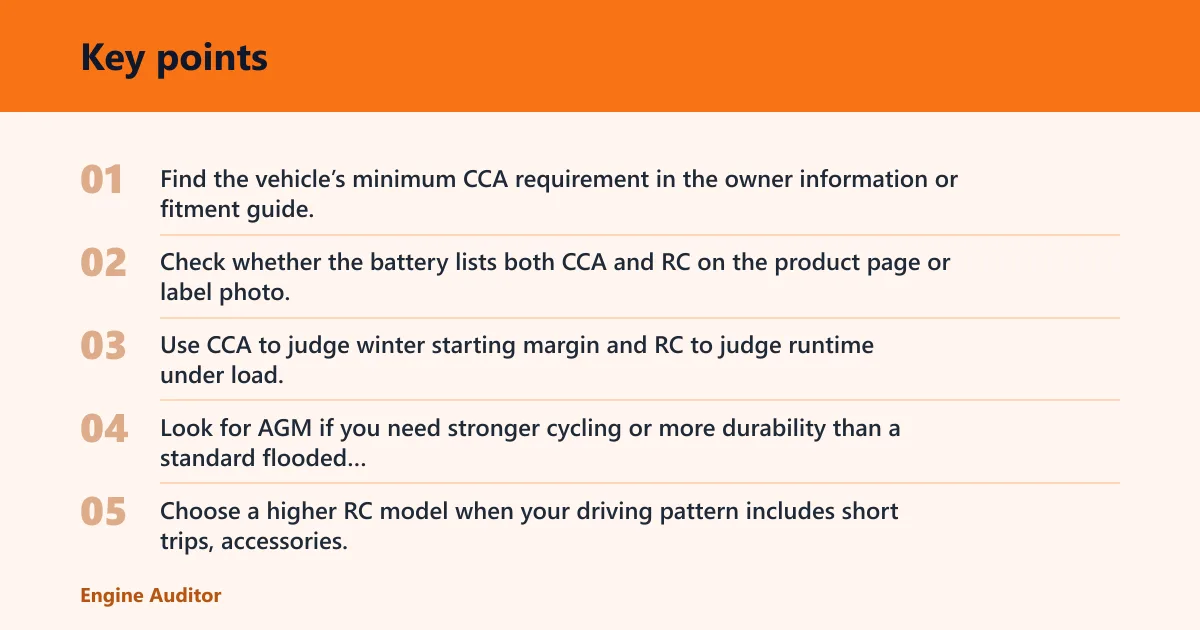
- Find the vehicle’s minimum CCA requirement in the owner information or fitment guide.
- Check whether the battery lists both CCA and RC on the product page or label photo.
- Use CCA to judge winter starting margin and RC to judge runtime under load.
- Look for AGM if you need stronger cycling or more durability than a standard flooded battery.
- Choose a higher RC model when your driving pattern includes short trips, accessories, or alternator-risk concerns.
What to do when one spec is missing
If a listing shows only CCA, do not assume reserve capacity is strong. If it shows only RC, do not assume it will meet winter-start needs. A product page that hides one number gives you less information than you need for a fair comparison.
How to translate the numbers into a purchase decision
Use CCA as the floor for starting reliability and RC as the tie-breaker for real-world use. If two batteries both clear the minimum CCA, the one with the higher RC is often the better buy for modern driving patterns. If winter is severe, reverse that logic and protect the cranking number first.
Frequently asked questions
Is reserve capacity more important than CCA for my car?
It is more important if you drive short trips, run accessories, or worry about alternator failure. CCA still has to meet the vehicle minimum, especially in cold weather. If you live where winters are harsh, CCA usually gets first priority for starting reliability.
How much CCA do I need for winter starting?
Use the vehicle’s minimum specification as the floor, then add margin if the climate is severe or the engine is hard to turn in winter. The right target depends on the vehicle, but the key rule is simple: do not buy below the published minimum just to gain more reserve time.
How does reserve capacity affect headlights and electronics if the alternator fails?
Reserve capacity tells you how long the battery can keep essential loads going when charging stops. That includes headlights and electronics, which become critical when the alternator fails. A higher RC gives more time to reach safety before voltage falls below the battery’s usable range.
Can a battery have high CCA but low reserve capacity?
Yes. That is a common trade-off, especially in batteries tuned for strong starting rather than long runtime. A high CCA rating only says the battery can crank hard at 0°F for 30 seconds while staying above 7.2 volts. It says little about how long it will power accessories.
What reserve capacity should I look for in a daily driver?
Look for enough RC to cover your driving pattern and accessory load after the engine is off. Daily drivers that only start and commute may be fine with a balanced battery, but short-trip or stop-start use benefits from stronger RC. The best number is the one that fits the vehicle and use case.
Does AGM improve reserve capacity and starting power?
AGM often improves the balance between starting power and reserve needs, especially where cycling and vibration matter. It is not a guarantee of a higher number on both specs, and it is not automatically the best buy for every car. It is a strong option when the battery must do more than basic starting.
Which matters more for short trips and city driving?
Reserve capacity usually matters more because the battery sees many starts and limited recharge time. City driving also adds idling and accessory use, which favors stronger backup time. Keep CCA above the minimum, but give RC the first look when the car spends much of its life in traffic.
Products related to this article
Sponsored / affiliate links. As an Amazon Associate I earn from qualifying purchases. I may earn additional commission from eligible campaigns.