What Happens If an EV Battery Gets Too Low?
An EV often warns first, then limits power, and may shut down before the pack truly reaches zero; many cars are reported to keep a small hidden reserve, but that reserve is not guaranteed. Ignoring the alerts can leave the vehicle stranded, and a dead high-voltage pack can leave the 12-volt system unable to wake the car. This guide explains the warning sequence, how much reserve is typical, why the 12-volt battery matters, and what to do before charge runs out.
How dash warnings and power changes unfold as charge drops
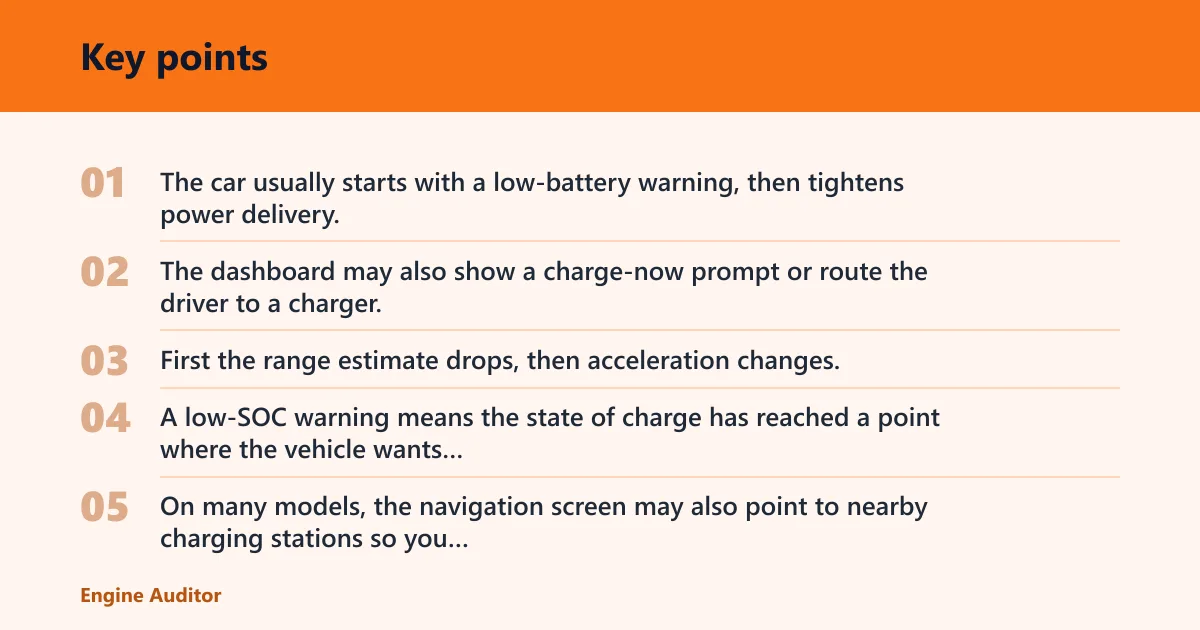


The car usually starts with a low-battery warning, then tightens power delivery, and only later reaches a no-drive state. The dashboard may also show a charge-now prompt or route the driver to a charger. First the range estimate drops, then acceleration changes, then top speed falls as the battery management system protects the pack.
What the dash warning usually means
A low-SOC warning means the state of charge has reached a point where the vehicle wants you to charge soon. The message can be visual, audible, or both. On many models, the navigation screen may also point to nearby charging stations so you can avoid the last stretch of the battery.
Why the car may still move after the alert
The battery pack usually still has usable energy after the first alert. The vehicle may keep a reserve below the displayed 0% reading, and that hidden margin can let the car move for a while. That reserve exists for protection, not for planning a long detour.
What changes first: range estimate, power, or speed
Range estimates often move first because they are built from recent driving, temperature, terrain, and load. As the pack gets lower, the car may cut power before it cuts speed completely. A steep hill, cold weather, or hard acceleration can shrink the practical margin fast.
Low-battery decision table
| State | Likely dash symptoms | Reserve may remain? | Keep driving? | Charge immediately? | Call roadside assistance? |
|---|---|---|---|---|---|
| Early warning | Low-SOC alert, charge-now message, possible route-to-charger prompt | Usually yes | Yes, but only to reach a charger | Yes | Usually no |
| Critical warning | Stronger alert, reduced range estimate, possible battery icon changes | Small margin, model-dependent | Only if a charger is very close | Yes, immediately | Maybe, if no charger is safely reachable |
| Reduced-power mode | Slower acceleration, lower top speed, reduced throttle response | Often yes, but shrinking fast | Only to move clear and reach power | Yes | Yes if the nearest charger is not nearby |
| No-drive shutdown | Vehicle will not propel, may show no-ready or warning messages | Possibly a tiny buffer, not useful for driving | No | Not until the car can be recovered | Yes, usually for a flatbed tow |
Use the table as a decision aid, not a mileage promise. Reserve size varies by model, and range error can be large near empty. If the car is still driving, the goal is to get to a charger with the fewest miles possible, not to “use up” the pack.
Will my EV stop immediately when the battery hits 0%?
No. Displayed 0% does not always mean the traction battery is physically empty. Many EVs keep a protected buffer below the dashboard reading, and the BMS may still allow a short crawl or no meaningful travel at all depending on model logic, temperature, and battery condition.
Displayed 0% versus usable reserve
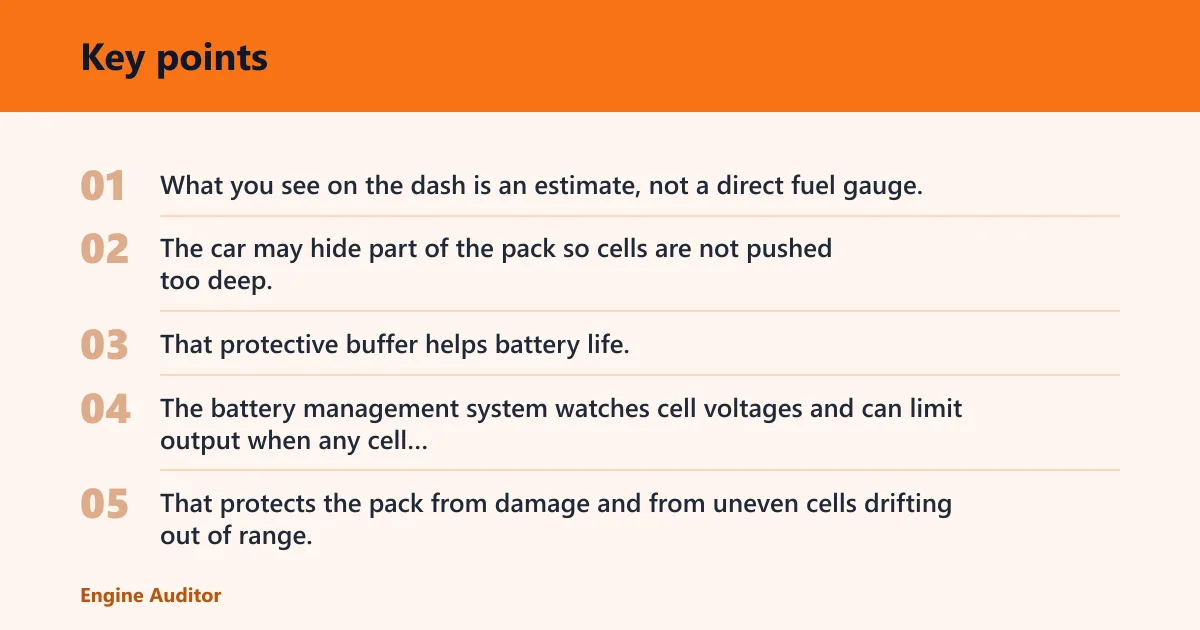
What you see on the dash is an estimate, not a direct fuel gauge. The car may hide part of the pack so cells are not pushed too deep. That protective buffer helps battery life, but it also means the last few percent are not a travel plan you can count on.
Why the BMS holds back a buffer
The battery management system watches cell voltages and can limit output when any cell gets too low. That protects the pack from damage and from uneven cells drifting out of range. The buffer also helps the car maintain a margin for contactors, electronics, and a safe shutdown path.
Why empty range is not a safe buffer
Range to empty can change with weather, speed, wind, hills, and cabin heating. A car showing “0 miles” may still move a short distance, but the estimate can also be wrong enough to leave no usable margin. Treat 0% as the point to stop gambling, not the point to keep testing.
Say your car shows 2 miles remaining after a freeway exit warning. If the next charger is 1 mile away on flat roads, it may still be worth a careful crawl. If that same 2 miles includes a steep climb, the safer move is to stop and arrange a tow or charge on-site if possible.
What turtle mode or reduced-power mode means
Reduced-power mode is the car saying it needs to limit demand before the battery or electronics get into a worse state. Expect slower acceleration, less throttle response, and a lower top speed. It is a protection step, not a normal driving mode, and it can arrive with little margin left.
Acceleration limits and top-speed reduction
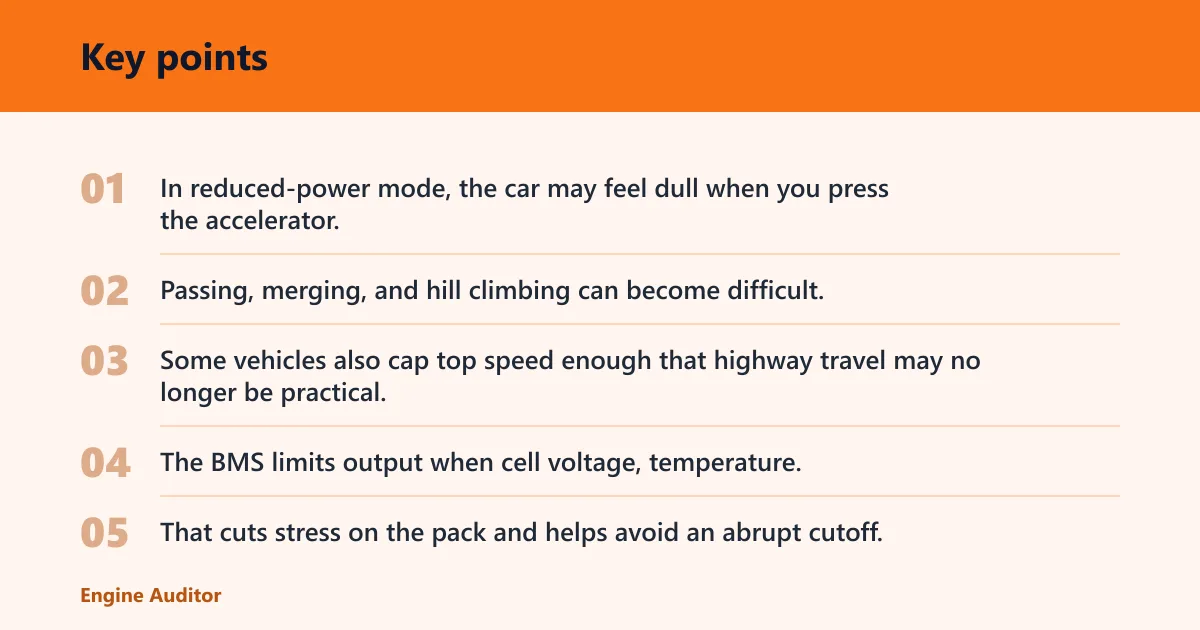
In reduced-power mode, the car may feel dull when you press the accelerator. Passing, merging, and hill climbing can become difficult. Some vehicles also cap top speed enough that highway travel may no longer be practical, even if the car still moves under light throttle.
Why the car limits output
The BMS limits output when cell voltage, temperature, or state of charge is getting too low. That cuts stress on the pack and helps avoid an abrupt cutoff. It can also keep the 12-volt charging system from being overloaded if the high-voltage side is near its lower boundary.
When reduced power is a warning, not a failure
Reduced power often means the car still has enough energy to reach a charger nearby. But the warning is serious. If the car is on a shoulder, in fast traffic, or far from charging, stop driving hard and make the recovery decision early rather than waiting for a full shutdown.
Can a low EV battery damage the pack?
Yes, repeated deep discharge is undesirable for battery health. A single low event does not usually ruin a pack, but running to empty often, leaving it empty for a long time, or demanding high power at very low SOC can add stress. Cold weather makes the margin smaller.
Why repeated deep discharge is undesirable
Cells are happiest with some buffer, not repeated trips to the bottom. The BMS uses protective buffering to reduce that stress, but draining to the last usable bit again and again is hard on the system. It also raises the chance of a roadside no-start if the reserve gets exhausted.
How cold weather and high load make low SOC worse
Cold cells deliver less power and show less useful range. High speed, steep grades, towing, and aggressive acceleration all pull the pack down faster. If the battery is already low, those conditions can push it into reduced-power mode sooner than a calm city drive would.
Why sitting empty for long periods is a bad idea
A pack that sits empty is more vulnerable than one that is promptly recharged. If the vehicle is left parked after shutdown, the low-voltage systems can also drain the 12-volt battery while the main pack remains low. That combination can make recovery harder.
Suppose an EV reaches reduced-power mode after a cold evening commute. If the driver stops at the first charger and plugs in, the pack gets back to a safer range. If the vehicle is parked overnight at empty, the chance of a no-start problem rises because the 12-volt system may lose support too.
How the 12-volt battery can complicate recovery
The traction battery may still have charge, yet the car may not wake up if the 12-volt battery is weak. The 12-volt system powers electronics, contactors, locks, and other wake-up functions. When it fails, the vehicle can look dead even though the main pack is not fully empty.
What the 12-volt system powers
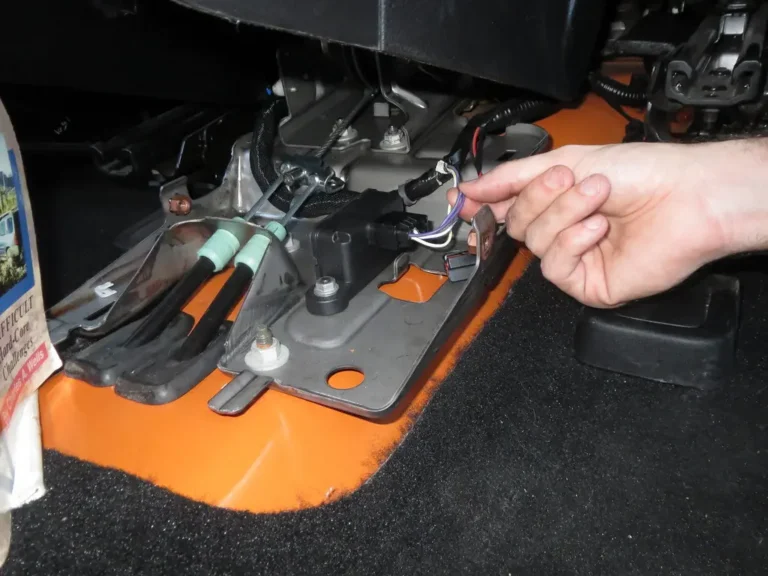
The 12-volt battery feeds the low-voltage controls that close the high-voltage contactors and boot the car’s computers. If that battery is low, the dash may go blank, the car may not enter ready mode, or warning messages may appear without the vehicle moving.
Low-voltage symptoms that look like a dead EV
Common signs include a blank screen, repeated clicking, interior lights that fade or flicker, doors that behave oddly, or a car that will not shift into drive. Those symptoms can come from the 12-volt system even if the traction battery still has charge left in reserve.
Why a traction pack with charge can still leave you stranded
Once the 12-volt battery cannot support the wake-up sequence, the car may not close the contactors needed to use the high-voltage pack. That is why a roadside call may still be needed after a traction-battery low event. A jump or charge of the 12-volt side may be part of recovery, depending on the model.
What should I do if my EV battery is almost dead?
Head for the nearest charger right away, slow down, and avoid heavy acceleration. If the car has already entered reduced-power mode, your priority is distance control, not speed. If the vehicle stops, do not keep trying to drive it; follow the maker’s recovery steps and arrange towing if needed.
- Check the dash and navigation for the nearest charger.
- Reduce speed and avoid hard acceleration.
- Turn off nonessential loads such as extra climate output if safe to do so.
- Exit the freeway early if the next charger is close enough on surface streets.
- If the car enters no-drive mode, call roadside assistance and follow towing instructions.
Use the charging cable or EVSE as soon as you can. Home Level 1 or Level 2 charging is often the simplest recovery after a low-battery event, but only after the car is safely parked and ready to accept a charge. If the vehicle has shut down, do not assume it will restart just because a plug is nearby.
What happens to old EV batteries?
When an electric car battery wears out after about a decade, it is often too weak by then to drive far, though it can still hold plenty of charge for lighter work. Retired packs can be recycled or used in second-life storage. The path depends on condition, chemistry, and local rules.
Recycling and second-life storage
A retired pack can run another five to 10 years in a warehouse if it still passes inspection for stationary use. That is a different job from propelling a car. Recycling then targets the valuable metals, while second-life use delays that step when the pack still has useful capacity.
What materials matter most
Nickel and cobalt are the valuable metals in many chemistries. Lithium-iron-phosphate batteries contain no nickel or cobalt, which changes the economics of recycling. China has 85% of the world’s recycling capacity, and its rules took effect on April 1.
Why old batteries are a separate topic from a dead car
The fact that a pack is retired does not explain what happens when the car is low on charge today. For the driver, the key issues are warning behavior, reduced power, shutdown, and towing. Recycling matters later, after the vehicle is no longer useful on the road.
Frequently asked questions
What happens when EV car battery dies?
Once the traction battery can no longer supply propulsion, the car enters a no-drive state and may shut down electrical functions needed for normal operation. Some vehicles may still power lights or accessories briefly from the 12-volt battery, but you should treat the car as stranded and arrange recovery.
Can I still drive after the battery warning comes on?
Often yes, but only long enough to reach a charger. The first warning usually means charge soon, not drive normally. If the car has already shifted into reduced-power mode, keep the trip short, avoid steep routes, and stop driving once the next safe charging option is available.
How far can I go once the low-battery warning appears?
There is no universal miles-left number. The remaining distance depends on the model’s reserve buffer, temperature, speed, hills, and battery condition. In real use, the warning means you should look for the nearest charger immediately rather than trying to stretch the estimate.
Is slow charging better for ev battery?
Slow charging is often gentler on the pack than repeated fast charging at high state of charge, but the best choice depends on the car and situation. For recovery from low battery, the main goal is simply to get the vehicle back into a safer charge range soon.
Why is my car battery voltage low?
If you mean the 12-volt battery, low voltage can come from age, repeated short trips, a failed charging system, or leaving the vehicle parked while systems keep drawing power. In an EV, low 12-volt voltage can prevent the car from waking even when the traction battery still has charge.
Products related to this article
Sponsored / affiliate links. As an Amazon Associate I earn from qualifying purchases. I may earn additional commission from eligible campaigns.