What Causes a Tire to Keep Losing Air with No Puncture?
A tire that drops more than about 2 psi in a week, or goes low overnight, is often a sign of a slow leak. Small swings from temperature are normal, about 1 psi for every 10°F drop. Leave it alone and you can damage the tire, wheel, or TPMS, then end up with a flat. This guide shows how to tell normal pressure drift from a real leak, then narrow the cause to temperature, valve, bead, rim, or hidden tire damage.
Normal tire pressure loss and warning signs


Not every pressure drop comes from a nail or screw. Tires lose a little air through the rubber itself, and older tires often lose faster. A pressure loss that is steady, small, and similar across months can be normal permeation rather than a hole.
Normal permeation versus a real leak
Many tires lose 1 to 3 PSI per month even with no damage. That kind of drift is different from a leak that shows up overnight or after a short drive. If the same tire loses more than 2 PSI in a day, it needs repair.
How much PSI loss is typical?
Use the pattern, not the dashboard warning alone. A loss of 3 to 5 PSI per week is likely a slow leak. More than 5 PSI per week is described as a definite leak. A tire that drops only a little over a month may simply be following the normal range.
When repeated loss means something is wrong
A tire that keeps needing air after each top-off is not acting like ordinary permeation. That points to a leak at the tread, valve, bead, rim, or inner liner. If the same tire is the only one dropping, start with that wheel assembly before assuming the tire carcass is damaged.
Temperature drop or leak?
Cold weather can make a good tire look low. A pressure drop of about 1 PSI can happen for every 10°F fall, and all four tires usually drop in the same direction at the same time. That is different from a true leak, which usually affects one tire more than the others.
How cold weather changes PSI
If the night turns colder, the pressure in every tire can fall by the morning. That does not mean air escaped through a puncture. Check the placard on the driver door-jamb for the recommended pressure, then refill to that value and recheck later when the tires are cold again.
Why all four tires may drop together
When all four tires read lower after a cold snap, temperature is the first suspect. A one-tire problem is different. If one tire is down 4 PSI while the others changed by about 1 PSI each, that lone tire deserves a leak check.
When to suspect a true leak instead
A tire that loses air faster than the others, or keeps falling after the weather stabilizes, likely has a real leak. TPMS can warn you, but it does not identify the source. The light may come on when a tire is 25% below recommended PSI, which is already low enough to need attention.
Leak triage table
| Symptom pattern | Likely source | At-home test and shop confirmation | Repairable versus replace-only |
|---|---|---|---|
| All four tires drop together after a cold night | Temperature change | Compare pressures at the same time of day; refill and recheck when cold | Not a repair case unless one tire keeps falling after temperature stabilizes |
| One tire loses 3 to 5 PSI per week | Slow leak at tread, valve, bead, or rim | Soapy water on tread, valve, bead, and rim lip; bubbles mark the source | Often repairable if the leak is in the tread and the tire body is sound |
| One tire loses more than 5 PSI per week | Definite leak | Inspect for bubbles, then have the wheel assembly checked | Depends on source; wheel cracks, sidewall damage, and some liner issues are replace-only |
| Tire drops overnight with no visible nail | Valve core, valve stem, bead seat, or rim corrosion | Check the valve area first, then the bead and rim lip with soapy water | Valve parts and resealing may be repairable; cracked stems and cracked wheels are replace cases |
| Loss returns after a prior repair | Bad repair, hidden damage, or a second leak source | Have the tire demounted for inner-liner inspection | Repairable only if the new source is a valid tread puncture and the tire still qualifies |
| Bulge, cut, or crack on the sidewall | Sidewall damage | Stop driving and inspect visually | Replace only; sidewall damage is not safe to repair |
Check the valve area first
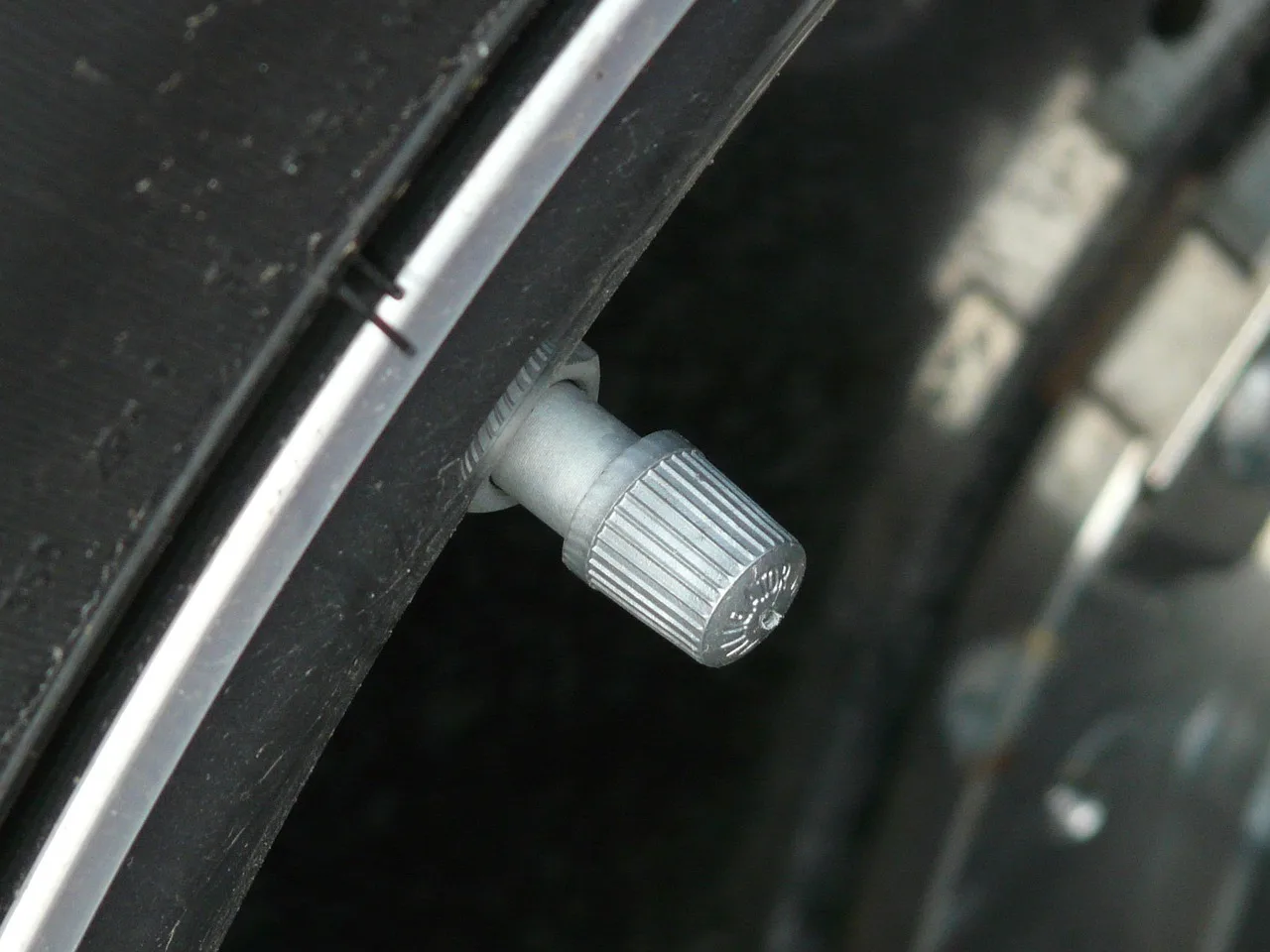
The valve assembly is a common leak point and easy to inspect. Start there before you pull the tire off the wheel. A valve core can loosen or corrode, and a rubber valve stem can crack at the base or seep where it passes through the wheel.
Valve core leaks
The valve core is the tiny brass insert inside the stem. If it loosens or corrodes, it can bleed air slowly. A quick soapy water check at the valve tip will show bubbles if the core is leaking.
Cracked or leaking valve stems
Rubber valve stems often crack after 5+ years. The crack may be near the base, where the stem flexes and seals against the wheel. A metal stem can also leak if its seal or hardware is damaged. In many cases, the stem is replaced with a service kit.
TPMS stem and service-kit issues
Some TPMS systems use stems with separate service parts. If a tire keeps losing air after a sensor service or stem swap, the leak may be at the stem seal, washer, or grommet rather than in the tire itself. That is a shop-level inspection.
Is the leak at the bead or rim?
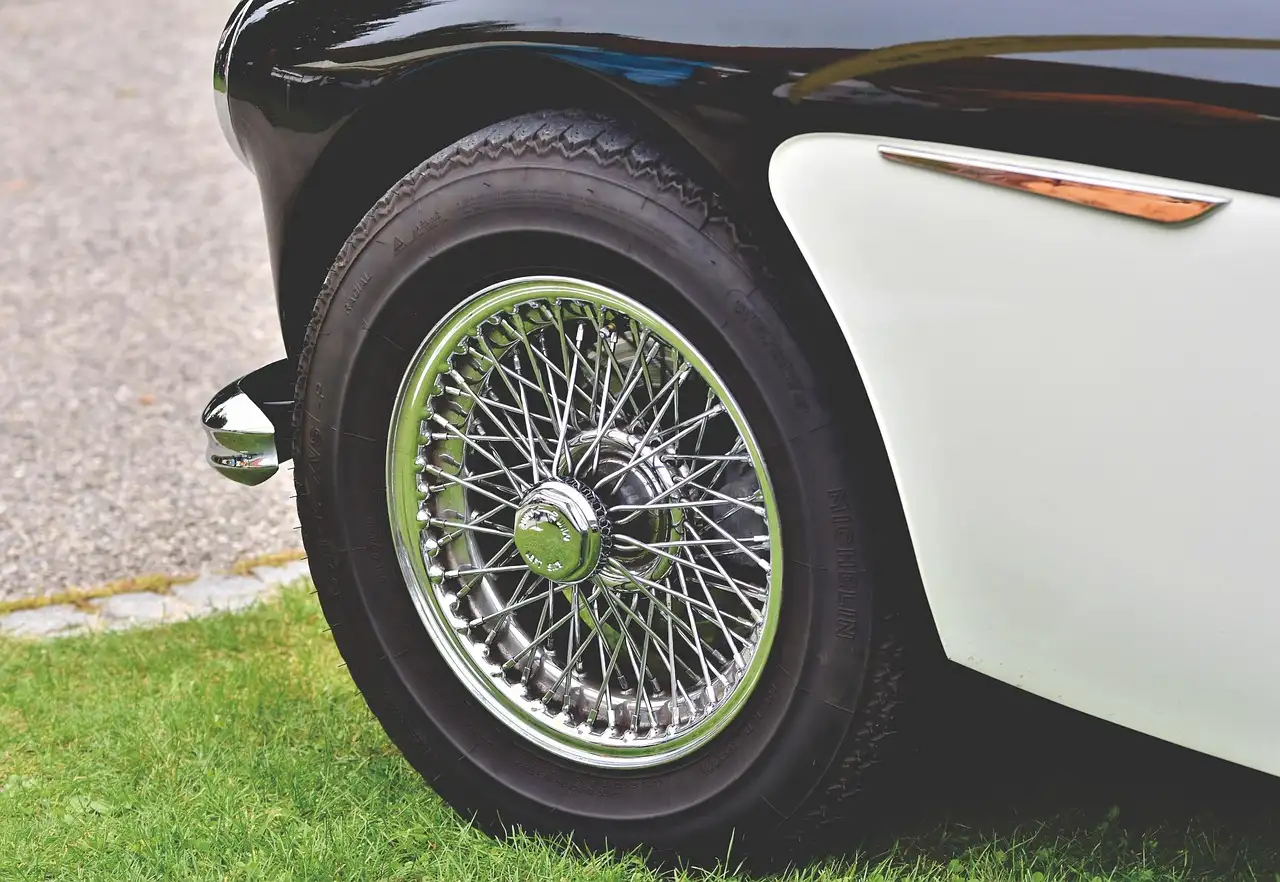
A bead leak happens at the tire’s sealing edge where it meets the wheel. Dirt, corrosion, or poor seating can break that seal. Wheel damage can do the same thing. These leaks often sound or test like a tire leak, but the problem is in the wheel assembly.
What a bead leak looks like
A bead leak often leaves no obvious puncture in the tread. Air escapes at the contact line around the rim, so the tire may go low without any nail or screw in sight. On a soapy water test, bubbles form along the rim seat rather than in one spot on the tread.
Corrosion and dirt at the rim seat
Corroded wheel bead leaks are common on older alloy wheels. Rust, dirt, or old sealant can prevent a proper seal at the bead seat. Fixing it may require demounting the tire, cleaning the seat, and resealing the bead.
Bent, cracked, or corroded wheels
A bent lip from potholes can leak at the bend. Wheel rims can also crack from impacts, and alloy bead-seat corrosion can leak even when the tire is intact. If air loss continues after cleaning and resealing, ask for a runout or crack inspection.
Suppose your front-right tire on a compact sedan loses 4 PSI every week, but the other three stay nearly steady. That pattern points away from weather and toward one wheel assembly. If bubbles appear only at the lower rim edge, the bead or wheel lip is the next place to inspect.
Use a soapy water test
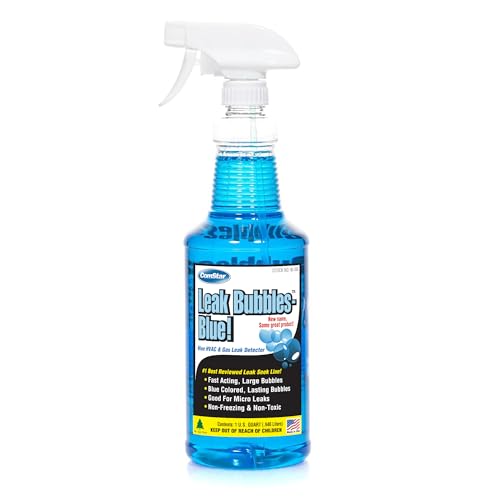
Soapy water is the simplest way to locate a slow leak. Spray it on the tread, valve core, valve stem base, bead, and rim lip. Bubbles mean air is escaping there. The goal is to narrow the source before any tire is removed.
Where to spray
Check the valve tip first, then the stem base where it passes through the wheel. Move to the bead on both sides, then the visible tread and any repair area. Finish by spraying the rim lip where the tire meets the wheel.
How bubbles identify the source
A cluster of bubbles at the valve tip usually points to the core. Bubbles at the stem base suggest a stem seal issue or a crack. A line of bubbles around the rim edge suggests a bead leak. A single spot on the tread suggests hidden puncture damage.
When to stop and go to a shop
If the tire loses air quickly, if bubbles appear from the sidewall, or if the wheel is visibly bent or cracked, stop driving and get it inspected. Sidewall damage is not safe to repair, and a damaged wheel may need replacement rather than resealing.
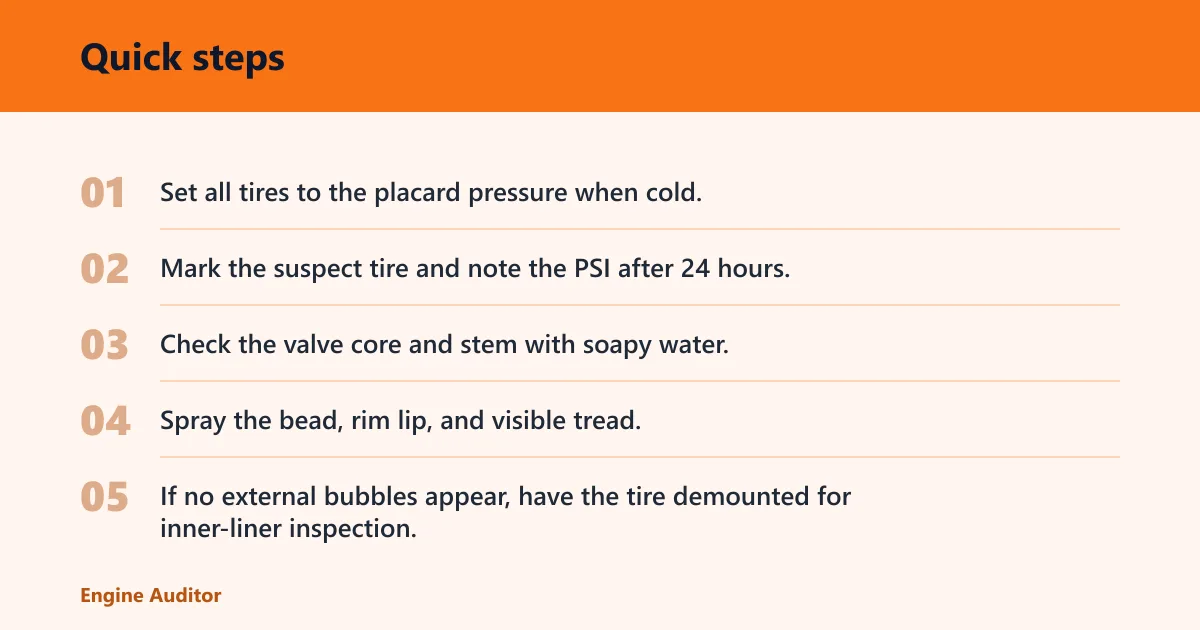
- Set all tires to the placard pressure when cold.
- Mark the suspect tire and note the PSI after 24 hours.
- Check the valve core and stem with soapy water.
- Spray the bead, rim lip, and visible tread.
- If no external bubbles appear, have the tire demounted for inner-liner inspection.
When is the tire itself the problem?
Sometimes the tire casing, not the wheel, is the source. Hidden tread damage may leak only under load or after the tire flexes. Repeated loss after a prior repair is also a warning sign that the tire has a second issue or was not repaired the right way.
Hidden tread damage
A nail in the tread can leak 2 to 5 PSI per day. Sometimes the head is gone, the object has fallen out, or the hole is hidden. An internal inspection can find damage that a quick visual check misses.
Sidewall cuts, bulges, and cracks
Sidewall damage is not safe to repair and requires replacement. Bulges, cuts, and cracks mean the tire structure may be compromised. Do not keep driving on it longer than needed to reach a safe stopping point or tow.
Repeated leaks after prior repair
A proper repair for a tread puncture is an internal plug patch, not an outside string alone. If a tire leaks again after an outside-only plug, the repair may never have sealed the inner liner. Run-flat tires can also have inner-liner damage that needs a shop inspection before any repair decision.
A common first-timer mistake is to keep inflating the same tire for a week because the TPMS light went out after top-off. If the pressure keeps falling again, the warning was only the alarm. The leak source still needs to be found.
Frequently asked questions
Why does my tire keep losing air but I can’t find a puncture?
The most common reasons are slow leaks at the valve, bead, rim, or hidden tread damage, plus normal permeation through the rubber. If the tire loses 3 to 5 PSI per week or more, treat it as a leak even if you cannot spot a nail.
How much air loss is normal in a car tire?
Many tires lose 1 to 3 PSI per month even with no damage. That is normal drift, not a puncture. If the same tire loses more than 2 PSI in a day, or keeps dropping after refill, it needs a leak check.
Can cold weather make a tire look flat with no leak?
Yes. A pressure drop of about 1 PSI can happen for every 10°F fall, and all four tires often drop together. If the pressure comes back after warming or after refilling to the placard value, temperature was probably the cause.
How do I check a valve stem for a slow leak?
Spray soapy water on the valve tip and the stem base where it enters the wheel. Bubbles at the tip suggest a valve core leak. Bubbles at the base suggest a stem seal or crack problem, which often means the stem or service parts need replacement.
Can a bent rim cause a tire to lose air slowly?
Yes. A bent lip from potholes can leak at the bend, and alloy wheels can also corrode at the bead seat. If soapy water bubbles appear at the rim edge and the tire itself looks intact, the wheel assembly may be the source.
Is a sidewall leak repairable?
No. Sidewall damage is not safe to repair and requires replacement. If you see a bulge, cut, or crack in the sidewall, stop driving as soon as it is safe to do so and arrange replacement rather than repair.
Products related to this article
Sponsored / affiliate links. As an Amazon Associate I earn from qualifying purchases. I may earn additional commission from eligible campaigns.