What Causes Cupping on Car Tires?
Cupping on car tires is usually caused by a suspension or damping problem, such as worn shocks or struts, but imbalance, loose suspension parts, bad alignment, low tire pressure, or a bent wheel can also create it. If you ignore it, the tread can wear out quickly, the vehicle can shake and drone at speed, and a hidden wheel or suspension fault can get worse. This guide shows how to tell cupping from feathering, read the wear pattern, and decide what to inspect first.
What tire cupping looks like

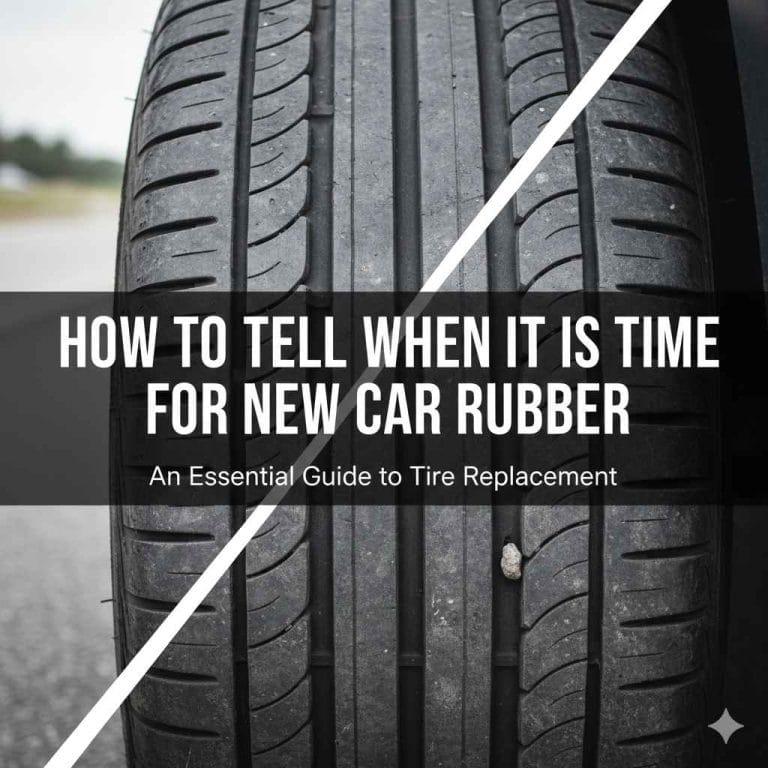
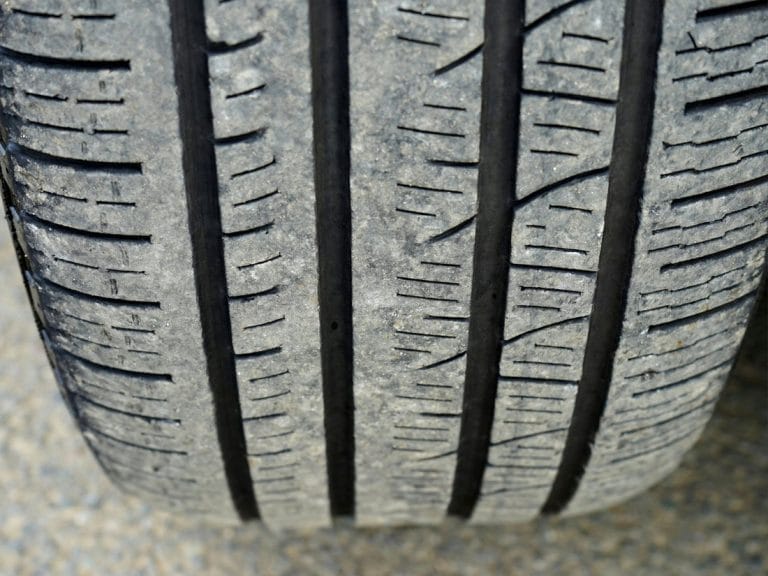
Tire cupping, also called scalloping, shows up as little scooped-out dips in the tread. The worn spots are usually 3–4 inches wide, and the tread often looks wavy instead of evenly worn across the face of the tire. It is usually a symptom of a vehicle problem, not random tire wear.
Scalloped tread pattern and where it shows up
The pattern often appears in repeating dips around the tire. On a single tire, you may notice one shoulder that looks lower than the rest, or a series of alternating high and low spots that you can feel with a hand rubbed lightly across the tread blocks. That uneven shape is the clue.
Say your front right tire has a series of shallow dips across the outer half of the tread, and the left front tire looks even. That corner-specific wear pattern points more toward a suspension or wheel problem on that side than toward a general rotation issue.
How cupping sounds and feels while driving
Cupped tires often cause vibration at highway speeds and a rumbling noise. The noise may sound like a bad wheel bearing or an aggressive all-terrain tire, but the key clue is that the sound usually gets worse as speed rises and the tread pattern shows repeated dips.
How to tell cupping from normal wear
Normal wear is usually smooth and even. Cupping leaves a pattern that feels choppy. If the tread is worn low in isolated patches rather than uniformly across the tread width, suspect a vehicle issue before you blame the tire itself.
Cupping vs. feathering
Cupping and feathering are different patterns. Cupping looks like scooped-out dips or a wavy tread. Feathering usually means the tread blocks feel sharp on one edge and rounded on the other, which points more toward toe and alignment than toward damping. That distinction matters because the first checks are different.
Edge shape and tread direction clues
Run your hand across the tread carefully. Feathering feels smooth in one direction and sharp in the other. Cupping feels like a rhythm of hollows and rises. If the wear has a directional edge to it, alignment moves higher on the list. If the tread has repeating dips, damping or wheel motion comes first.
Which wear pattern points more toward alignment?
Alignment problems, especially toe-related wear, are commonly associated with feathering rather than cupping. Alignment can contribute to cupping, but it is usually not the first suspect when the tread has repeating scallops and the vehicle also bounces or rumble-wears one corner.
Which wear pattern points more toward damping?
Cupping points more toward shock or strut control than to alignment alone. When the wheel keeps bouncing after a bump, the tire contacts the road unevenly and the tread wears in patches. That is why damping problems sit near the top of the list.
What causes tire cupping?
The most common cause cited is worn shock absorbers. Worn shocks let the wheel hop after bumps, so the tread hits the road in repeated bursts instead of holding steady. Struts can do the same job on the front axle, so front-end cupping often starts with those parts. Wheel imbalance, bent rims, loose suspension parts, and alignment can also contribute.
Worn shock absorbers and struts
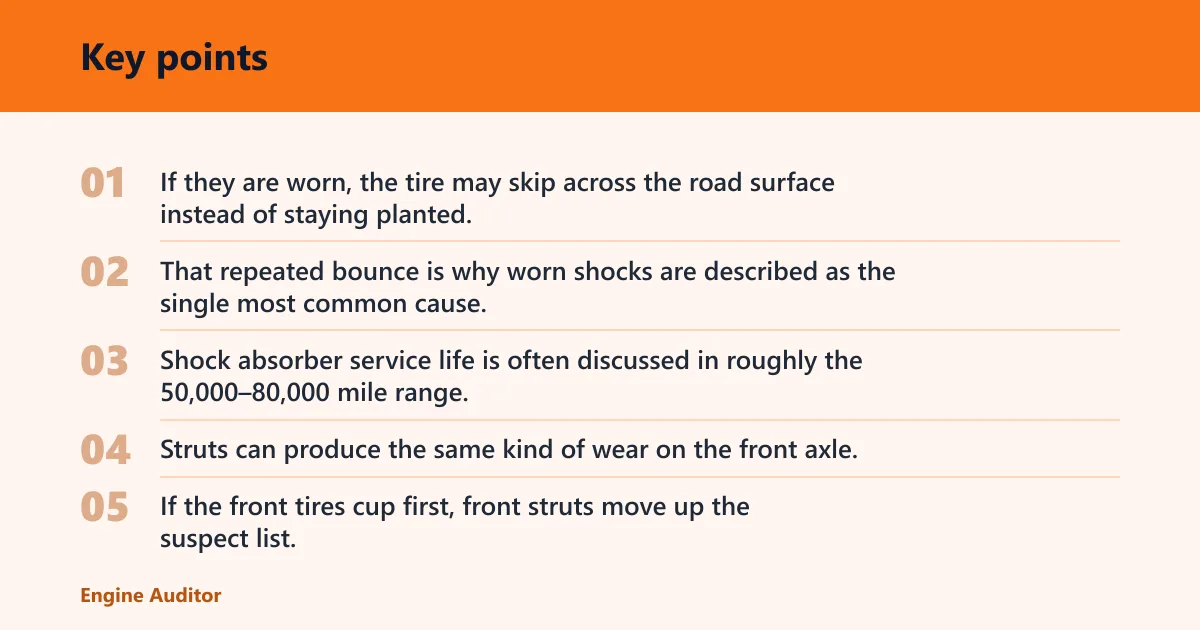
Shock absorbers control suspension rebound. If they are worn, the tire may skip across the road surface instead of staying planted. That repeated bounce is why worn shocks are described as the single most common cause. Shock absorber service life is often discussed in roughly the 50,000–80,000 mile range, but that is only a common range, not a rule.
Struts can produce the same kind of wear on the front axle. If the front tires cup first, front struts move up the suspect list. The parts do not need to be completely failed to cause trouble; reduced damping is enough to let the tire hop and wear unevenly.
Wheel imbalance and bent rims
Wheel balancing addresses weight imbalance and can help prevent localized wear. A bent wheel or rim can create a vibration that the tire “feels” every revolution, which can add to cupping. Balancing can reduce the cause, but it does not repair already cupped tread.
Control arm bushings and ball joints
Control arm bushings and ball joints hold wheel motion in a repeatable path. When they wear, the wheel can move inconsistently under load. That can mimic a tire problem, especially if cupping is isolated to one corner. If one tire cups while the others wear normally, inspect those parts closely.
Alignment problems as a contributor
Wheel alignment can contribute to cupping, especially when toe or camber is off and the suspension already has wear. Alignment is worth checking after suspension repairs, not as the first and only fix. If the vehicle also shows feathering, alignment moves higher on the list.
Cupping diagnosis matrix
This matrix helps you sort the most likely cause by wear pattern, axle, noise, and bounce test result before you spend money on parts. A common diagnostic sequence is to start with tire pressure, visual inspection, wheel balance, and suspension inspection before alignment, after worn parts are corrected.
| Symptom | Likely cause | First check | Next action |
|---|---|---|---|
| Front tires cup, rumbling at speed, one corner bounces more after a push-down test | Worn front struts or shocks | Inspect front damping and rebound control | Replace worn struts or shocks, then check alignment |
| Rear tires cup, rear feels loose over small bumps, bounce test shows repeated motion | Worn rear shocks | Inspect rear dampers for leakage or weak rebound | Replace shocks before fitting new tires |
| One tire cups more than the others, vibration comes with speed, bounce test is normal | Wheel imbalance or bent rim | Check wheel balance and wheel runout | Balance the wheel or repair/replace the bent rim |
| One corner cups, steering or ride feels inconsistent, bounce test is not conclusive | Control arm bushing or ball joint wear | Inspect for play at the affected corner | Repair worn suspension parts, then recheck tire wear |
| Wear includes cupping and feathering together | Suspension wear plus alignment error | Check damping first, then alignment angles | Fix suspension wear, then align the vehicle |
Wear pattern by axle and corner
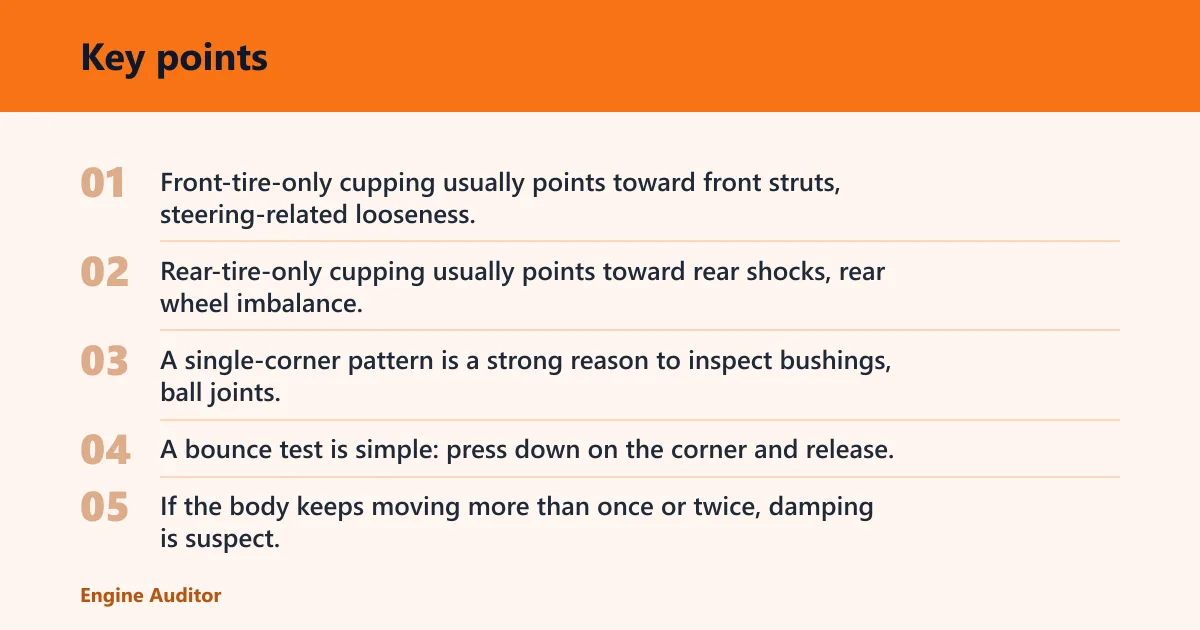
Front-tire-only cupping usually points toward front struts, steering-related looseness, or wheel issues at the front. Rear-tire-only cupping usually points toward rear shocks, rear wheel imbalance, or rear suspension wear. A single-corner pattern is a strong reason to inspect bushings, ball joints, and the wheel itself on that corner.
Bounce test results and what they suggest
A bounce test is simple: press down on the corner and release. If the body keeps moving more than once or twice, damping is suspect. If the body settles quickly but the tire still cups, look harder at wheel balance, rim condition, and suspension play.
Noise, vibration, and the most likely cause
Vibration at highway speeds with a rumbling noise supports cupping, but it does not name the cause by itself. Pair the noise with the location of the wear. Front noise plus front cupping points to front damping or steering wear. Rear noise plus rear cupping points to rear shocks or rear suspension issues.
Why are my front tires cupping?
Front tires cup most often because the front damping parts are worn, especially struts. The front end also carries steering loads, so loose bushings, ball joints, or a bent wheel can show up there first. If the wear is front-only, do not start with tire replacement before checking those parts.
Front struts and damping wear
Front struts can lose control of wheel rebound while still looking normal at a glance. That makes front tires hop and wear in patches. If the cupping is on the front axle and the noise changes with speed, struts belong near the top of the inspection list.
Steering and suspension play at one corner
When only one front tire cups, inspect the control arm bushings and ball joints on that side. A small amount of play can be enough to let the wheel change angle under load. That motion can make a tire look damaged when the real fault is in the suspension.
When front alignment is part of the problem
Front alignment can worsen the wear pattern if toe or camber is off, especially after a curb strike or after suspension parts wear out. Set alignment after the worn parts are fixed. An alignment set on worn parts often drifts again.
Will tire rotation fix cupping?
Tire rotation can slow future uneven wear, but it will not reverse advanced cupping. If the tread already has scalloped dips, rotation only changes where the wear sits on the vehicle. The root cause must be fixed first, or the next set of tires can cup again in the same pattern.
What rotation can and cannot do
Rotation spreads wear across tires that are still healthy. It is a prevention step, not a repair for a damaged tread pattern. If the wear is already deep enough to cause vibration or a rumbling noise, rotation alone will not solve the problem.
When balancing or road-force balancing helps
Balancing helps when weight imbalance is contributing to localized wear. Road-force balancing can help find tire and wheel variation that a standard balance may miss. Even so, balancing does not flatten a cupped tread. It only addresses one possible cause.
Why the root cause must be repaired first
Picture a sedan with fresh tires on the front, but worn shocks on the rear. If the rear damping is left alone, the new tires can start cupping again. Replace or repair the cause before you spend money on the next set.
The cheapest path starts with checks that cost little or nothing, then moves to parts and alignment. That order matters because cupping often comes from a vehicle fault, not the tire alone. Fix the cause first, then decide whether the tires can stay on the car.
- Check tire pressure and compare it across all four tires.
- Inspect the tread for scallops, feathering, sidewall damage, and uneven wear by corner.
- Inspect shocks or struts for weak rebound, leakage, or obvious wear.
- Check control arm bushings and ball joints for play at the affected corner.
- Inspect wheel balance and look for a bent rim or wheel runout.
- Set alignment after worn suspension parts are repaired.
- Replace tires only if the tread damage is too advanced to reuse safely.
- Resume a steady rotation schedule once the vehicle is corrected.
NHTSA TireWise is a tire maintenance resource that covers buying, maintenance, aging, labeling, and fuel efficiency. It emphasizes checking tire pressure, rotating tires, and checking tread, which fits this diagnosis path. Tire safety ratings and recall awareness also belong on the checklist.
Frequently asked questions
What causes cupping on car tires
The most common cause is worn shock absorbers, with worn struts close behind on the front axle. Wheel imbalance, bent rims, alignment issues, and worn suspension joints can also contribute. If the tread has scooped-out dips and the car rides rough or noisy, inspect damping and suspension before replacing tires.
What is the main cause of tire cupping?
Worn shock absorbers are commonly cited as the single most common cause. They let the wheel bounce instead of staying planted on the road, which creates uneven tread wear. If the front tires are involved, worn struts can produce the same pattern.
What causes cupping on front tires
Front-tire cupping usually points to front struts, front shock control, or looseness in steering and suspension parts such as bushings and ball joints. Front alignment can add to the wear, but it is often not the root cause. Check the front end first, then set alignment after repairs.
Why do my tires keep cupping?
If new tires cup again, the vehicle fault has not been fixed. The usual reasons are worn dampers, an out-of-balance wheel, a bent rim, or suspension play that keeps repeating the same wear pattern. Rotation alone will not stop it if the root cause remains.
Can worn shocks cause tire cupping?
Yes. Worn shocks can let the wheel bounce repeatedly, and that repeated motion creates the scalloped wear pattern. That is why shock absorbers are often the first parts inspected when cupping appears. Replacement is often needed before fitting new tires, especially if the old tires already show rumbling wear.
Will tire rotation fix cupping: no, not once the tread?
No, not once the tread is already cupped. Rotation can help prevent uneven wear and spread load more evenly across the set, but it cannot repair scalloped dips. Use rotation as maintenance after the suspension, wheel, and alignment issues have been corrected.
Products related to this article
Sponsored / affiliate links. As an Amazon Associate I earn from qualifying purchases. I may earn additional commission from eligible campaigns.