How to Tell if a Tire Is Out of Round: Quick Checks
A tire is likely out of round when the vibration or thump repeats once per wheel revolution and follows the tire after rotation, while a bent wheel stays with the rim. Ignore it and you can chase the wrong part, replace good components, and wear suspension parts faster. This guide shows how to separate an out-of-round tire from a bent wheel or balance problem with a few driveway checks.
What you’ll need
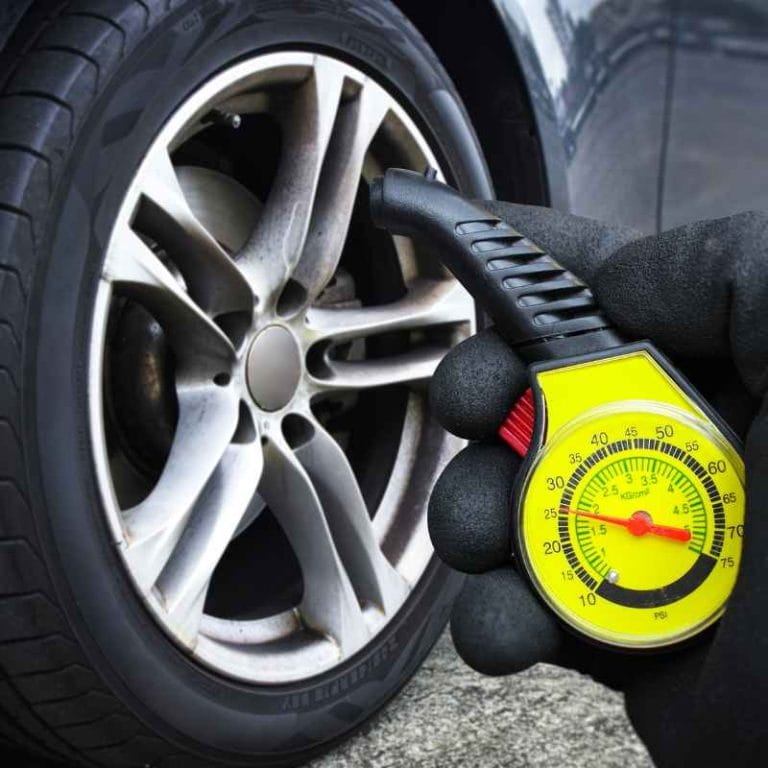
- Tire pressure gauge
- Tread depth gauge
- Jack, jack stands, and wheel chocks
- Dial indicator, or access to a shop that has one
- Tire balancer, or access to a shop that has one
- Basic hand tools for wheel removal
- Flashlight or inspection light
What an out-of-round tire feels like
An out-of-round tire usually causes a repeating hop, thump, or vibration that rises with road speed. The feel may come through the seat, steering wheel, or floor depending on which corner is affected. A balance problem more often feels smooth at low speed and gets worse in a narrower speed range.
Road-speed vibration
Road-speed vibration is the first clue because it often appears at a specific speed band, then fades or changes above it. A tire out-of-round condition is a roundness defect in the tire carcass or tread, and it can create a rhythmic shake even when the wheel is balanced.
Thumping, hop, and steering shake
A tire with a high spot can create a thump once per rotation. If the front tire is affected, the steering wheel may shake. If the rear tire is affected, the seat or floor often carries more of the sensation.
How the symptom changes with speed
If the symptom grows in direct step with speed, suspect roundness, imbalance, or a bent wheel. If it is strongest at one speed and then changes character, suspension wear, tire pressure, or uneven tread wear may also be involved.
What you’ll need before you start
- Set tire pressure to the driver-door placard value before checking anything else.
- Measure tread depth at the inner edge, center, and outer edge of each tire.
- Jack up the corner and secure the vehicle on stands.
- Spin each wheel and watch the tread and rim edge.
- Measure runout with a dial indicator if symptoms continue.
How to tell if a tire is out of round
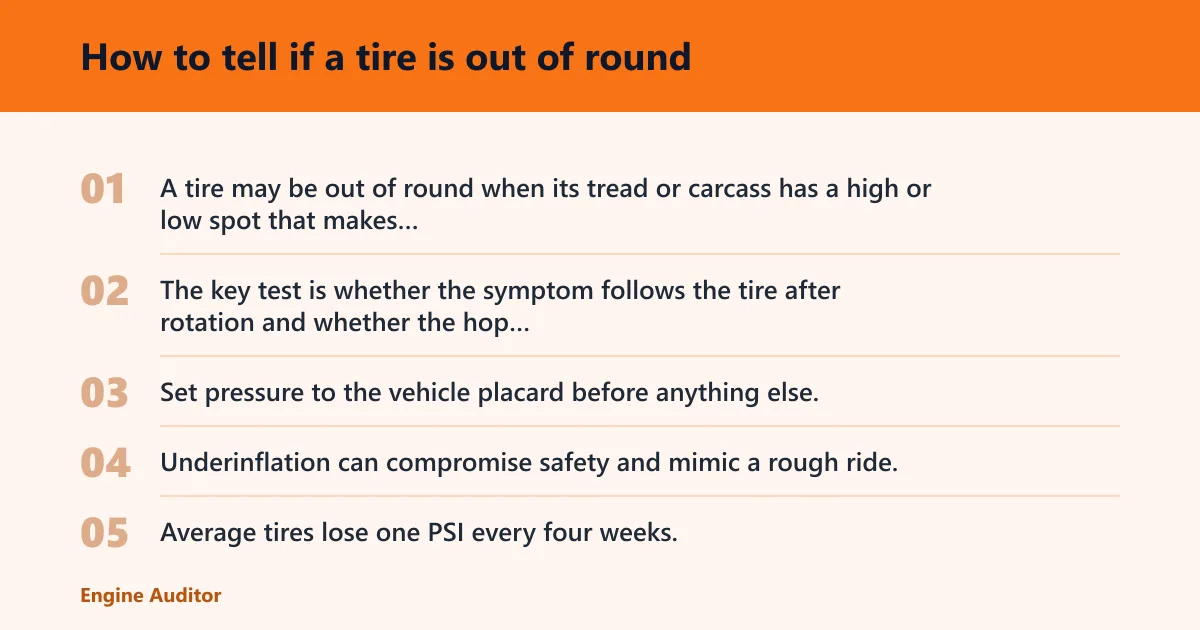
A tire may be out of round when its tread or carcass has a high or low spot that makes it hop as it rolls. The key test is whether the symptom follows the tire after rotation and whether the hop repeats at a regular interval as the wheel turns.
1. Verify pressure and inspect the tread
Set pressure to the vehicle placard before anything else. Underinflation can compromise safety and mimic a rough ride, while overinflation can make harshness feel worse. Average tires lose one PSI every four weeks, so a low reading deserves attention even if the tire looks normal.
2. Rotate the wheel and look for hop or side wobble
Lift the wheel, spin it slowly, and watch the tread line against a fixed point. A hop points more toward a roundness issue; a side wobble points more toward wheel runout. Look for cuts, bulges, exposed cord, and cupping or scalloping wear while the tire is in motion.
3. Compare runout, balance, and symptom location
If the tire looks irregular but the wheel face stays true, the tire itself is more suspect. If the symptom changes after swapping that wheel to another corner, the culprit is likely following the assembly. A tire balancer can help separate imbalance from a roundness issue, but it will not fix a bent rim.
How to tell if a wheel is out of round
A wheel is out of round when the rim itself has radial or lateral runout, meaning it moves up and down or side to side as it spins. That can produce the same kind of shake as a bad tire, so the wheel and tire must be checked separately.
Measure lateral and radial runout
Use a dial indicator against the wheel lip or mounting surface. Radial runout is the up-and-down variation, and lateral runout is the side-to-side wobble. A dial indicator reads small deviations and helps show whether the wheel or the tire is creating the fault.
Look for bent rims and bead-seat damage
Inspect the rim edge, bead seat, and inner barrel for curb strikes, pothole dents, or cracks. Harsh road conditions, uneven pavement, potholes, and even a sharp turn over a curb can damage a wheel or stress a tire enough to create symptoms later.
Separate wheel runout from tire runout
Mark the tire and wheel, then break the bead or remount the tire if a shop can do that step. If the runout stays on the wheel alone, the wheel is the problem. If the runout stays with the tire, the tire is the problem.
How to tell which tire is out of round
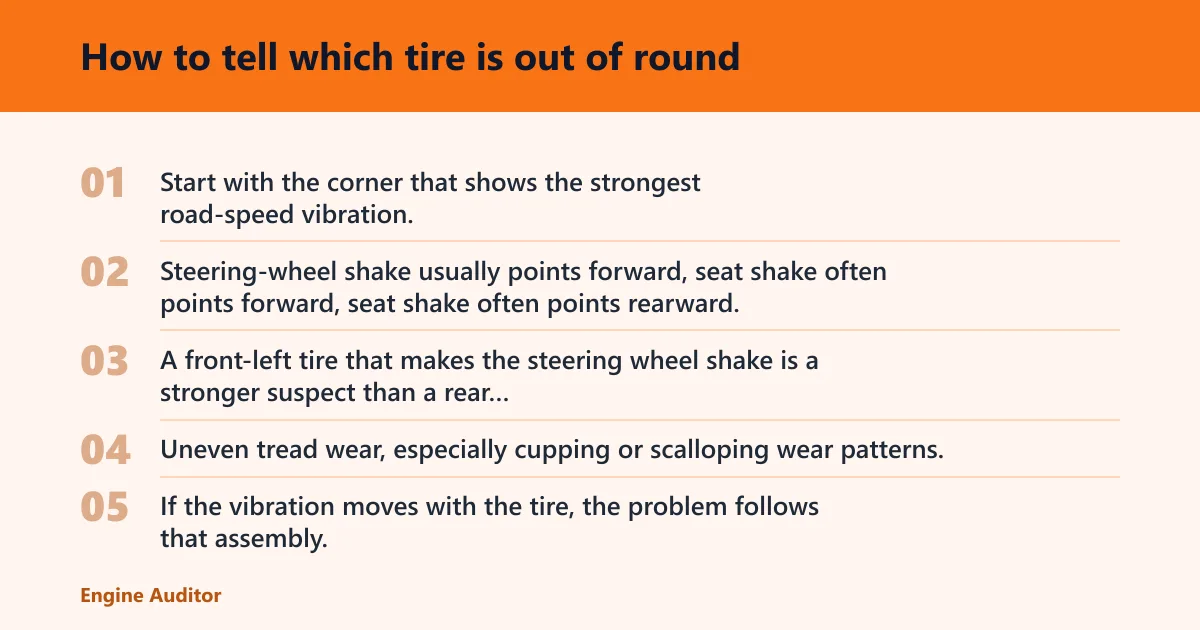
Start with the corner that shows the strongest road-speed vibration, then compare corners one at a time. Steering-wheel shake usually points forward, seat shake often points rearward, and a repeating thump that moves with rotation usually tracks the bad assembly after rotation or swapping positions.
| Symptom | Likely source | Next test |
|---|---|---|
| Steering-wheel shake at highway speed | Front tire, front wheel, or front suspension | Swap front tires side to side; check runout and balance |
| Seat shake or rear floor vibration | Rear tire, rear wheel, or rear suspension | Move rear wheels forward; repeat road test |
| Rhythmic thump once per revolution | Out-of-round tire or bent wheel | Spin by hand and measure runout |
| Vibration that improves after rotation | Tire-specific defect or uneven wear | Check tread depth and cupping or scalloping |
Use the symptom matrix
Match the symptom to the corner. A front-left tire that makes the steering wheel shake is a stronger suspect than a rear tire that only creates seat buzz. Uneven tread wear, especially cupping or scalloping wear patterns, should be documented because it can point to imbalance or suspension faults.
Recheck after rotation or swapping positions
If the vibration moves with the tire, the problem follows that assembly. If it stays at the same corner, look harder at the wheel, hub, brake rotor, tie rods, bearings, shocks, or struts. A common first-timer mistake is blaming the tire before checking the nearby wheel-end parts.
3-step diagnostic checklist
- Step 1: Set pressure to the placard value and inspect tread depth, cupping, bulges, and cord exposure.
- Step 2: Spin the wheel on jack stands and watch for hop, side wobble, or a repeating thump.
- Step 3: Compare runout, balance, and symptom location after a rotation or corner swap.
Decision path for balance versus runout
If the assembly shakes but the wheel and tire both run true, a tire balancer is the next stop. If the tire balancer points to imbalance but the thump remains, measure runout next. If runout is present, the wheel or tire is physically out of shape and balance alone will not solve it.
When to stop and book a professional inspection
Stop driving if you see a bulge, exposed cords, or a rapid pressure loss. Book an inspection if the shake gets worse after rotation, if the wheel shows measurable lateral or radial runout, or if the symptom survives a balance check and pressure correction. Advise professional inspection if symptoms persist.
Common mistakes to avoid
Skipping pressure checks causes false leads. Confusing imbalance with runout wastes time. Ignoring cupping or scalloping means you miss wear that can point to shocks, struts, or alignment problems. Keeping a damaged tire in service too long can turn a repairable issue into a failure.
What does an out of round tire mean?
It means the tire no longer rolls with a true circular shape. The defect may be in the tread or the carcass, and it can create vibration or a rhythmic thump even when the wheel is balanced. That is why appearance alone is not enough for diagnosis.
Can a tire be out of round without visible damage?
Yes. Internal carcass variation, tread variation, or a hidden defect can cause a tire to run imperfectly even when the sidewall looks normal. A clean-looking tire still needs a spin test and, if needed, a dial-indicator check to confirm the source.
Is an out of round tire the same as an unbalanced tire?
No. Imbalance means weight is uneven around the assembly, while out-of-round means the shape is uneven. Uneven tread wear is presented as a sign of unbalanced tires, and scalloped or cupped wear can appear with imbalance, but a roundness defect needs a different fix.
Can rough roads or potholes make a tire feel out of round?
Yes. Harsh road conditions, uneven pavement, potholes, and a sharp turn over a curb can contribute to vibration or damage that feels like a roundness problem. They can also bend a wheel, which is why the tire and rim both need inspection.
Should I replace a tire or just rebalance it?
Rebalance first if the tire is sound, the tread is even, and runout stays within spec. Replace the tire if there is a bulge, cord exposure, severe cupping, or a persistent hop that follows the tire after rotation. A balance fix cannot correct a structurally damaged tire.
Frequently asked questions
how to check if a tire is out of round
Set tire pressure to the placard value, lift the wheel, and spin it while watching the tread against a fixed point. Then measure runout with a dial indicator. If the hop follows the tire after rotation, the tire is the stronger suspect.
how to tell if a wheel is out of round
Check the rim with a dial indicator for radial and lateral runout. A bent wheel often shows visible wobble or a dented lip, and the symptom stays with that rim when the tire is moved. A tire balancer will not correct a bent wheel.
how to tell which tire is out of round
Move the suspect tire to another corner and road test again. If steering-wheel shake becomes seat shake, or the thump moves with the swap, the tire is following the symptom. Measure tread depth and wear patterns at several points around that tire.
what does an out of round tire feel like
It usually feels like a repeating hop, thump, or vibration that gets more obvious with speed. Front tire problems are more likely to shake the steering wheel, while rear tire problems more often show up in the seat or floor.
what does it mean when a tire is out of round
It means the tire does not roll in a true circle. The issue may come from the tread or the carcass, and it can create a rhythmic disturbance that balance alone will not cure. Runout and rotation checks are the quickest way to confirm it.
should I replace a tire or just rebalance it
Choose balancing if the assembly has no damage, no bulge, and no measurable roundness issue. Replace the tire if the thump repeats with each revolution, the tire shows cupping or structural damage, or the symptom returns after the wheel is rotated to another position.
Products related to this article
Sponsored / affiliate links. As an Amazon Associate I earn from qualifying purchases. I may earn additional commission from eligible campaigns.