What Vehicle Type Is A Jeep Wrangler: Your Essential Answer
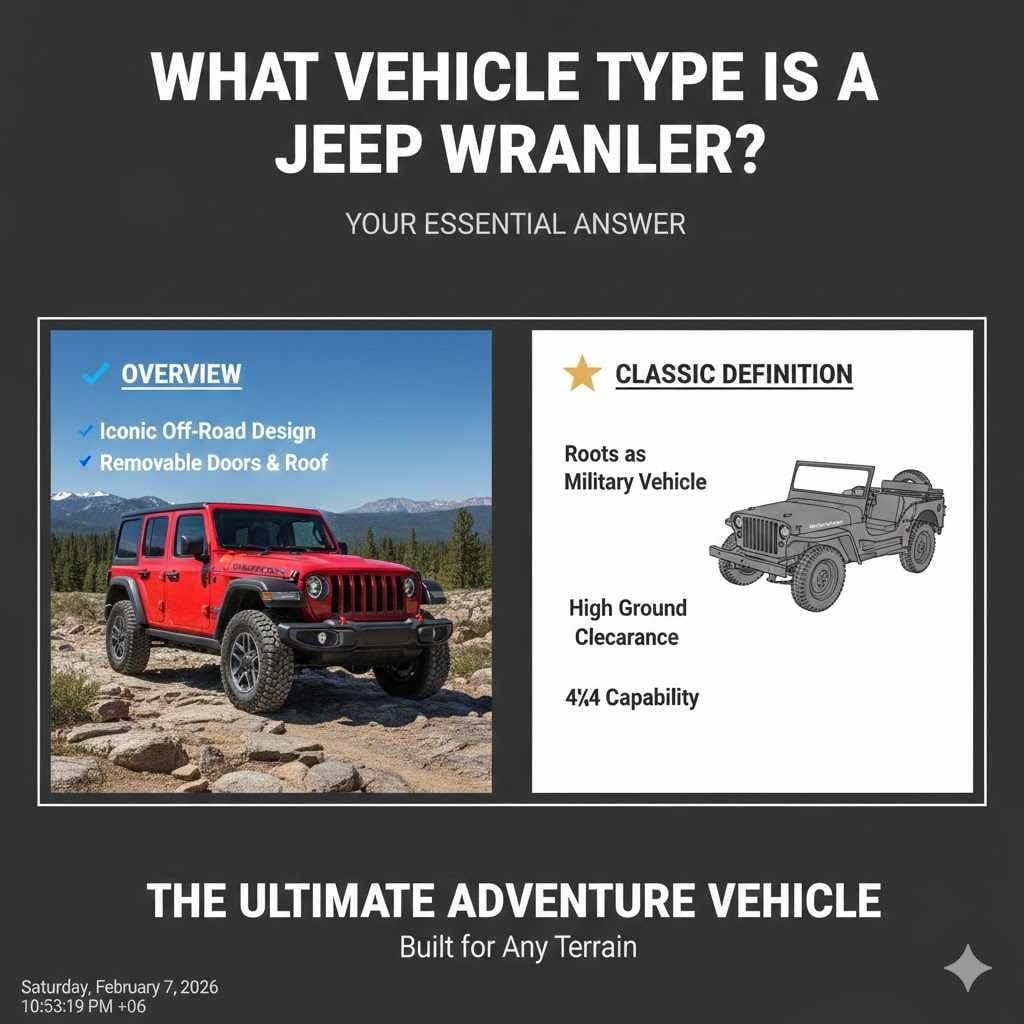
A Jeep Wrangler is officially classified as a body-on-frame Sport Utility Vehicle (SUV), specifically designed for off-road performance. Its key features, like a separate frame, standard four-wheel drive, and solid axles, distinguish it from unibody crossovers. Think of it as a purpose-built adventure vehicle, not a typical family SUV.
Have you ever looked at a Jeep Wrangler and wondered, “What exactly is that?” It doesn’t look like most cars on the road. It has a unique shape, big tires, and you often see them with the doors and roof missing. It’s easy to get confused. Is it a truck? Is it a regular SUV? This question is more common than you think.
Trying to fit the Wrangler into a simple category can be tricky because it breaks a lot of modern car-design rules. But don’t worry. I’m here to clear up the confusion for you. We are going to walk through exactly what a Jeep Wrangler is, what makes it so different, and why its unique design is its greatest strength. You’ll soon understand its official classification and everything that makes it an automotive icon.
The Official Classification: A True Sport Utility Vehicle (SUV)
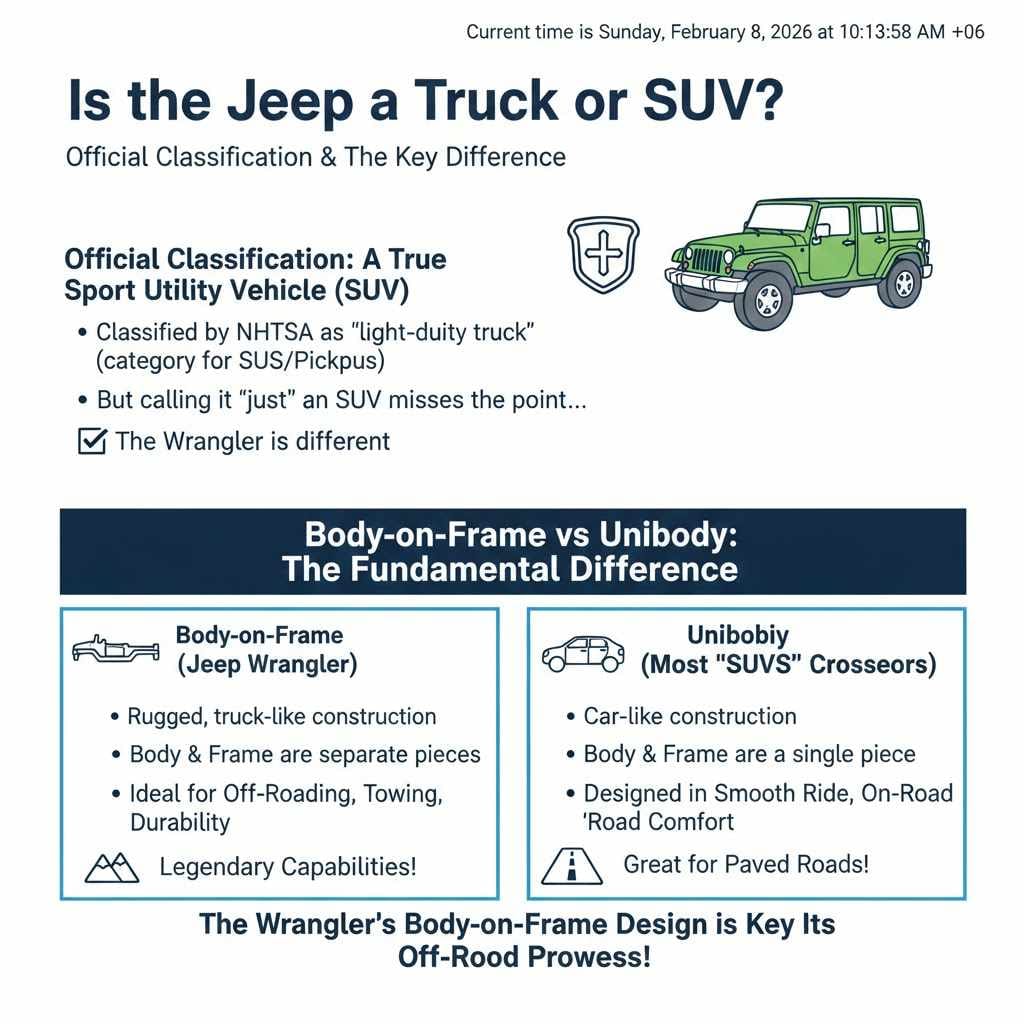
At its core, the Jeep Wrangler is a Sport Utility Vehicle, or SUV. Government agencies like the National Highway Traffic Safety Administration (NHTSA) generally classify it as a “light-duty truck” for regulatory purposes, which is a broad category that includes SUVs and pickup trucks. But calling it just an “SUV” doesn’t tell the whole story.
Most vehicles you see today that are called SUVs are actually “crossovers.” Crossovers are built like cars, using a single-piece frame and body structure called a unibody. They are designed for a smooth, comfortable ride on paved roads. The Jeep Wrangler is different. It is a traditional, “body-on-frame” SUV, which is a much more rugged design. This construction is the fundamental difference that sets the Wrangler apart and gives it its legendary capabilities.
Body-on-Frame vs. Unibody: The Wrangler’s Rugged Foundation
Understanding the difference between body-on-frame and unibody construction is the key to understanding the Jeep Wrangler. It’s the single most important design choice that defines its character, its strengths, and its weaknesses.
Imagine building with LEGOs. A body-on-frame vehicle is like building a strong, rectangular base (the frame) and then building the car’s body on top of it as a separate piece. A unibody vehicle is like using a single, large, molded piece for both the base and the body.
What is Body-on-Frame?
This is the old-school way of building trucks and tough SUVs. The Wrangler has a strong, rigid steel ladder frame that acts as its backbone. The engine, transmission, axles, and suspension are all attached to this frame. Then, the body of the Jeep is bolted on top of it. This separation makes the vehicle incredibly strong and resistant to the twisting forces it experiences during extreme off-roading.
- Pros: Extremely durable, excellent for off-roading, higher towing capacity, easier to lift and modify.
- Cons: Heavier, less fuel-efficient, can have a bouncier ride on pavement.
What is Unibody?
Nearly all modern cars and crossover SUVs (like the Honda CR-V, Toyota RAV4, and even other Jeeps like the Cherokee and Compass) use unibody construction. The frame and body are integrated into one single structure. This makes the vehicle lighter and more rigid on a flat surface, which is great for on-road handling and safety.
- Pros: Lighter weight, better fuel economy, smoother and quieter ride, superior on-road handling.
- Cons: Less suited for extreme off-road stress, lower towing capacities, more difficult to modify significantly.
Here is a simple table to help you see the differences at a glance:
| Feature | Body-on-Frame (Jeep Wrangler) | Unibody (Most Crossover SUVs) |
|---|---|---|
| Construction | Separate body bolted to a steel ladder frame. | Body and frame are one single, integrated piece. |
| Primary Strength | Durability and flexibility for rough terrain. | On-road comfort and handling. |
| Ride Quality | Can be firm or bouncy on pavement. | Smooth, quiet, and car-like. |
| Best For | Serious off-roading, towing, and modifications. | Daily driving, family transport, and fuel efficiency. |
| Example | Jeep Wrangler, Ford Bronco, Toyota 4Runner | Toyota RAV4, Ford Escape, Jeep Cherokee |
Key Features That Define the Jeep Wrangler
Beyond its body-on-frame construction, several other key features make a Wrangler a Wrangler. These are not just for looks; they are functional elements that contribute to its incredible off-road ability and unique driving experience.
Standard Four-Wheel Drive (4×4)
Every Jeep Wrangler comes with a four-wheel-drive system. This isn’t the all-wheel-drive (AWD) system you find on many crossovers, which is primarily for slick roads. A Wrangler’s 4×4 system is a robust, part-time system designed for serious traction. It includes a “low-range” gear setting, which acts like a super-low gear to multiply the engine’s power, allowing the Jeep to crawl slowly and safely over very difficult obstacles like rocks and steep hills.
Solid Axles
This is another feature the Wrangler shares with heavy-duty trucks. Most vehicles today have independent front suspension, where each wheel can move up and down independently. The Wrangler uses solid axles in both the front and rear. This means the left and right wheels are connected by a solid metal tube. While this contributes to a less refined on-road ride, it’s a huge advantage off-road. It allows for more “articulation”—the ability for one tire to go way up over a rock while the opposite tire pushes down to stay on the ground, maintaining traction.
Removable Doors and Roof
This is perhaps the most iconic Wrangler feature. The ability to remove the doors and the roof panels creates a unique, open-air driving experience that no other vehicle can match. It connects you with your surroundings in a way that’s perfect for scenic drives and trail rides. Owners can choose between a soft top that folds back, a hard top with removable panels, or even a power-retractable top.
Fold-Down Windshield
A nod to its military heritage, every Wrangler still comes with a windshield that can be folded down onto the hood. While it requires a bit of work and isn’t something most owners do regularly, it provides the ultimate open-air feeling and is a classic feature that honors the original military Jeeps.
Is a Jeep Wrangler a Truck?
This is a very common question, and the answer is simple: no, a standard Jeep Wrangler is not a pickup truck. A pickup truck is defined by its separate cab and open cargo bed. The Wrangler has an enclosed body that integrates the passenger and cargo areas, which firmly places it in the SUV category.
However, the confusion is understandable, which is why Jeep created the Gladiator. The Jeep Gladiator is essentially a Wrangler that has been stretched and given a five-foot pickup bed. It shares the same front half, removable doors and roof, and off-road capabilities as the Wrangler, but it is officially classified as a pickup truck. So, if you want a Wrangler with a truck bed, the Gladiator is the vehicle you’re looking for.
| Characteristic | Jeep Wrangler | Jeep Gladiator |
|---|---|---|
| Vehicle Type | SUV | Pickup Truck |
| Cargo Area | Enclosed, inside the vehicle | Open 5-foot bed, separate from the cab |
| Towing Capacity | Lower (up to 3,500 lbs) | Higher (up to 7,700 lbs) |
| Off-Road Agility | More agile due to shorter wheelbase | Less agile on tight trails due to longer wheelbase |
Is a Jeep Wrangler a Crossover?
Absolutely not. This is one of the most important distinctions to make. A crossover is specifically designed to blend the practicality of an SUV with the comfort and efficiency of a car. A Wrangler is designed with the opposite priority: off-road capability first and foremost.
Here’s a quick breakdown of the key differences:
- Platform: A Wrangler uses a rugged, truck-like body-on-frame platform. A crossover uses a lighter, car-based unibody platform.
- Drivetrain: A Wrangler has a part-time 4×4 system with a low-range transfer case for serious off-roading. A crossover typically has front-wheel drive (FWD) or an all-wheel-drive (AWD) system for wet roads and light snow.
- Suspension: A Wrangler uses durable solid axles designed for maximum articulation. A crossover uses a comfortable independent suspension designed for a smooth on-road ride.
- Purpose: A Wrangler is a purpose-built adventure vehicle. A crossover is a practical, family-friendly daily driver.
Putting a Wrangler and a crossover in the same category is like comparing a sturdy hiking boot to a comfortable running shoe. Both are footwear, but they are designed for very different purposes and terrains.
A Brief History: From Military Hero to Off-Road Icon
The Wrangler’s design makes perfect sense when you look at its history. It wasn’t born in a design studio to appeal to families; it was born on the battlefield. The ancestor of every Jeep is the Willys-Overland MB, a small, tough, go-anywhere vehicle developed for the U.S. Army during World War II. Soldiers affectionately called it the “Jeep.”
After the war, Willys began selling a civilian version, the “CJ” (for Civilian Jeep), to farmers, ranchers, and adventurers. For decades, the CJ series built a reputation for being simple, rugged, and unstoppable. In 1987, the first vehicle to officially be named “Wrangler” was introduced. It carried on the CJ’s legacy with the same core principles: body-on-frame construction, solid axles, and a focus on off-road freedom. This heritage, detailed in places like The Henry Ford Museum, is why the Wrangler is built the way it is today.
Who is the Jeep Wrangler For?
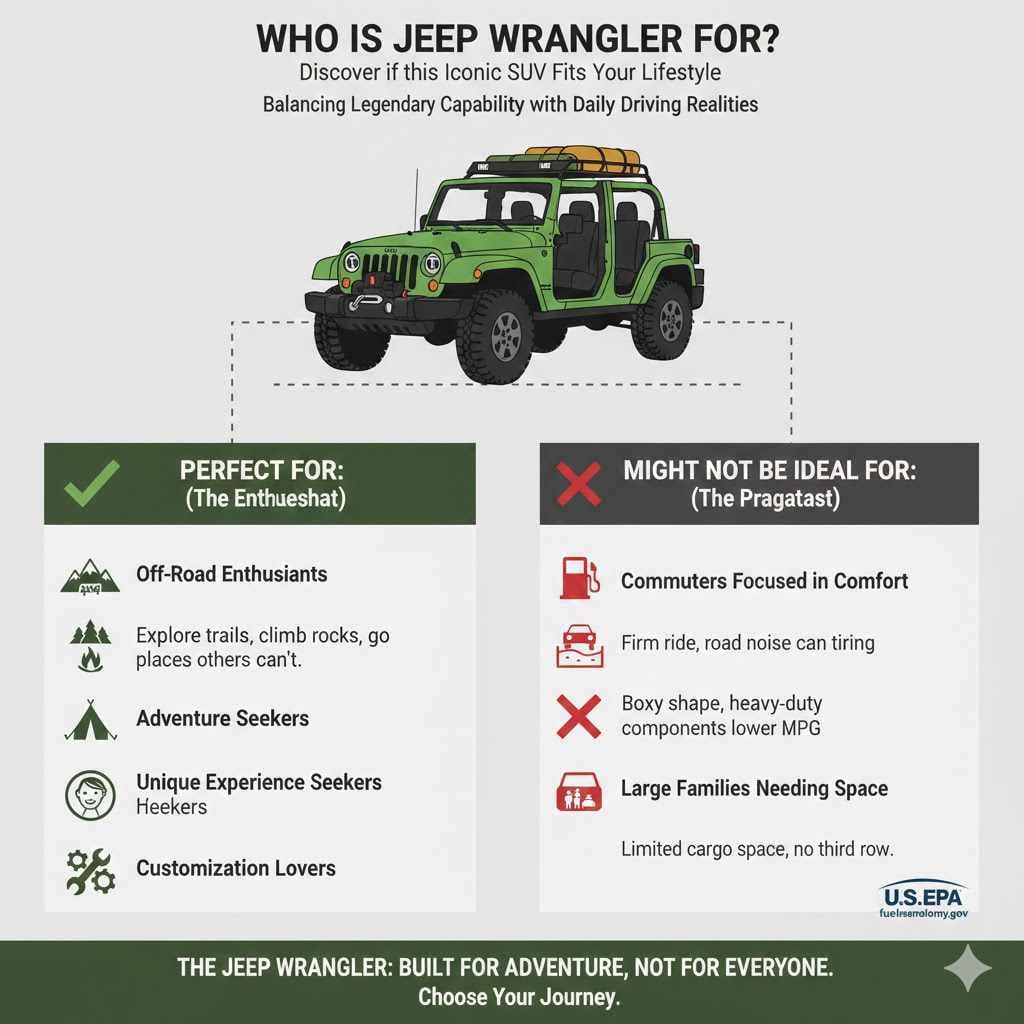
The Wrangler is a fantastic vehicle, but its unique design means it’s not the right fit for everyone. It asks you to make some compromises in on-road comfort and fuel economy in exchange for unparalleled capability and fun.
The Wrangler is a great choice for:
- Off-Road Enthusiasts: This is its primary audience. If you want to explore trails, climb rocks, and go places other vehicles can’t, the Wrangler is one of the best choices right out of the box.
- Adventure Seekers: For those who love camping, hiking, kayaking, or just getting outdoors, the Wrangler is a perfect companion to get you and your gear to the trailhead.
- Drivers Who Crave a Unique Experience: The open-air driving with the top and doors off is an experience no other vehicle can offer. It’s pure fun.
- People Who Love Customization: The Wrangler is one of the most customizable vehicles on the planet. There is a massive aftermarket community to help you make it truly your own.
The Wrangler might not be the best choice for:
- Commuters Focused on Comfort: If you spend hours on the highway, the firm ride and road noise may become tiring compared to a crossover or sedan.
- Anyone Prioritizing Fuel Economy: Its boxy shape and heavy-duty components mean it’s not going to win any awards for gas mileage. You can check specific model ratings on the EPA’s fueleconomy.gov website.
- Large Families Needing Space: While the four-door model has good rear-seat room, cargo space is limited compared to larger SUVs, and it doesn’t offer a third row.
Frequently Asked Questions (FAQ)
What is the difference between a Jeep and a Wrangler?
“Jeep” is the brand name of the car company (like Ford or Toyota). “Wrangler” is a specific model made by Jeep. Jeep makes many different models, including the Grand Cherokee, Compass, and Gladiator, but the Wrangler is their most iconic vehicle, known for its off-road focus.
Are Jeep Wranglers good for everyday driving?
They can be, but it depends on your priorities. Modern Wranglers are much more comfortable and civilized on the road than older models. However, their ride is still firmer and louder than a typical car or crossover. For many owners, the fun and unique style are well worth the trade-off for daily driving.
Do Jeep Wranglers get good gas mileage?
Generally, no. Due to their heavy, body-on-frame construction, boxy aerodynamics, and large tires, Wranglers are not very fuel-efficient. However, the introduction of the plug-in hybrid Wrangler 4xe model offers significantly better fuel economy and the ability to drive on all-electric power for short distances.
Are Jeep Wranglers safe?
Modern Jeep Wranglers are equipped with standard safety features like airbags, anti-lock brakes, and stability control. Their strong frame provides good protection in certain types of collisions. However, their high center of gravity and removable components can result in lower scores in some specific crash tests compared to car-based unibody SUVs.
Why are Jeep Wranglers so popular?
Wranglers are popular because they offer something unique: a sense of freedom and adventure. They have a timeless, iconic style, incredible off-road capability, a huge community of enthusiastic owners, and offer a fun-to-drive experience that is unlike anything else on the road.
Is it hard to take the doors and roof off?
It’s surprisingly easy! The doors are held on by two hinges and a single wiring connector and can be removed in a few minutes with the toolkit that comes with the Jeep. The hardtop has several panels that can be removed individually, while the soft top can be folded back quickly. It’s designed to be a user-friendly process.
What does “Jeep” stand for?
This is a topic of historical debate, but the most widely accepted theory is that it comes from the military designation “GP,” which stood for “General Purpose” vehicle. When spoken quickly, “GP” sounds like “Jeep,” and the name stuck.
Conclusion: More Than Just an SUV
So, what vehicle type is a Jeep Wrangler? The simple answer is that it’s a body-on-frame, off-road-focused SUV. But the real answer is so much more than that. It is a direct link to a rich history of go-anywhere, do-anything vehicles. It’s a symbol of freedom, adventure, and rugged individualism.
The Wrangler proudly rejects the modern trend of making every vehicle a soft, comfortable, car-like crossover. Instead, it doubles down on the features that make it a legend: a tough frame, solid axles, and an open-air design. While those features come with compromises for daily street driving, they are the very reason why the Wrangler can take you to places you’ve only dreamed of. It’s not just a vehicle; for many, it’s a key to a whole new lifestyle. See also types of small vehicles best compact options explained.
Products related to this article
Sponsored / affiliate links. As an Amazon Associate I earn from qualifying purchases. I may earn additional commission from eligible campaigns.