Coolant Temperature Gauge Rising: Safe Steps to Take
If the coolant temperature gauge climbs into the hot zone, stop at once if it keeps rising, a warning light flashes, steam appears, or cabin heat disappears. If it rises slowly and then levels off, cut load and head to a safe stop. Ignoring an overheating engine can warp the head, blow a gasket, or turn a cheap fix into major damage. This guide gives a fast triage path for stopping, limping home, or diagnosing the car in the driveway.
What a rising gauge means


The normal gauge position varies by vehicle. Many cars sit near the middle once fully warm, but some digital displays show an exact number and some analog gauges stay fixed over a wide range, so the needle moving a little does not always mean danger.
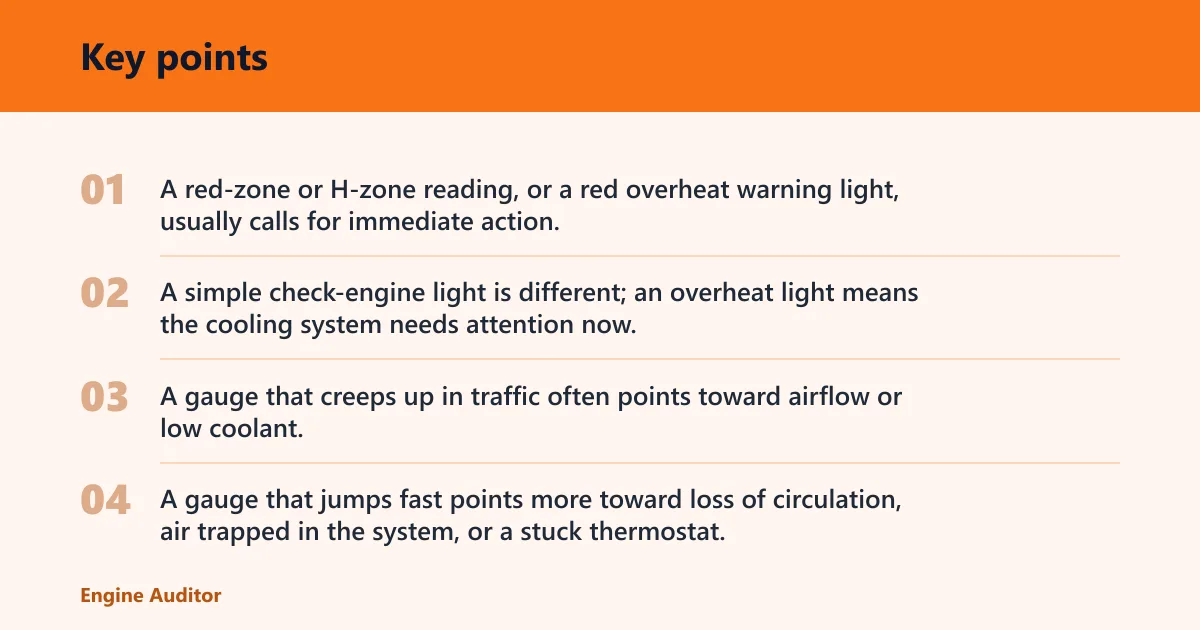
A red-zone or H-zone reading, or a red overheat warning light, usually calls for immediate action. That warning can appear before steam or boil-over, and it can coexist with a low-coolant warning. A simple check-engine light is different; an overheat light means the cooling system needs attention now.
Watch the pattern as much as the position. A gauge that creeps up in traffic often points toward airflow or low coolant. A gauge that jumps fast points more toward loss of circulation, air trapped in the system, or a stuck thermostat.
What you’ll need
- Gloves and a rag
- Wait until the engine is fully cool before opening anything
- Coolant matched to the vehicle specification
- Distilled water for a 50/50 mix if topping off
- OBD2 scan tool with live-data display
- Flashlight
- Paper towels or shop towels
Can you keep driving?
If the gauge is near hot but not in the red, a common rule of thumb is to reduce load, switch off the air conditioning, turn the heater to full hot, and head to a safe stop. If the needle keeps climbing, the warning light comes on, or heat from the vents disappears, stop and shut the engine off.
A common first-timer mistake is to treat every hot gauge the same. A steady, slightly high reading during a long hill may allow a short limp to a safe place. A red-zone spike with steam is generally a stop-now case.
- Switch off the A/C. Turn off the compressor first. That removes one load from the engine and can buy time while you move out of traffic.
- Turn the heater to full hot. Set the fan high and temperature to maximum. This sends hot coolant through the heater core, which can pull heat away from the engine long enough to reach a shoulder or parking lot.
- Reduce engine load. Ease off the throttle, avoid hard acceleration, and skip hills if you can choose another route. If the gauge stabilizes below the red zone, a short limp may be possible.
- Stop if the gauge climbs. If the needle keeps moving up, pull over safely, shut the engine off, and let it cool. Do not keep driving in the red.
Coolant gauge triage table
| Scenario | Likely cause | Safest next step | What to check once cool | Drive, limp, or tow? |
|---|---|---|---|---|
| Idle or traffic | Radiator fan not coming on, low coolant, weak fan relay, or air pocket | Turn off A/C, turn heater to full hot, move to safe stop if the gauge keeps rising | Fan operation, fuse, relay, coolant level, leaks, reservoir marks | Limp only if the gauge settles below hot; tow if it keeps climbing |
| Highway | Low coolant, stuck thermostat, water pump flow problem, collapsed hose | Ease off throttle and exit soon; stop if the gauge climbs fast | Coolant level, hose condition, thermostat code, water pump leak or noise | Limp to a nearby safe stop only if temperature stays stable |
| After coolant service | Air trapped in the system, incomplete bleed, low fill level | Let it cool, then recheck level and bleed procedure before driving again | Reservoir level, bleed screw use, heater output, live coolant temperature | Do not keep driving if the gauge swings up and down; tow if it returns to red |
| Sudden red-zone spike | Serious flow loss, broken belt, failed water pump, stuck-closed thermostat, major leak | Stop immediately and shut the engine off | Hoses, belts, puddles, steam, cap seal, fan operation, coolant loss | Tow |
How do you check the cause once it cools?
Wait until the engine is fully cool before opening anything. Then check the coolant reservoir first, using the MIN and MAX marks, and inspect the cap, hoses, and visible leak points. If the level keeps dropping or the fluid looks rusty, oily, or contaminated, the system needs more than a top-off.
- Check the reservoir first. Open only the overflow bottle, never a hot radiator cap. A level below MIN can point to a leak, while a level above MAX after overheating can still hide air in the system.
- Inspect coolant condition. Look for brown sludge, oil sheen, or debris. Sweet smell, wet spots, white crust at a hose joint, and repeated reservoir drop-off are common leak clues.
- Verify the cap seal. A failed pressure cap can lower the boiling point and push coolant into the recovery bottle too early. That does not prove an internal engine failure by itself.
- Scan live temperature. Use an OBD2 scan tool to read coolant temperature in degrees and check for codes such as P0128 or fan-related faults before replacing parts.
Suppose the gauge rises after a coolant flush and then drops back down after a short stop. That pattern often points to trapped air, not an immediate thermostat failure. The fix is a proper bleed, not another bottle of coolant.
If that didn’t work, bleed the system
Air pockets can cause erratic gauge spikes, weak cabin heat, and brief temperature swings. Some vehicles need bleed screws or a vacuum fill tool; others use a heater-on procedure with the engine at idle and the reservoir cap off only when the service manual calls for it.
- Follow the fill procedure. Use the vehicle-specific bleed path, not a generic top-off. Some systems need the front of the car raised slightly to help air move out.
- Run the heater hot. Set the cabin heat to maximum so coolant can circulate through the heater core. Watch for a steady stream of warm air, which suggests the air pocket is leaving.
- Recheck after heat cycles. After the engine cools again, confirm the reservoir sits between MIN and MAX. If the gauge still spikes, the issue is likely flow, cooling fan control, or a leak.
Why does it rise in traffic?
Traffic overheating often points to a fan problem, because the car has little natural airflow at idle and low speed. Highway speed can hide the fault because road airflow helps the radiator even when the fan is weak or not running.
Electric fan systems should run when the engine gets hot or the A/C is on. On some vehicles, a bad fuse or relay is the first check. Other vehicles use a fan clutch, and a worn clutch can let the fan freewheel when it should pull air.
- Check fan operation. With the engine warm and A/C on, look for electric fan movement. No fan at idle but normal highway temperature strongly suggests an airflow fault.
- Inspect fuse and relay. Check the cooling fan fuse and relay in the under-hood fuse box. A failed relay can stop the fan even when the motor is fine.
- Consider fan clutch type. If the vehicle uses a belt-driven fan with a clutch, a weak clutch can cause traffic overheating with no obvious highway issue.
Why does the temperature gauge go up in traffic but not on the highway? Because airflow changes. Low-speed driving depends on the fan, while highway speed gives the radiator free air. That split points away from a simple “bad radiator” diagnosis and toward fan control, low coolant, or trapped air.
If that didn’t work, check thermostat and flow
A stuck-closed thermostat can cause rapid overheating because coolant cannot reach the radiator in time. A stuck-open thermostat usually causes slow warm-up or weak cabin heat instead of overheating, but intermittent sticking can still create short spikes.
- Look for warm-up behavior. If the heat stays weak for a long time, a thermostat that is stuck open is more likely. If the gauge climbs fast soon after start-up, a stuck-closed thermostat is a better fit.
- Check circulation clues. A hot upper hose and a cold lower hose during overheating can point toward poor flow. On some cars, an OBD2 reading near P0128 helps confirm a thermostat control problem.
If that didn’t work, inspect cap and pump
The radiator cap keeps system pressure where it belongs. If it cannot hold pressure, coolant can boil sooner and escape into the overflow bottle. That is a pressure issue, not proof of a cracked head.
The water pump moves coolant through the engine and radiator. Belt-driven pumps can leak at the weep hole or show pulley play; electric pumps can fail with no belt clue. Bearing noise, seepage, and reduced circulation all point in that direction.
- Inspect the cap area. Look for crust around the neck, coolant loss near the cap, or a hose that vents to the reservoir too often. A weak cap can mimic more serious trouble.
- Check the pump and drive. Look for leaks at the weep hole, noise at the pulley, loose belt, or signs that the pump impeller is not moving coolant.
Common mistakes
- Opening the radiator cap hot. Pressure and scalding coolant can blow out suddenly.
- Adding coolant without checking for leaks or air. Top-offs help only if the system can hold coolant and purge air correctly.
- Replacing parts before reading live coolant temperature. An OBD2 scan can keep you from buying a thermostat, fan, or pump on guesswork.
- Ignoring a red warning light because the car still runs. A red overheat light means stop now, even if steam has not started.
- Confusing traffic-only overheating with highway overheating. Fan faults and flow faults do not usually behave the same way.
Say your gauge rises to three-quarters only at a stoplight, the heater stays hot, and the needle drops once you move again. That pattern points more toward fan or airflow trouble than a blown head gasket. If the same car hits red within a mile after a coolant service, trapped air jumps higher on the list.
Frequently asked questions
Why is my coolant temperature gauge rising while driving?
A gauge that rises while driving usually means the system cannot shed heat fast enough. Common causes are low coolant, a stuck thermostat, trapped air, a weak water pump, or a fan problem that only shows up at low speed or under load.
Can I keep driving if the temperature gauge is near hot?
Only if the reading stays below the red zone and does not keep climbing. Turn off A/C, use full heat, reduce speed, and head to a safe stop. If it rises again, shut the engine off and arrange a tow.
What should I do first if my engine starts overheating?
Pull over safely, switch off the A/C, and set the heater to full hot. Then watch the gauge. If it keeps rising, stop the engine and let it cool before checking coolant or looking for leaks.
How do I tell if it’s low coolant, a bad thermostat, or a fan problem?
Low coolant often shows up as repeated reservoir drop-off, sweet smell, or a visible leak. A bad thermostat can cause rapid spikes or weak cabin heat. A fan problem usually shows up in traffic or at idle, while highway driving stays more normal.
Can I open the radiator cap when the engine is hot?
No. Leave the cap closed until the engine is fully cool. Pressure can force boiling coolant out of the neck, which can cause serious burns and make the overheating worse by dumping more coolant from the system.
What damage can happen if I drive with the gauge in the red?
Red-zone overheating can sometimes warp the cylinder head, blow a head gasket, damage hoses and seals, and contaminate the cooling system with combustion gases. Boil-over or misfire from severe heat can also damage the catalytic converter, so the right move is to stop and tow.
Products related to this article
Sponsored / affiliate links. As an Amazon Associate I earn from qualifying purchases. I may earn additional commission from eligible campaigns.