Car Battery Voltage Calculator
A car battery voltage reading is usually healthy at about 12.6V resting, weak below about 12.4V, and charging at about 13.7V to 14.7V with the engine running; during cranking, stay above about 9.6V. Read it wrong, and you can replace a good battery, miss a failing alternator, or get stranded. This guide shows how to use a car battery voltage calculator to classify resting, cranking, and charging voltage, then explains what each reading most likely means.
How is this calculated?
Press Calculate to see the math with your numbers.
What a battery voltage reading means
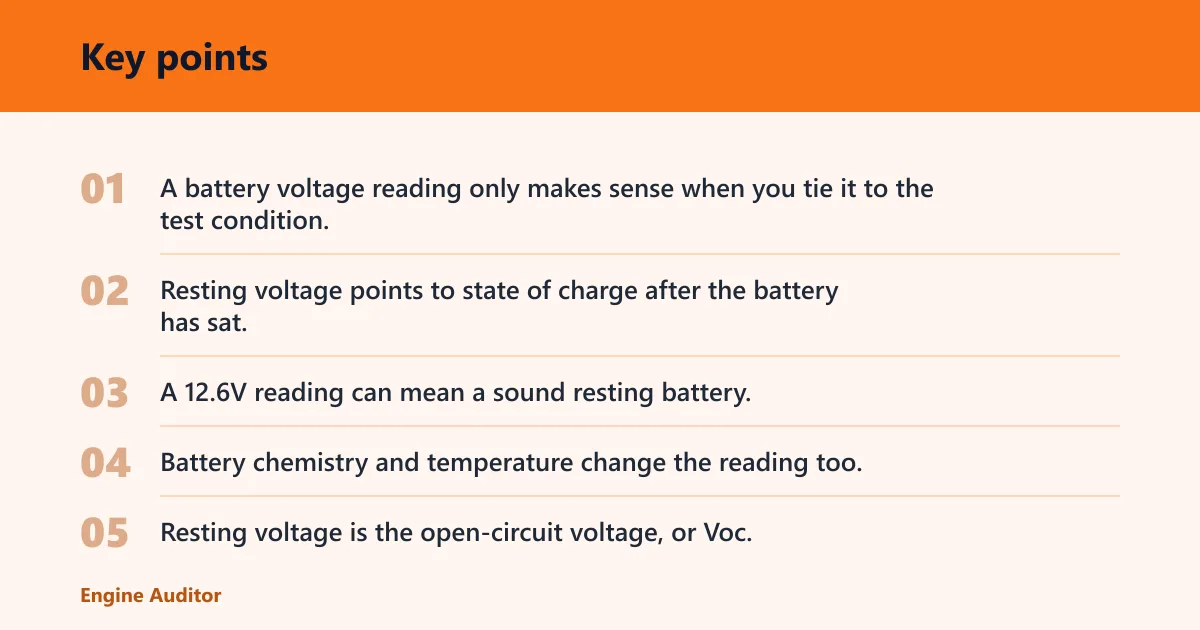


A battery voltage reading only makes sense when you tie it to the test condition. Resting voltage points to state of charge after the battery has sat, cranking voltage shows how much the voltage sags under starter load, and charging voltage shows whether the alternator and regulator are doing their job.
One number is not enough. A 12.6V reading can mean a sound resting battery, but the same battery may dip hard under crank if its internal resistance is high, or climb too high with the engine running if the regulator is off. Battery chemistry and temperature change the reading too.
Resting voltage versus cranking voltage
Resting voltage is the open-circuit voltage, or Voc, after the battery has sat long enough to settle. That number is used in terminal-voltage calculations and is the best quick clue for state of charge. Cranking voltage is the loaded value, where terminal voltage falls as starter current rises.
The page formula is simple: terminal voltage under load equals open-circuit voltage minus current times resistance. Discharge current is treated as positive in that formula. As current draw rises, voltage drop rises too, especially when internal resistance is higher from age or cold.
Charging voltage from the alternator
Take charging voltage with the engine running and the meter on DC volts. It should be higher than resting voltage because the alternator is feeding the electrical system and the regulator is limiting output. That reading points to alternator behavior, wiring loss, and regulator health, not battery condition alone.
Why one number is not enough
Voltage under rest, crank, and charge can point to different faults. Low resting voltage can mean a discharged or worn battery. Good resting voltage with poor crank behavior often points to weak battery internals. Normal rest with low charging voltage shifts suspicion toward the alternator or regulator.
Use a multimeter set to DC volts and connect the probes to the battery posts, not the cable clamps, because corrosion or a loose clamp can skew the reading. Measure after the car has sat, while cranking, and again with the engine running.
- Set the meter to DC volts and a range above 15V if it does not auto-range.
- Touch the red probe to the positive battery post.
- Touch the black probe to the negative battery post.
- Read the resting voltage after the car has sat long enough to settle.
- Have an assistant crank the engine and watch the lowest value.
- With the engine running, read charging voltage at the posts again.
Do not take a resting reading right after a drive or immediately after charging. Surface charge can make the battery look stronger than it is. Resting voltage matters most after the car has sat for a while.
Battery voltage interpretation table
This table turns the reading into the next step. The ranges below are general for 12V automotive lead-acid systems, and chemistry and temperature can shift the result. Use the measured condition, not the number alone, to decide whether to charge, load test, inspect the alternator, or replace the battery.
| Test condition | Measured voltage | Likely diagnosis | Next action |
|---|---|---|---|
| Resting | 12.6V to 12.8V | Healthy fully charged lead-acid battery in many cases | Use normally; retest after sitting overnight if symptoms persist |
| Resting | 12.4V to 12.5V | Partially charged battery or early wear | Charge fully, then retest resting voltage |
| Resting | Below 12.4V | Low state of charge, weak battery, or parasitic drain | Charge first; if it falls again, test for drain or replace battery |
| Cranking | Above 10.0V | Good starting support in many vehicles | Battery is likely acceptable; look elsewhere if the engine still starts poorly |
| Cranking | 9.6V to 10.0V | Borderline sag, often age or cold related | Load test the battery and inspect terminals and cables |
| Cranking | Below 9.6V | Weak battery, high internal resistance, or cold-stressed battery | Charge fully, then load test; replace if sag remains |
| Engine running | 13.7V to 14.7V | Normal charging range for many vehicles | Charging system is likely working; check battery only if other symptoms remain |
| Engine running | Below 13.3V | Low charging output, belt issue, wiring loss, or alternator fault | Inspect alternator, belt, and connections |
| Engine running | Above 14.8V | Possible overcharging or regulator fault | Inspect the regulator and charging control circuit |
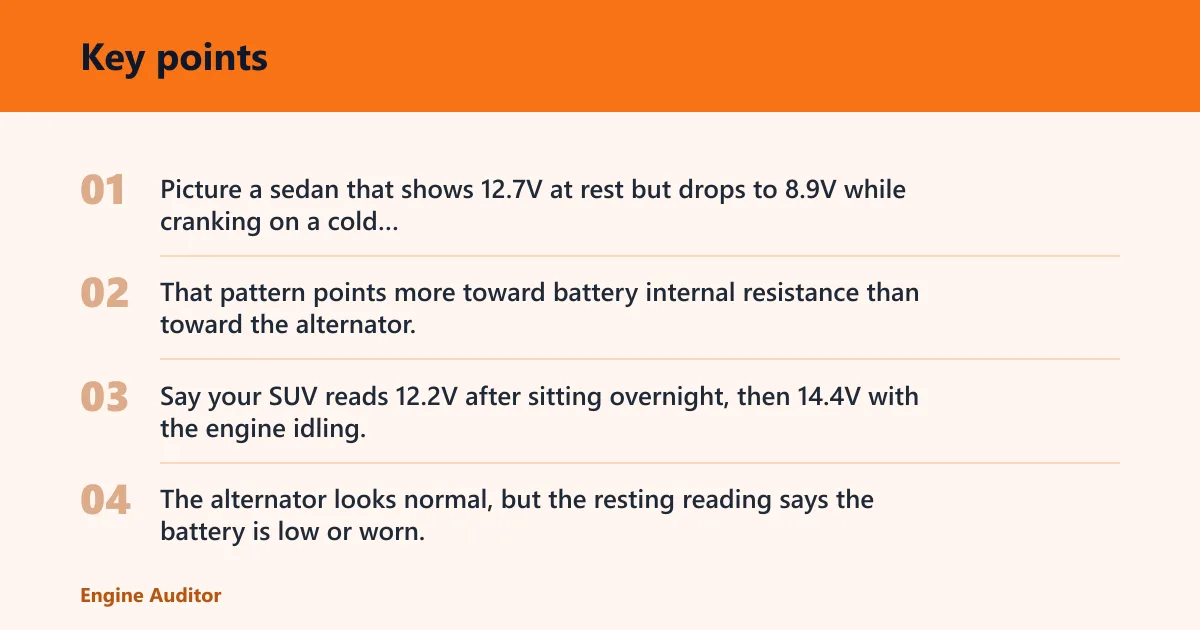
Picture a sedan that shows 12.7V at rest but drops to 8.9V while cranking on a cold morning. That pattern points more toward battery internal resistance than toward the alternator, because the charging system is not the part under stress during crank.
Say your SUV reads 12.2V after sitting overnight, then 14.4V with the engine idling. The alternator looks normal, but the resting reading says the battery is low or worn. Charge it, then repeat the resting test.
How does chemistry change the reading?
Battery chemistry changes the expected reading, so do not treat every 12V battery the same. Flooded lead-acid, AGM, EFB, and lithium helper batteries do not all sit at the same nominal voltage or behave the same under load. The calculator has to be read in context.
Flooded lead-acid
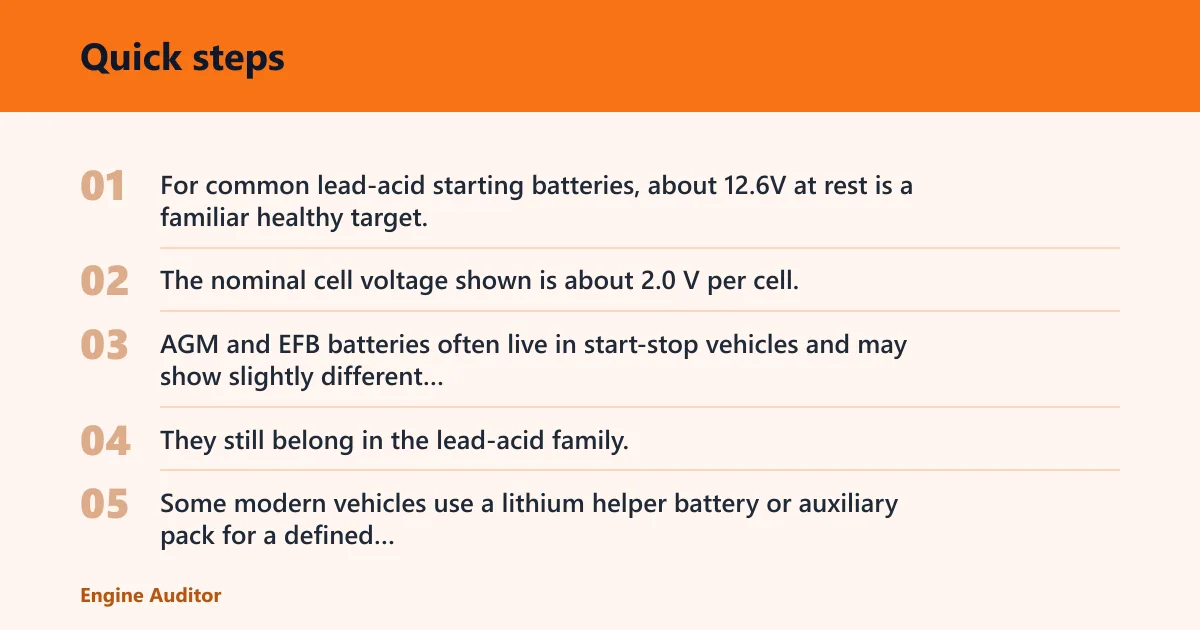
For common lead-acid starting batteries, about 12.6V at rest is a familiar healthy target. The nominal cell voltage shown is about 2.0 V per cell, so a six-cell 12V battery is expected to land near that range when fully charged and settled.
AGM and EFB batteries
AGM and EFB batteries often live in start-stop vehicles and may show slightly different resting and charging behavior than flooded batteries. They still belong in the lead-acid family, but they can accept charge differently and can be more sensitive to incorrect charging methods.
Lithium helper batteries
Some modern vehicles use a lithium helper battery or auxiliary pack for a defined function. Lithium types use different nominal voltage expectations. The page lists Li-ion at about 3.6 V, LiPo at about 3.7 V, and LiFePO4 at about 3.2 V per cell, so you should not judge them by lead-acid rules.
The page also notes that parallel cells add capacity, not voltage. That matters when a helper battery or pack appears to be “12V” by label but uses a different internal arrangement. Always match the reading to the battery chemistry first.
What does cranking voltage tell you?
Cranking voltage tells you how much the battery sags under a real starter load. A battery with high internal resistance will drop more voltage for the same current, and that drop often gets worse with age and cold weather. A poor reading here can mean the battery is weak even if resting voltage looks fine.
Internal resistance is the hidden part of the diagnosis.
Cold weather effects
Cold temperature increases internal resistance and can make a healthy battery read lower under load. That is why a battery that seems borderline on a warm day may fail on a freezing morning. The same measured voltage can mean something different when the air is cold.
When a load test is the next step
If cranking voltage is near the edge, do a load test. A load test compares open-circuit voltage and loaded voltage with a known current draw. That lets you estimate internal resistance and decide whether the battery is simply discharged or actually worn out.
Suppose a battery sits at 12.6V open-circuit and drops to 10.2V during a 200A cranking event. Using the page formula, resistance is about (12.6 – 10.2) / 200 = 0.012 ohm. That is a plain sign of voltage sag under load, and in a cold engine bay it can become a no-start issue fast.
What does charging voltage tell you?
Charging voltage tells you whether the alternator and regulator are supplying the system at a sensible level. A running engine should show higher voltage than rest. If it does not, the battery may be fine and the charging system may be the fault instead.
Normal alternator and regulator ranges
Many vehicles charge in the 13.7V to 14.7V range with the engine running. That is a practical clue, not a universal law, because temperature, battery type, and smart charging strategy can shift the number. Still, that span is a useful first pass.
Low charging voltage
Low charging voltage with the engine running points to the alternator, regulator, belt slip, or wiring loss. If the battery was already weak, low charging voltage can make the symptom look like a battery failure. Do not replace the battery until you have checked charging output.
High charging voltage
Voltage above the expected range can mean a regulator fault. Overcharging damages batteries and can shorten life quickly. If the reading stays high with the engine running and electrical loads on, the charging control circuit deserves immediate attention.
How to tell how many volts a car battery
You tell the voltage by measuring it with a multimeter, then reading it in the right condition. Resting voltage estimates charge, cranking voltage shows starting stress, and engine-running voltage checks the alternator. That three-part view is more useful than a single snapshot.
A common first-timer mistake is reading the battery right after a short drive and calling 12.8V “fully charged.” That can be surface charge. Let the battery settle, then measure again on the posts for a more useful resting value.
Frequently asked questions
How many volts should a car battery have?
A healthy 12V lead-acid car battery is usually around 12.6V at rest after it has sat long enough to settle. During cranking, stay above 9.6V. With the engine running, many vehicles show about 13.7V to 14.7V if the alternator and regulator are working normally.
What voltage should a car battery be?
It depends on the test condition. At rest, about 12.6V is a common healthy target for lead-acid. Under crank, lower than 9.6V is a warning sign. With the engine running, voltage should rise above resting because the charging system is active.
What is the voltage of a car battery?
For a standard 12V car battery, the meaningful answer changes by condition. Resting voltage near 12.6V suggests a full battery, while charging voltage is higher with the engine running. If you are diagnosing a problem, the condition matters more than the label on the case.
What is the max voltage of a car battery?
For a typical 12V automotive system, a charging reading much above the normal running range is a concern. Many vehicles operate in the 13.7V to 14.7V span while running. A higher steady reading can point to a regulator problem and should not be ignored.
How much voltage does a car battery need?
To start with confidence, the battery needs enough voltage under load to keep cranking speed up. A common benchmark is staying above 9.6V during crank, though cold weather can make a borderline battery sag further. Resting around 12.6V gives a better starting point.
What should the voltage be for a car battery?
For a 12V lead-acid battery, about 12.6V at rest is the usual healthy figure, and charging voltage should be higher when the engine is running. If the battery is lower than 12.4V at rest, charge it first. If crank voltage sags, perform a load test.
Products related to this article
Sponsored / affiliate links. As an Amazon Associate I earn from qualifying purchases. I may earn additional commission from eligible campaigns.