Transmission Control Solenoid Pack Replacement: What to Expect
Expect a transmission control solenoid pack replacement to start with scan-tool diagnosis, fluid checks, and pan removal, then about 1 to 6 hours of labor depending on vehicle design. OEM service information and major scan-tool guides consistently show that access, adaptation/relearn steps, and solenoid testing vary by transmission family. Ignore it or install the wrong part, and the same shifts can return, limp mode can stay active, or you can pay twice for repeat diagnostics. This guide covers the symptoms, diagnosis steps, labor flow, parts decisions, and what to verify after the swap.
What a solenoid pack does
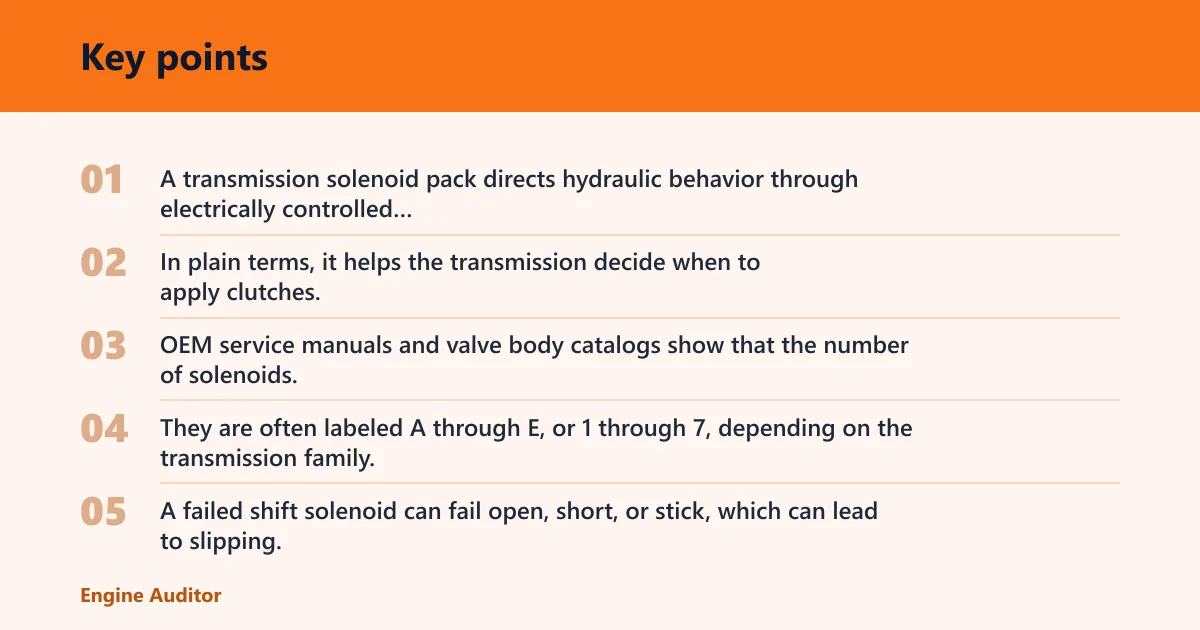


A transmission solenoid pack directs hydraulic behavior through electrically controlled valves. In plain terms, it helps the transmission decide when to apply clutches, how hard to apply them, and whether torque converter lockup happens at the right time. OEM service manuals and valve body catalogs show that the number of solenoids, connector style, and even the assembly layout differ by make and transmission family, so the exact failure pattern is not universal.
Shift solenoids control gear engagement. They are often labeled A through E, or 1 through 7, depending on the transmission family. A failed shift solenoid can fail open, short, or stick, which can lead to slipping, hard shifts, or a no-engage condition. Scan-tool documentation from major diagnostic platforms also notes that shift-solenoid naming can change by manufacturer, so code meaning should be checked against the exact transmission code chart, not just the generic P-code description.
Pressure control solenoids regulate line pressure across the transmission. When that control goes off, shifts can feel mushy, flare between gears, or slip under load. The torque converter clutch, or TCC, solenoid handles converter lockup at cruising speed, and it is often associated with P0740. Reputable repair databases and OEM code charts also show that TCC faults can stem from wiring, hydraulic wear, or command issues, not only from the solenoid itself.
Where the pack sits and why it matters
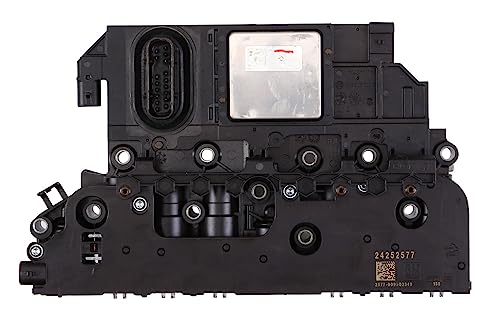
On many modern transmissions, the pack may contain about 4 to 7 solenoids and may sit inside the case, on or near the valve body, or inside mechatronic components. That layout changes labor, fluid handling, and whether pan removal and filter removal are part of the repair. Some designs allow solenoid service from below; others require valve body removal or integrated mechatronic replacement, which is why labor time and parts decisions vary so much by transmission family.
FWD transaxles often place the control parts deep in the case, which raises labor time and fluid loss. Rear-wheel-drive units may give better access from below, while mechatronic designs can bundle electronics and hydraulics into one assembly, which makes diagnosis more specific and repair decisions less forgiving. OEM procedures for common FWD and longitudinal transmissions regularly split the job into different access paths, which is why a generic quote can be misleading.
Why one failure can mimic bigger damage
Solenoid faults overlap with valve body wear, wiring faults, low or dirty fluid, and TCM problems. A transmission can feel harsh or lazy for reasons that have nothing to do with gear damage. That is why a code by itself does not prove the pack is bad, and why scan-tool live data plus fluid condition matter before parts are ordered.
Say your sedan drops into limp mode after a cold start and sets P0700 plus P0755. That points to a transmission control fault, but it does not tell a shop whether the issue is the solenoid, a connector with corrosion, or a circuit problem in the control module. OEM and diagnostic-database guidance both treat P0700 as a request to inspect the transmission control system, not as proof of a single failed component.
What symptoms point to a bad pack?
Common signs include slipping, hard shifts, delayed engagement, no-engage, and mushy shifts under load. Those symptoms can come from a bad solenoid pack, but they can also come from low fluid, a clogged filter, wiring faults, valve body wear, or a TCM command problem. Because the symptom set overlaps, the same complaint can point to different repairs in different transmission families.
Do not treat every shift complaint as an internal failure. A single bad solenoid can create very specific symptoms, while a wider electrical or hydraulic issue can make the transmission feel inconsistent across several gears. Scan-tool help files from major brands also note that some faults show up only under load, during warm-up, or during a commanded shift, which is why a short parking-lot check can miss the real problem.
When driving should stop or be limited
If the transmission will not engage, slips badly under acceleration, or bangs into gear so hard that it feels unsafe, the repair should be prioritized. Continued driving can add heat and wear, especially if the unit is already running low on pressure or the converter clutch is commanded incorrectly. In many OEM procedures, a transmission that is repeatedly slipping or stuck in limp mode is treated as a driveability concern first, not a wait-and-see issue.
Picture a crossover that only shudders in 4th gear on the highway, then starts slipping under a light grade. That pattern can point to pressure control trouble or TCC issues, and it is not a case for ignoring the warning until the unit fails completely.
Which codes matter most?
Codes commonly tied to transmission solenoid complaints include P0700, P0740, P0750, P0755, P0760, P0765, P0770, and P0775. A generic OBD-II scanner can find the code, but it cannot confirm the failed part on its own. Reputable repair databases and OEM code definitions show that the same code can map to different circuit names or component labels depending on transmission family.
P0700 is a generic transmission control system code. P0740 is tied to the torque converter clutch circuit.
Why a code is only a starting point
A code can point a technician toward one circuit, but it does not separate a failed solenoid from damaged wiring, poor power or ground, dirty fluid, or a module command issue. The next step should use transmission-capable diagnostics that can read live pressure data, solenoid current data, and commanded versus actual gear data. Major scan-tool documentation also warns that generic code readers usually cannot access the full transmission data stream needed for this kind of diagnosis.
If the scan tool shows the TCM commanding one gear but the transmission repeatedly delivering another, that is stronger evidence than the code alone. That same data can show whether the TCM is sending the right signal and whether the hardware is responding.
Transmission solenoid repair decision table
| Situation | Likely repair path | Why that path fits |
|---|---|---|
| One circuit code, one consistent symptom, other solenoids test normal | Replace one solenoid | Best when the failure is isolated and the scan data matches a single circuit fault |
| Multiple solenoid codes, repeated current faults, or widespread shift complaints | Replace the full pack | Common when several solenoids or circuits fail and the pack is easier to service as one unit |
| Codes persist after solenoid testing, or live data points to hydraulic or command faults | Valve body or TCM inspection | Needed when the problem may be mechanical, electrical, or a control issue rather than a single solenoid |
How to decide between one solenoid, the full pack, or a deeper inspection
Start with the exact code family, the transmission layout, and the scan data. If the fault is isolated to one circuit and the vehicle layout allows straightforward access, a single-solenoid repair may be enough. If multiple solenoids share the same assembly, or if the pack is sold as an integrated unit, replacing the full pack can be the more practical choice. If the code comes back after electrical checks, the problem may sit in the valve body, harness, or TCM command path rather than in the solenoid itself.
That decision changes by transmission family. Some units use discrete solenoids with separate service parts, while others use a solenoid pack assembly or mechatronic module. In those integrated designs, OEM procedures often favor assembly-level replacement and a relearn afterward.
What does replacement cost?
Expect a full solenoid pack assembly to cost $600-$1,500 installed. A single external solenoid replacement totals $180-$450 installed, while a single internal solenoid replacement totals $330-$700 installed. Dealer pricing is typically 30 to 50% higher. These ranges line up with parts-catalog pricing, labor guides, and repair-database estimates, but exact totals still depend on transmission family, access, and whether the assembly is sold individually or only as part of a pack.
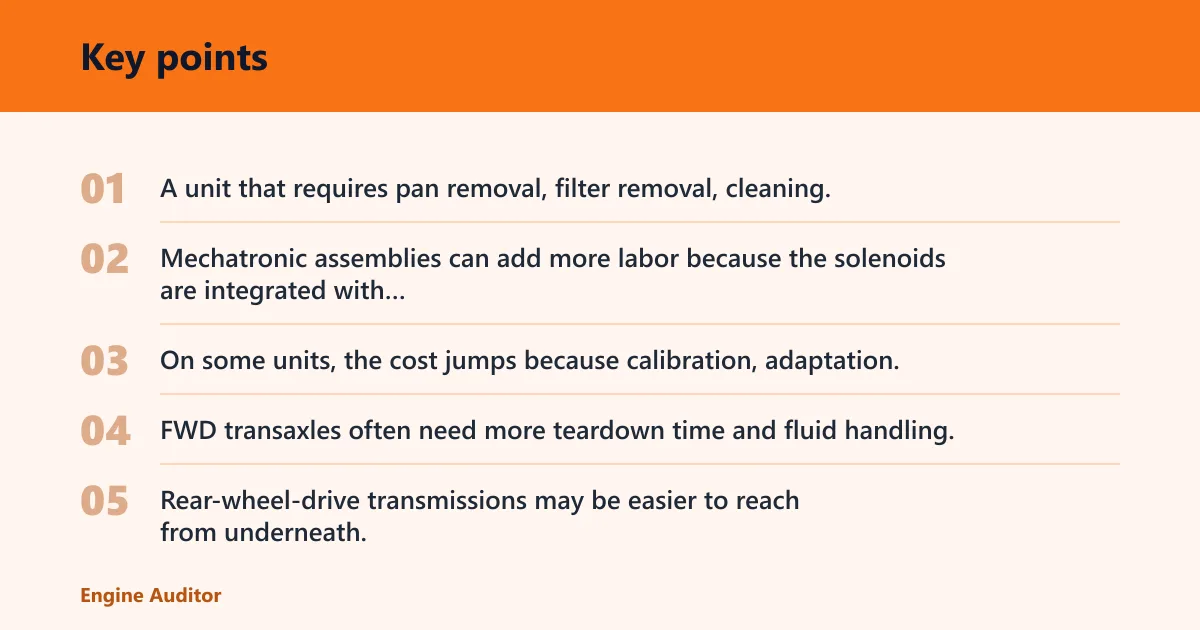
Those ranges shift with access. A unit that requires pan removal, filter removal, cleaning, and refill will take longer than a design with easier external access. Mechatronic assemblies can add more labor because the solenoids are integrated with other control hardware. On some units, the cost jumps because calibration, adaptation, or programming is part of the finished job, not an add-on.
Labor stages by vehicle layout
FWD transaxles often need more teardown time and fluid handling. Rear-wheel-drive transmissions may be easier to reach from underneath, but a packed valve body can still require careful removal and reinstallation. Mechatronic units can add calibration work after the hardware is swapped. OEM service information often separates these layouts into different procedures, which is why quoted labor can vary significantly even when the same code appears.
That is why a “cheap part” can still become an expensive visit. The part price is only one piece; access, scan time, fluid service, and post-repair verification can matter as much as the component itself.
Solenoid pack checklist
This checklist shows what a solid replacement visit should include. Ask for these items before approving the job, during the labor stages, and after the repair is complete. A good repair plan should include diagnosis, access planning, replacement work, and a verification drive, not just a parts swap.
| Stage | What to confirm | What a real fix should include |
|---|---|---|
| Pre-repair diagnostics | Codes, freeze-frame data, fluid condition, connector inspection, wiring check, commanded versus actual gear data | A transmission-capable scan tool, not a generic code read |
| In-shop labor | Drain fluid as needed, remove pan if required, remove filter if required, access valve body or mechatronic assembly, replace the failed part, inspect seals and connectors | Correct part orientation, clean mating surfaces, and no damaged harness pins |
| Post-repair verification | Clear codes, perform adaptation or relearn, verify fluid level and condition, road test, recheck live data | No return of the original code and no repeat slip, hard shift, or no-engage event |
What should happen after the swap?
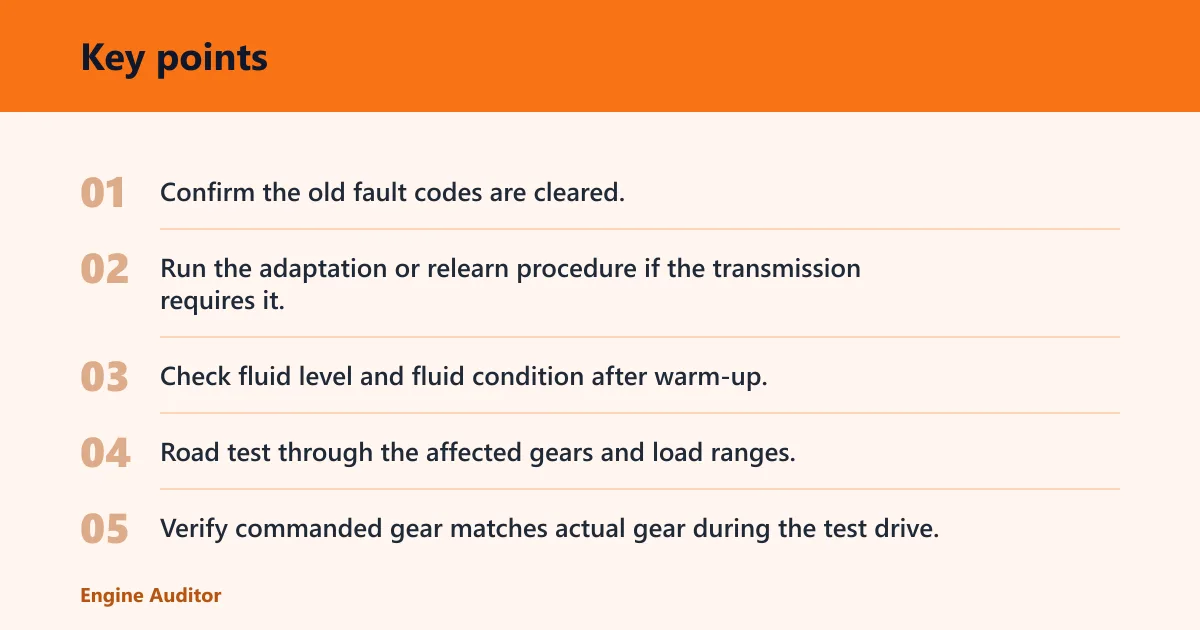
- Confirm the old fault codes are cleared.
- Run the adaptation or relearn procedure if the transmission requires it.
- Check fluid level and fluid condition after warm-up.
- Road test through the affected gears and load ranges.
- Verify commanded gear matches actual gear during the test drive.
After the road test, the shift pattern should be consistent, flare should be gone, and the converter clutch should apply and release when commanded. If the same symptom remains, the original diagnosis should be revisited before more parts are installed. OEM relearn procedures commonly require this final check because solenoid replacement alone does not guarantee the transmission will shift correctly without adaptation.
Why shops misdiagnose this job
Shops miss solenoid problems when they stop at the code, skip live data, or assume every transmission complaint means internal damage. Wiring and connector faults can mimic a failed solenoid because the circuit still sets a code even when the hardware itself is fine.
Fluid and filter issues create another trap. Low, dirty, or aerated fluid can change pressure control behavior and make a good solenoid look bad. A clogged filter can do the same by starving the hydraulic circuit.
TCM faults also get blamed on the wrong part. If the module is not sending the right command, the solenoid may test normally while the transmission still shifts badly. Commanded versus actual gear data is the practical red flag that separates those cases. Major scan tools and OEM diagnostics both rely on that comparison because a code alone cannot tell you whether the fault is electrical, hydraulic, or software-related.
When a deeper inspection is the smarter call
If several transmission codes appear at once, if the pack tests normal, or if the vehicle still shifts poorly after a solenoid swap, the next step should be valve body and TCM inspection. That is especially important when the problem returns immediately after clearing codes. At that point, more parts without deeper testing usually means repeating the same repair cycle.
A common first-timer mistake is authorizing a full pack because P0700 showed up on a basic scanner. That code says the transmission control system wants attention. It does not say which part failed.
Frequently asked questions
How much does transmission control solenoid pack replacement cost?
Expect a full solenoid pack assembly to cost $600-$1,500 installed. Dealer pricing is typically 30 to 50% higher, and labor rises with access, fluid service, and post-repair testing.
What are the symptoms of a bad transmission solenoid pack?
The most common symptoms are slipping, hard shifts, mushy shifts, delayed engagement, no-engage, and harsh or erratic gear changes. Those symptoms can also come from fluid, wiring, valve body wear, or TCM faults, so the symptom alone should not be treated as proof of a bad pack.
Is a solenoid pack replacement cheaper than a rebuild?
Usually, yes. A solenoid pack replacement is often far less expensive than a rebuild because it targets the control hardware instead of disassembling the entire transmission. If the unit also has clutch wear, metal contamination, or hydraulic damage, though, a rebuild or deeper repair can still be the correct path.
Can a bad solenoid pack cause slipping or hard shifts?
Yes. A failed shift or pressure control solenoid can cause slipping, flare, delayed shifts, or hard engagement because the transmission is not getting the pressure or timing it needs. TCC faults can also create shudder or abnormal lockup behavior at cruising speed.
Do I need a transmission-capable scan tool to confirm the problem?
Yes, for deeper diagnosis. A generic OBD-II scanner is not enough to confirm a failed solenoid pack. A transmission-capable scan tool can read live pressure data, solenoid current, and commanded versus actual gear information, which is what helps separate a bad solenoid from wiring or module trouble.
Is the solenoid pack inside or outside the transmission?
It can be either, depending on design. Many internal solenoids sit on or near the valve body, and some packs are integrated with mechatronic components. External access is easier, but internal layouts often require pan removal, filter removal, and more labor to reach the part.
Why do shops misdiagnose solenoid pack problems as internal transmission damage?
Because the symptoms overlap. A slipping or hard-shifting transmission can come from a solenoid, a valve body issue, a wiring fault, dirty fluid, or a TCM problem. If a shop stops at the code instead of checking live data and fluid condition, it can mistake a fixable control issue for major internal damage.
Products related to this article
Sponsored / affiliate links. As an Amazon Associate I earn from qualifying purchases. I may earn additional commission from eligible campaigns.