
Is Synthetic Oil Better for Cold Weather?
The recommendations below are based on how winter viscosity grades behave in cold-start conditions, not on brand marketing claims.
Yes—synthetic oil is usually better for cold weather because it resists thickening at low temperatures, but you still need the manufacturer’s approved winter viscosity for your climate and engine. That means reading both parts of the label correctly: the cold-start wear side of the equation and the operating-temperature grade side defined by SAE J300. Pick the wrong grade and cold starts can mean slower oil circulation, more wear, and a battery that works harder. This guide explains how synthetic compares with conventional oil, how to read winter viscosity labels, and when the owner’s manual should override the weather.
Methodology: The guidance here follows SAE J300’s winter-grade definitions, then cross-checks them against common OEM approval language used in owner manuals and service bulletins. Where the literature is strongest, the article favors “manual-approved only” decisions over broad claims; for example, many OEMs allow only specific approvals such as dexos1 Gen 3, VW 504 00/507 00, Mercedes-Benz 229.5/229.51, or BMW Longlife-17 FE+ depending on engine family and market. Cold-start wear, battery output loss in low temperatures, and the limited value of extended idling are also accounted for using reputable engineering and maintenance sources rather than anecdotal advice.
How cold weather changes oil flow
Cold temperatures thicken oil, so it moves more slowly through the engine. That matters most at startup, when oil has drained back to the sump and full circulation has not yet reached every part that needs it. SAE J300 separates winter performance from high-temperature viscosity: the “W” number describes cold-cranking and pumpability limits, while the second number describes operating viscosity at temperature.
Viscosity rises as temperature falls
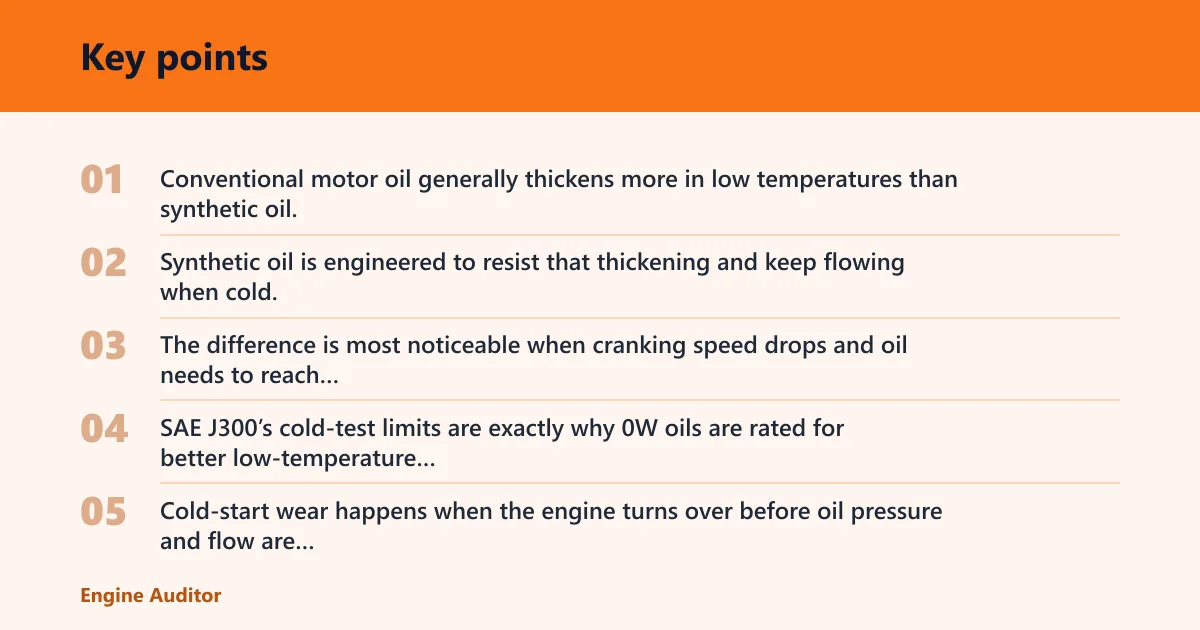
Conventional motor oil generally thickens more in low temperatures than synthetic oil. Synthetic oil is engineered to resist that thickening and keep flowing when cold, which is why it often supports easier cold starts. The difference is most noticeable when cranking speed drops and oil needs to reach bearings, cam parts, and valve-train components quickly. SAE J300’s cold-test limits are exactly why 0W oils are rated for better low-temperature crankability than 5W oils, all else equal.
Why startup delay matters more than driving heat
Cold-start wear happens when the engine turns over before oil pressure and flow are fully established. That is the real winter test. Once the engine warms, many oils behave more normally, so the cold-start window matters more than steady highway driving for winter choice. This is also why manuals and approval sheets focus on startup flow, pumpability, and engine-specific durability testing rather than just the number printed on the bottle.
If a sedan sits outside at about 5°F overnight, it may start with a slow crank on the first turn of the key. If the battery is weak and the oil is a thicker grade than the manual allows, the engine can sound sluggish even before it catches. The fix is not guessing a thicker oil; it is checking the approved viscosity and battery health together. In that kind of cold-soak scenario, battery output can drop substantially, so the starting system and lubricant both matter. See also cold-start oil selection for winter driving.
What the W in oil grades means
The first number before the W measures cold-start performance. Lower W ratings generally mean better winter flow, so 0W-20 generally flows better at low temperature than 5W-30, and 0W-30 generally stays more fluid in the cold than 5W-30. That does not make the lowest grade the right choice for every engine. SAE J300 sets the low-temperature tests; the owner’s manual and OEM approval decide whether the engine can actually use that grade.
Reading 0W-20, 0W-30, 5W-30, and 5W-40
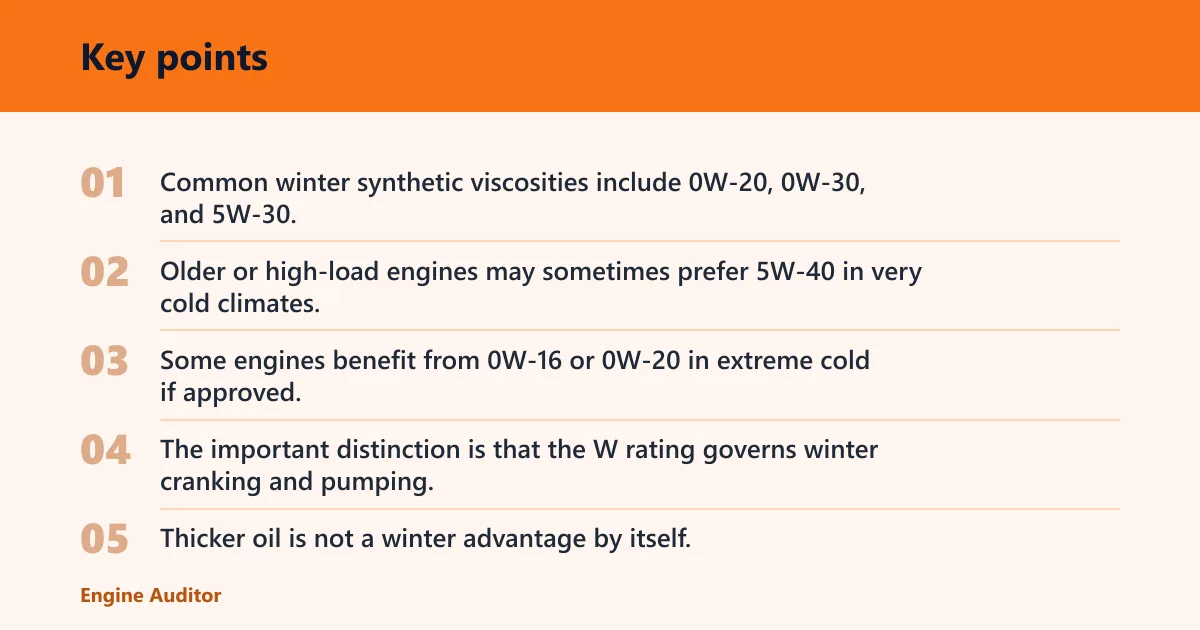
Common winter synthetic viscosities include 0W-20, 0W-30, and 5W-30. Older or high-load engines may sometimes prefer 5W-40 in very cold climates, but only when the owner’s manual or OEM approval allows it. Some engines benefit from 0W-16 or 0W-20 in extreme cold if approved. The important distinction is that the W rating governs winter cranking and pumping, while the second number governs the oil film once the engine is hot.
Why thicker is not automatically safer
Thicker oil is not a winter advantage by itself. If the manual calls for a lower winter grade, using a heavier oil can slow circulation at startup and increase the time before the engine sees full lubrication. That is why “thicker for protection” can backfire in cold weather. OEMs often prohibit unapproved thickening because it can affect phaser timing, turbocharger lubrication, fuel economy calibration, and emissions-system operation.
Winter oil decision table
Use the manual first, then match the approved viscosity to the cold band and engine type. Synthetic helps most when the vehicle sees genuine cold starts, repeated short trips, or overnight parking in low temperatures. It is less useful when the approved grade already fits mild winter conditions and the engine starts easily. The safest rule is manual-approved only: do not substitute a grade just because another one sounds “better” for winter.
| Ambient temperature band | Engine type | Manual-approved viscosity | Safest oil choice | Do not change if… |
|---|---|---|---|---|
| Mild winter, near freezing and above | Gasoline | 0W-20 approved | 0W-20 full synthetic or synthetic blend if approved | Your manual already approves 0W-20 and starts are normal; a switch is unnecessary if the current oil already meets the OEM specification and approval. |
| Mild winter, near freezing and above | Turbocharged | 5W-30 approved | 5W-30 full synthetic with the exact OEM approval | Do not move to a thinner or thicker grade unless the manual explicitly allows it; turbo engines often need the specified viscosity for heat control, oil coking resistance, and bearing protection. |
| Cold winter, frequent subfreezing starts | Gasoline | 0W-30 approved | 0W-30 full synthetic | Do not change if the engine already calls for 0W-30 and starts cleanly; synthetic still helps, but the approved grade is already the winter target. |
| Cold winter, frequent subfreezing starts | Older or high-mileage | 5W-40 approved | 5W-40 synthetic only if the manual lists it | Do not switch down to a thinner grade if the engine has oil-pressure, consumption, turbo, or timing-chain concerns and the manual does not permit the change. |
| Very cold, prolonged overnight parking | Gasoline or turbocharged | 0W-20 or 0W-16 approved | 0W-20 or 0W-16 full synthetic, if approved | Do not ignore OEM approval; lower viscosity helps cold flow only when the engine is built and calibrated for it. Examples of approval logic include dexos1 Gen 3, VW 508 00/504 00, or BMW LL-17 FE+ where the manual specifies them. |
| Very cold, heavy load or older design | Diesel | Varies by model | Manual-approved winter diesel oil, often synthetic | Do not use a gasoline recommendation as a substitute; diesel engines may have separate winter-oil needs, low-temperature pumpability limits, ash/sulfation requirements, and OEM approvals. |
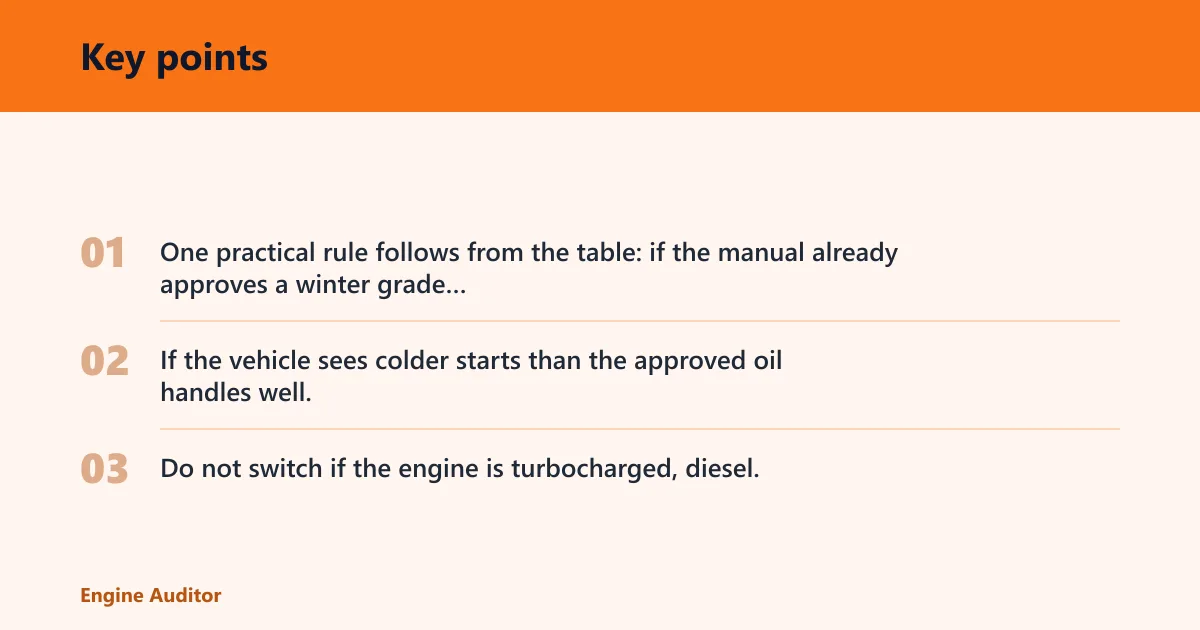
One practical rule follows from the table: if the manual already approves a winter grade that fits your climate band, synthetic may be beneficial but not necessary. If the vehicle sees colder starts than the approved oil handles well, synthetic is often the better choice, as long as the grade and approval still match. Do not switch if the engine is turbocharged, diesel, or high-mileage and the change would break the OEM approval list.
Does synthetic oil flow better in cold weather?
Yes. Full synthetic usually flows better than conventional oil in cold weather, and synthetic blend sits between the two. Better flow can mean quicker circulation after startup and less strain during the first seconds of cranking. That advantage matters most in very cold conditions, repeated short trips, and vehicles that sit outside overnight. It does not mean a 5W-40 will outperform a properly approved 0W-20 at cold start; the W rating and the engine’s actual approval have to be considered separately.
Full synthetic versus synthetic blend
Full synthetic is the stronger cold-weather choice when the manual allows it. Synthetic blend can be a middle ground for drivers who want some winter improvement without going to a full synthetic formulation, but it does not match full synthetic cold-flow performance. Industry tests and OEM approval systems exist because the differences show up in low-temperature pumpability, oxidation control, and deposit resistance—not just marketing claims.
When conventional oil is still acceptable
Conventional oil can still be acceptable when it already meets the required viscosity and the climate is mild. If the engine starts easily, the battery is healthy, and the manual does not call for a lower winter grade, there may be no cold-weather reason to switch only because the oil is not synthetic. In other words, “synthetic” is not a substitute for the right SAE grade or the right OEM approval.
Picture a compact car that is parked in a garage, sees 35°F mornings, and uses an approved 5W-30 conventional oil. If starts are quick and the manual does not require synthetic, moving to a full synthetic may be fine, but it is not automatically necessary for winter reliability. In mild winter service, the correct specification matters more than the label type.
What else affects cold starts?
Oil is only part of the cold-start picture. Battery health matters because cold weather increases starter strain, and a weak battery can mimic an oil-flow problem with slow cranking. Oil filter condition matters too, since cold thick oil can make a restricted filter more of a problem. Reputable battery testing guidance also notes that available cranking power drops in low temperatures, so battery state-of-charge and age are part of the decision.
Battery condition and starter load
A cold battery delivers less cranking power, which makes the starter work harder. If the engine cranks slowly, do not assume oil is the only issue. Check the battery, terminals, and charging system, especially if the symptom is slow cranking before the engine even fires. This is one reason extended idling is not a cure-all: it can recharge only so much, and it does not undo a weak battery or an out-of-spec oil grade.
Oil filter restriction and short-trip habits
An oil filter that is clogged or poorly suited to winter service can worsen flow delay. Short trips add another problem because moisture and fuel dilution can build up when the engine never gets fully warm. That habit does not change the correct grade, but it makes winter maintenance more important. It also explains why repeated short-trip drivers often benefit more from shorter oil-change intervals and the exact factory-approved oil spec than from idling the car before driving.
- Confirm the exact viscosity and OEM approval in the owner’s manual.
- Choose a lower W rating only if the manual allows it.
- Check battery health before blaming oil for slow starts.
- Replace a restricted oil filter on schedule.
- Watch for repeated short trips and moisture buildup in winter.
What oil is better for cold weather in your engine?
The best cold-weather oil depends on engine type, approved viscosity, and how low your mornings actually get. Gasoline engines often do well with 0W-20 or 0W-30 when those grades are approved. Turbocharged engines usually need their exact specified grade. Older or high-mileage engines may be better served by 5W-40 only if the manual permits it. Diesel engines can have separate winter requirements. The answer is always manual-first, approval-first, then climate.
Gasoline versus turbocharged engines
For many modern gasoline engines, a lower winter grade such as 0W-20 can improve cold-start flow when it is OEM-approved. A 5W-40 may be the right choice in some engines, but it is not a general “better cold-flow” option; its operating viscosity is heavier than 0W-20 or 0W-30 once the engine is warm. Turbocharged engines are less forgiving of guesswork because oil control and approval matter as much as winter flow. In those engines, the right viscosity is the one the manufacturer specifies, and sometimes the exact approval is just as important as the SAE grade.
Older and high-mileage engines
Older or high-mileage engines may prefer 5W-40 in very cold climates if that grade appears in the approved list. Do not choose it just because the engine has miles on it. The approval and oil-pressure needs come first, then the winter band. If the manual does not list 5W-40, high mileage alone is not a reason to use it.
Diesel engines and separate winter needs
Diesel engines may need their own winter oil strategy. Their starting behavior, soot loading, and manufacturer approvals can differ from gasoline engines. If the vehicle is diesel, skip generic advice and follow the exact spec in the manual. That may include specific ACEA classes, OEM diesel approvals, or low-temperature pumpability requirements that are not interchangeable with gasoline recommendations.
Frequently asked questions
Is synthetic oil better for cold weather?
Usually, yes. Synthetic oil is engineered to resist thickening and keep flowing when cold, so it often supports easier starts and faster lubrication than conventional oil. The catch is simple: the correct winter viscosity and OEM approval still matter more than the word synthetic on the bottle. SAE J300 and the owner’s manual should both be checked before switching.
Is synthetic oil good for cold weather?
Yes, synthetic oil is a strong choice for cold weather because it generally flows better at low temperature and can reduce startup strain. It is most helpful when the vehicle sees hard winter starts, repeated short trips, or overnight parking outside. If the approved grade already fits the climate, the gain may be modest.
Is full synthetic oil better for cold weather?
Full synthetic is usually better than a blend or conventional oil for cold-weather flow. It tends to circulate faster at startup and thickens more slowly in the cold. That said, it should still match the viscosity and approval listed in the owner’s manual. Better flow does not cancel a wrong spec, and it does not replace a required OEM approval.
What engine oil is better for cold weather
The better cold-weather oil is the one that combines the right OEM approval with a winter-friendly W rating. For many vehicles that means 0W-20, 0W-30, or 5W-30; some older or high-load engines may use 5W-40 if approved. The manual decides first, not the temperature alone. SAE J300 defines the viscosity grade, while the OEM list decides whether the oil is allowed.
What oil is better for cold weather
For cold weather, the better oil is usually a full synthetic in the lowest approved winter grade for your engine. If the manual allows 0W-20 or 0W-30, those grades often help cold starts more than a thicker oil. If the approved grade is already 5W-30, synthetic can still help, but you do not need to change grades without approval. Reputable guidance on cold-start wear, battery output loss in the cold, and the limits of extended idling all point to the same conclusion: follow the manual first, then optimize within it.
Products related to this article
Sponsored / affiliate links. As an Amazon Associate I earn from qualifying purchases. I may earn additional commission from eligible campaigns.