Can Cold Weather Cause a Rough Idle?
Yes, cold weather can cause a rough idle, especially for the first 30–120 seconds after start. If the rough idle lasts after the engine warms up, treat it as a fault. Ignoring it can waste fuel, foul plugs, and hide a sensor, air, fuel, or oil problem that will get worse in winter. This guide maps the cold-start causes in fuel, air, spark, and oil viscosity, then shows how to tell normal winter behavior from a diagnosis-worthy idle.
Can cold weather cause a rough idle?
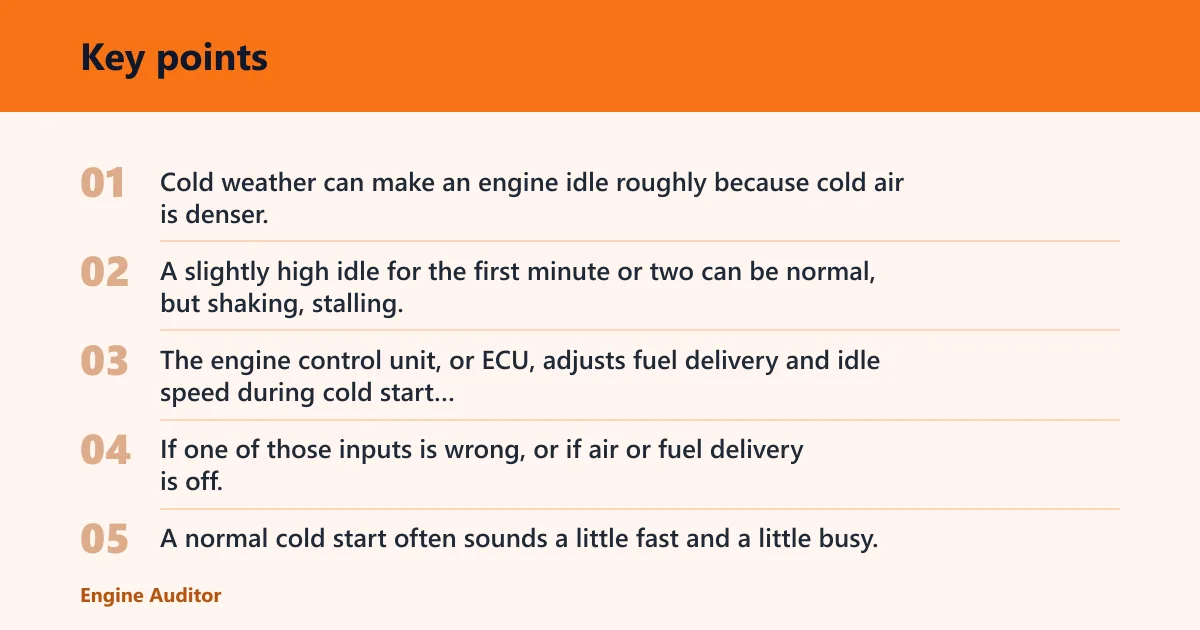


Yes. Cold weather can make an engine idle roughly because cold air is denser, fuel does not vaporize as easily, battery output drops, and rubber parts shrink enough to expose leaks. A slightly high idle for the first minute or two can be normal, but shaking, stalling, or a misfire is not.
The engine control unit, or ECU, adjusts fuel delivery and idle speed during cold start using coolant temperature, airflow, and other sensor data. If one of those inputs is wrong, or if air or fuel delivery is off, the engine can run lean, rich, or uneven until conditions stabilize.
What a normal cold-start idle feels like
A normal cold start often sounds a little fast and a little busy. The idle may settle down as coolant temperature rises and the ECU leans the mixture toward warm operation. That pattern is different from repeated shaking, dead-cylinder misfire, or an idle that never smooths out.
When winter simply makes a flaw easier to notice
Winter often does not create the fault. It exposes it. A hose that seals well when warm may leak when contracted, a weak coil may misfire only when cold, and a marginal battery may drop voltage enough to upset injector or throttle control during the first start of the day.
What changes during a cold start
Cold engines need a richer fuel mixture to idle smoothly. A healthy cold idle may be slightly higher than warm idle for the first minute or two. If the mixture, airflow, spark, or voltage is off, the ECU has less margin to keep the idle steady.
How the ECU changes fuel and idle speed
During cold start, the ECU relies on coolant temperature, airflow, throttle position, and other inputs to set fuel and idle speed. If the coolant temperature sensor reads too warm, the ECU may underfuel. If it reads too cold, the ECU may overfuel. Either error can disturb cold idle quality.
Why coolant temperature, airflow, and voltage matter
The coolant temperature sensor can read too warm or too cold, and that can lead to lean or rich cold-start fueling errors. The mass airflow, or MAF, sensor measures incoming air; dirty or faulty readings can upset mixture and idle. Low battery voltage can reduce power to starting and engine control systems.
Where thick oil can add drag
Thick engine oil can add load when temperatures drop, especially in the first moments after start. That extra drag can make idle feel heavier or a little less smooth. It usually does not explain a strong fuel smell, a clear misfire code, or a rough idle that remains after the engine is warm.
Which system is most likely?
The symptom pattern matters. Rough idle that improves quickly often points to a cold-start control issue, while rough idle that follows the engine into warm operation points more strongly to an actual fault in air, fuel, ignition, or sensor input. Use the pattern to narrow the first check.
Air leaks and idle control faults
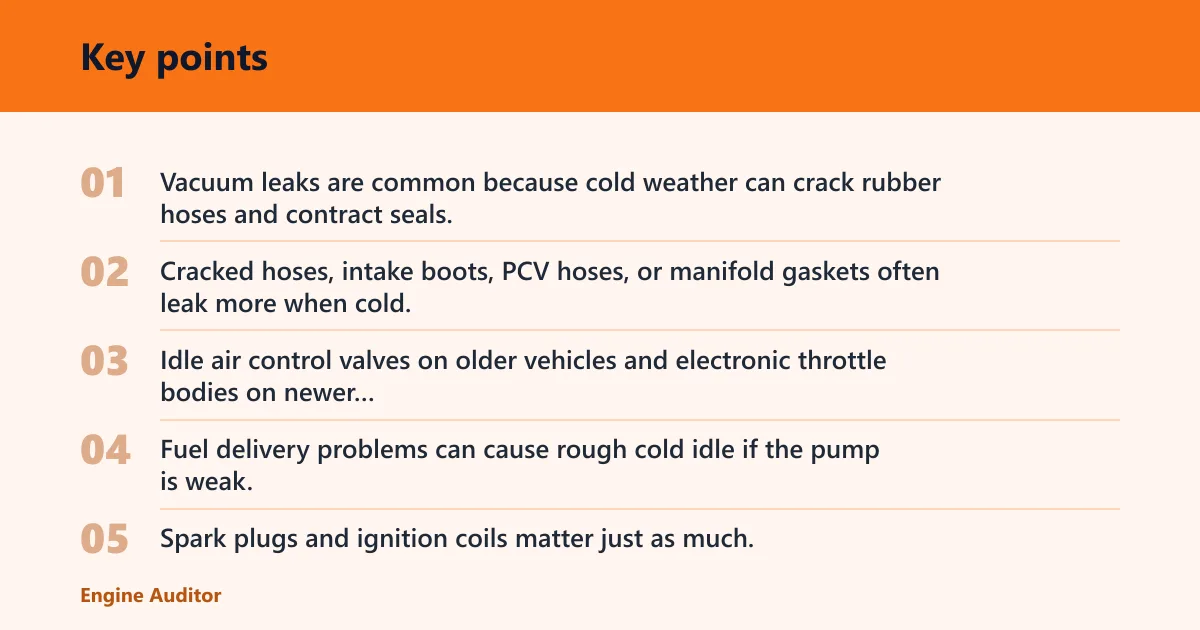
Vacuum leaks are common because cold weather can crack rubber hoses and contract seals. Cracked hoses, intake boots, PCV hoses, or manifold gaskets often leak more when cold. Idle air control valves on older vehicles and electronic throttle bodies on newer vehicles can also stick or collect dirt, causing hunting, stalling, or unstable idle.
Fuel and ignition faults
Fuel delivery problems can cause rough cold idle if the pump is weak, injectors spray poorly, fuel pressure is low, or the fuel filter is restricted. Spark plugs and ignition coils matter just as much; weak spark often shows up most at cold start, and misfire codes may appear in the P0300 series.
Sensor and voltage faults
A bad coolant temperature signal can distort the fuel calculation at the moment the engine needs the most help. MAF faults can do the same by skewing the air estimate, and P0101 is listed as a mass airflow sensor code. A weak battery can also lower voltage enough to affect ignition, injectors, and throttle control.
Cold idle decision table
This table turns the symptom into the first system to verify. Start with the row that matches what the engine actually does, not what it feels like in the morning.
| Symptom pattern | Most likely system | First verification step |
|---|---|---|
| Rough only for 30–90 seconds | Sensor | Compare coolant temperature on a cold start against ambient temperature with an OBD-II scanner. |
| Rough with fuel smell | Fuel | Check for rich codes, injector issues, and fuel pressure before chasing idle parts. |
| Rough only at idle but smooths under throttle | Air | Inspect for vacuum leaks and idle control faults, then confirm with a smoke test. |
| Rough that persists fully warm | Ignition | Scan for P0300 series misfire codes and inspect plugs, coils, and fuel delivery. |
Say your sedan idles roughly for about one minute on a 20-degree morning, then smooths out and drives normally. That pattern fits a cold-start correction issue better than a constant mechanical fault, so coolant temperature data and vacuum leak checks make more sense than replacing random parts.
Can a cold air intake cause a rough idle?
Yes, but only in the right context. A cold air intake can cause a rough idle if fitment is poor, air is unmetered, or the MAF sensor placement and calibration no longer match the intake path. If the system is installed correctly and tuned for the vehicle, it is less likely to be the real cause.
Fitment and unmetered air
An intake tube that does not seal, or that leaves the MAF seeing air flow it was not calibrated for, can upset mixture control at idle. Idle is where that error shows up first because airflow is low and the ECU has less room to correct the mixture.
MAF calibration and sensor placement
The MAF sensor measures incoming air. If it reads dirty, damaged, or out of position, the ECU may command the wrong fuel amount. That can create unstable idle, stumble, or a lean code such as P0171 or P0174 during cold-start diagnosis.
When the intake is not the real issue
A cold air intake is not a common cause by itself. If the rough idle persists with the stock intake, the problem is elsewhere. Check for vacuum leaks, ignition faults, coolant temperature sensor errors, or fuel delivery issues before blaming the intake hardware.
What should you check first?
Start with the simplest checks that separate a cold-start control issue from a real fault. Read stored and pending codes, look at live data, compare coolant temperature to ambient on a cold start, and inspect intake and vacuum parts before replacing sensors or coils.
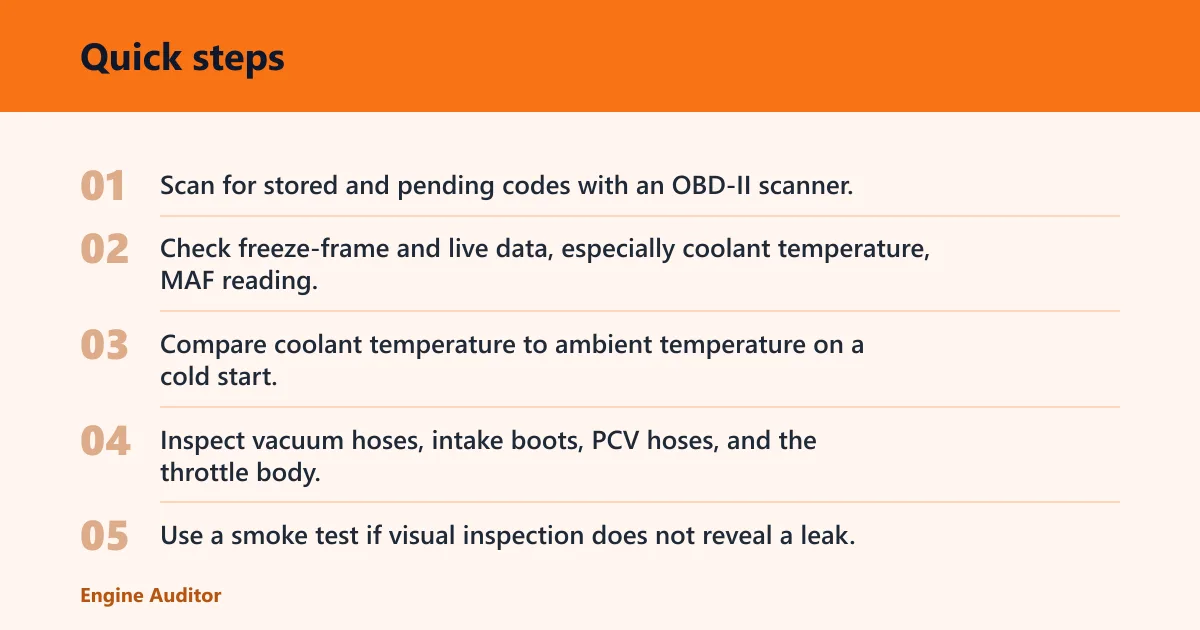
- Scan for stored and pending codes with an OBD-II scanner.
- Check freeze-frame and live data, especially coolant temperature, MAF reading, and short-term fuel trim.
- Compare coolant temperature to ambient temperature on a cold start.
- Inspect vacuum hoses, intake boots, PCV hoses, and the throttle body.
- Use a smoke test if visual inspection does not reveal a leak.
- If misfire codes are present, inspect plugs, coils, and fuel delivery before chasing idle hardware.
An OBD-II scanner helps separate guesswork from pattern. P0115 to P0119 are coolant temperature sensor code ranges mentioned for diagnosis, P0505 is listed as an idle air control valve fault code, and P0101 can point toward a MAF issue. Codes alone are not enough; pair them with live data and inspection.
Why a smoke test matters
A smoke test is the better way to find hidden intake leaks when a visual inspection comes up empty. Tiny leaks around intake boots, manifold gaskets, or PCV hoses may not show themselves by eye, especially if the leak opens more when the parts are cold and contracted.
Picture a pickup that idles smoothly in the afternoon but shakes badly on winter mornings and smooths out under light throttle. That pattern points away from a major load problem and toward a leak, idle control issue, or sensor error that matters most at idle, not on the road.
When is a cold idle problem urgent?
A cold idle becomes urgent when the check engine light flashes, misfire codes appear, fuel odor is strong, the engine stalls, or the roughness continues after warm-up. A flashing check engine light is treated as a stop-driving condition in this guide because active misfire can damage the catalytic converter.
Flashing check engine light or P0300-series misfire codes
P0300 series misfire codes can help confirm ignition or fuel-related rough idle. If the light flashes, do not keep driving and hoping the symptom clears. That pattern means the misfire is active enough to risk downstream damage.
Fuel smell, stalling, or roughness that persists warm
Fuel smell can point to overfueling, leaking injectors, or a sensor error that is commanding the wrong mixture. Stalling and roughness that remain once the engine is warm usually mean the fault is not just a winter quirk. Those symptoms deserve prompt diagnosis.
Battery and charging problems that worsen winter drivability
Cold weather reduces battery performance, and a weak battery can reduce power to starting and engine control systems. If voltage drops during crank or idle, ignition output, injector operation, and throttle control can all suffer. That is especially relevant on vehicles with electronic throttle only.
Frequently asked questions
Why does my car idle rough when cold?
A cold engine needs richer fueling and stable airflow control to idle smoothly. If the ECU gets the wrong coolant temperature signal, the MAF reads incorrectly, or there is a vacuum leak, the mixture can go lean or rich and the idle can shake until conditions change.
Can a vacuum leak cause a rough idle only when cold?
Yes. Cold weather can make rubber hoses crack and seals shrink, which often makes leaks worse on cold starts. A leak may be small enough to matter only at idle, then fade as parts warm and expand. A smoke test is the best way to confirm it.
Does a bad coolant temperature sensor cause a rough idle in winter?
Yes. A coolant temperature sensor that reads too warm or too cold can mislead the ECU during cold start. That can create lean or rich fueling errors, and a rough idle that clears after the first minute can point to this fault. P0115 to P0119 are code ranges to check.
Can worn spark plugs make a cold engine idle rough?
Yes. Weak spark often shows up most at cold start, when the mixture is harder to ignite and the engine is less forgiving. Ignition problems may set P0300 series misfire codes, and a misfire that remains warm is more urgent than a brief rough start.
Can thick engine oil make idle rough in cold weather?
It can add drag and make the engine feel heavier at startup, especially in very cold conditions. That said, oil viscosity is rarely the main cause of a persistent rough idle, fuel smell, or repeated misfire. If the symptom stays after warm-up, look elsewhere first.
Products related to this article
Sponsored / affiliate links. As an Amazon Associate I earn from qualifying purchases. I may earn additional commission from eligible campaigns.