How Long Should You Warm Up a Car in Winter?
For most modern gas cars, 30 seconds to 1 minute of idling is enough before you drive. In subzero weather, give it 1 to 2 minutes. Older carbureted engines may need several minutes. Idling longer than that burns fuel, adds emissions, and often delays real warm-up. Driving off too soon can leave thick oil, weak defrost, and poor cabin heat. This guide gives a simple warm-up rule by vehicle type and temperature, plus when to drive, when to wait, and when slow warm-up signals trouble. Always follow your owner’s manual first, and if your vehicle specifies a different procedure, use that instead.
This guide is part of our Cold Weather Engine Care: Oil Viscosity, Cold Starts and Fuel Problems series.
Quick answer by temperature
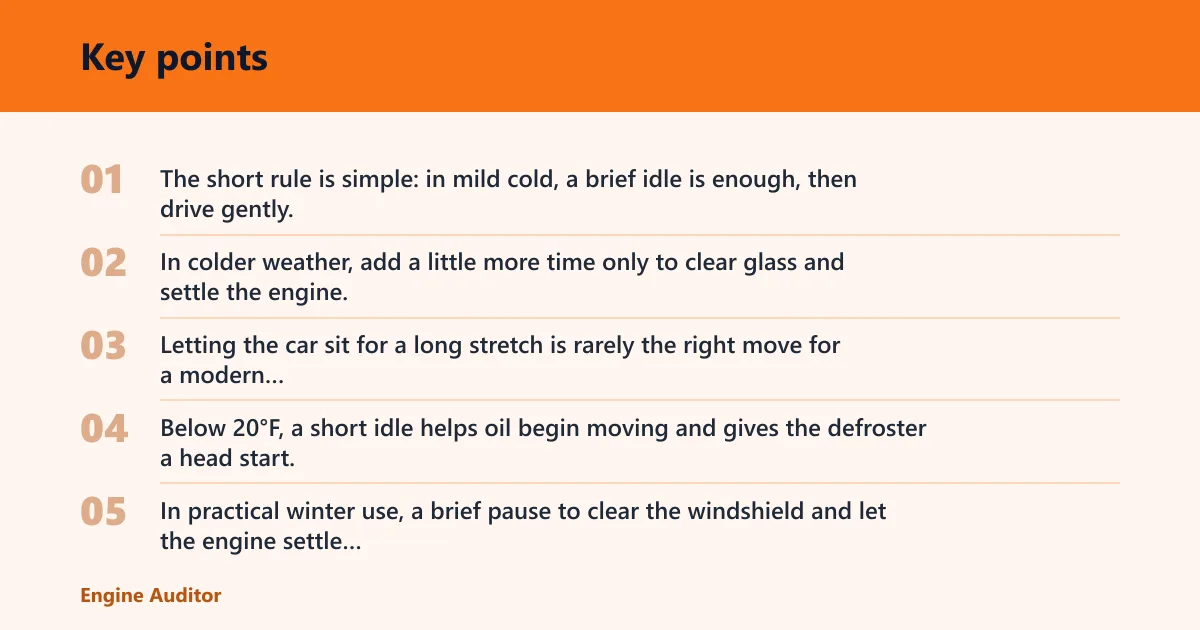


The short rule is simple: in mild cold, a brief idle is enough, then drive gently. In colder weather, add a little more time only to clear glass and settle the engine. Letting the car sit for a long stretch is rarely the right move for a modern fuel-injected engine.
Under 20°F: when a short idle makes sense
Below 20°F, a short idle helps oil begin moving and gives the defroster a head start. In practical winter use, a brief pause to clear the windshield and let the engine settle is usually the right balance; most modern cars do not need a long curbside warm-up. If the windshield is frosted, use that time to scrape the windows and clear snow before you roll.
If the cabin still feels cold after you start moving, that does not mean the engine needs ten more minutes at the curb. Modern cars warm up faster when driven than when left idling, and the heater only gets strong once the coolant is hot.
20°F to 40°F: when to drive off
Between 20°F and 40°F, many cars are ready to move after a brief idle, often within 30 seconds to a minute. The goal is not full operating temperature at the curb. The goal is a steady idle, clear glass, and enough circulation to protect the engine while you keep speed and throttle light.
Below 0°F: when to wait a little longer
Below 0°F, a longer brief idle can be reasonable, especially if the car has been parked outside and the windows are iced over. Even then, the wait is usually measured in minutes, not 10 to 15 minutes. Older carbureted engines are the main exception, because they were built around a choke instead of electronic fuel control. For hybrids, diesels, and turbocharged direct-injection gas engines, use the owner’s manual as the final word because start-up behavior and heat management can differ.
How long should you warm up a car in winter?
For a modern gas car, the answer is usually short: idle briefly, then drive gently. Modern cars use sensors and ECU fuel control, so they do not need the long warm-up that carbureted engines once needed. Older gas engines, diesels, and very cold starts may need more time, but the right amount still depends on temperature and vehicle type.
Modern gas cars
A modern fuel-injected engine does not need 10 to 15 minutes of idle time. It starts with a cold-start rich mixture, then the control system trims fuel as parts warm up. A short idle helps settle the engine after startup, but gentle driving does the real warming work faster.
That is why long idle time is discouraged in winter. The engine reaches useful temperature faster under light load, and the catalytic converter also heats faster under driving load than it does while parked and idling. The U.S. Department of Energy advises avoiding extended idling because it wastes fuel, and EPA guidance similarly notes that the best way to warm a vehicle is to drive it gently after a short pause rather than let it sit and idle. Popular Mechanics has also summarized Natural Resources Canada’s winter testing showing that a five-minute idle can worsen fuel economy by about 7% to 14%, while a ten-minute idle can worsen it by about 12% to 19%.
Older gas cars
Older carbureted engines were different. They used a choke, and cold running could be rough until the engine took some heat. If you own a very old car, several minutes of idle time may still be reasonable in cold weather, especially if the engine stumbles or stalls right after startup.
Diesel engines
Diesels often need a little more patience in cold weather because they can be slower to make heat and may idle roughly until conditions settle. Even so, extended idling is still not the best way to warm them. Use the shortest idle that gives stable running, then drive gently and keep engine speed modest. In very cold weather, glow-plug cycling and, if equipped, a block heater can make cold starts much easier; let those systems finish their job before you pull away.
Very cold-weather use
In very cold weather, the issue is not only engine wear. You also need enough time for the windshield to clear and for the cabin to stop fogging. A brief idle can help visibility, but it should be paired with a slow, easy first few miles rather than a long wait in the driveway.
What a cold start changes
A cold start changes how the engine lubricates, fuels, and heats. winter engine oil viscosity matters because oil is thicker when cold, so it moves more slowly through galleries and bearings. The engine also runs rich at first during a cold start, which helps starting but burns extra fuel until temperatures rise.
Cold engine oil is thicker
Cold temperatures make engine oil more viscous and slower to flow. That is the main reason a brief idle is useful. It gives the pump a moment to move oil where it needs to go before you ask the engine to take load, climb a hill, or run at higher rpm. The exact benefit depends on the oil grade specified in the owner’s manual; thinner winter-rated oils flow sooner than heavier grades in the cold.
Cold-start fuel enrichment
During a cold start, the engine runs rich at first. That richer mixture helps combustion, but it also increases fuel use before warm-up. If the car sits and idles for a long time, that extra fuel use continues without adding much useful heat, and it can contribute to fuel wash over time.
Why idle time is limited
Idle time helps in the first minute or so. After that, the gains drop fast. Long idling burns fuel, raises emissions, and does less to warm the drivetrain than a gentle drive. Popular Mechanics notes that the warm-up myth mainly applied to carbureted engines, not today’s sensor-controlled cars.
Winter warm-up table
This decision table separates “safe to drive off” from “fully warmed up.” Safe to drive off means the engine is stable enough for gentle movement. Fully warmed up means coolant, oil, and cabin heat have had time to reach normal working temperature. Follow the owner’s manual if it recommends a different idle, block-heater, or drive-off routine.
| Vehicle segment | Temperature band | Recommended idle time | Drive-off point | First 5 minutes driving behavior | Red-flag symptoms |
|---|---|---|---|---|---|
| Modern gas | 20°F to 40°F | 30 seconds to 1 minute | When idle is steady and glass is clearing | Light throttle, low rpm, no hard acceleration until the gauge begins to rise | Temperature gauge stays low after normal driving; cabin heat stays weak |
| Modern gas | Under 20°F | 1 minute | After windshield is scraped and the engine settles | Keep speeds modest, avoid towing or hard throttle, and let the drivetrain warm in motion | Warm-up is unusually slow, or the gauge never rises toward normal |
| Modern gas | Below 0°F | 1 to 2 minutes | When visibility is safe and throttle can stay light | Use a very gentle first few miles; consider whether a block heater would help on future starts | Repeated rough idle, heater stays cold, or coolant level drops |
| Older gas | 20°F to 40°F | 1 to 3 minutes | When choke behavior calms and it no longer stumbles | Drive off gently, keep rpm low, and avoid sudden throttle until the engine takes load cleanly | Hard starting, repeated stalling, or black smoke after warm-up |
| Older gas | Under 20°F | 3 to 5 minutes | When the engine takes throttle cleanly | Use light throttle and shallow shifts; if it still runs poorly, check choke, ignition, or fuel delivery | Runs too cold for too long, low gauge readings, or poor cabin heat |
| Older gas | Below 0°F | Several minutes | When idle smooths out enough to move slowly | Keep the first miles easy and avoid high load until heat starts building | Fuel smell, stall after start, or erratic temperature readings |
| Diesel | 20°F to 40°F | 30 seconds to 1 minute | Once idle is stable and glow-plug cycling is complete | Drive gently, keep revs modest, and do not expect full heat immediately | Excessive white smoke, poor heat, or extended rough idle |
| Diesel | Under 20°F | 1 to 2 minutes | When the engine is smooth enough for light driving | Use a light load first; a block heater may be helpful in repeated deep-cold starts | Slow cabin heat, low coolant temperature, or heater output that never improves |
| Diesel | Below 0°F | 2 to 5 minutes | After stable idle and enough visibility to move safely | Let glow plugs finish, then roll off gently and keep rpm low until heat builds | Hard starting, repeated misfire feel, or excessive smoke at idle |
| Very cold-weather use | Any band below 0°F | 1 to 5 minutes depending on type | When windows are clear and controls respond normally | Defrost first, then drive lightly; if the vehicle has a block heater, use it according to the manual | Persistent fogging, no cabin heat after driving, or a temperature gauge that stays unusually low |
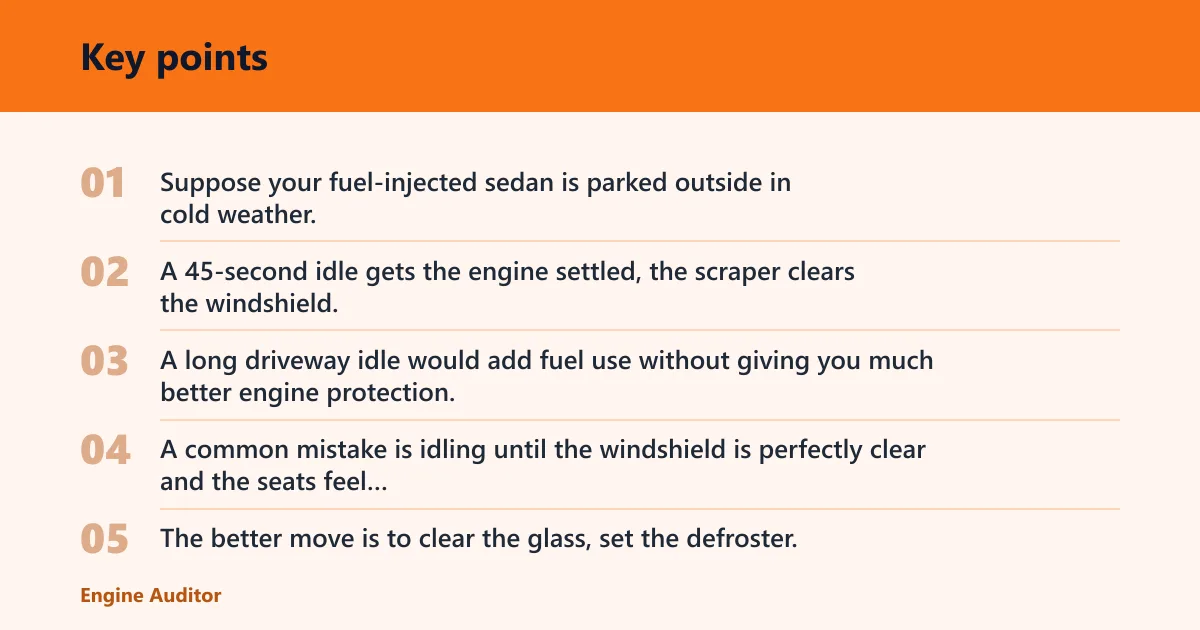
Suppose your fuel-injected sedan is parked outside in cold weather. A 45-second idle gets the engine settled, the scraper clears the windshield, and you drive off gently. That is enough. A long driveway idle would add fuel use without giving you much better engine protection.
A common mistake is idling until the windshield is perfectly clear and the seats feel warm before driving off. That usually takes longer than necessary. The better move is to clear the glass, set the defroster, and start driving lightly so the engine and catalytic converter can heat under load.
Why gentle driving warms the car faster
Gentle driving warms the engine faster than idling because the engine is doing real work. More load creates more heat, and that heat moves the coolant, oil, and exhaust system toward normal operating temperature. Catalytic converters do not work until they are hot, so they benefit from that extra heat as well.
Engine load builds heat quicker than idle
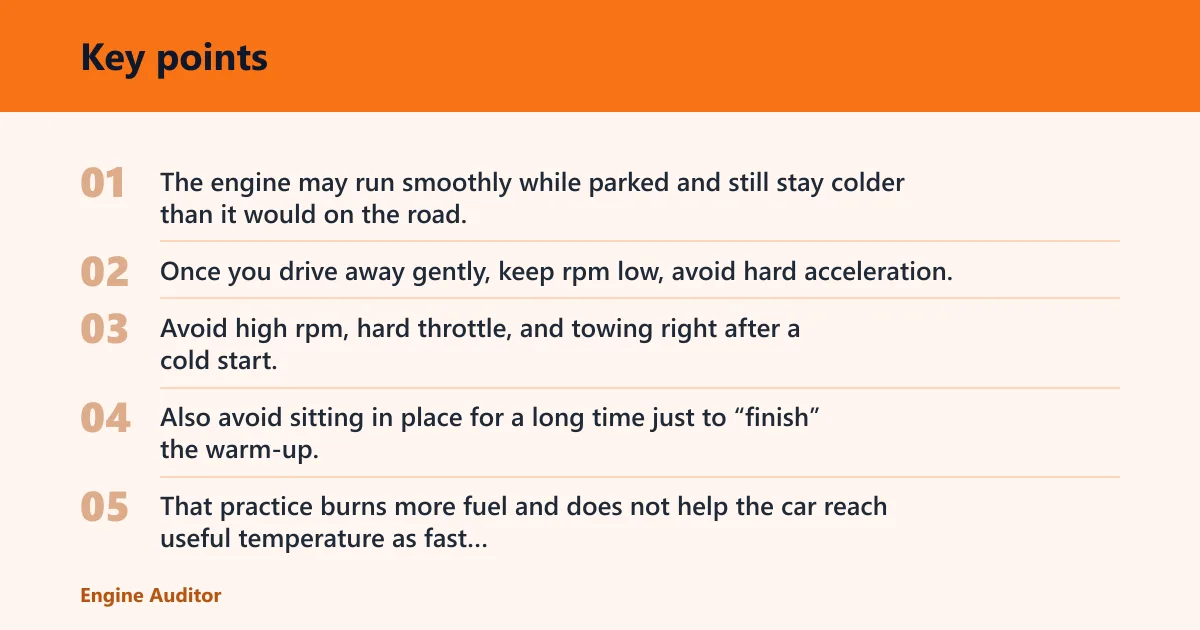
Idle is low-stress, but it is also low-heat. The engine may run smoothly while parked and still stay colder than it would on the road. Once you drive away gently, keep rpm low, avoid hard acceleration, and let the drivetrain warm in motion.
What to avoid in the first few minutes
Avoid high rpm, hard throttle, and towing right after a cold start. Also avoid sitting in place for a long time just to “finish” the warm-up. That practice burns more fuel and does not help the car reach useful temperature as fast as a short idle plus easy driving.
Does warm-up help the heater and defroster?
Yes, but only to a point. Cabin heat depends on hot coolant, and the heater core can only warm air once coolant is hot enough to pass through it. A brief idle can help the defroster begin clearing the glass, but it will not give you full heat as quickly as driving will.
Cabin heat depends on hot coolant
The heater core uses hot coolant to warm cabin air. If the engine is still cold, cabin air stays cool or lukewarm. That is normal for the first few minutes. If heat never improves even after the engine has been driven, that points away from “needs more idle” and toward a fault.
When brief idle helps visibility
Brief idle helps when the inside of the windshield is fogged and the outside glass is frosted. It gives the blower, rear defogger, and defroster a head start while you finish scraping windows and clearing snow from the roof, hood, lights, and mirrors.
When weak heat points to a fault
If the temperature gauge stays low, the heater never gets hot, or the windshield never clears well after several miles, suspect more than cold weather. A stuck-open thermostat, low coolant, an air pocket, or a heater-core restriction can all delay cabin heat.
When slow warm-up is a warning sign
If a car still warms up too slowly after a normal cold start, look for a mechanical problem rather than adding more idle time. The most common clues are a stuck-open thermostat, low coolant, or a heater-core issue. Those faults affect temperature control, not just comfort.
Stuck-open thermostat
A thermostat controls coolant flow to the radiator. If it sticks open, the engine sends heat to the radiator too early and warms slowly. A common sign is a low temperature gauge reading even after a normal drive, along with weak cabin heat.
Low coolant or a leak
Low coolant can leave the heater core partly dry and reduce heat transfer. That can show up as poor cabin heat, a fluctuating temperature gauge, or visible coolant loss. If the level keeps dropping, do not treat the problem as a warm-up issue.
Heater-core restriction or air in the system
The heater core depends on steady hot coolant. A restriction, clog, or trapped air can delay cabin heat or make one vent hot and another cool. If the engine reaches normal temperature but the cabin stays cold, the heater circuit deserves attention.
Picture a minivan at 5°F that still blows cold air after 15 minutes of driving. The engine temperature gauge is lower than usual, and the windshield fogs again at stoplights. That combination points more toward a thermostat or coolant problem than toward a need for a longer idle.
Frequently asked questions
Should you let your car idle or start driving right away in winter?
For a modern fuel-injected car, a brief idle is usually the better choice, followed by gentle driving. That short pause gives oil time to circulate and helps the engine settle. Starting to drive right away is fine only if the engine is stable and visibility is already clear.
Does warming up longer help the heater and defroster?
Only to a point. Brief idling can help the defroster start clearing glass, but cabin heat depends on hot coolant. If you want warmer air sooner, scrape the windows, clear snow, and drive gently. If heat stays weak after driving, check for a thermostat, coolant, or heater-core issue.
When is long idling actually harmful in winter?
Long idling is harmful when it goes past the point needed for stable running and visibility. It burns fuel, increases emissions, and slows the move toward normal operating temperature. Popular Mechanics cites NRCan testing showing five-minute idling worsened fuel economy by 7% to 14%, and ten-minute idling by 12% to 19%.
How do you safely drive off after a cold start?
Clear all windows, lights, mirrors, and the roof before you move. Put the car in gear after a brief idle, then use light throttle and low rpm for the first few minutes. Avoid hard acceleration until the temperature gauge begins to rise and the engine feels normal.
How long should you warm up your old car in the winter?
Older carbureted cars can need several minutes, especially in cold weather, because they rely on a choke rather than modern sensor control. Even then, avoid needless extra idling. Once it runs cleanly and responds to throttle without stumbling, drive gently instead of letting it sit and burn fuel.
Sources
U.S. Department of Energy, FuelEconomy.gov, and EPA guidance on limiting idling and driving gently after startup; Popular Mechanics summary of Natural Resources Canada winter idling tests showing higher fuel use with 5- and 10-minute idles; and general cold-start manufacturer guidance reflected in owner’s manuals.
Products related to this article
Sponsored / affiliate links. As an Amazon Associate I earn from qualifying purchases. I may earn additional commission from eligible campaigns.