What Happens If You Never Change Your Coolant?
If coolant is never changed, it can lose corrosion protection, become acidic, and may damage the radiator, water pump, thermostat, heater core, and engine before an overheat warning. Repairs can range from a thermostat or hose to a radiator, water pump, or head gasket. This guide explains the failure chain and the warning signs to catch it early.
What coolant does in your engine

Engine coolant carries heat away from the engine block and cylinder head, helps reduce freezing in cold weather, and raises the boiling point so the system can move heat under load. It also carries corrosion inhibitors that protect aluminum, steel, iron, solder, and rubber parts inside the cooling circuit.
Heat transfer and temperature control
The coolant absorbs heat from the engine block and cylinder head, then releases that heat at the radiator. The thermostat opens and closes with coolant temperature, so the engine reaches operating temperature and stays near it. When that circuit is clean and pressurized, the engine has a wide safety margin.
Freeze and boil protection
A proper water-glycol mix resists freezing in winter and boiling at normal operating pressure. That matters because steam pockets move heat poorly. Once steam forms, hot spots appear fast, and the temperature gauge can climb even if some coolant is still in the system.
Why coolant chemistry matters
Coolant chemistry is not all the same. Silicate, phosphate, and organic acid formulas protect metal in different ways and for different service lives. Most manufacturers tie service intervals to the coolant type, not just mileage, because additive life and inhibitor depletion vary by chemistry and engine design.
What happens when coolant gets old?
Old coolant often fails first as a chemistry problem rather than a level problem. The corrosion inhibitors wear out, the fluid can turn acidic, and the system loses protection against rust, aluminum pitting, and deposits. Heat damage often comes later, after the metal has already started to suffer.
Additive depletion over time
Fresh coolant contains additives that slow corrosion and control scale. As those additives break down, the fluid stops protecting the system evenly. Modern aluminum-heavy engines are especially sensitive because aluminum pits faster once the inhibitor package weakens.
Corrosion starts before overheating
Corrosion can form in iron and steel parts, while aluminum parts can pit and shed debris into the coolant. That debris travels through narrow passages, where it can clog the radiator, thermostat housing, heater core, and small coolant passages in the engine.
Why aluminum parts are at higher risk
Many newer engines use more aluminum in the head, radiator, and related parts. Aluminum does not tolerate neglected coolant well because weak fluid chemistry can let oxidation and pitting start early. That changes the failure pattern from simple overheating to gradual internal damage and restriction.
Coolant neglect escalation table
| Stage | Visible symptoms | Likely component risks | Next diagnostic check |
|---|---|---|---|
| Fresh coolant | Stable gauge, clean reservoir, steady cabin heat | Low immediate risk if level and pressure are normal | Check service record, coolant type, and cap condition |
| Aged coolant | Dull or darker fluid, weak service history, slight temp swing under load | Radiator corrosion, thermostat sticking, water pump seal wear | Inspect coolant color, test freeze/boil protection, inspect cap and hoses |
| Contaminated coolant | Sludge, rust tint, gel-like residue, low heater output, overflow after shutdown | Radiator clogging, heater core blockage, impeller erosion, hose swelling | Check for debris in reservoir, pressure test, inspect for leaks and restricted flow |
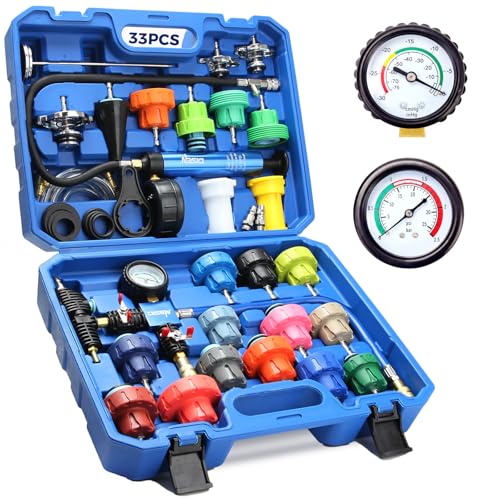
| System damage | Overheating, coolant loss, bearing noise, sweet smell, steam, limp mode | Water pump failure, radiator restriction, thermostat failure, head gasket risk | Compression test, combustion-gas test, scan for temperature sensor data and fault codes |
Which parts fail first?
The first damaged parts are often the ones that depend on clean flow and steady pressure. Radiators clog, water pump seals wear, thermostats stick, and heater cores restrict. A neglected system may still run for a while, but the failure chain is already moving.
Radiator restriction and corrosion
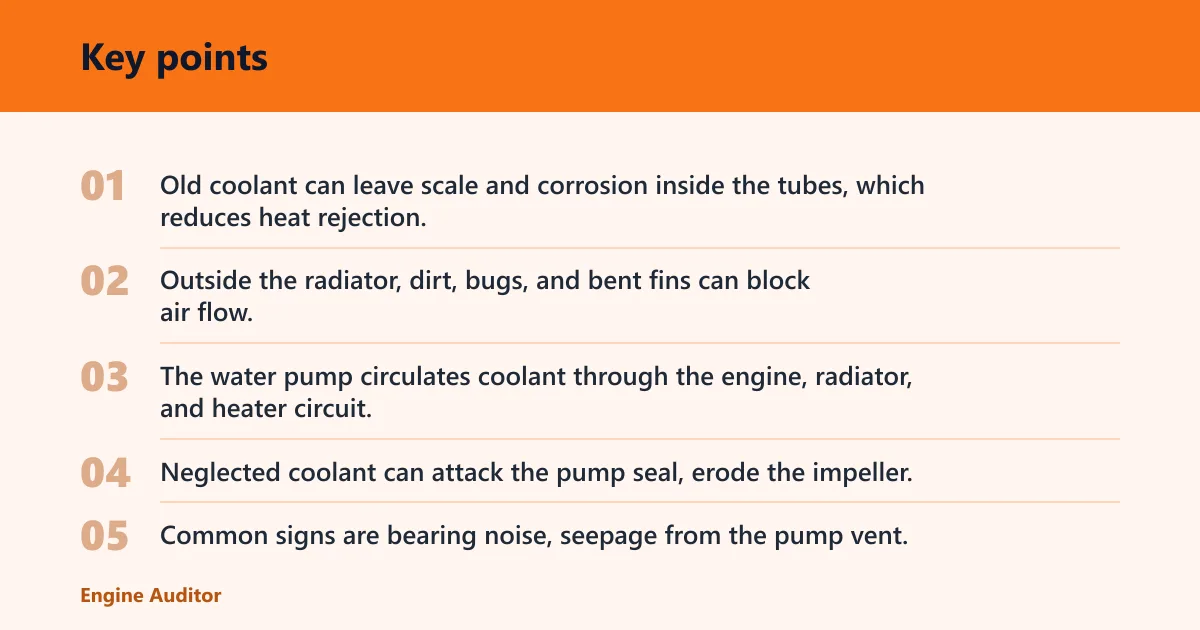
The radiator is the main heat exchanger. Old coolant can leave scale and corrosion inside the tubes, which reduces heat rejection. Outside the radiator, dirt, bugs, and bent fins can block air flow, so the system loses cooling capacity from both sides.
Water pump wear and leaks
The water pump circulates coolant through the engine, radiator, and heater circuit. Neglected coolant can attack the pump seal, erode the impeller, or leave abrasive deposits that shorten bearing life. Common signs are bearing noise, seepage from the pump vent, and a damp area near the front of the engine.
Thermostat sticking and temperature swings
The thermostat is a temperature-regulating valve. If it sticks open, the engine may warm up slowly and cabin heat may stay weak. If it sticks closed, coolant flow drops sharply and the engine can overheat fast, sometimes before the gauge looks fully abnormal.
Heater core blockage
The heater core is a small radiator for cabin heat. Restricted coolant can cut cabin heat, cause fogging, or leave a sweet smell from an internal leak. In some vehicles, a damp carpet or wet passenger footwell can point to a leaking heater core.
Say your compact sedan starts taking longer to warm up on a 40-degree morning, and the cabin vents stay cool at idle. That can point to a thermostat stuck open or flow restriction from debris, not just a low coolant level. A quick scan for leak-free hoses and a pressure test can separate those causes.
Suppose a crossover has rust-colored coolant and a faint grinding noise from the front of the engine. That combination points more toward pump wear and contamination than a simple level issue. If the reservoir also shows brown sludge, the next check should be flow restriction and pump seepage, not only a refill.
Can neglected coolant cause engine damage?
Yes. Neglected coolant can trigger engine damage through repeated heat spikes, poor flow, and loss of pressure control. The temperature gauge may rise first, but the real damage can include warped parts, head gasket trouble, and limp mode if the engine control module sees unsafe temperatures.
Overheating and limp mode
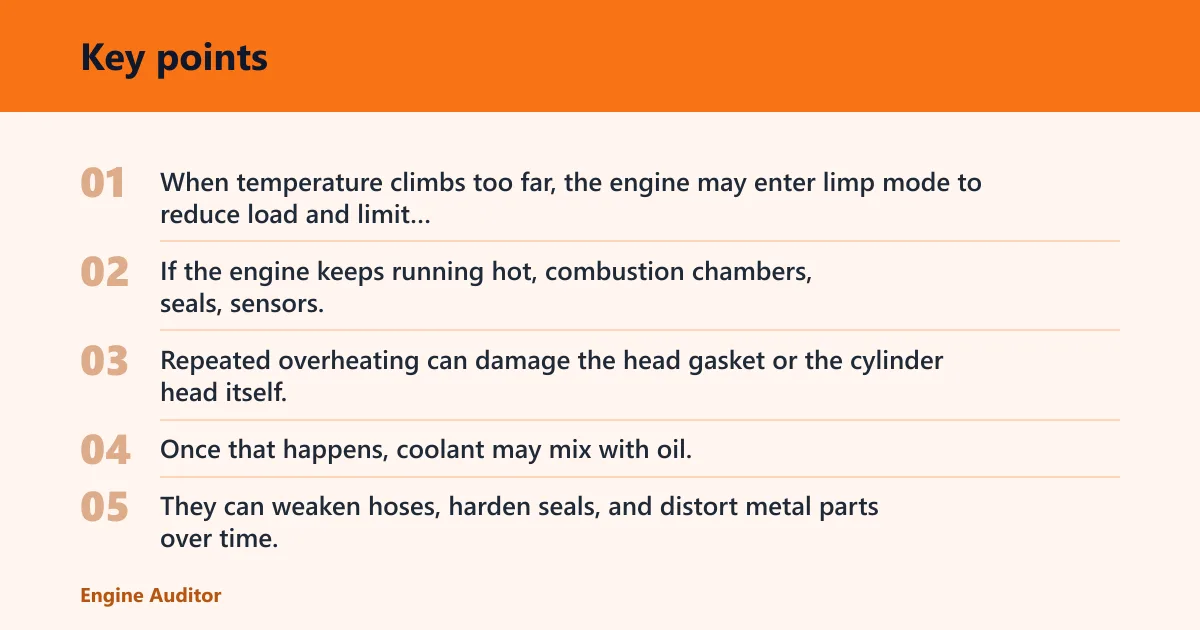
When temperature climbs too far, the engine may enter limp mode to reduce load and limit damage. That is a warning, not a fix. If the engine keeps running hot, combustion chambers, seals, sensors, and nearby plastic parts can all suffer heat stress.
Head gasket risk
Repeated overheating can damage the head gasket or the cylinder head itself. Once that happens, coolant may mix with oil, combustion gases can enter the cooling system, and pressure can push fluid into the reservoir or out of the cap. That is a repair path far beyond a flush.
Why repeated heat spikes matter
Short heat spikes are not harmless. They can weaken hoses, harden seals, and distort metal parts over time. Even if the engine cools back down, the cooling system may be closer to the next failure because the thermostat, cap, or pump is already stressed.
Flush, top-off, or repair?
A coolant flush drains old coolant, removes degraded fluid and some contaminants, then refills the system with the correct mixture. It is not the same as topping off. If the system already has a failed pump, sticking thermostat, or clogged heater core, a flush alone will not fix the root problem.
What a coolant flush removes
A proper drain and refill removes aged coolant and can clear loose debris from the circuit. Many service plans also call for inspecting the thermostat and pressure cap at the same time. That inspection matters because weak pressure control can cause boil-over even when the coolant level looks normal.
Why top-off is not a flush
Top-off only restores level. It does not remove acidic fluid, rust, scale, or gelled coolant. If the reservoir is low because of a leak, topping off without a diagnosis can hide the problem until the next overheat event.
When inspection should come first
If the coolant looks brown, oily, sludgy, or mixed with the wrong type, inspect before flushing. A flush can move debris through the system and reveal weak parts, but it should not be used to hide a leak, a bad cap, or a failing water pump.
- Check the coolant level only when the engine is cool.
- Inspect the reservoir for low level, sludge, or discoloration.
- Look for hose swelling, crusty residue, or wet spots near the radiator and water pump.
- Review service records for coolant type and last change date or mileage.
- Use the manufacturer schedule as the main guide, then shorten the interval if the fluid is dirty or the vehicle has mixed coolant history.
Frequently asked questions
What happens if you never change your coolant
If you never change your coolant, the inhibitors wear out, corrosion starts, and deposits collect in the radiator, heater core, thermostat area, and water pump. The system may still run for a while, but the failure chain often begins long before a full overheat warning appears.
What happens if you don’t replace your coolant
Not replacing coolant can lead to rusty passages, aluminum pitting, weak pressure control, and reduced heat transfer. The first signs may be slow warm-up, poor cabin heat, or a higher-than-normal temperature gauge under load. Later, the system can overheat or leak.
What happens when you dont change your coolant
When you do not change coolant, the fluid can become acidic and contaminated with scale or sludge. That mix can wear out the water pump seal, restrict the radiator, and clog the heater core. If the thermostat sticks, the temperature swing can become much worse.
What happens if you don’t change your engine coolant
If you do not change engine coolant, the corrosion protection fades and the metal inside the cooling system starts to degrade. Aluminum parts can pit, iron and steel parts can rust, and the radiator can lose flow. Overheating is often the last symptom, not the first.
What happens if you never flush your coolant
If you never flush your coolant, degraded fluid and loose contaminants stay in the system. A flush is not always required on every service interval, but when the coolant is old or dirty, leaving it in place can raise the chance of blockage, leaks, and pump wear.
What happens if coolant is not changed
If coolant is not changed, the system can lose freeze and boil protection as well as corrosion control. That raises the risk of radiator restriction, heater core blockage, thermostat problems, and water pump damage. If the gauge rises or the reservoir boils over, stop driving and let the engine cool.
Products related to this article
Sponsored / affiliate links. As an Amazon Associate I earn from qualifying purchases. I may earn additional commission from eligible campaigns.