Why Your Ford Pulls to One Side and How to Fix It
If your Ford pulls to one side, check tire pressure first, then brake drag and visible tire wear; if the steering wheel is off-center too, alignment is likely in play, and a pull after braking points to brakes. Skipping those checks can send you to the wrong repair and leave a safety problem in place. This guide shows how to separate tire, brake, alignment, and suspension causes before you pay for parts or an alignment.
Ford pull worksheet



Why ford pulls one log
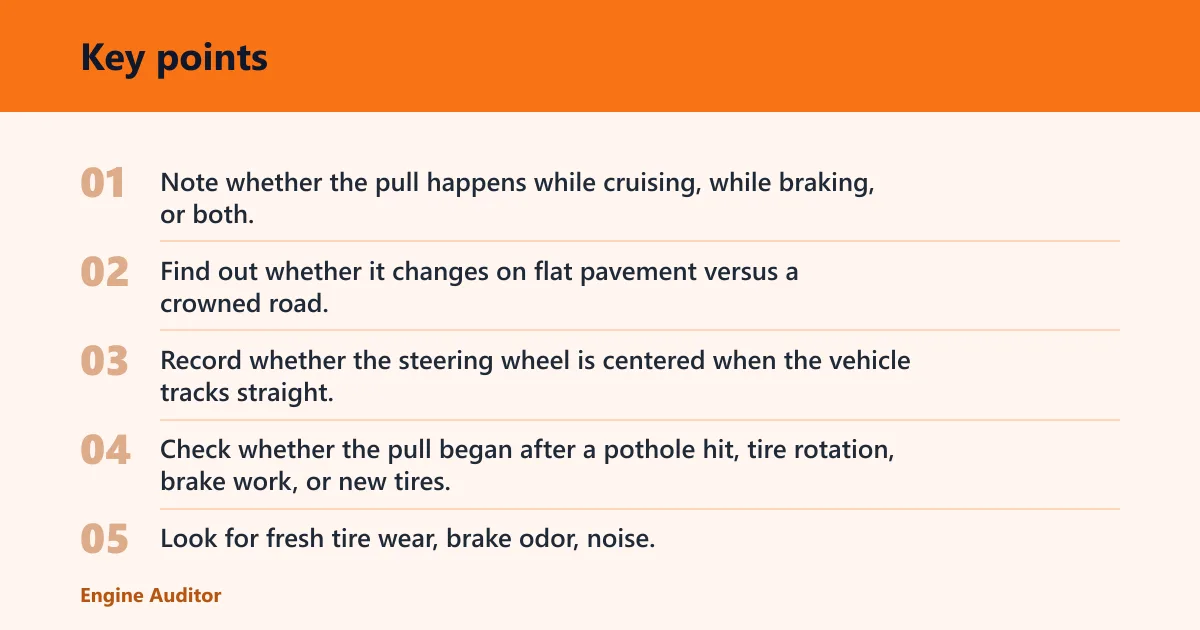
- Note whether the pull happens while cruising, while braking, or both.
- Find out whether it changes on flat pavement versus a crowned road.
- Record whether the steering wheel is centered when the vehicle tracks straight.
- Check whether the pull began after a pothole hit, tire rotation, brake work, or new tires.
- Look for fresh tire wear, brake odor, noise, or one wheel that seems hotter than the others.
Why ford pulls one checklist
| Check item | What to verify | Why it matters |
|---|---|---|
| Cold pressure | Check all four tires before driving | Heat changes pressure and can hide a low tire |
| Reference spec | Use the driver-door placard | The placard, not the sidewall max, is the target for your vehicle |
| Side-to-side match | Compare left and right tires on the same axle | Uneven pressure can create drag and drift |
| Leak check | Inspect valve stems, tread, and sidewalls | A slow leak can create repeat pull after refill |
Braking vs cruising notes
Write down whether the pull appears all the time or only when the brake pedal is pressed. That split matters. A pull during braking usually points to brake imbalance, while a pull that stays present while cruising shifts attention to tire pressure, tire wear, alignment, or suspension.
Repair priority table
| Symptom pattern | Likely area | Next step | Urgency |
|---|---|---|---|
| Gentle drift on a sloped road only | Road crown | Verify on flat pavement before buying parts | Low if mild and predictable |
| Pull after recent tire change or rotation | Tire pressure or tire-related pull | Check cold pressure, wear, and tire direction/placement | Medium |
| Pull only during braking | Brake imbalance | Inspect caliper, hose, pads, rotor, and contamination | High |
| Steering wheel off-center with straight tracking | Alignment | Inspect camber, caster, and toe after mechanical checks | Medium |
| Strong pull with heat, odor, or noise | Brake or suspension fault | Stop driving and inspect promptly | High |
Say your Ford began pulling right after a tire rotation, and the steering wheel now sits slightly left on a flat road. That pattern points first to pressure, tire placement, or alignment, not a brake fault. A brake pull would usually show up most clearly during braking, not steady cruising.
Why is my Ford pulling to one side?
Mild drift versus strong pull
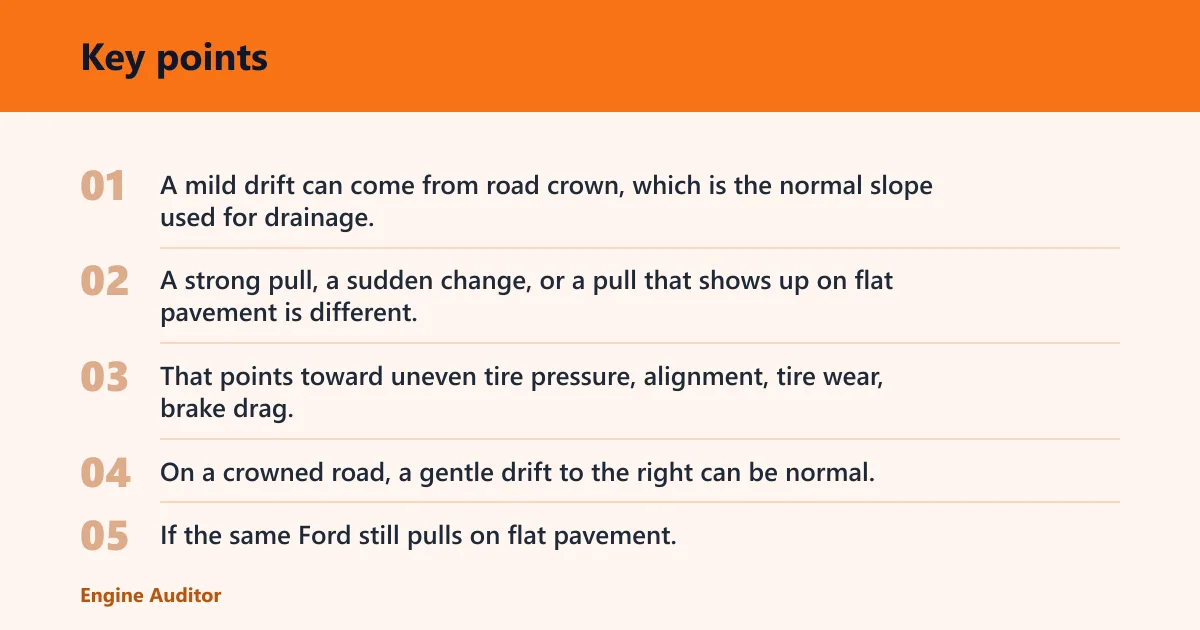
A mild drift can come from road crown, which is the normal slope used for drainage. A strong pull, a sudden change, or a pull that shows up on flat pavement is different. That points toward uneven tire pressure, alignment, tire wear, brake drag, or worn suspension parts.
Road crown versus flat pavement
Start on a level, straight road if possible. On a crowned road, a gentle drift to the right can be normal. If the same Ford still pulls on flat pavement, the cause is more likely mechanical than road shape.
Front axle versus rear axle clues
Front-axle issues usually show up as steering pull or a crooked steering wheel. Rear brake problems can still mimic alignment trouble by nudging the vehicle off line, especially if a rear caliper or rear hose is dragging. That is one reason the braking-versus-cruising split matters so much.
Check tire pressure first
Cold pressure only
Check tire pressure cold, before driving. Use the driver-door placard for the target pressure, not the sidewall max. Uneven pressure across the left and right tires can create drag and drift that feels like an alignment issue.
Find low-pressure drag
A tire that is low on one side can steer the vehicle toward that side. The effect can be subtle at first and stronger after highway driving or when the load changes. Monthly inspection helps catch the slow leak before it becomes a repeat pull.
Look for slow leaks
Inspect for nails, valve stem damage, bead leaks, or sidewall damage. If one tire repeatedly loses pressure after refill, that tire needs leak diagnosis before any alignment decision. A good alignment will not fix a tire that keeps changing shape or pressure.
Why does it pull while braking?
A pull during braking usually points to brake imbalance. The most common brake-pull culprit is a seized caliper. A collapsed brake hose can also act like a one-way valve, trapping hydraulic pressure so one brake stays applied even though the outside of the hose may look normal.
Sticking caliper clues
A sticking brake caliper can drag continuously and overheat the rotor. That can make the vehicle pull while braking and sometimes while driving. If the pull gets worse over time, brake drag should move high on the list.
Collapsed brake hose clues
A collapsed brake hose can fail internally while looking fine on the outside. Because it can trap pressure like a one-way valve, the wheel may stay partly applied after the pedal comes off. The symptom often builds gradually, which is why it gets missed.
Brake contamination checks
Before replacing pads or rotors, look for contamination from brake fluid, grease, or oil. Contamination can reduce friction and create a side-to-side imbalance. Fix the source first, or the new wear parts may not solve the pull.
Wheel temperature comparison
After about a 10-minute drive, compare wheel temperatures with an infrared thermometer. Check both sides, then compare front to front and rear to rear. A much hotter wheel points toward drag on that corner. That is safer and more reliable than touching the wheel by hand.
How do you tell if alignment is the cause?
Alignment affects how the tires meet the road through camber, caster, and toe. A wheel alignment service resets those angles to manufacturer specifications. If the steering wheel is crooked but the vehicle goes straight, alignment is a strong suspect, especially after a pothole hit or curb strike.
Camber, caster, and toe
Camber, caster, and toe control tire contact and steering response. A single hard pothole hit can knock alignment out of spec. When the pull began after impact, alignment inspection should come before costly parts replacement unless brake drag or a damaged tire is obvious.
Crooked steering wheel clue
When the steering wheel is off-center yet the Ford tracks straight, toe is often involved, though camber and caster can contribute too. That symptom is not proof by itself, but it is a strong alignment clue when braking does not change the pull.
Recent pothole or curb hits
Recent impact matters. A hard pothole can shift alignment angles or bend a part enough to create a pull. If the pull started after a hit, inspect for tire damage and worn suspension parts before assuming the issue is only an adjustment.
Could a tire or suspension part be causing the pull?
Yes. Uneven tire wear can create a pull even when alignment is close, and a tire can cause drift even on a fairly new set. Shoulder wear, saw-tooth wear, or a tire that developed radial pull can all change how the vehicle tracks. Worn suspension parts can do the same.
Shoulder wear and saw-tooth wear
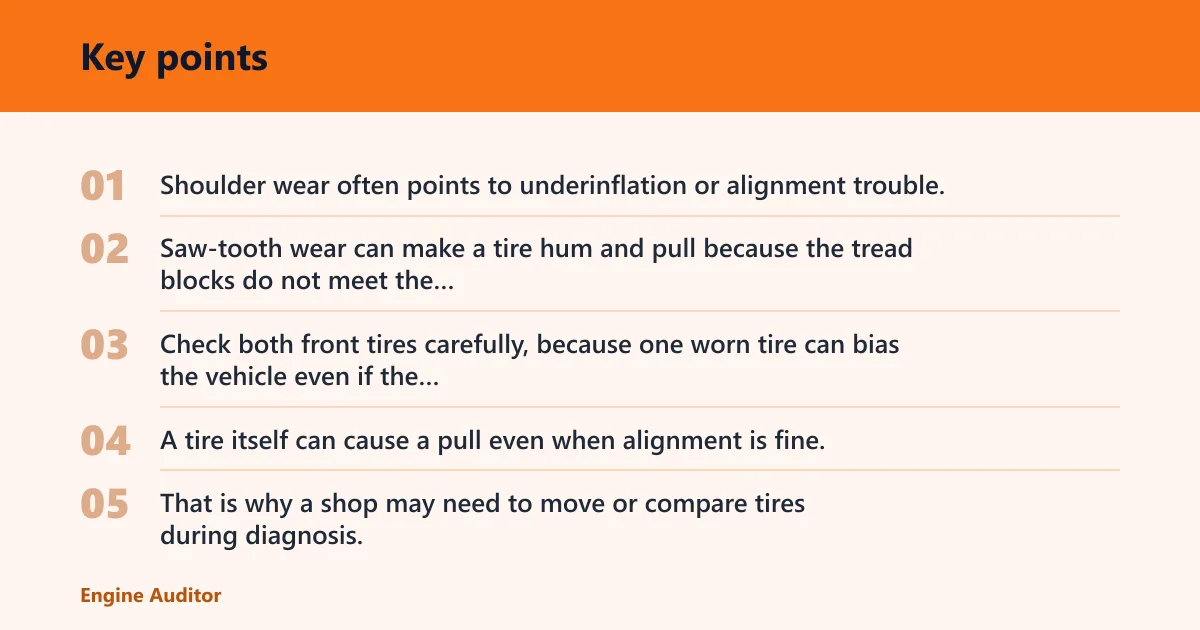
Shoulder wear often points to underinflation or alignment trouble. Saw-tooth wear can make a tire hum and pull because the tread blocks do not meet the road evenly. Check both front tires carefully, because one worn tire can bias the vehicle even if the other side looks normal.
Radial pull from the tire itself
A tire itself can cause a pull even when alignment is fine. That is why a shop may need to move or compare tires during diagnosis, but the tire must be handled correctly. Directional or staggered tires should not be swapped side to side without checking the manufacturer’s allowed rotation pattern.
Suspension and steering wear points
Ball joints, tie rod ends, control arm bushings, struts, and wheel bearings can all affect tire position. These parts can let the wheel sit at a bad angle or move under load, which makes the pull feel like an alignment problem. On some vehicles, rear suspension wear can also change tracking.
Suppose a Ford pulls left only after highway driving, and the left front tire shows shoulder wear while the steering wheel is still centered. That mix points toward a tire issue first, then alignment and suspension inspection. Replacing parts before checking the tire would risk paying for the wrong repair.
When should you stop driving it?
Stop driving and arrange inspection if the pull is strong, changes suddenly, or comes with a very hot wheel, brake smoke, brake noise, or odor. A steering wheel that is suddenly off-center after recent service is another sign worth prompt inspection. Those symptoms can point to brake drag or a steering fault that should not be ignored.
Recent service warning
If the steering wheel is suddenly off-center after brake work, tire work, or suspension repair, the issue needs prompt review. Do not assume the new symptom is normal break-in. A recent repair can reveal an installation problem, a missed fastener issue, or a part that was already near failure.
Do-not-drive threshold
A very hot wheel after a short drive, a strong pull that needs constant correction, or brake smoke can mean the car should be inspected promptly. If the vehicle still pulls after you verify cold pressure and road crown, the safest path is to stop guessing and inspect the brake or steering system.
Repair order that avoids wasted money
Start with free checks: cold tire pressure, tread wear, visible leaks, and whether the pull changes with road crown. Next, inspect for brake drag, contamination, and wheel heat differences. Then move to alignment, or to tire replacement and suspension repair if the symptom pattern points there.
| Step | Action | Likely cost tier | Why it comes here |
|---|---|---|---|
| 1 | Cold pressure check at all four tires | Free | Fixes simple drag and avoids bad guesses |
| 2 | Inspect tread, wear pattern, and road-crown behavior | Free | Separates normal drift from a real fault |
| 3 | Brake inspection and wheel temperature comparison | Low to medium | Needed when the pull appears during braking or one wheel is hot |
| 4 | Alignment check and correction to manufacturer specifications | Medium | Best after tire and brake causes are ruled out |
| 5 | Repair damaged tires or worn suspension parts | Medium to higher | Needed when wear or looseness is the source |
| 6 | Replace a seized caliper or collapsed brake hose when diagnosed | Higher | Use diagnosis to choose the part, not the other way around |
The brake side of the repair path also has rough cost ranges often cited in service guidance: brake hose replacement is typically $75–$150 per hose, and a seized caliper repair is often $150–$350 per corner including parts. Those figures only matter after the fault is confirmed.
Frequently asked questions
Why does my Ford pull to one side while driving?
A pull while driving usually points first to tire pressure, tire wear, alignment, or suspension wear. Road crown can cause a mild rightward drift on a crowned road, but a pull that stays present on flat pavement deserves diagnosis. Start with cold pressure, then inspect wear and steering feel.
Why does my Ford pull to one side when braking?
A pull during braking usually points to brake imbalance. The most common culprit is a seized caliper, but a collapsed brake hose can trap pressure and act like a one-way valve. Check for heat, odor, noise, contamination, and whether the pull changes only when the pedal is pressed.
Can low tire pressure make my Ford pull left or right?
Yes. Uneven tire pressure can create drag and drift, especially if one tire is lower than the others on the same axle. Check all four tires cold and compare them to the driver-door placard. Do not use the sidewall max as your target pressure.
How do I tell if a bad alignment is causing the pull?
Bad alignment becomes more likely when the steering wheel is crooked, the pull started after a pothole hit or curb strike, and braking does not change the symptom much. Camber, caster, and toe control how the tires meet the road, so alignment should be checked after tire and brake issues are excluded.
Can a stuck brake caliper make my Ford pull to one side?
Yes. A sticking brake caliper can drag continuously and overheat the rotor, which can create a pull while braking and while driving. A wheel that runs much hotter than its mate is a strong clue. Use an infrared thermometer after a short drive, not a bare-hand check.
What does it mean if the steering wheel is crooked but the car goes straight?
That usually points to alignment, often toe, even if the vehicle still tracks straight. It can happen after a pothole hit, suspension work, or a recent alignment that did not center the wheel. If the pull is mild or absent, the crooked wheel is still worth fixing.
Can a tire itself cause a pull even if alignment is fine?
Yes. Uneven tire wear, shoulder wear, saw-tooth wear, or radial pull from the tire itself can make a Ford drift even when alignment is close. A tire can also cause a pull even if it is relatively new. Verify wear and pressure before paying for alignment work.
When is a pulling Ford unsafe to keep driving?
It is unsafe to keep driving when the pull is strong, sudden, or paired with a very hot wheel, brake smoke, odor, or noise. A steering wheel that is suddenly off-center after service also deserves prompt inspection. Those signs point to an active brake or steering fault.
Should I check tire pressure before paying for an alignment?
Yes. Cold tire pressure is the first check because uneven pressure can create drag and mimic a bigger problem. If the pull remains after the tires match the driver-door placard and the vehicle is tested on flat pavement, alignment becomes a more reasonable next step.
What suspension parts can cause a Ford to pull to one side?
Ball joints, tie rod ends, control arm bushings, struts, and wheel bearings can all affect tire position and tracking. If these parts are worn, the vehicle may pull, wander, or feel loose. They should be inspected when alignment will not hold or the pull returns after correction.
Products related to this article
Sponsored / affiliate links. As an Amazon Associate I earn from qualifying purchases. I may earn additional commission from eligible campaigns.