How to Remove Squeaks From Car Pedals Fast
Find the squeak by pressing the pedal slowly and listening for the exact point in travel, then lubricate only the contact pin, bushing, or stop pad; do not spray the whole assembly. If you guess wrong, the noise usually stays, and excess spray can soak trim, attract grit, or leave brake and clutch feel inconsistent. This guide shows how to locate the source by sound and pedal position, then fix the worn point fast and safely.
Find the squeak source first
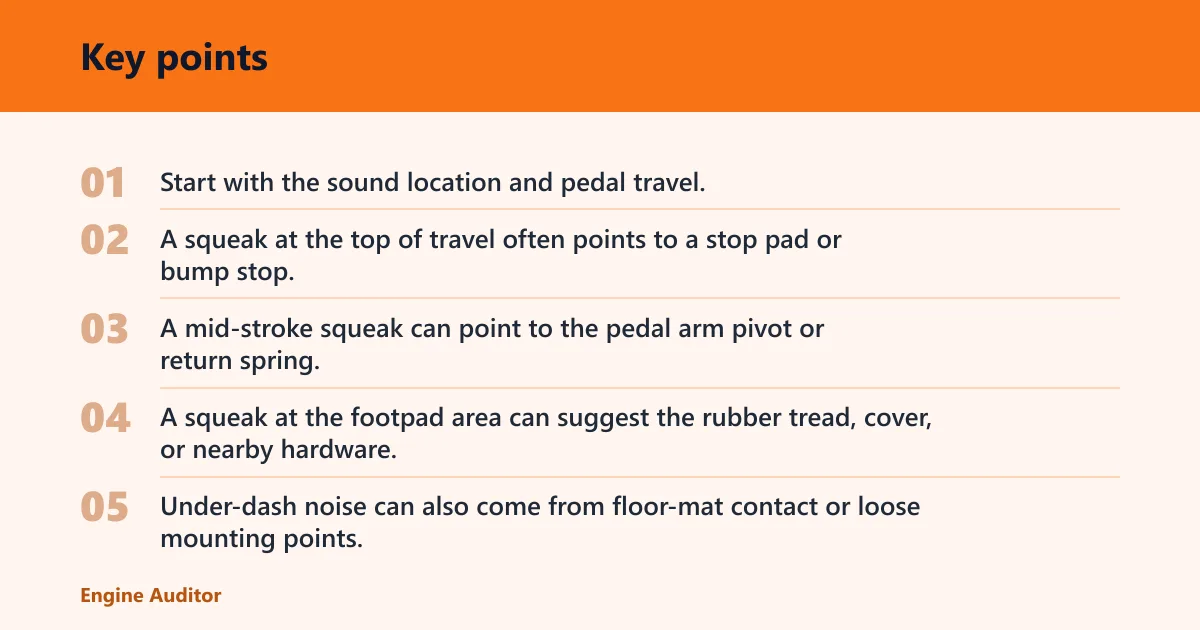


Start with the sound location and pedal travel. A squeak at the top of travel often points to a stop pad or bump stop. A mid-stroke squeak can point to the pedal arm pivot or return spring. A squeak at the footpad area can suggest the rubber tread, cover, or nearby hardware. Under-dash noise can also come from floor-mat contact or loose mounting points.
Press the pedal slowly with the engine off, then with your foot lightly off the floor so you can hear whether the sound happens on the way down, on the return, or both. That timing matters. It separates a dry hinge from a worn rubber contact point, and it keeps you from replacing the wrong part.
For manual-transmission cars, a clutch pedal squeak often appears near the top of travel or on return. On many automatic vehicles, the brake pedal is the main source because it moves more often and its rubber pad or pivot can age faster. A brake pedal squeak is still a pedal problem unless the noise clearly comes from the brake system itself.
Picture a pedal that squeaks only when it comes back up after a stoplight. That pattern usually points to a dry pivot or return spring, not a tire, rotor, or suspension issue. If the squeak happens only when the pedal meets the floor mat, fix the mat first.
Car pedal squeak diagnostic table
| Symptom location | Most likely cause | Fastest safe fix | Do not do this |
|---|---|---|---|
| Top of travel | Clutch pedal stop pad or stop pad / bump stop hardening, cracking, or missing bumper contact | Inspect the rubber stop, replace the pad if cracked or absent, and verify the pedal contacts rubber instead of metal | Do not ignore a missing bumper or ongoing metal-to-metal contact. |
| Mid-stroke | Pedal arm pivot with dry bushings or wear | Clean the hinge area and apply a small amount of silicone or dry lube only to the pivot point | Do not overspray the whole pedal assembly |
| Footpad area | Brake pedal pad worn smooth, loose, or rattling; pedal cover fitment problem | Check retention tabs, replace the pad if it is loose or worn, and confirm the cover fits the correct pedal shape | Do not spray lubricant on the rubber tread or pedal face |
| Under-dash | Pedal return spring dry or corroded; mounting hardware or mat interference | Inspect spring hooks, brackets, and mat placement; correct the interference before replacing parts | Do not blame the brake system before checking the mat and hardware |
Is the floor mat causing the squeak?
Yes, and this is the first thing to rule out because it is a safety issue. A mat can rub the pedal, block full travel, or catch the edge of a pedal cover. If the squeak disappears with the mat removed, the pedal hardware is probably fine and the mat placement needs correction.
Check whether the mat overlaps the accelerator or brake pedal, shifts under braking, or touches the clutch pedal at the top of travel. Make sure the mat anchors are engaged and that the mat lies flat. If the mat bunches up, replace or reposition it before touching the pedal assembly.
Confirm full pedal travel
With the mat out of the way, press each pedal from rest to the floor and release it slowly. The pedal should move freely, return fully, and not drag. If the squeak is gone, you have found the cause. If not, move on to the pedal hardware itself.
Which pedal parts wear out first?
Common wear points include the clutch pedal stop pad, the brake pedal pad, the pedal arm pivot, the return spring, and any pedal cover added on top. Each fails differently. That is why a squeak diagnosis should begin with sound location, not with a full-assembly spray or a parts guess.
Clutch pedal stop pad and bump stop
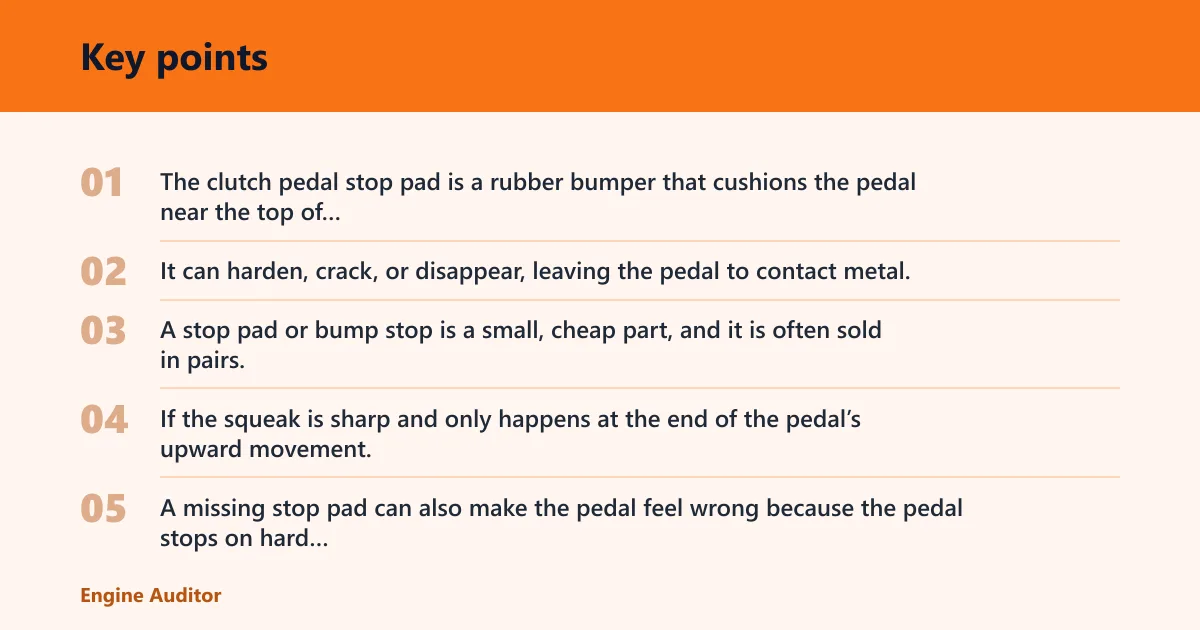
The clutch pedal stop pad is a rubber bumper that cushions the pedal near the top of travel. It can harden, crack, or disappear, leaving the pedal to contact metal. A stop pad or bump stop is a small, cheap part, and it is often sold in pairs. It is also commonly model-specific.
If the squeak is sharp and only happens at the end of the pedal’s upward movement, inspect this pad first. A missing stop pad can also make the pedal feel wrong because the pedal stops on hard parts instead of rubber.
Brake pedal pad and pedal cover fitment
The brake pedal pad is the rubber tread on the pedal face. It can wear smooth, loosen, or rattle. Some replacements are sold by vehicle model, such as Dorman 20753 for specific Ford, Lincoln, and Mercury models. That listing shows a sale price of $5.99, previously cost $9.99, and has a 4.9-star rating.
A pedal cover can also squeak if it shifts on the pedal or changes pedal feel. A universal cover may fit many pedals, but fitment and retention matter. If the cover slips, it can become a safety problem, especially on the brake or accelerator pedal.
Pedal arm pivot and return spring
The pedal arm pivot is the hinge point for pedal motion. Dry bushings or wear there often create a squeak that repeats on every press or release. The pedal return spring can also squeak if it is dry, corroded, or rubbing its bracket.
Do not soak either area blindly. Spray that misses the hinge can collect dust, drip onto trim, or reach the wrong surfaces. A pivot wants a small, targeted amount of lubricant, not a wet pedal bay.
How do I fix a squeaky clutch pedal fast?
For a clutch pedal, begin at the top of travel and listen for the squeak during release. If the sound is there, check the clutch pedal stop pad first, then the pivot and return spring. The fastest safe fix is usually a clean pivot with a small amount of dry or silicone lubricant, or a stop pad replacement if the rubber is cracked or missing.
On many manual cars, the clutch pedal squeak is more likely to come from a rubber contact point than from the clutch itself. If the pedal travel feels smooth after cleaning and the squeak still returns, the hinge or spring may be worn enough to need a new part.
How do I stop my brake pedal from squeaking when pressed?
Start by checking the brake pedal pad, the pivot, and the floor mat. If the squeak happens only when your foot contacts the pedal face, a worn brake pedal pad or loose cover is the better lead. If it happens in the hinge area, clean the pivot and use a small amount of lubricant only there.
Do not spray the tread surface. A slippery brake pedal is worse than a squeak. If the pad is loose, worn smooth, or cracked, replace it with a part that matches the pedal shape and model fit.
How do I know if the squeak is from the pedal or the brake system?
Press the pedal with the engine off and listen near the under-dash area. A pedal squeak usually changes with pedal travel and is easiest to hear inside the cabin. A brake system noise is more likely tied to wheel movement, pad contact, or vehicle motion, and it may continue after the pedal is released.
For a quick split, hold the pedal lightly and move it a few times at a standstill. If the sound repeats without the vehicle rolling, the pedal hardware is the stronger suspect. If the sound appears only while driving or braking at the wheels, the brake system needs a different check.
How to stop a squeaky pedal safely
Clean dirt and grime from the hinge, spring seat, and surrounding hardware before any fix. Then apply lubricant only to pivot points, pin joints, or a dry spring contact point. Use silicone or dry lube rather than oily overspray, and wipe away excess so nothing reaches the pedal face or floor mat.
After that, press the pedal several times and listen for the same point in travel. The motion should stay smooth, return fully, and feel unchanged under your foot. If the squeak persists, stop and inspect the rubber stop, pedal cover, or pivot wear instead of adding more spray.
- Remove the floor mat and check for rub marks or blocked travel.
- Locate the exact point where the squeak starts.
- Inspect the stop pad, pedal pad, pivot, and return spring.
- Clean the moving joint.
- Apply a small amount of lubricant only to the pivot or spring contact.
- Wipe off excess and retest full travel and return action.
When should you replace parts instead of lubricating?
Replace parts when the rubber is cracked, missing, or hard enough that it no longer cushions contact. Replace a loose brake pedal pad or pedal cover if it shifts underfoot. Replace a worn pivot or damaged spring if cleaning and light lubrication do not remove the squeak or if the pedal feels sloppy.
Some replacement parts are vehicle-specific, especially stop pads and pedal pads. Dorman 74015 is a brake and clutch stop pad product for specific Acura and Honda models, and that listing shows a sale price of $6.00, previously cost $12.31, with a 4.6-star rating and 18 reviews. That kind of fitment matters because a stop pad must match the pedal and bracket geometry.
Walmart lists more than 1000 car pedals and pedal covers items, but that broad selection does not mean every part fits every vehicle. Choose by pedal shape, mounting style, and vehicle application, not by appearance alone.
Are replacement pedal pads and covers universal?
Some are, but many are not. Replacement pedal pads and stop pads are often sold for specific makes and models, while some pedal covers are marketed as universal overlays. Universal does not mean guaranteed. A cover that does not lock in place can shift, change pedal feel, or create a slip risk on the brake or accelerator.
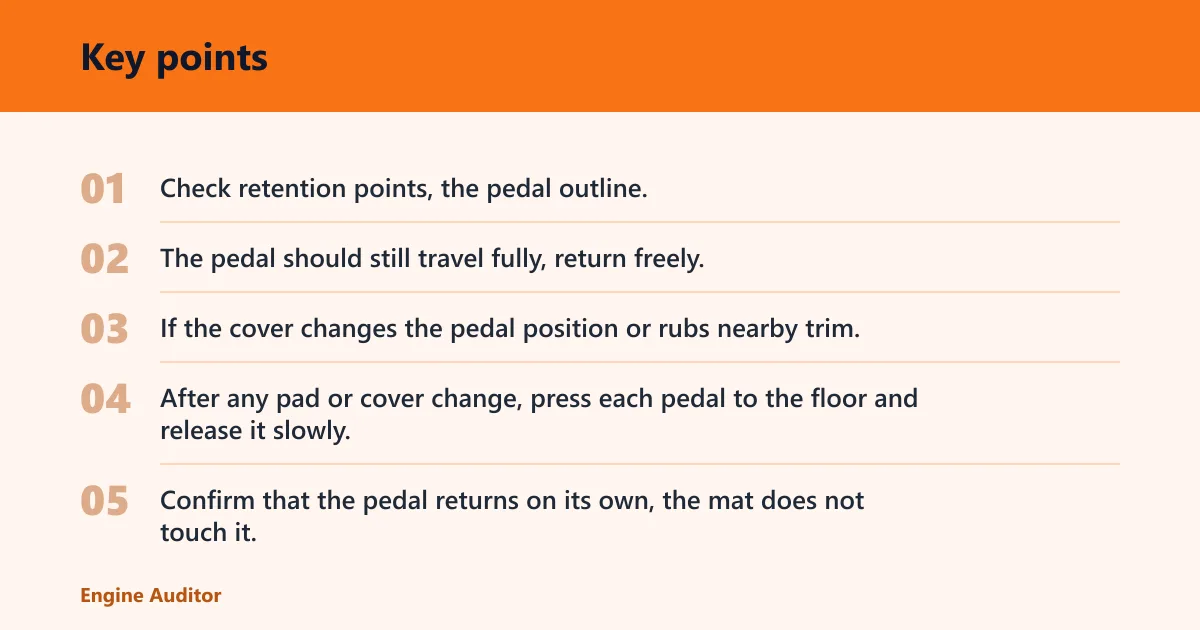
Check retention points, the pedal outline, and the thickness of the overlay before installation. The pedal should still travel fully, return freely, and leave enough room for safe foot movement. If the cover changes the pedal position or rubs nearby trim, remove it and fit the correct part instead.
Safety checks after installation
After any pad or cover change, press each pedal to the floor and release it slowly. Confirm that the pedal returns on its own, the mat does not touch it, and the cover stays fixed. If the pedal binds, squeaks, or feels different, stop and correct the fitment before driving.
Suppose a brake pedal cover fits at the top but shifts when pressed hard. That is not a usable fit, even if it looks fine while parked. A secure pedal matters more than a generic size claim.
Frequently asked questions
Why is my brake pedal squeaky?
Most brake pedal squeaks come from a dry pivot, a worn pedal pad, a loose cover, or a return spring that is dry or corroded. A squeak at the top of travel often points to a stop pad. A squeak at the pedal face points more toward pad or cover fitment.
Can I spray lubricant on car pedals to stop squeaks?
No. Spray lubricant belongs on pivot points only, and even there it should be used sparingly. Do not coat the pedal face, tread, or floor mat contact area. Excess spray can make the pedal slippery, trap grit, and leave the pedal feel inconsistent.
Do pedal pads or stop pads fix pedal squeaks?
Yes, when the squeak comes from worn rubber or metal-to-rubber contact. A pedal pad helps if the tread is loose or worn smooth. A stop pad helps if the noise comes from the top of travel. Choose the part that matches the symptom location, not the cheapest one.
Are replacement pedal pads model-specific or universal?
Both exist, but fitment is not interchangeable. Many brake and clutch pedal pads are model-specific, and stop pads often are too. Universal pedal covers can fit several vehicles, but only if the retention is secure and the pedal still moves freely with no binding or slip.
Products related to this article
Sponsored / affiliate links. As an Amazon Associate I earn from qualifying purchases. I may earn additional commission from eligible campaigns.