How Do You Test for a Blown Head Gasket at Home?
A common DIY approach is to start with a cold-start inspection, then use a cooling-system pressure test and a chemical block test; if the block test changes color, that is commonly taken to suggest combustion gas in the coolant. Miss it and you can overheat the engine, warp the head, or spend money on the wrong repair. This guide shows a low-cost workflow that separates head-gasket failure from leaks, thermostat faults, and other cooling-system problems.
Start here


A head gasket seals the cylinder head to the engine block and keeps coolant, oil, and combustion pressure in their own passages. When it fails, those fluids and gases can cross over, and the usual clues are overheating, white exhaust smoke after warm-up, coolant loss with no external puddle, and milky oil on the dipstick or under the cap. Those clues matter, but they do not prove the fault.
Do not keep driving if the temperature gauge rises quickly, fluctuates in traffic, or the engine has already overheated more than once after a top-off. Continued driving can turn a gasket problem into warped metal or a damaged engine.
What you’ll need
- Flashlight
- Nitrile gloves and eye protection
- Paper towels or clean shop towels
- Cool engine before opening any cap
- Cooling-system pressure tester
- Compression tester
- Leak-down tester and compressed air supply
- Block tester or combustion leak test kit with test fluid
- Basic hand tools for hose clamps and cap inspection
- Vehicle service information for cooling-system cap rating and cylinder order
- Start with a cold engine and note the symptom pattern.
- Check coolant level in the radiator or reservoir only when cool.
- Inspect the oil dipstick and oil cap for milkiness or foam.
- Look for white exhaust smoke after warm-up, not just at cold start.
- Pressurize the cooling system and watch for external leaks or rapid pressure loss.
- Run a compression test on every cylinder and compare readings.
- Run a leak-down test on the weak cylinders to find where air escapes.
- Finish with a block tester to check the coolant for exhaust gas.
Is a blown head gasket likely?
It is likely when several signs point the same way: repeated overheating after coolant is added, persistent white exhaust smoke after warm-up, coolant loss with no visible puddle, and milkiness on the dipstick or under the oil cap. One sign alone is weak evidence. Two or more together raise the odds.
Overheating after a coolant top-off
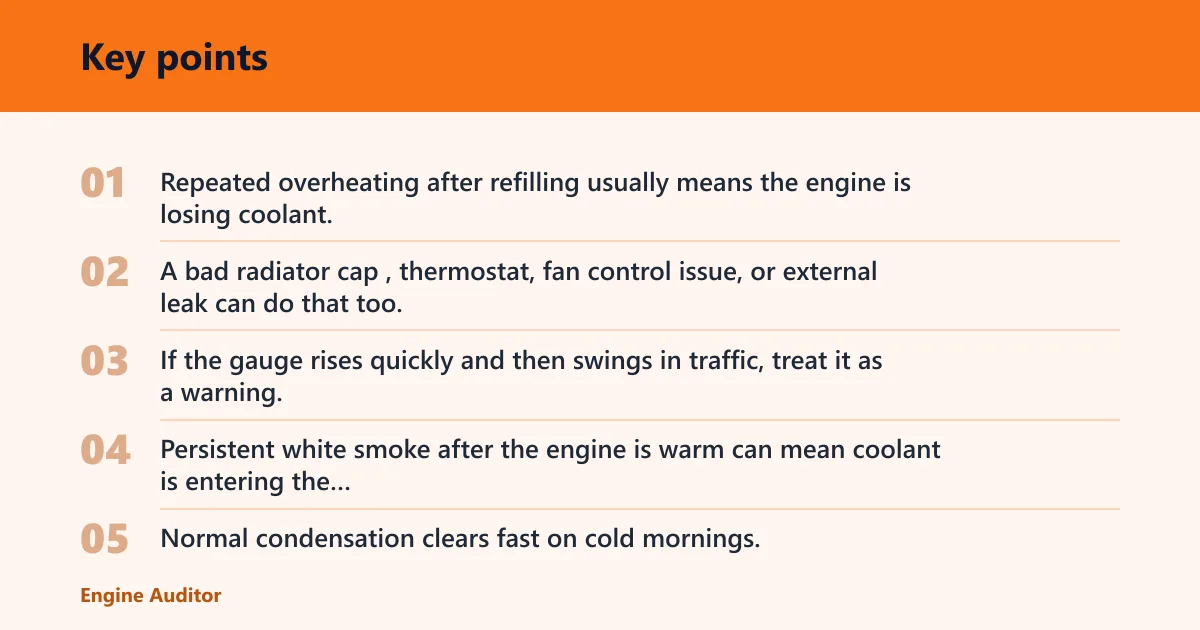
Repeated overheating after refilling usually means the engine is losing coolant, trapping air, or pushing combustion pressure into the cooling system. A bad radiator cap, thermostat, fan control issue, or external leak can do that too. If the gauge rises quickly and then swings in traffic, treat it as a warning, not a diagnosis.
White exhaust smoke and sweet smell
Persistent white smoke after the engine is warm can mean coolant is entering the combustion chamber and burning. A sweet smell is a common clue. Normal condensation clears fast on cold mornings, so a brief plume at startup is not enough by itself. Watch for smoke that stays present after the engine is fully warm.
Milky oil and coolant loss
Milky or foamy oil can indicate coolant contamination, and the first checks are the dipstick and the underside of the oil cap. Context matters. Short trips can leave condensation and a light tan sludge near the cap, which is not the same as coolant in the crankcase. A true contamination pattern usually appears on the dipstick too.
Head gasket decision table
Use this table to sort each home check by confidence. A single low-confidence clue should not send you straight to teardown. The more checks that point the same direction, the stronger the case for a gasket problem.
| Home check | What you see | Confidence | Next step |
|---|---|---|---|
| Visual symptoms | One clue only, such as one overheated trip or a brief cold-start smoke puff | Low | Repeat the check when cold and look for a second clue |
| Cooling-system behavior | Coolant keeps dropping, overflow tank bubbles, or pressure builds too fast | Medium | Pressure test the system and inspect hoses, cap, and radiator |
| Oil condition | Milky oil on the dipstick and under the cap, with coolant loss | Medium | Confirm with compression, leak-down, and block testing |
| Compression test | One or more cylinders read low compared with the others | Medium | Use leak-down testing to find the escape path |
| Block tester | Test fluid changes color in the coolant vapor stream | High | Plan repair or professional verification before further driving |
How do you check the cooling system?
Check for bubbling in the overflow tank, rapid coolant loss, and pressure behavior before you touch the engine internals. Bubbling can mean combustion gas is entering the system, but it can also come from trapped air after service. A pressure test and cap inspection help separate a leak from gas intrusion.
Look for bubbling in the overflow tank
Start the engine cold, cap on, and watch the overflow tank as it warms. Continuous bubbling after warm-up is a clue, especially if the coolant level keeps falling. A few bubbles right after a recent refill can be trapped air. That makes a difference.
Check coolant level and pressure behavior
Use the cooling-system pressure tester on a cool engine and pump only to the cap rating listed in the service information. If pressure drops quickly and no external leak appears, suspect internal leakage or a hidden hose, radiator, or water-pump leak. If the system builds pressure too fast from a cold start, combustion gas intrusion moves higher on the list.
Inspect the radiator cap and hoses
Check the cap seal, spring, and neck for damage. A weak cap can mimic head-gasket symptoms by lowering system pressure and letting coolant boil sooner. Squeeze hoses when cool. Soft, cracked, or swollen hoses point to a cooling-system fault that needs attention before you blame the gasket.
How do compression and leak-down tests fit in?
A compression test and a leak-down test help sort out internal engine problems, but neither one proves a blown head gasket by itself. Compression shows whether a cylinder seals well enough against engine specifications. Leak-down shows where pressure is escaping, which can point to valves, pistons, the gasket, or a crack.
Run a compression test and compare cylinders
Remove the spark plugs, disable fuel and ignition, and crank the engine with the throttle held open if the service procedure calls for it. Compare all cylinders rather than focusing on one number. A low cylinder suggests an internal problem, but worn piston rings, cracked pistons, and cylinder-head cracks can produce similar results.
Use a leak-down test to trace where air escapes
Bring each cylinder to top dead center on the compression stroke, then apply compressed air with a leak-down tester. Air from the intake points toward intake valves. Air from the exhaust points toward exhaust valves. Bubbles in the radiator or overflow tank can point toward the head gasket or a crack into the cooling system.
Read results with caution
Leakage from these tests does not always mean a blown head gasket. You need the pattern, not one weak reading. Suppose cylinder 3 reads low on compression and the leak-down test sends air into the radiator while the other cylinders are normal. That is much stronger evidence than a single low compression number alone.
How do you confirm combustion gas in the coolant?
The block tester, sometimes sold as a combustion leak test kit, is often described as one of the most direct DIY checks because it looks for exhaust gas in the coolant. It uses test fluid that changes color when combustion gases are present. If the fluid changes color under the correct procedure, the cooling system is seeing exhaust gas.
Set up the block tester
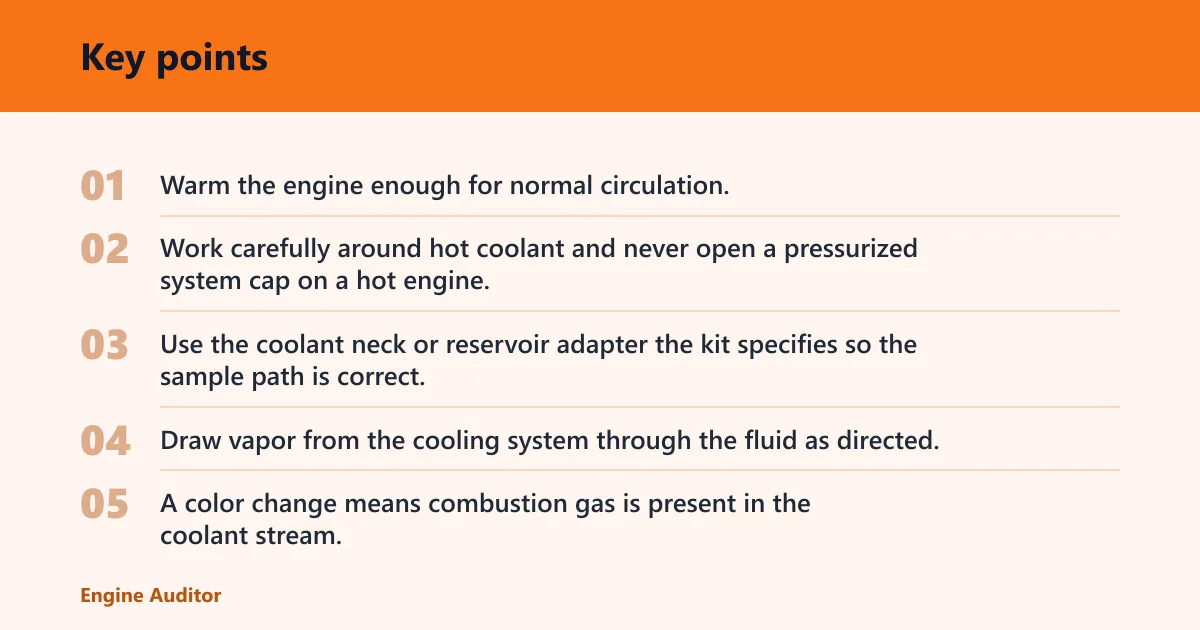
Warm the engine enough for normal circulation, then follow the kit instructions for the tester body and fluid chamber. Work carefully around hot coolant and never open a pressurized system cap on a hot engine. Use the coolant neck or reservoir adapter the kit specifies so the sample path is correct.
Read the test fluid color change
Draw vapor from the cooling system through the fluid as directed. A color change means combustion gas is present in the coolant stream. No color change does not fully clear the engine if symptoms remain strong, because a small leak can be intermittent. Repeat the test only if the kit allows it and the engine has been cooled properly.
Know what a positive result means
A positive block test is the most direct home sign that the cylinder and cooling system are communicating. It does not tell you whether the breach is the gasket, a cracked head, or a cracked block. It does tell you that the engine needs repair before more driving.
How do you check for a blown head gasket at home?
Use a ladder: visual clues first, cooling-system behavior second, internal pressure tests third, and the block tester last for confirmation. That order keeps you from spending money on parts you do not need and helps you separate probable failure from a confirmed one.
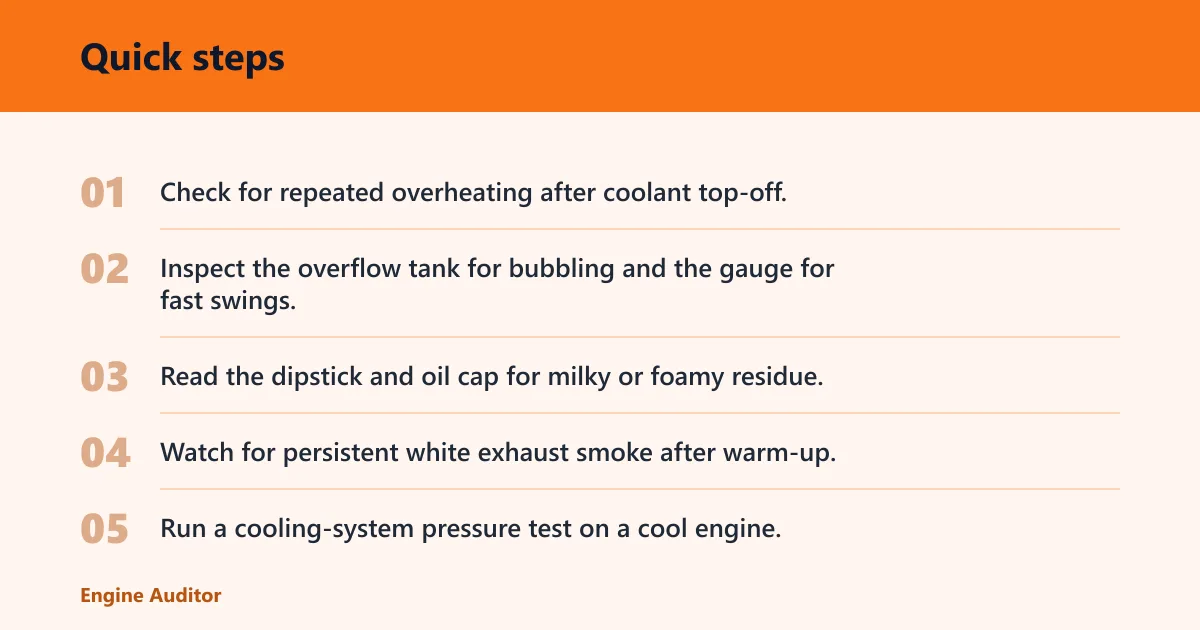
- Check for repeated overheating after coolant top-off.
- Inspect the overflow tank for bubbling and the gauge for fast swings.
- Read the dipstick and oil cap for milky or foamy residue.
- Watch for persistent white exhaust smoke after warm-up.
- Run a cooling-system pressure test on a cool engine.
- Run compression and leak-down tests if the first checks point inward.
- Finish with a block tester to confirm exhaust gas in the coolant.
Picture a 2.0-liter aluminum engine that loses coolant every 100 miles and bubbles in the overflow tank after a short drive. If the dipstick is clean and compression is even, the cooling system may still have a leak or trapped air. If the block tester turns color, the diagnosis moves from likely to confirmed.
If that didn’t work, try this next
If the block tester stays negative but the symptoms continue, inspect for an external coolant leak, a failed radiator cap, a sticking thermostat, or a water-pump fault. If compression and leak-down both point to one cylinder yet the coolant test is negative, a valve issue, ring wear, or a crack may be the better lead. A professional opinion is the next step when the pattern stays mixed.
Common mistakes
The most common mistake is treating one clue as proof. A warm-up puff of steam is not the same as persistent white smoke. A tan cap is not automatically milky oil. One overheated commute does not prove a blown head gasket.
Another mistake is ignoring safety. Hot coolant can erupt from a pressurized system. Let the engine cool, wear eye protection, and open caps slowly only when the system is safe to service.
A common first-timer mistake is seeing bubbles after a recent refill and calling it a gasket failure. Air can stay trapped in the cooling system after repairs or top-offs. Bleed the system according to the service procedure before you draw conclusions.
Do not keep driving to “see what happens.” Repeated overheating can damage the head, the block, and the bearings. If the gauge climbs again after a refill, stop the engine and finish diagnosis on the ground.
On turbo engines, coolant and oil passages often sit close to very hot parts, so small leaks may show up as white smoke, residue, or pressure problems before a puddle appears. On hybrids, the engine may cycle on and off, which can make cold-start condensation and short-trip sludge easier to confuse with coolant contamination. Aluminum engines also deserve extra caution because overheating can warp the head faster than many owners expect.
What home tests can confirm a blown head gasket?
The block tester is the only common home test that directly checks for combustion gas in the coolant. Compression and leak-down tests help narrow the cause, but they cannot confirm a gasket failure on their own. A positive block test, plus matching symptoms, gives the strongest at-home case.
Frequently asked questions
How to check for a blown head gasket at home
Start cold, then check coolant level, oil condition, and exhaust smoke before you buy parts. Move next to a cooling-system pressure test, then compression and leak-down if the first clues point inward. Finish with a block tester. That order keeps low-cost checks ahead of invasive ones.
How to test for a bad head gasket at home
Use the combination of symptom checks and a chemical block test. Compression and leak-down can support the diagnosis, but the block tester is the most direct home confirmation because it checks for exhaust gas in the coolant. Do not rely on one symptom alone.
How can you check for a blown head gasket?
Check for repeated overheating, coolant loss, white smoke after warm-up, and milky oil on the dipstick or under the oil cap. If those signs line up, move to pressure testing and then a block test. A single sign may come from a cooling-system leak or trapped air.
Can you test a head gasket without a mechanic?
Yes, if you have basic tools and can work safely around coolant and ignition components. A pressure tester, compression tester, leak-down tester, and block tester cover most at-home diagnosis. If the results conflict, or if the engine overheats again, a shop inspection is the safer move.
What home tests can confirm a blown head gasket: the block tester
The block tester is the home test that can confirm combustion gas in the coolant. Compression and leak-down can point to an internal problem and help localize leakage, but they do not prove a gasket failure by themselves. If the block test changes color, treat the engine as needing repair.
Products related to this article
Sponsored / affiliate links. As an Amazon Associate I earn from qualifying purchases. I may earn additional commission from eligible campaigns.