Can Gas Freeze in a Car Fuel Line?
Gasoline can thicken in extreme cold, but a true fuel-line freeze is uncommon. If water is in the fuel system, ice can block flow, and a no-start may show up around freezing temperatures. If you misread the symptom, you can replace the wrong part, waste time, and leave the car dead in the cold longer. This guide explains what actually freezes, which failure usually shows first, and how to separate fuel-line ice from battery, filter, or ignition problems.
This guide is part of our Cold Weather Engine Care: Oil Viscosity, Cold Starts and Fuel Problems series.
Different fuels behave differently in cold
Direct answer for gasoline
Gasoline generally does not freeze in normal winter weather. It is a hydrocarbon blend, not a single substance with one fixed freezing point, and commercial gasoline typically stays liquid well below freezing, often below roughly -40°F. When drivers say “frozen gas,” they usually mean water in the fuel system or a restriction elsewhere.
Why the answer changes by fuel type
The fuel type matters because gasoline and diesel behave differently in the cold. Diesel fuel is more prone to cold-weather gelling than gasoline, while gasoline cars usually point first to water, battery weakness, thick oil, a clogged filter, or ignition trouble.
What actually freezes in a fuel system
Water in the fuel system is the real winter culprit. Water freezes at 32°F (0°C), and even a small amount can block narrow passages in a fuel line or fuel filter before the injectors are affected.
How ice blocks narrow passages
Ice does not need to fill the whole line to cause trouble. A partial blockage can make the engine crank, catch briefly, then die, or it may sputter and stall under load. In returnless systems, the restriction may show up at the in-tank module or fuel filter rather than at the engine bay.
Where contamination comes
Water can enter through condensation, a damaged seal, or a loose gas cap. It can also build up in vehicles that make repeated short trips, because the tank and lines may never get hot enough for moisture to leave the system.
Gasoline cold weather behavior
Gasoline has no single exact freezing point because it is a blend of hydrocarbons. Seasonal formulations and additives change how it behaves in cold weather, but the blend still remains liquid far below ordinary winter temperatures in most climates.
Seasonal fuel blends and additives
Refiners adjust gasoline for seasonal use, which is one reason cold-weather drivability can improve without any special action from the driver. Additives can help with moisture control or starting behavior, but they do not cure a water-filled line, a failing pump, or a weak battery.
Gasoline versus diesel in winter
Do not mix up gasoline problems with diesel problems. Diesel can gel around about 10°F to 15°F because paraffin wax can crystallize, while gasoline complaints are more often tied to water, ignition, or a weak electrical system.
Gas freeze decision table
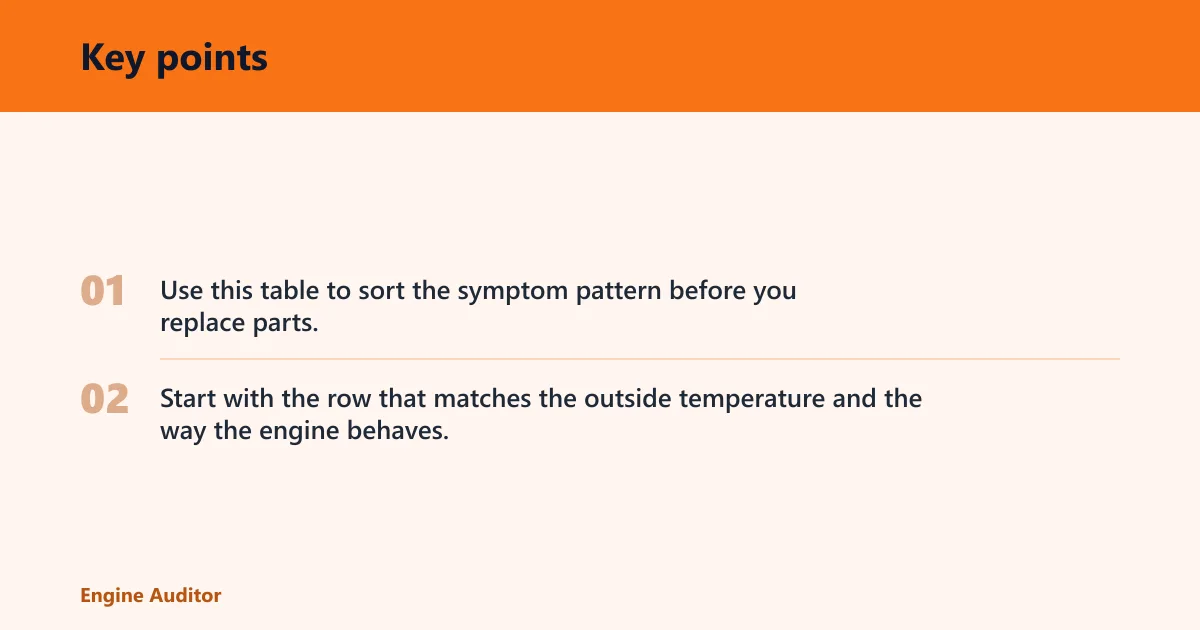
Use this table to sort the symptom pattern before you replace parts. Start with the row that matches the outside temperature and the way the engine behaves, then pick the safest next action.
| Outside temperature | Symptom pattern | Most likely cause | Safest next action |
|---|---|---|---|
| Above 32°F (0°C) | Hard start, strong cranking, no fuel smell, no brief catch | Battery weakness or ignition fault | Check battery health and ignition diagnosis before assuming fuel freeze |
| At or below 32°F (0°C) | Cranks, catches briefly, then dies or sputters | Water-in-fuel ice | Stop repeated cranking; inspect for water contamination and have the system thawed safely |
| Below about 10°F to 15°F | No-start on a diesel, weak fuel delivery, waxing symptoms | Diesel gelling | Use diesel cold-weather procedure; do not apply gasoline fuel advice |
| Any winter temperature | Slow crank, dim lights, repeated no-start, then a good start after a jump | Battery weakness | Test or charge the battery and check charging system output |
| Any winter temperature | Cranks normally but starves under load, may start after sitting, then stumble again | Clogged fuel filter | Inspect the filter and fuel delivery path before blaming frozen gasoline |
| At or below 32°F (0°C) | Frozen-fuel suspicion after storage, short trips, or a loose cap | Gasoline freeze suspicion is usually water or contamination | Check for moisture entry, seals, and filter blockage; do not assume gasoline itself froze |
How to tell fuel ice from battery trouble
A weak battery can mimic fuel starvation because cold reduces starting power. If the starter turns slowly, lights dim hard, or the engine barely rotates, battery weakness is the better fit than a frozen line. If cranking sounds normal but the engine catches, sputters, or stalls, look harder at fuel delivery.
Cranking speed clues
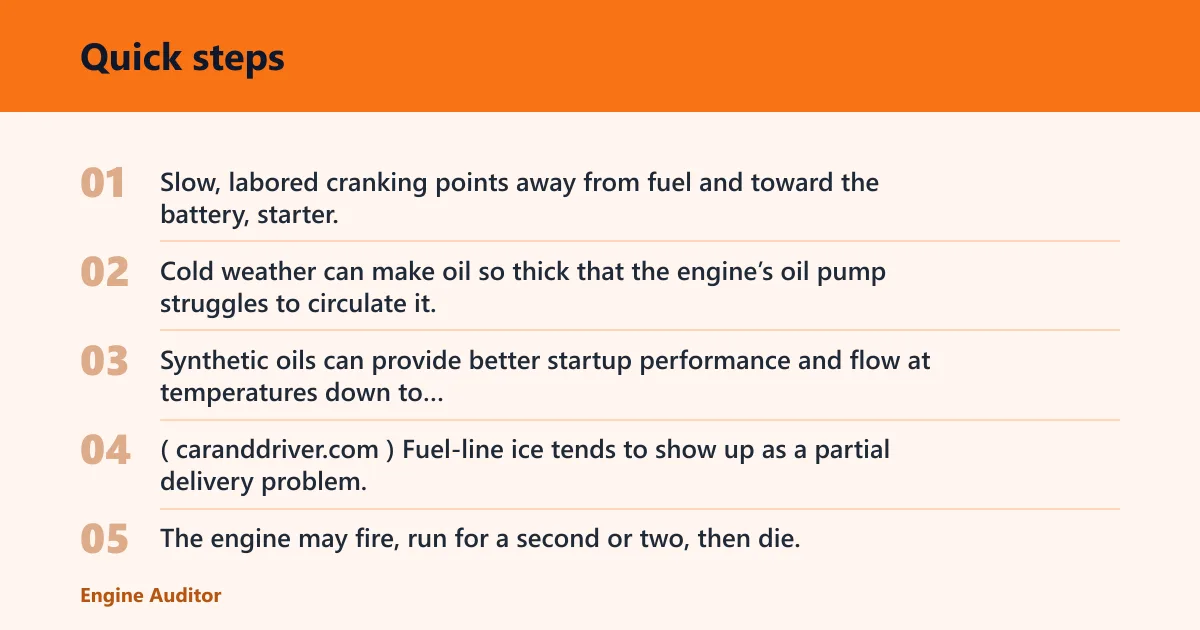
Slow, labored cranking points away from fuel and toward the battery, starter, or oil viscosity. Cold weather can make oil so thick that the engine’s oil pump struggles to circulate it, and the starter has to work harder. Synthetic oils can provide better startup performance and flow at temperatures down to -40 Fahrenheit. (Caranddriver)
Sputtering and restart patterns
Fuel-line ice tends to show up as a partial delivery problem. The engine may fire, run for a second or two, then die. It may also sputter under throttle because the restriction is in the narrow passage before the injectors, not at the ignition system.
When a weak battery is the better fit
If the vehicle has a weak battery, jump-starting may bring it back to life quickly. If it still cranks slowly after a jump or charger, the issue may be the battery itself, thick oil, or a charging problem rather than frozen fuel.
Say your compact sedan sits outside at 18°F after two short commutes the previous day. It cranks at normal speed, fires once, then dies and repeats the same pattern. That is more consistent with a delivery restriction or water ice than with a battery problem, especially if the dash lights stay bright during cranking.
How do water and ethanol change the risk?
E10 and E15 can absorb moisture from the air, which raises phase-separation risk when moisture is present. That matters most in stored fuel and in vehicles that see many short trips, because moisture has more time to collect than burn off.
Condensation, seals, and gas caps
A fuller tank leaves less empty space for moist air, reducing condensation. The Car Care Council recommends keeping the tank at least half full. A loose gas cap or damaged seal can make the problem worse by letting humid air move in and out of the tank more easily.
Short trips and stored fuel
Short-trip use is a common winter pattern behind fuel complaints. The engine may never fully warm the tank and lines, so moisture stays in the system. Stored fuel can be worse, especially when ethanol-blended fuel sits long enough to absorb water from the air.
A common first-timer mistake is blaming the fuel line when the real issue is old E10 in a vehicle that only moved a few miles at a time for weeks. In that case, the fuel may be contaminated enough to cause starting trouble even though the gasoline itself did not freeze.
How do you know if a frozen fuel line is the problem?
Look for a cold-weather no-start that includes cranking, a brief catch, sputtering, or stalling, especially when temperatures are at or below 32°F (0°C). Then rule out the faster lookalikes first: battery weakness, thick oil, a clogged fuel filter, and ignition faults.
Diagnostic sequence
- Check the cranking speed. Slow cranking points first to battery or oil issues.
- Note whether the engine catches briefly. That pattern supports a fuel delivery restriction.
- Listen for pump prime and look for any change after a short rest. No change can point to fuel supply or electrical control trouble.
- Inspect for a loose gas cap, damaged seal, or signs of water entry if the vehicle has been parked in moisture and cold.
- Consider the filter age. An aging or dirty fuel filter can mimic frozen fuel.
Common cold-weather lookalikes
Ignition faults can prevent the engine from firing at all. A clogged fuel filter can limit flow even when the fuel is liquid. Thick oil can make the engine drag so hard that the complaint sounds like a fuel problem when it is not.
What should you do if the line is already frozen?
If a frozen line is suspected, stop repeated endless cranking and avoid open flames. The safest move is to confirm that the problem is not a weak battery, then let the fuel system thaw in a controlled way or have it inspected if the car will not recover normally.
Safe thawing steps
- Turn the ignition off and pause. Do not keep grinding the starter.
- Check battery condition first, because a weak battery can imitate fuel starvation.
- If possible, move the vehicle into a warmer space or use safe, indirect heat around the vehicle area only.
- Inspect the gas cap and visible seals for obvious moisture or damage.
- After the system warms, try a normal start once. If it still sputters or dies, stop and diagnose the fuel system.
What not to do
Do not use an open flame, a torch, or a space heater placed near fuel vapors. Do not pour hot liquid on fuel system parts. Do not keep cranking until the battery dies, because that can hide the original problem and make diagnosis harder.
When to stop and get help
Stop immediately if the engine smells strongly of fuel, the battery is draining fast, or the car still only catches briefly after warming. Those signs point to a fault that needs proper diagnosis, not more cranking.
What else causes a car to not start in cold weather?
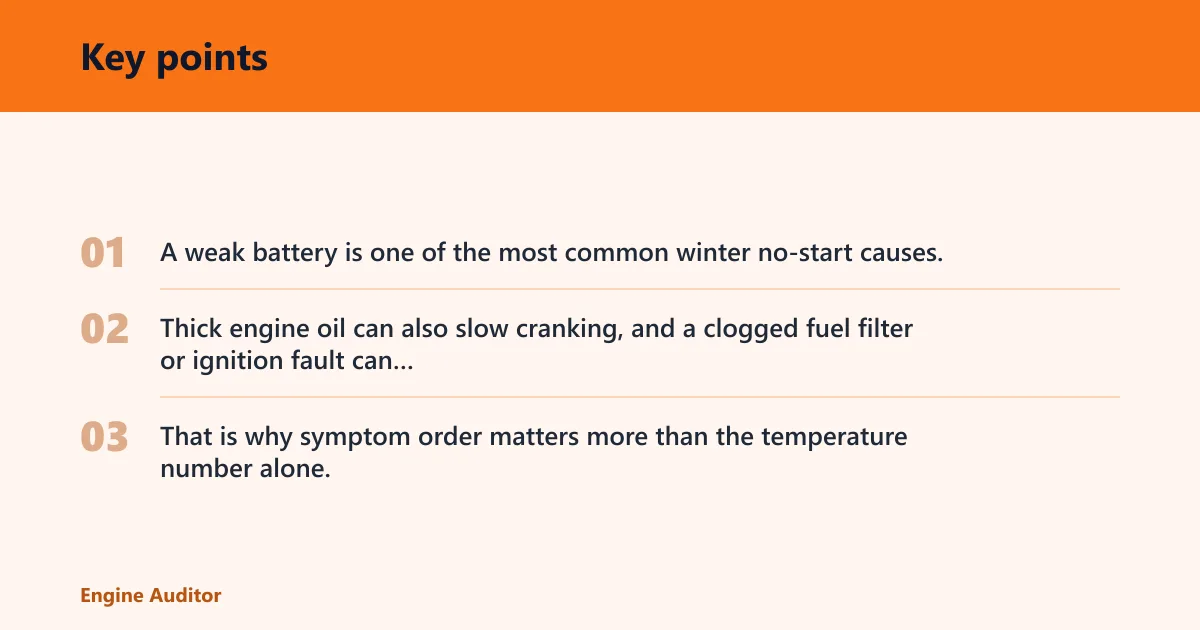
A weak battery is one of the most common winter no-start causes. Thick engine oil can also slow cranking, and a clogged fuel filter or ignition fault can mimic a frozen line. That is why symptom order matters more than the temperature number alone.
Can a full gas tank help prevent fuel line freeze up?
Yes. A fuller tank leaves less empty space for moist air, which reduces condensation and helps limit water buildup. Keeping the tank at least half full is a practical winter habit, especially for short-trip driving or vehicles that sit for long stretches.
Frequently asked questions
Can gas freeze in a car fuel line?
Gasoline usually does not freeze in normal winter conditions. If a car will not start and the weather is cold, the more likely problem is water in the fuel system, a weak battery, thick oil, a clogged filter, or an ignition fault.
Can gasoline freeze in your car?
Gasoline has no single exact freezing point because it is a hydrocarbon blend. Commercial gasoline typically stays liquid well below freezing, often below roughly -40°F, so a normal winter no-start is usually not caused by gasoline freezing.
What actually freezes in a fuel line?
Water is the main thing that freezes in a fuel line or filter. It can come from condensation, a damaged seal, or a loose gas cap, and it can block narrow passages before the injectors are affected.
How do you unfreeze a car gas line safely?
Stop endless cranking, avoid open flames, and let the system warm safely in a controlled place if possible. Check the battery first, because a weak battery can look like a fuel problem, and get help if the car still only catches briefly after thawing.
How do gasoline and diesel winter problems differ?
Gasoline cold-weather complaints often involve water, battery issues, or filters. Diesel is more prone to cold-weather gelling, with paraffin wax crystallization and fuel starvation around about 10°F to 15°F. The two problems need different diagnosis and different treatment.
Products related to this article
Sponsored / affiliate links. As an Amazon Associate I earn from qualifying purchases. I may earn additional commission from eligible campaigns.
 RVS Technology G6 Engine oil Treatment; For Gasoline Engines with a Motor oil capacity up to 6 quarts; Save fuel, Boost Power and Safely Restore and protect your Car, Truck, and all other engines
 FRAM Synthetic XG3614P 20K Mile Change Automotive Replacement Engine Oil Filter for Synthetic Oil Changes, Premium Vehicle Engine Protection Oil Filter for Select Vehicle Model Years