How Much Does a Thermostat Replacement Cost?
A bad diagnosis can waste money and leave the overheating problem untouched. This guide breaks down the cost drivers, common add-ons, and the signs that point away from the thermostat.
Thermostat cost breakdown table


| Vehicle type | Parts needed | Labor difficulty | Diagnostic charge | Coolant refill/bleed | Estimated total cost bands |
|---|---|---|---|---|---|
| Easy-access vehicles | Thermostat + gasket | Low; short labor time | $0 to $100 | $25 to $75 | $150 to $300 |
| Average-access vehicles | Thermostat + gasket, sometimes housing | Moderate; some intake or accessory removal | $50 to $150 | $50 to $100 | $250 to $500 |
| Hard-access vehicles | Thermostat + housing + gasket or seal | High; cramped bay, transverse engine, longer labor | $100 to $200 | $75 to $150 | $450 to $800+ |
What the total includes
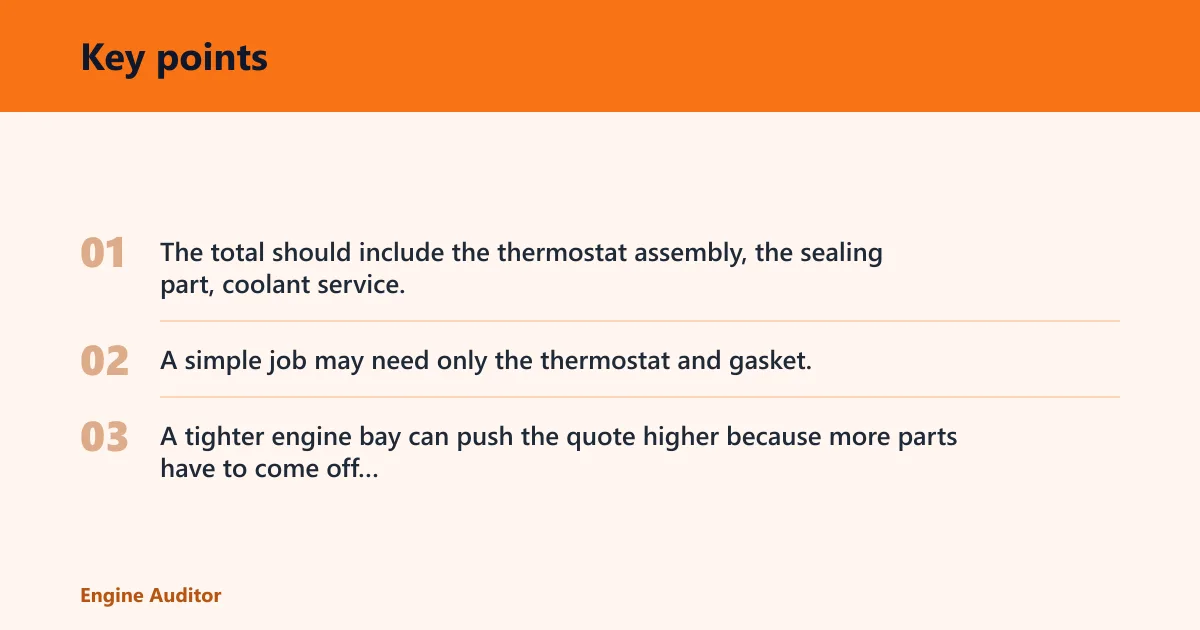
The total should include the thermostat assembly, the sealing part, coolant service, and labor. A simple job may need only the thermostat and gasket. A tighter engine bay can push the quote higher because more parts have to come off before the housing is reachable.
How much does a thermostat replacement cost?
A thermostat replacement usually lands in the $150 to $500 range. Easy access keeps the price down. Difficult layouts, extra coolant work, or housing replacement push it up. The part itself is often inexpensive, while labor, coolant handling, and diagnosis make up most of the bill.
Why the range is wide
The same thermostat can take very different amounts of time to reach. A front-engine layout with clear access is one job. A transverse engine buried under intake parts can become a much larger repair. Shops also price labor differently, and dealers often charge more than independent repair facilities.
A bad diagnosis can waste money too. If the real fault is a coolant temperature sensor, a fan problem, or low coolant from a leak, a thermostat swap may not fix the overheating. A diagnostic scan can save money even when it adds a line item.
What most bills include
Most bills include the thermostat assembly, a gasket or seal, coolant drain and refill, and labor. Some quotes also include a scan to confirm fault codes. If the shop has to bleed air from the cooling system after refilling, that can add time and sometimes a little more cost.
What a thermostat replacement includes
A thermostat replacement usually means removing the thermostat assembly, installing a new thermostat and seal, then refilling coolant and bleeding air from the system. Many modern vehicles use a thermostat housing that can also fail, so some repairs turn into a thermostat-plus-housing job rather than a thermostat-only swap.
Thermostat assembly
The thermostat assembly controls engine coolant temperature by opening and closing at a specified temperature. When it sticks closed, the engine can overheat. When it sticks open, the engine may run too cold and struggle to reach normal operating temperature.
Thermostat housing
The thermostat housing can be plastic, aluminum, or built into a module. Plastic housings can crack, and metal housings can warp. On many modern vehicles, the thermostat and housing are replaced together because the housing seals, mounts, or internal passages are part of the failure pattern.
Thermostat gasket or seal
The gasket or seal is small, but it matters. Reusing a seal can lead to coolant leaks, which then create a second problem after the repair. Even when the thermostat is the main fault, the sealing surface should be checked carefully.
Coolant refill and bleed
Coolant usually must be drained and refilled during the job. Air can get trapped in the cooling system, so bleeding is often necessary after the repair. If the vehicle needs a full flush instead of a simple top-off and refill, the total cost rises.
Why access changes the price
Access changes the price because labor time changes. A thermostat on a simple, open layout may take little more than removal, cleaning, and reassembly. A thermostat buried under intake parts, belts, or accessory brackets can take much longer, and that extra labor is often the biggest difference between a cheap quote and an expensive one.
Transverse engines and cramped bays
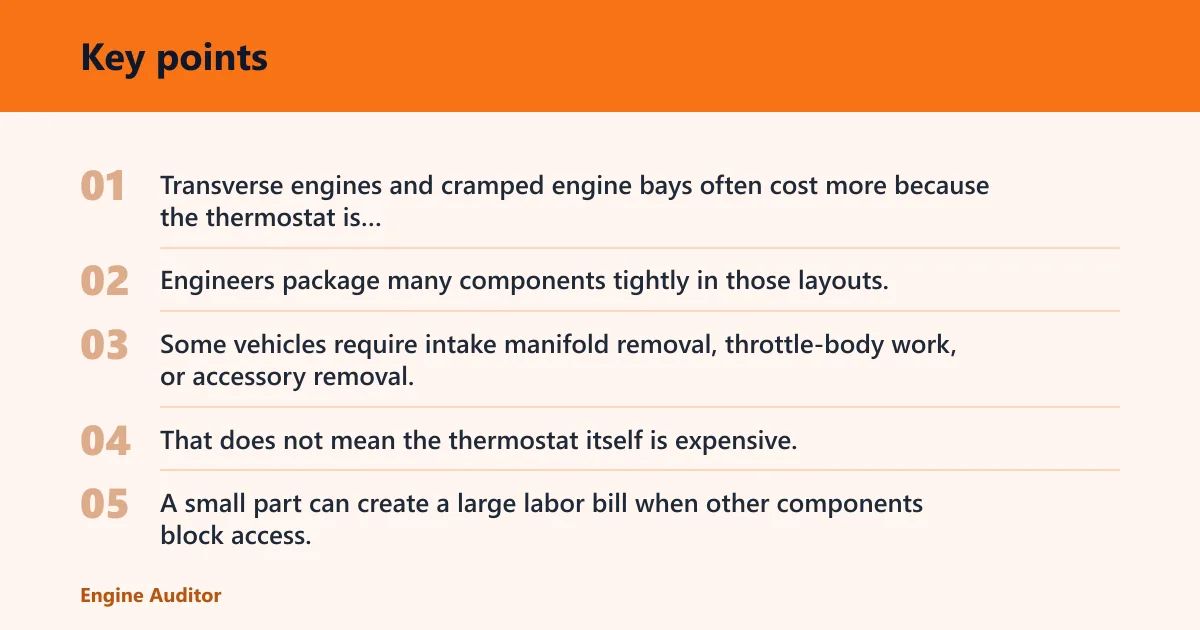
Transverse engines and cramped engine bays often cost more because the thermostat is harder to reach. Engineers package many components tightly in those layouts, so a repair may require moving intake parts, air boxes, or accessories before the thermostat housing is exposed.
Intake or accessory removal
Some vehicles require intake manifold removal, throttle-body work, or accessory removal. That does not mean the thermostat itself is expensive. It means the path to it is. A small part can create a large labor bill when other components block access.
Labor time differences by shop
Independent shops and dealerships price labor differently, and book time is only part of the story. One shop may quote a straightforward thermostat change; another may bundle extra time for bleeding, testing, and cleanup. Ask whether the quote includes coolant, gasket, scan, and recheck.
Say your compact sedan overheats in traffic but cools down on the highway. That pattern can fit a thermostat that sticks closed. It can also point to airflow or fan control problems. A scan and cooling-system check should come before parts are replaced.
How do you tell if the thermostat is the problem?
A bad thermostat often shows up as overheating, a temperature gauge that swings oddly, or an engine that runs too cold. Weak or inconsistent heater output can also fit the pattern. Those symptoms are useful clues, but they do not prove the thermostat is the only fault in the cooling system.
Overheating or running too cold
If the thermostat sticks closed, coolant flow is restricted and the engine may overheat. If it sticks open, the engine can stay below normal operating temperature. Either condition can trigger drivability problems, reduced heater performance, or a check-engine light.
Gauge and heater symptoms
An abnormal gauge reading matters, especially if it changes quickly or never settles. A weak heater at idle, or heat that comes and goes, can also point to low coolant, trapped air, or thermostat trouble. Those symptoms overlap, so the diagnosis should not stop at one guess.
Diagnostic scan and fault codes
A diagnostic scan helps confirm thermostat-related fault codes and can separate thermostat failure from coolant sensor or fan issues. It is a useful step because the thermostat is not the only part that can trigger a temperature problem. If the code points elsewhere, replacing the thermostat first can waste money.
Picture a minivan with a 3.6-liter V6 that shows a temp warning but still blows warm air at idle. A scan may show no thermostat fault at all, which pushes the diagnosis toward a sensor, fan control, or coolant flow issue instead of a parts swap.
What can raise the total bill?
Several add-ons can move the bill from a basic repair to a larger cooling-system job. Cracked housings, extra coolant service, diagnostic labor, and related cooling faults are the most common reasons. The thermostat may be the starting point, but the final price often depends on what the technician finds once the system is opened up.
Cracked or warped housing
A cracked or warped thermostat housing can add parts cost and labor. If the housing leaks or will not seal flat, replacing only the thermostat is a short-term fix. Many shops replace the housing at the same time on modern vehicles because reopening the job later costs more.
Full coolant flush
A full coolant flush costs more than a drain-and-refill. It may be needed if the coolant is old, contaminated, or mixed incorrectly. Flushing also takes more time, and that extra labor is part of the total bill.
Extra diagnostic labor
Extra diagnostic labor can appear when the first scan does not settle the issue. If the shop has to check coolant flow, test the fan circuit, or verify sensor readings, the estimate grows. That is still cheaper than replacing the wrong part and returning later for the real fix.
Related cooling-system repairs
Hoses, coolant sensors, radiator caps, water pumps, and cooling fans can all be part of the same failure chain. A thermostat change should turn into a broader cooling-system inspection if there are leaks, repeated overheating, or signs of poor circulation.
Should you replace the thermostat or keep diagnosing?
Replace the thermostat when the fault pattern fits, the scan supports it, and the cooling system does not show signs of a larger problem. Keep diagnosing when the symptoms point to airflow, sensor, or coolant-flow issues instead. That choice matters because a thermostat swap will not fix every overheating complaint.
When a thermostat swap makes sense
A thermostat swap makes sense when the engine runs too cold, takes too long to warm up, or shows a fault pattern that matches thermostat behavior. If the housing is integrated or the seal is likely to leak, replacing the full assembly can be the cleaner choice.
When to inspect sensors, fans, and coolant flow
Inspect sensors, fans, and coolant flow when the gauge reading is erratic, the warning appears only in traffic, or the heater output does not match the temperature reading. Those clues can point away from the thermostat and toward a different cooling-system fault.
When a cooling-system check should come first
A cooling-system check should come first if the engine has repeated overheating, visible leaks, low coolant, or contamination in the reservoir. A mechanic should diagnose overheating before replacing parts. That order reduces waste and lowers the chance of an incomplete repair.
- Confirm the symptom: overheating, running too cold, or odd gauge behavior.
- Check coolant level and look for leaks before ordering parts.
- Run a diagnostic scan to separate thermostat codes from sensor or fan faults.
- Ask whether the quote includes the thermostat, gasket, coolant, bleed, and housing if needed.
- Compare at least two quotes for the same repair scope.
Frequently asked questions
How much does a thermostat replacement cost for a car?
For most cars, the price depends on access, housing replacement, coolant bleeding, and extra diagnosis. Easy-access vehicles land near the lower end, while cramped engine bays and more involved cooling-system work can push the price higher. If the overheating complaint is not clearly tied to the thermostat, more testing may be needed first.
How much does a thermostat change cost?
A thermostat change usually costs the same as a thermostat replacement, because the job normally includes the new thermostat, gasket or seal, coolant service, and labor. If the housing is damaged or integrated into the assembly, the quote rises. Vehicle layout is the biggest reason one job costs more than another.
How much does a thermostat housing replacement cost?
Thermostat housing replacement often costs more than a thermostat-only repair because the housing can add both parts cost and labor. If the housing is cracked, warped, or built into a module, the bill can move into the higher end of the range. Coolant refill and bleeding usually still apply.
Does changing the thermostat cost more money?
Changing the thermostat can cost more money when access is poor, the housing is part of the repair, or the system needs a flush and bleed afterward. A simple part swap is one price. A deeper repair that requires intake or accessory removal is another.
How much does it cost to get a new thermostat?
A new thermostat by itself is usually inexpensive compared with the full repair. The total bill is higher because labor, coolant, gasket, and diagnosis are part of the job. In practice, the final cost is driven more by vehicle access than by the thermostat part price.
Products related to this article
Sponsored / affiliate links. As an Amazon Associate I earn from qualifying purchases. I may earn additional commission from eligible campaigns.