How Do I Know If an Overheated Engine Is Damaged?
If the gauge reached the red, the engine lost power, or it kept overheating after coolant was refilled, damage may be possible until compression, leak-down, and oil checks say otherwise. Ignoring a serious overheat can warp the head, damage the gasket, or seize the engine. This guide explains the warning signs, quick triage steps, and the tests that separate a cooling-system fault from internal engine damage.
Engine damage triage table
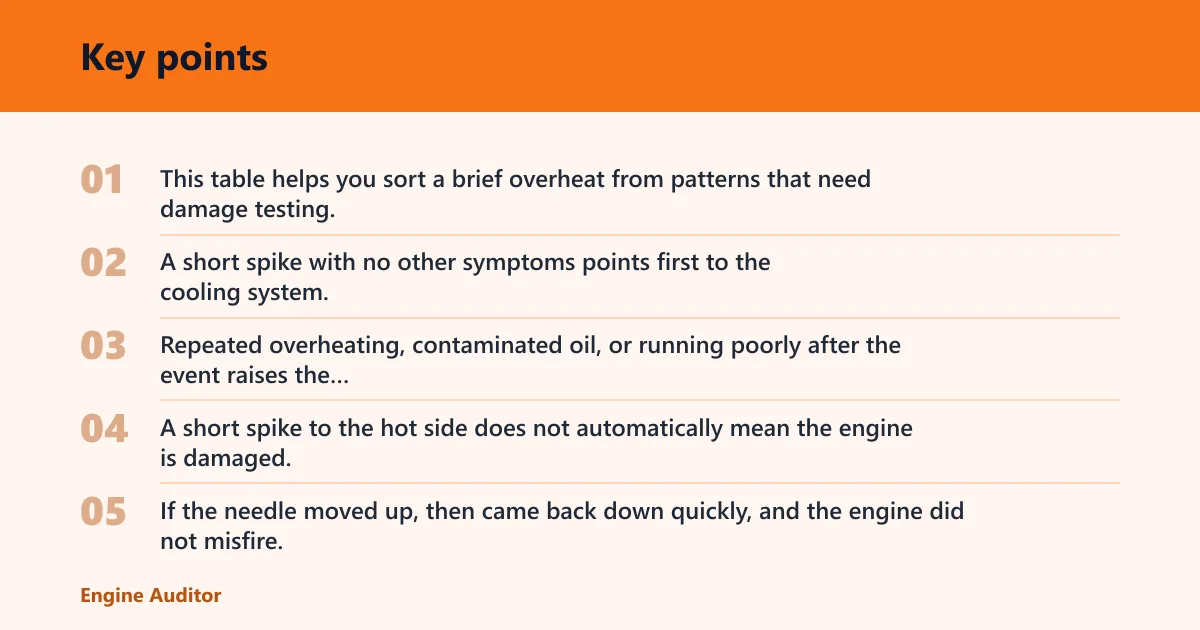


This table helps you sort a brief overheat from patterns that need damage testing. A short spike with no other symptoms points first to the cooling system. Repeated overheating, contaminated oil, or running poorly after the event raises the odds of head gasket or cylinder head damage.
| Symptom pattern | Likely severity | Next diagnostic step |
|---|---|---|
| Brief temperature spike, then gauge returns to normal and the engine runs normally | Low likelihood of internal damage | Check coolant level, fan operation, and for a stored overheat code |
| Repeated overheating after refilling coolant | Moderate likelihood of internal damage | Pressure test the cooling system and scan for temperature or fan-control codes |
| Steam with coolant loss, especially if the gauge stayed hot | Moderate to high likelihood of internal damage | Inspect for leaks, then test for combustion gas in the cooling system and verify oil condition |
| Milky oil on the dipstick or under the oil cap | High likelihood of internal damage | Do not keep driving; perform a compression test and inspect for head gasket failure |
| White exhaust smoke that continues after warm-up | High likelihood of internal damage | Check coolant loss, scan for misfire codes, and confirm with a compression or leak-down test |
| Misfire, rough idle, or loss of power after overheating | High likelihood of internal damage | Scan for codes, check plugs if needed, and test cylinder sealing |
| No-start after a severe overheat | High likelihood of internal damage | Check for seized engine, then verify compression and rotation before further cranking |
Brief temperature spike
A short spike to the hot side does not automatically mean the engine is damaged. If the needle moved up, then came back down quickly, and the engine did not misfire, lose power, or push coolant out, the first suspect is usually a cooling-system fault rather than internal failure.
That pattern often points to a fan cycle issue, a weak radiator cap, low coolant, a thermostat that lagged, or air in the system. The key detail is duration. A brief spike with normal drivability is very different from a gauge that stays hot or pegged hot.
Repeated overheating
Repeated overheating after a refill is more serious. It suggests the engine is still losing coolant, not shedding heat correctly, or building pressure where it should not. That is the point where a leak, cap, hose, radiator, fan, thermostat, or water pump issue can overlap with a head gasket problem.
Do not assume a second overheat is the same as the first. Each repeat event raises the chance of warped metal and gasket failure, especially if the driver kept running the engine while the gauge stayed hot.
Steam, coolant loss, and engine warning signs
Steam plus coolant loss means the cooling system is boiling or venting pressure, but it does not by itself prove internal damage. The risk rises sharply if the engine also ran rough, lost power, or pushed out coolant again after the refill. Those added symptoms point toward combustion gas entering the cooling system or a cylinder sealing problem.
Suppose a 4-cylinder sedan shows a hot gauge, a sweet smell, and a half-empty reservoir after a five-minute climb. If it cools down, refills, and then overheats again within a few miles, that pattern deserves pressure testing and a scan tool check before any more driving.
How do you tell if the engine is damaged?
You tell by the pattern, not the gauge alone. Internal damage becomes more likely when overheating is followed by recurring coolant loss, milky oil, white exhaust smoke, misfire, hard starting, or a no-start. A cooling-system fault is more likely when the engine overheated once, then runs normally after a proper refill and repair.
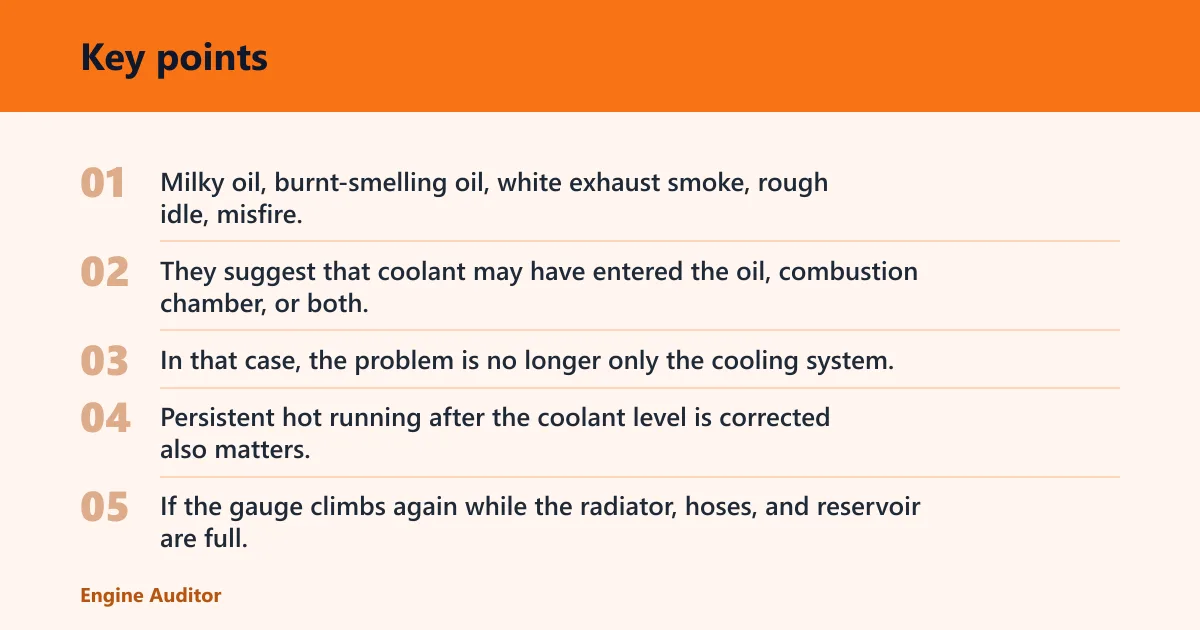
Symptoms that point to internal damage
Milky oil, burnt-smelling oil, white exhaust smoke, rough idle, misfire, and a no-start after a severe overheat are the strongest clues. They suggest that coolant may have entered the oil, combustion chamber, or both. In that case, the problem is no longer only the cooling system.
Persistent hot running after the coolant level is corrected also matters. If the gauge climbs again while the radiator, hoses, and reservoir are full, the engine may have a head gasket leak, warped cylinder head, or another sealing failure that lets pressure and heat build in the wrong places.
Symptoms that point to a cooling-system fault
A single hot event with no smoke, no oil contamination, and normal idle after cooling often points to a repairable cooling issue. Common causes include a sticking thermostat, failed fan control, weak radiator cap, blocked radiator, leaking hose, or low coolant from an external leak. Those faults can overheat an engine without damaging it.
The difference matters because repair costs can change fast. A hose, cap, or thermostat is a cooling-system repair. A warped cylinder head or blown head gasket is an engine-level repair that may require teardown, machine work, or replacement parts.
When a restart changes the risk level
Restarting after an overheat is not automatically a mistake, but it raises the stakes if the gauge stayed hot or the engine ran rough. If the vehicle was restarted and now shows a misfire, slower cranking, or another temperature rise, treat the event as more than a temporary heat spike. The next 24 to 72 hours matter.
Watch for coolant loss after the engine cools, bubbles in the reservoir, oil that turns cloudy, and any exhaust smoke that was not there before. Worsening signs after a restart are the best reason to move from visual checks to compression and pressure testing.
What should you check first after overheating?
Start with three checks that can indicate whether the engine may have taken internal damage: coolant level and contamination, oil level and condition, and whether the engine starts and idles normally. Those checks give a faster read on severity than guessing from heat alone. They also tell you whether the next step is simple leak hunting or deeper engine testing.
Coolant level and contamination
Check the reservoir and, only when safe, the radiator. Look for a low level, rusty coolant, oily film, or debris. Coolant boils at a higher temperature under pressure, so a low system loses that protection and can overheat faster. If the level fell again after refilling, do not treat that as normal.
Any sign of contamination matters. Oil in the coolant, or coolant that looks dirty and foamy, can point to a gasket leak or a cracked component. A clean level that drops again over a short drive points more toward an active leak or a combustion leak into the cooling system.
Oil level, color, and smell
Check the dipstick and oil filler cap. Milky oil suggests coolant in the oil. Burnt-smelling oil suggests the oil may have broken down from heat, which reduces its ability to protect bearings and valvetrain parts. Low oil after overheating is also a concern, because heat can thin oil and increase consumption or leaks.
A common first-timer mistake is to check the coolant and skip the oil. That misses one of the clearest clues. If the oil looks normal and the level is stable, the damage risk drops. If it looks cloudy, foamy, or unusually dark with a sharp burnt smell, move straight to engine testing.
Leaks, steam, and driveability changes
Look for wet hoses, dried coolant residue, a split tank, or fresh drips near the radiator, water pump, or heater hoses. Then pay attention to how the engine runs. Loss of power, rough idle, a flashing check engine light, or a strong coolant smell after the overheat all move the case toward damage testing.
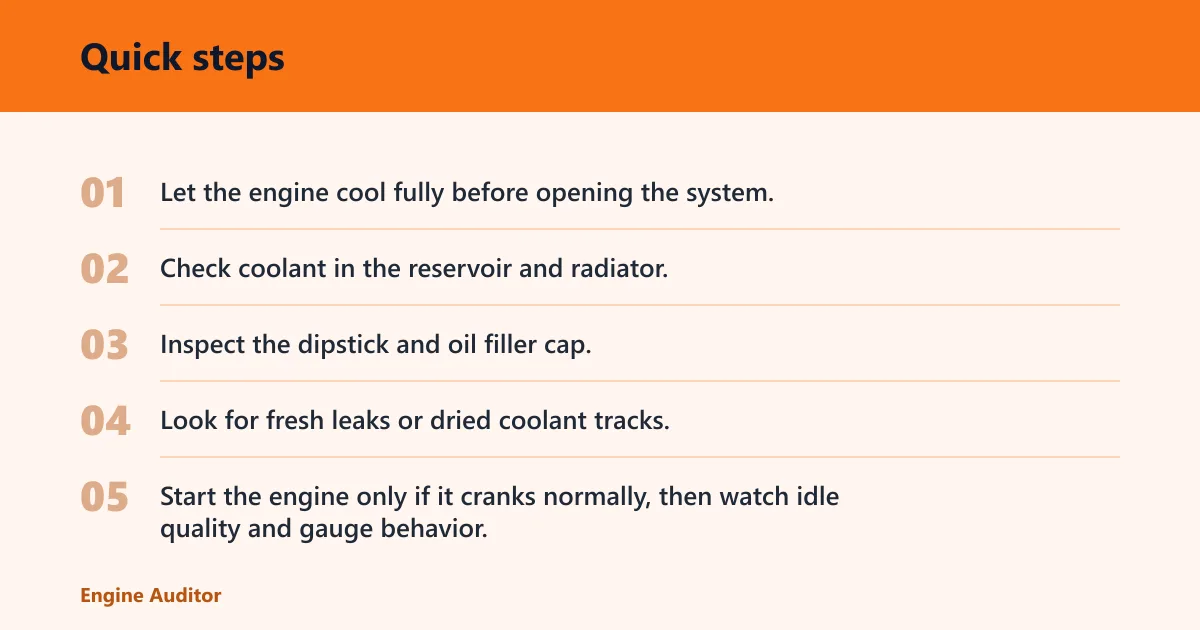
- Let the engine cool fully before opening the system.
- Check coolant in the reservoir and radiator.
- Inspect the dipstick and oil filler cap.
- Look for fresh leaks or dried coolant tracks.
- Start the engine only if it cranks normally, then watch idle quality and gauge behavior.
What points to head gasket or head damage?
Head gasket failure and cylinder head warping are the two most common internal damage concerns after a serious overheat. The strongest clues are milky oil, repeated coolant loss, white exhaust smoke that does not fade, and misfire after warm-up. A warped head can also let the engine lose compression even when no outside leak is visible.
Milky oil and coolant contamination
Milky oil means coolant and oil have mixed. That can happen when the head gasket fails or when heat warps the head enough to open a sealing path. Either way, the engine should not be driven far, because contaminated oil does not protect bearings well.
Look for coolant that appears oily too. If the reservoir has a slick film or the overflow tank keeps dropping without a clear external leak, the engine may be pushing combustion gas or oil into the cooling system.
White exhaust smoke and misfire
White exhaust smoke that continues after warm-up is one of the more serious signs. Water vapor at cold start is normal in some weather. Thick white smoke that keeps going, especially with a coolant smell, points toward coolant entering a cylinder. If a misfire appears with it, a sealing fault becomes more likely.
Misfire after overheating can come from a weak coil or plug, but the pattern matters. If the misfire started right after the overheat and the engine also lost coolant, the cylinder itself may be affected. Scan codes help separate ignition trouble from coolant-related damage.
Warped cylinder head signs
A warped cylinder head may not show a visible crack. It can still cause low compression, repeated coolant loss, and overheating that returns quickly after refilling. If the head is removed, a machine shop inspection and resurfacing may be needed before reassembly. That step matters because a slightly warped head can keep a new gasket from sealing.
Picture a V6 that overheats on the highway, then restarts and runs, but begins pushing coolant into the overflow tank every time it gets hot. That pattern is not a simple thermostat story anymore. It is the sort of case that calls for compression testing and a flatness check on the head.
Which tests confirm damage?
Visual inspection can only go so far. The most useful first-pass tests after an overheat are a cooling system pressure test, an OBD-II scan, and a compression test. Those checks tell you whether the engine has an external leak, a sensor or fan-control clue, or poor cylinder sealing that points to internal damage.
Cooling system pressure test
A pressure test checks whether the system holds pressure with the engine off. It can reveal a leaking cap, hose, radiator, water pump seal, heater core, or head gasket path. If pressure drops and no outside leak appears, internal leakage becomes more likely.
This test matters because it separates a visible cooling fault from a hidden one. If the system will not hold pressure, the problem is not just “it got hot once.” It is losing the pressure it needs to keep coolant from boiling early.
OBD-II scan tool clues
An OBD-II scan tool can read stored and pending codes that point to misfire, coolant temperature sensor faults, fan-control issues, or overheat history. It may also show if the engine computer saw abnormal temperature behavior before the gauge went hot. That data helps turn a guess into a traceable fault pattern.
Do not ignore pending codes because the light is off. A pending misfire code after an overheat is a useful clue, especially when paired with rough running or coolant loss. The scan tool does not prove head damage by itself, but it narrows the next test.
Compression test and leak check
A compression test checks whether each cylinder can seal and build pressure. Low compression in one or two cylinders after overheating can point to a blown head gasket, warped head, or damaged valve seal. A leak-down test, when available, can show where the pressure escapes.
These are the tests that confirm what symptoms only suggest. If a cylinder fails to hold pressure, the engine-level damage is real. If all cylinders are even and the pressure test finds only an external leak, the repair may stay in the cooling system.
Can an overheated engine be fixed?
Yes, but the repair depends on what failed. Many overheated engines are fixed with cooling-system repairs such as a hose, thermostat, cap, fan, or water pump. If the overheat warped the head or blew the gasket, the repair becomes larger. If the engine seized, replacement or a full teardown may be the realistic path.
When repair is usually a cooling-system fix
If the engine overheated briefly, then cooled, restarted normally, and passes oil and pressure checks, the fix is often outside the engine. A leak, bad cap, failed fan, thermostat fault, or radiator restriction can cause the event without harming internal parts. In that case, the goal is to find why coolant temperature rose above the normal operating range.
When head gasket or machine work is likely
If there is white smoke, milky oil, repeated coolant loss, or low compression, expect engine work. A blown head gasket is common after a severe overheat. If the cylinder head warped, it may need machine shop inspection and resurfacing before the gasket can seal again.
When replacement or teardown becomes likely
A seized engine, heavy knocking, or a no-start after severe overheating may mean the damage is beyond a simple repair. Severe heat can break down oil film, score bearings, and cause the engine to lock up. At that point, teardown or replacement is usually part of the decision.
The timing question has a plain answer: how long an engine can run hot before damage varies by severity, coolant loss, and how fast it was shut down. A brief spike may leave no lasting harm. A hot engine that kept running after losing coolant can damage parts in minutes. There is no safe blanket number.
Frequently asked questions
How do you tell if overheated engine is damaged?
Look for the pattern after the event, not the heat alone. Repeated coolant loss, milky oil, white exhaust smoke, misfire, rough idle, or a no-start point toward internal damage. If the engine runs normally after cooling and the tests are clean, the problem may be limited to the cooling system.
How do you know if your engine overheated?
The gauge moving into the hot zone is the clearest sign. A warning light, reduced power, steam, coolant smell, or a sudden loss of heat from the cabin also fit. A sustained hot or pegged-hot gauge matters more than a short spike that returns to normal quickly.
How long can an engine run hot before damage?
There is no fixed time. A brief spike may cause no internal harm, while an engine that runs hot with low coolant can suffer damage quickly. The risk rises with load, temperature, and how long the engine stayed in the red. Shut the engine down once the gauge stays hot.
How long does it take to fix an overheated engine?
A cooling-system repair may be completed faster than engine work, but the exact time depends on the failed part and what testing is needed first. A head gasket or cylinder head repair takes longer because teardown, machine inspection, cleaning, and reassembly are part of the job.
What are the signs of head gasket damage after overheating?
Watch for milky oil, white exhaust smoke that does not fade, repeated coolant loss with no clear outside leak, misfire, and rough idle after warm-up. Bubbles in the reservoir and low compression also point in that direction. Those signs fit a sealing failure more than a simple cooling issue.
Products related to this article
Sponsored / affiliate links. As an Amazon Associate I earn from qualifying purchases. I may earn additional commission from eligible campaigns.