Engine Displacement Calculator
Engine displacement is π/4 × bore² × stroke × cylinder count, with bore and stroke in the same units. Divide by 16.387 to convert cubic centimeters from cubic inches. Mix units, skip the math, and you can end up with the wrong engine size, the wrong parts choice, or the wrong class-rule call. This guide lays out the calculator formula, unit conversions, and how to read the result for real build work.
How is this calculated?
Press Calculate to see the math with your numbers.
What engine displacement means
Engine displacement is the total swept volume of all cylinders, from bottom dead center to top dead center. It is a size number, not a power number. Builders use it to compare engines, check class limits, estimate parts fit, and set the baseline for later calculations such as compression ratio.
That size is usually shown in cubic centimeters, cubic inches, or liters. A cc figure is common on motorcycles and small engines. Cubic inches still appear in many American automotive references. Liters are common on modern badges and spec sheets.
Where the swept volume comes
Each cylinder sweeps a column of space as the piston moves from bottom dead center to top dead center. Bore sets the cylinder diameter. Stroke sets how far the piston travels. Multiply one cylinder by the cylinder count, and you get total engine displacement.
How do you calculate engine displacement?
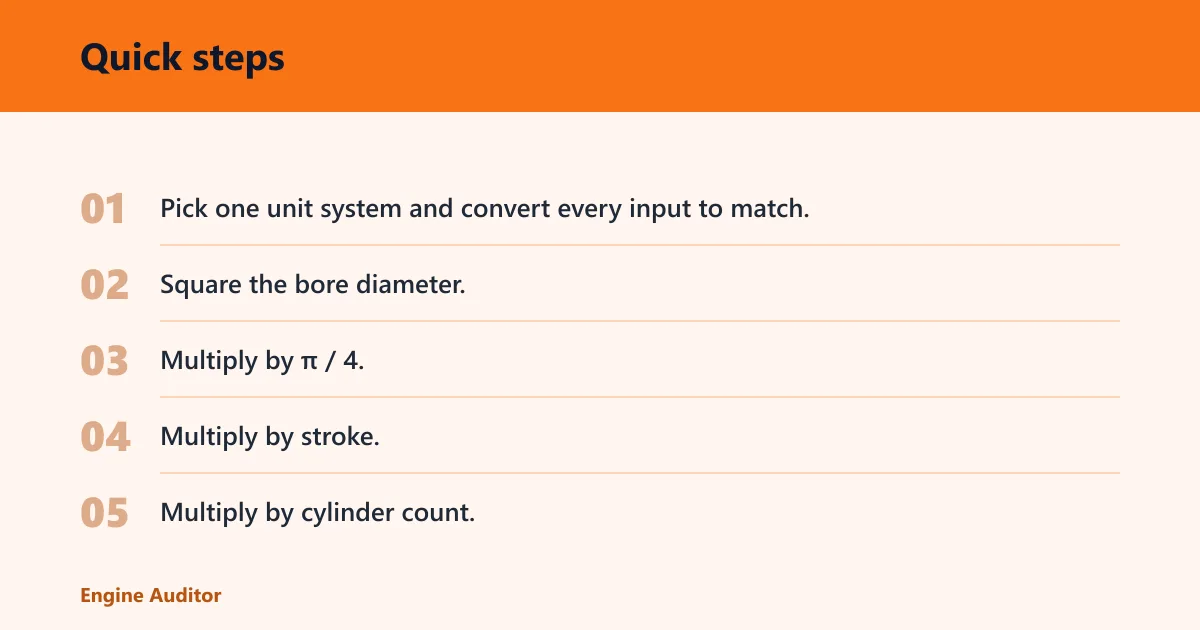
Use the standard piston-engine formula: displacement = π / 4 × bore² × stroke × cylinder count. Bore is squared, so a small change in diameter has a larger effect than the same-sized change in stroke. Keep every linear measurement in one unit before you calculate.
The formula from the calculator uses number of cylinders, bore diameter, and stroke length. For metric work, if the inputs are in millimeters, the result comes out in cubic millimeters. If the inputs are in centimeters, the result comes out in cubic centimeters. For imperial inputs, the result comes out in cubic inches.
Why bore is squared in the formula
Bore is squared because you are calculating the area of a circle before multiplying by stroke. Area grows with the square of diameter, so a larger bore changes displacement faster than many people expect. That is why a small overbore can move the total engine size more than a similar stroke change.
Worked example with one cylinder and then total displacement
Start with one cylinder. Measure bore and stroke in the same unit, compute π / 4 × bore² × stroke, and then multiply by cylinder count. The calculator example uses a 4-cylinder engine with 50 mm bore and 250 mm stroke, and it returns 1,963,495 mm³, which is equivalent to 119.82 cu. in.
For a quick mental check, a single cylinder with a 50 mm bore and 250 mm stroke gives a swept volume of about 245,437 mm³. Multiply that by four cylinders, and the total matches the reported 1,963,495 mm³. The math is simple. The unit discipline is where most mistakes happen.
Bore, stroke, and cylinder count
Bore diameter is the cylinder width. It enters the formula as a squared value, so it drives the cross-sectional area. Stroke length is the piston travel distance, sometimes described as cylinder depth in informal explanations, and it changes displacement in a straight line. Cylinder count multiplies the single-cylinder result into total engine size.
Bore diameter as the input that drives area
Increase bore, and the cylinder’s area grows fast. That matters in engine building because an overbore can change total size, compression, and piston choice. A calculator that hides the squared term can make the result look smaller than the geometry really is.
Stroke length as piston travel
Stroke is the distance between bottom dead center and top dead center. Add stroke, and you add volume in direct proportion if bore stays fixed. This is why long-stroke and short-stroke versions of the same bore often land in different displacement classes.
Cylinder count as the total multiplier
One cylinder gives you swept volume for one hole only. A four-cylinder engine with the same bore and stroke as a single-cylinder engine has four times the displacement. That multiplier is easy to miss when people compare only bore and stroke numbers from spec sheets.
How do units change the result?
Units decide the output. If bore and stroke are in millimeters, the answer is in cubic millimeters unless you convert it. If they are in centimeters, the answer is in cubic centimeters. If they are in inches, the answer is in cubic inches. Do not mix millimeters, centimeters, inches, cc, and liters in the same calculation without converting first.
Inch Calculator notes that if measurements are in centimeters, the result is in cubic centimeters. It also notes that cubic inches can be converted to liters by multiplying by 0.016387. For cc to liters, divide by 1,000. These are simple conversions, but they are easy to skip when a build sheet uses mixed units.
Millimeters, centimeters, and inches in the same formula
Choose one unit family and stay there. If bore is 86 mm and stroke is 86 mm, keep both in millimeters until the end. If a spec sheet lists bore in inches and stroke in millimeters, convert one of them before calculating. Mixed inputs can produce a number that looks plausible and still be wrong.
Converting cc to liters
Use a straight divide-by-1,000 conversion. A 2,000 cc engine is about 2.0 L. A 750 cc engine is about 0.75 L. This matters when a class rule or parts catalog lists liters instead of cubic centimeters.
Converting cubic inches to liters and cc
Multiply cubic inches by 0.016387 to get liters. To get cc, multiply cubic inches by 16.387. A cubic inch engine size can look smaller than the same number in cc, so always read the unit label before comparing engines.
- Pick one unit system and convert every input to match.
- Square the bore diameter.
- Multiply by π / 4.
- Multiply by stroke.
- Multiply by cylinder count.
- Convert the answer to cc, cubic inches, or liters as needed.
Displacement sanity-check table
Use this table to catch mixed-unit errors and numbers that do not fit the geometry. The figures below are calculated from the standard piston-engine formula and rounded for readability. If your result is far outside the expected range, recheck units first, then recheck bore, stroke, and cylinder count.
| Bore | Stroke | Cylinders | Displacement (cc) | Displacement (cu in) | Displacement (L) | Common mistake |
|---|---|---|---|---|---|---|
| 50 mm | 250 mm | 4 | 1,963.5 | 119.82 | 1.964 | Mixing mm with inches gives a false giant engine |
| 3.4 in | 3.6 in | 8 | 4,285.4 | 261.48 | 4.285 | Reading the result as cc instead of cubic inches |
| 86 mm | 86 mm | 4 | 1,998.6 | 121.97 | 1.999 | Using 86 as inches would be impossible geometry |
| 78 mm | 82 mm | 4 | 1,569.4 | 95.75 | 1.569 | Forgetting to multiply by four cylinders |
| 89 mm | 80 mm | 6 | 2,982.1 | 182.06 | 2.982 | Entering stroke in cm while bore stays in mm |
| 72 mm | 61 mm | 4 | 991.9 | 60.54 | 0.992 | Expecting a 1.6 L result from a sub-1.0 L geometry |
| 70 mm | 70 mm | 1 | 269.4 | 16.44 | 0.269 | Reading single-cylinder displacement as total engine size |
| 96 mm | 73 mm | 4 | 2,115.8 | 129.16 | 2.116 | Swapping bore and stroke changes the result enough to mislead parts choice |
| 54 mm | 54 mm | 2 | 247.9 | 15.13 | 0.248 | Mixing liters and cc can hide a small motorcycle engine |
| 100 mm | 100 mm | 8 | 6,283.2 | 383.01 | 6.283 | Unrealistic if the engine family normally uses much smaller bores |
| 23.15 mm | 150 mm | 2 | 200.0 | 12.20 | 0.200 | Reverse-calculated bore that looks tiny for a piston engine |
| 81 mm | 77 mm | 4 | 1,587.6 | 96.92 | 1.588 | Leaving stroke in mm but converting bore to cm mid-calculation |
How do you use displacement in real decisions?
Use displacement as a planning number. It helps you compare build options, check class limits, and choose compatible parts. It also sets the starting point for compression ratio planning, because cylinder volume at bottom dead center changes the ratio math that follows.
Say your ruleset caps a class at 2.0 L. A 1,998.6 cc engine is close enough to require careful verification, while a 2,115.8 cc combo is over the line. That is not a power claim. It is a compliance check, and it needs an exact size number.
Choosing bore or stroke for a build
If you are deciding between a larger bore and a longer stroke, displacement is part of the trade. Bore changes area quickly. Stroke changes volume directly. The right choice depends on your target size, parts availability, and the head, piston, and rod package that will fit the engine family.
Suppose a motorcycle cylinder needs to stay near a class limit. A small bore increase can move the engine out of the class even before the rest of the build changes. That is why riders and builders watch cc figures so closely on small-displacement engines.
Checking class limits and spec sheets
Manufacturers and rulebooks often list size in cc or liters. Compare like with like. A 750 cc engine is 0.75 L. A 96 cu in engine is about 1.57 L. If a spec sheet uses cubic inches and the rulebook uses liters, convert both before you decide whether the engine fits.
Planning compression ratio and parts fit
Compression ratio depends on displacement and on the clearance volume above the piston at top dead center. Once you know swept volume, you can work the rest of the ratio math with more confidence. Piston dome shape, head chamber size, and gasket thickness all matter after displacement is known.
When does the formula need caution?
The standard formula is for piston engines with a conventional bore-and-stroke layout. It does not fit every engine geometry cleanly. Rotary engines and other nonstandard designs use different volume logic, so the same calculator can give a misleading result if you apply it outside its intended case.
Reverse calculations are also estimates, not exact answers. If you know displacement and stroke, you can solve for bore. But the result assumes a standard cylinder shape, exact geometry, and no unusual chamber design that changes how the engine is described.
Reverse calculations for bore or stroke
The calculator can work backward when one variable is missing. The reverse example uses a 2-cylinder engine with about 200 cc displacement and a 150 mm stroke, and it calculates a bore diameter of about 23.15 mm. That is useful for planning, but it only works when the other inputs are reliable and in the same unit system.
A common first-timer mistake is to treat the reverse answer as exact without checking the rest of the engine layout. If the bore seems implausibly small or the stroke seems too long for the engine family, stop and verify the inputs before buying parts.
Frequently asked questions
How is engine displacement calculated?
Use displacement = π / 4 × bore² × stroke × cylinder count. Keep bore and stroke in the same unit, then convert the result to cc, cubic inches, or liters if needed. The formula measures total swept volume from bottom dead center to top dead center across all cylinders.
What is engine displacement in cc?
In cc, engine displacement is the swept volume measured in cubic centimeters. It is the total space all pistons move through, not the space above the pistons at rest. If the calculator inputs are in centimeters, the result comes out directly in cubic centimeters.
How do I convert cubic inches to liters for engine size?
Multiply cubic inches by 0.016387 to get liters. For example, a 261.48 cu in engine is about 4.285 L. If you also need cc, multiply cubic inches by 16.387. Keep the unit label visible so you do not compare numbers that mean different things.
How do bore and stroke affect engine displacement?
Bore affects displacement through a squared area term, so it changes size faster than many people expect. Stroke affects displacement linearly, so a longer stroke adds volume in direct proportion. Cylinder count then multiplies the single-cylinder volume into the full engine size.
How do I calculate engine displacement for a motorcycle?
Use the same formula, but be careful with small-unit errors because motorcycle bores and strokes are often listed in millimeters. Multiply π / 4 by bore squared, then by stroke, then by cylinder count. Convert the final answer to cc, since motorcycle displacement is usually labeled that way.
Can I calculate bore from engine displacement?
Yes, if you know displacement, stroke, and cylinder count, you can solve for bore by rearranging the formula. The result is only an estimate if the engine uses standard piston geometry. Check whether the answer is plausible for the engine family before treating it as a parts order number.
Can I calculate stroke from engine displacement?
Yes. If displacement, bore, and cylinder count are known, stroke can be solved by rearranging the same formula. This is useful for build planning, but it assumes a standard bore-and-stroke engine. Unusual chamber shapes or non-piston layouts can make the estimate misleading.
What does cc mean in an engine?
CC means cubic centimeters. In engine sizing, it refers to the swept volume of the cylinders. A higher cc number usually means a larger engine size, but it does not by itself tell you power, airflow, or how the engine will perform under load.
How many liters is a cubic inch engine?
Multiply cubic inches by 0.016387. That gives the liter value. For a quick check, 119.82 cu in is about 1.964 L, while 261.48 cu in is about 4.285 L. Always convert before comparing engines listed in different units.
Products related to this article
Sponsored / affiliate links. As an Amazon Associate I earn from qualifying purchases. I may earn additional commission from eligible campaigns.
 Car A/C Repair Kit, 270PCS Rubber O-Ring Seal Kit + 40PCS Car Air Conditioner Valve Core Kit for R12 R134a A/C with Remover & Install Tool+10pcs R134a AC Valve Caps, Fix Refrigeration System
 Auto Car Dent Repair Puller Head Paintless-Dent Repair Removal Kit for Slide Hammer Pulling Tab Adapter Pulling Tabs Car Aluminum-alloy Puller Head Adapter Screw Glue-tabs for Slide Hammer and