Best Premium Car Batteries for Drivers (2026): We Compared
The best premium car battery is the one sized to your vehicle, matched to its charging system, and built with enough reserve capacity for your electrical load and climate. Pick the wrong one, and you can get slow cranking, shorter battery life, and avoidable no-start risk. This guide compares premium options and gives short rules for fit, load, and weather.
Quick comparison
| Product | Badge | Best for | Price | ||
|---|---|---|---|---|---|
 |
Weize Platinum AGM Battery Group 48WEIZE | Our pick | Group 48 · 70Ah · 760 CCA AGM | $159.99
Price as of 8 Nov 2026
|
View |
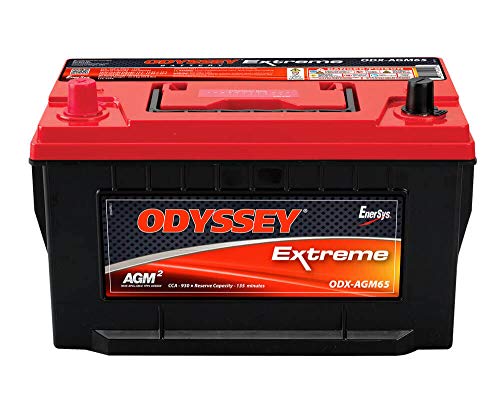 |
Odyssey Battery ODX-AGM65 Extreme Series AGM BatteryOdyssey | Upgrade pick | Group 65 · 930 CCA · AGM | $422.74
Price as of 8 Nov 2026
|
View |
 |
OPTIMA® Batteries High Performance DH6 YELLOWTOP® DualOPTIMA | Also great | Group 48 · 800 CCA · YELLOWTOP AGM | $369.99
Price as of 8 Nov 2026
|
View |
The main trade-off is direct: more premium construction usually brings more reserve capacity, better cycling tolerance, and stronger warranty terms, but only if the battery fits the car and matches the charging system. A battery with a higher CCA label can still be the wrong buy if the group size, terminal layout, or stop-start requirement is off.
For most drivers who want a premium upgrade, AGM is the safest default because it fits modern charging systems and stop-start use better than standard flooded lead-acid. EFB can be the better middle ground in some stop-start cars, and a standard flooded lead-acid battery still makes sense when the vehicle does not need extra cycle life or sealed construction.
How we chose
These picks were compared on four things that matter most in premium battery shopping: fitment, charging-system compatibility, reserve capacity, and warranty structure. Date-code freshness also matters because old shelf stock can shorten useful life before the battery ever reaches the car.
CCA matters, but it is not the whole story. In premium use, reserve capacity, stop-start compatibility, and case-fit risk often decide whether a battery performs well for three years or becomes an expensive mistake.
| Model | Type | Group size | CCA | Reserve capacity | Warranty | Best fit | Price |
|---|---|---|---|---|---|---|---|
| WEIZE Platinum AGM Battery Group 48 | AGM | 48 / H6 | 760 | 120 minutes | 36 months | Value-conscious stop-start cars that need Group 48 | $159.99 |
| Odyssey Battery ODX-AGM65 Extreme Series | AGM | 65 | 930 | 135 minutes | Varies by seller listing | High-load vehicles that need strong starting and long reserve | $422.74 |
| OPTIMA YELLOWTOP DH6 Group 48 | AGM | 48 | 800 | 140 minutes | Varies by seller listing | Accessory-heavy cars and trucks that want strong reserve | $369.99 |
AGM battery: best for stop-start and high-load cars
AGM is the best premium default for many modern cars because it handles deeper cycling, supports stop-start use, and is sealed and spill-resistant. If your car has a smart charging system, regenerative braking, or heavy accessory use, AGM usually gives the widest safety margin.
Absorbed glass mat construction keeps the electrolyte held in glass mats rather than free-flowing liquid. That helps with vibration resistance, deep-cycle tolerance, and mounting flexibility, which is why many premium and performance applications use AGM instead of standard flooded lead-acid.
The WEIZE Group 48 AGM fits the common premium buyer who wants a lower-cost AGM with stop-start support, 760 CCA, and 120 minutes of reserve capacity. The drawback is simple: it is a value-priced AGM, so it does not bring the long reserve or high-end build cues of pricier batteries.
Say your SUV has Group 48, a factory stop-start system, and short-trip use. A battery with decent CCA but weak reserve capacity may crank fine on day one and still wear out early from repeated shallow discharge. That is the failure mode premium buyers often miss.
EFB battery: best for compatible stop-start vehicles
EFB is the middle ground for some stop-start vehicles. It improves cycle life over standard flooded lead-acid and often costs less than AGM, but it must still match the vehicle’s charging strategy. Put the wrong type in the wrong system, and the car can undercharge or age the battery quickly.
EFB works best when the car was designed for it or the owner’s manual lists it as an approved replacement. It is not a universal upgrade. In vehicles with high accessory load or advanced energy management, AGM usually offers more margin.
An EFB may be the right answer if the car uses stop-start lightly, spends most of its time on longer drives, and does not ask for the deeper reserve that AGM brings. If the vehicle is coded for AGM from the factory, EFB is usually the poorer choice.
Is AGM better than lead-acid for your car?
AGM is usually better when the car has stop-start, strong accessory demand, short-trip use, or a premium charging system that expects higher cycle life. Standard flooded lead-acid is still fine for many non-stop-start cars that do not need the extra reserve or sealed construction.
AGM is a better premium choice because it tolerates repeated partial discharge better than ordinary flooded batteries. It also tends to hold up better in vehicles that run frequent electrical loads at idle, such as heated seats, audio systems, or power accessories.
Standard flooded lead-acid remains the sensible buy when the vehicle is simple, the charging system is conventional, and the OEM spec does not call for AGM or EFB. In that case, spending more on AGM may not deliver a real payoff over three years.
A common first-timer mistake is buying AGM only because it sounds higher end. If the car does not need it, the premium can buy little more than a heavier battery with the same fitment burden.
What makes a premium battery worth the price?
A premium battery earns its price when the extra money buys measurable benefits: more reserve capacity, a better warranty structure, stronger cycle life, and a closer match to the car’s charging system. If those gains do not line up with the vehicle, the premium is wasted.
Reserve capacity and real-world backup time
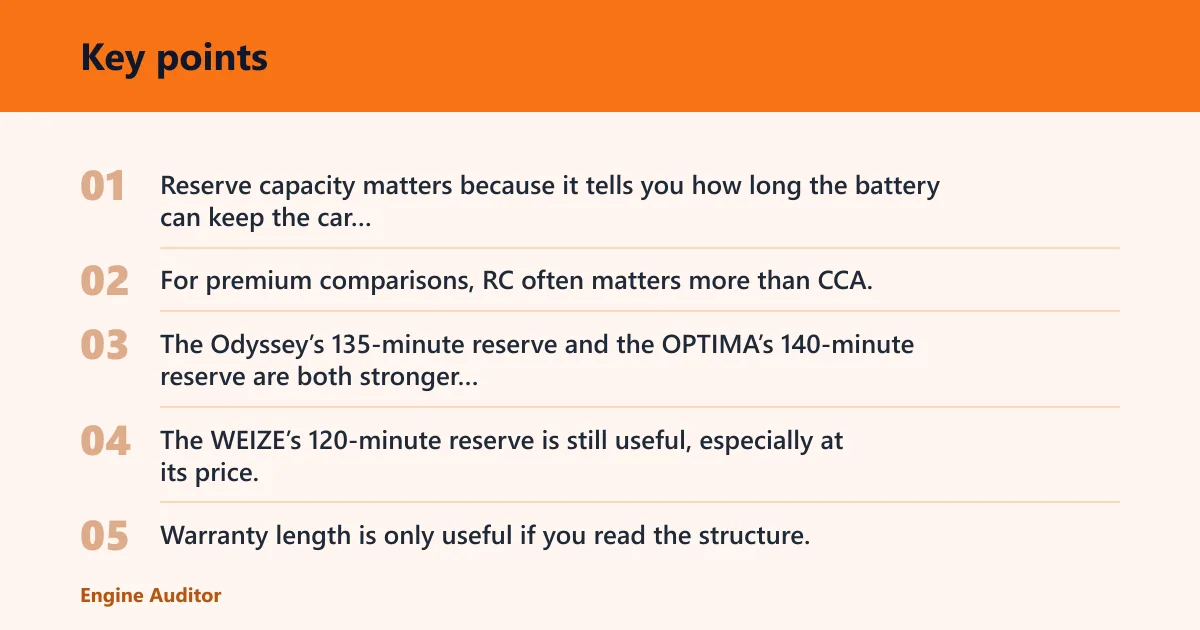
Reserve capacity matters because it tells you how long the battery can keep the car alive under load if charging output drops. For premium comparisons, RC often matters more than CCA, especially for short-trip drivers and cars with parasitic draw or accessory-heavy use.
The Odyssey’s 135-minute reserve and the OPTIMA’s 140-minute reserve are both stronger signals of endurance than CCA alone. The WEIZE’s 120-minute reserve is still useful, especially at its price, but it gives less backup margin than the two higher-end AGM choices.
Warranty structure and replacement risk
Warranty length is only useful if you read the structure. A strong premium warranty should spell out the free-replacement period, whether pro-rata coverage follows, and whether registration is required. Exclusions for deep discharge, misuse, or improper fit can narrow the real value fast.
The WEIZE listing gives a 36-month warranty, which is straightforward and useful on paper. The larger question is whether the retailer and manufacturer process claims cleanly, because warranty value is lower when replacement work and downtime are high.
Fresh stock and battery date codes
Battery date code freshness matters because lead-acid batteries age on the shelf. A premium battery can lose part of its useful life before installation if it has sat too long in storage. Look for a date code or manufacturing stamp and avoid old stock when you can.
This matters most on expensive AGM models, where shelf age can erase part of the value you paid for. A fresh midrange battery is often a better buy than an old premium battery with a stale date code.
Premium car battery decision matrix
The matrix below scores each battery on seven criteria that matter in premium buying. The notes explain why each criterion matters. Scores are relative, using the product data available here and a typical premium-buying lens. Your car’s OEM spec still rules the final choice.
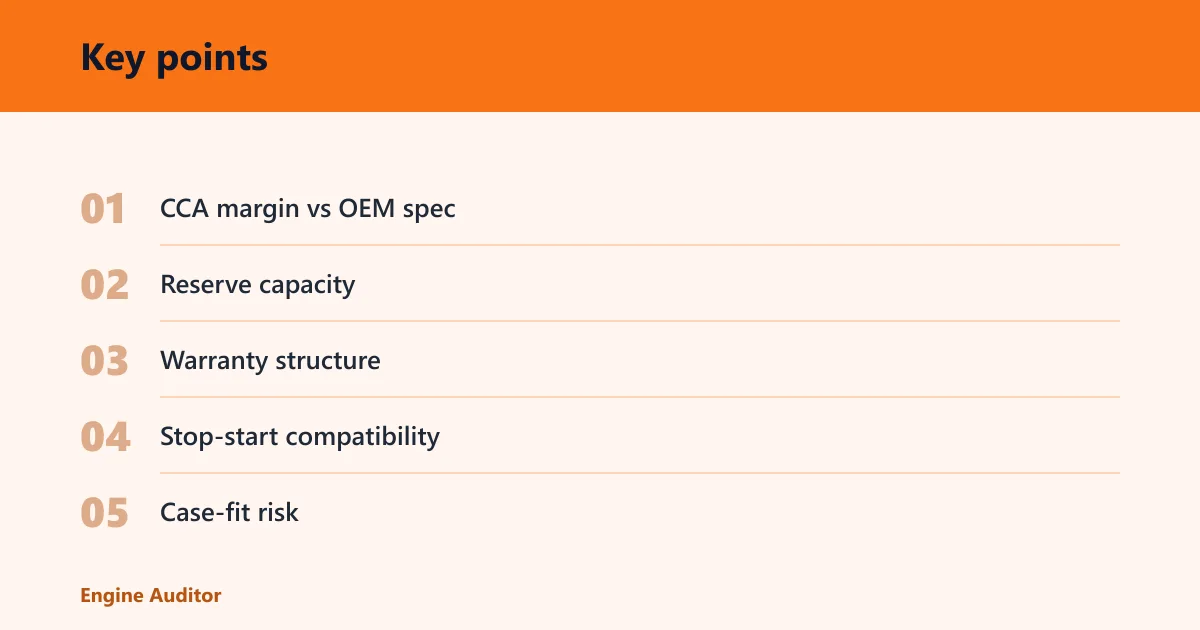
| Battery | CCA margin vs OEM spec | Reserve capacity | Warranty structure | Stop-start compatibility | Case-fit risk | Shelf-freshness/date code | Estimated 3-year total ownership cost |
|---|---|---|---|---|---|---|---|
| WEIZE Platinum AGM Group 48 | 4/5 | 3/5 | 4/5 | 5/5 | 3/5 | 3/5 | Low |
| Odyssey ODX-AGM65 Extreme Series | 5/5 | 5/5 | 3/5 | 3/5 | 2/5 | 3/5 | High |
| OPTIMA YELLOWTOP DH6 Group 48 | 5/5 | 5/5 | 3/5 | 4/5 | 3/5 | 3/5 | High |
Why each criterion matters
- CCA margin vs OEM spec: CCA is the starting-power rating. It matters in cold weather, but matching the OEM spec is safer than chasing the biggest number.
- Reserve capacity: RC shows how long the battery can support load if the alternator output is low or the car sits with accessories on.
- Warranty structure: The free-replacement period, pro-rata terms, and exclusions tell you how much of the premium price is actually protected.
- Stop-start compatibility: AGM or approved EFB matters because stop-start systems increase cycling and may need battery coding or reset work.
- Case-fit risk: Group size and terminal layout must match the tray and hold-down, or a better battery becomes a bad fit.
- Shelf-freshness/date code: Fresh stock keeps you from paying premium money for a battery that has already aged on the shelf.
- Estimated 3-year total ownership cost: A cheap battery that fails early can cost more than a pricier one after replacement labor and downtime.
Best premium car batteries: top pick for most drivers
It is the clearest value if your car needs Group 48 and does not require the strongest reserve on the market.
What stands out is the balance. It is not the biggest battery in the group, but it gives you the premium features most drivers actually need: sealed AGM construction, decent reserve, and a warranty that is easy to understand.
The drawback is the obvious one: it is not the longest-lasting reserve battery in this comparison, and it will not be the right answer if your vehicle asks for Group 65 or if you need the strongest possible accessory buffer.
Odyssey AGM65 Extreme Series: best for long reserve and high cranking
This battery is for drivers who need serious starting power and a strong reserve window in a Group 65 fitment. Based on the published specs, 930 CCA and 135 minutes of reserve make it the strongest starting and endurance option in this comparison.
What stands out is the combination of high CCA, long reserve, and tin-plated brass SAE posts. That mix is useful in vehicles with heavy electrical loads, frequent short trips, or owners who want the widest buffer against low-voltage events.
The drawback is cost. At $422.74, it is the most expensive option here, and that premium only makes sense if your car actually needs the Group 65 size and can benefit from the extra reserve and starting headroom.
OPTIMA YELLOWTOP DH6: best for accessory-heavy vehicles
This battery suits drivers who want a sealed AGM with very strong reserve capacity and a premium reputation for dual-purpose use. The published 800 CCA and 140-minute reserve make it especially relevant for trucks, SUVs, and cars with accessory draw.
What stands out is the 140-minute reserve capacity. That is the best reserve figure in this comparison and a useful signal if your vehicle sees long accessory use, short-trip driving, or frequent engine-off electrical demand.
The drawback is price. At $369.99, it is still expensive, and its value depends on whether your vehicle truly needs the reserve and mounting flexibility that justify the spend.
Which one should you buy?
Pick the battery that matches the car first, then the climate and use pattern. The right premium battery for a cold-climate sedan may be wrong for a stop-start SUV, and the best reserve battery may still be a poor buy if the group size is off.
Best for cold climates
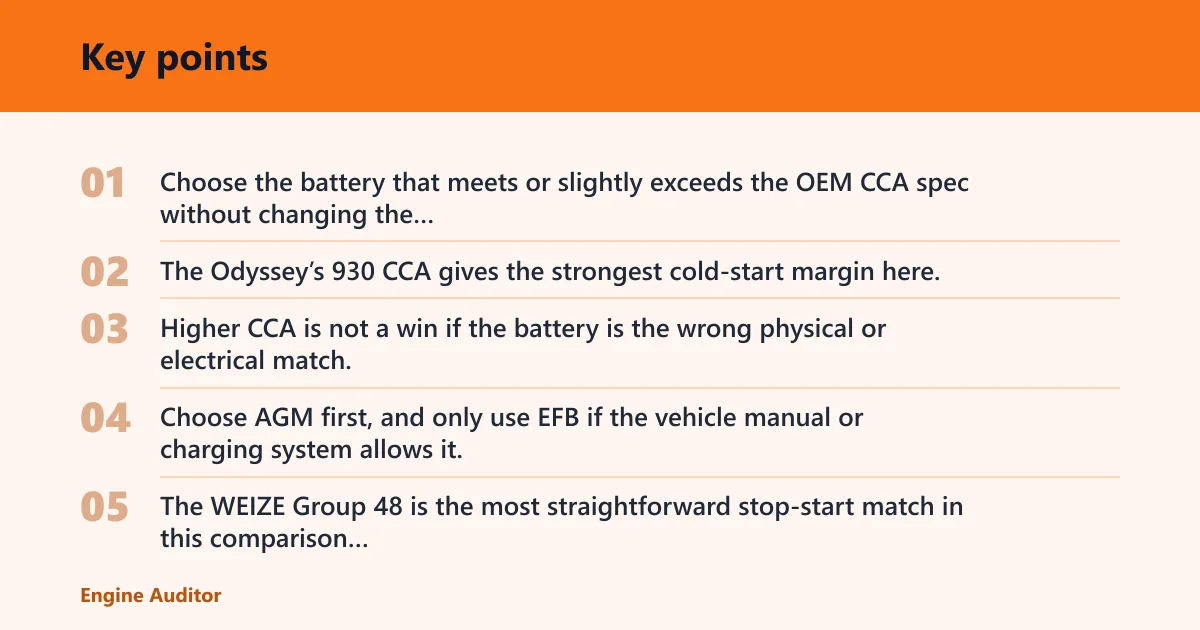
Choose the battery that meets or slightly exceeds the OEM CCA spec without changing the required group size or terminal layout. The Odyssey’s 930 CCA gives the strongest cold-start margin here, but only if Group 65 fits your car. Higher CCA is not a win if the battery is the wrong physical or electrical match.
Best for stop-start vehicles
Choose AGM first, and only use EFB if the vehicle manual or charging system allows it. The WEIZE Group 48 is the most straightforward stop-start match in this comparison because it is AGM, Group 48, and priced for broader use.
Best for short-trip and accessory-heavy driving
Choose the battery with the best reserve capacity and the best fit. The OPTIMA YELLOWTOP DH6 stands out here because 140 minutes of reserve gives more backup for short trips, idle load, and parasitic draw than a battery judged by CCA alone.
Best value if you do not need AGM
If the vehicle does not call for AGM or EFB, a standard flooded lead-acid battery is often enough and may cost less over three years. The extra premium is harder to justify when the car has no stop-start system, modest electrical load, and a simple charging setup.
Say your compact SUV uses Group 48, has stop-start, and sits outside in winter. The safer premium move is AGM with the right reserve and a fresh date code, not the biggest CCA number on the shelf.
Picture a luxury sedan with battery coding required after replacement. Even a high-end battery can disappoint if the install skips the reset or the replacement type does not match the original charging profile.
Frequently asked questions
What is the best premium car battery for my car?
The best premium battery is the one that matches your vehicle’s group size, terminal layout, charging system, and electrical load. For many modern cars, that means AGM. For some stop-start cars, EFB is acceptable. For simple vehicles without those demands, flooded lead-acid is still enough.
Are premium car batteries really worth the extra money?
They are worth it when the extra cost buys more reserve capacity, better cycle life, stronger warranty coverage, or a better fit for stop-start use. They are not worth it if the car does not need AGM or EFB, or if the charging system problem is the real fault.
Which premium car battery lasts the longest?
The longest-lasting battery is usually the one that best matches the vehicle’s charging behavior and use pattern. In this comparison, the Odyssey and OPTIMA have the strongest reserve figures, but lifespan still depends on fitment, charging quality, and how often the car is deeply cycled.
Is AGM better than lead-acid for a premium battery?
AGM is usually better when the vehicle has stop-start, high accessory draw, or frequent short trips. Standard flooded lead-acid is still acceptable for many cars that do not need those traits. AGM costs more, so the upgrade only makes sense when the system can use it.
What size battery does my car need for a premium upgrade?
Use the OEM group size first. The case must fit the tray, hold-down, and terminal layout. After that, check CCA, reserve capacity, and whether the car expects AGM or EFB. A premium battery in the wrong group size is the wrong battery.
How do I compare warranty terms on premium car batteries?
Compare the free-replacement period, any pro-rata phase, registration requirements, and exclusions for deep discharge or misuse. A longer warranty is useful, but only if the claim rules are clear and the battery type matches the car’s charging system and use pattern.
Products related to this article
Sponsored / affiliate links. As an Amazon Associate I earn from qualifying purchases. I may earn additional commission from eligible campaigns.