Can You Drive With Car Light On? What You Need to Know
Driving with your car light on is a situation every driver will face eventually, and it can feel confusing or even scary. That glowing dashboard icon might be a simple reminder or a sign of serious trouble. This post explains what each warning light means, when you can keep driving, and when you should pull over right away.
Simply put, you can drive with a check engine light on for a short time, but you should not drive with red warning lights like oil pressure, coolant temperature, or brake system lights. Red lights mean pull over immediately. Yellow lights mean schedule a repair soon and keep driving to a minimum.
Key Takeaways
- Driving with your car light on is risky if the light is red, so you need to learn the color codes.
- Dashboard warning lights fall into three groups: green info lights, yellow caution lights, and red danger lights.
- A solid check engine light usually means you can drive to a mechanic, but a flashing one means stop right away.
- Ignoring a warning light can turn a small repair into a costly one, sometimes adding thousands to your bill.
- Checking easy things first like the gas cap, oil level, and coolant level can save you a tow truck call.
What Does It Mean When a Car Warning Light Comes On?
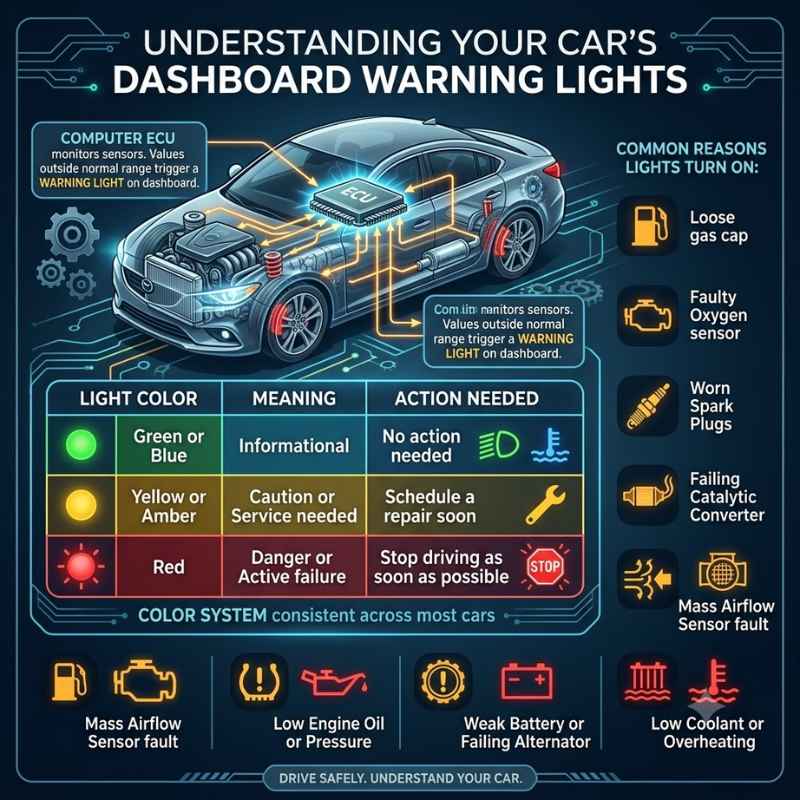
Modern cars have a computer called the engine control unit, or ECU. It constantly monitors sensors across the engine, transmission, brakes, and emissions system. When a sensor reads a value outside its normal range, the ECU turns on a warning light on your dashboard.
The light is your car’s way of telling you that something is wrong. But not all warning lights are equal. Some are informational, some warn of minor issues, and some signal a risk of immediate damage.
The color of the light tells you how urgent the problem is.
Common reasons a warning light turns on include:
- A loose or missing gas cap
- A faulty oxygen sensor
- Worn spark plugs or ignition coils
- A failing catalytic converter
- A dirty or failing mass airflow sensor
- Low engine oil or low oil pressure
- A weak battery or failing alternator
- Low coolant or engine overheating
| Light Color | Meaning | Action Needed |
|---|---|---|
| Green or blue | Informational | No action needed |
| Yellow or amber | Caution or service needed | Schedule a repair soon |
| Red | Danger or active failure | Stop driving as soon as possible |
The color system is consistent across most car brands, from Toyota to Ford to BMW. So once you understand the code, you can judge the risk in any vehicle.
Can You Drive With a Car Light On Safely?
The short answer is yes, but only for certain lights and only for a limited time. A solid yellow check engine light means you can usually drive to a repair shop or to your home. A red light, like the oil pressure light or the engine temperature light, means you should stop the car as soon as it is safe to do so.
The most important thing to check is the color and behavior of the light. Is it solid or flashing? A solid yellow light is a warning.
A flashing light is an emergency and means the engine is actively misfiring in a way that can damage the catalytic converter.
It is probably fine to keep driving when:
- The light is yellow or amber
- The engine sounds normal
- The car runs smoothly without shaking
- The light appeared right after you filled the gas tank
- You are close to home or a repair shop
You should stop the car when:
- The light is red
- The check engine light is flashing
- You see smoke, smell burning, or hear loud noises
- The engine feels rough, surges, or loses power
- The temperature gauge sits in the red zone
Warning: A flashing check engine light means unburned fuel is pouring into the exhaust system. That can destroy your catalytic converter within minutes and start a fire risk. Pull over and turn off the engine.
If your car feels fine and the light is solid yellow, you can drive with a car light on to get to a mechanic, but do not ignore it for days on end.
How Long Can You Drive With a Car Light On?
There is no single answer because it depends on what is actually wrong. Some drivers go hundreds of miles with a check engine light on and nothing bad happens. Others ignore a warning light and damage their engine within minutes.
The key is to read the situation, not just the light.
Several factors affect how long you can safely keep driving:
- Which specific light is on
- Whether the light is solid or flashing
- How the vehicle is performing at that moment
- The age and overall condition of the vehicle
- How hard you drive, such as highway speeds or heavy loads
| Warning Light | Typical Driving Window |
|---|---|
| Check engine light, solid yellow | Tens to hundreds of miles possible |
| Check engine light, flashing | Stop as soon as possible |
| Oil pressure light, red | Stop immediately |
| Coolant temperature light, red | Stop immediately |
| Battery charge light, red | Short distance only, limited |
| Tire pressure light, yellow | Short distance at low speed |
These windows assume the car is running normally. The moment you notice rough idling, power loss, strange sounds, or rising temperature, the window closes. Do not push it.
Tip: Keep a small OBD-II code reader in your glovebox. It plugs into your car and tells you the exact fault code in seconds, so you know whether the issue is a loose gas cap or something far worse.
What Are the Different Dashboard Warning Light Colors?
Dashboard lights use a simple color code across almost every car brand. Green and blue lights are informational. Yellow and amber lights ask you to schedule service.
Red lights warn you of a problem that needs immediate attention.
Red lights are the ones you must never ignore. They point to systems that keep the car running and safe:
- Oil pressure warning light
- Engine coolant temperature light
- Brake system warning light
- Battery charging system light
- Transmission temperature light
| Color | Common Examples | Urgency |
|---|---|---|
| Green or blue | Headlights, high beams, cruise control | None |
| Yellow or amber | Check engine, tire pressure, traction control, service reminder | Low to moderate |
| Red | Oil pressure, brake, coolant, battery, transmission temperature | High, stop soon |
CarMD’s surveys have found that roughly 31% of drivers ignore the check engine light for a month or more. In many of those cases, minor problems become major and expensive repairs, especially when red lights are involved.
Important: Some cars show a red battery light while the engine still runs. This usually means the alternator has failed and the car is running on battery power alone. Once the battery drains, the engine will stall, often with no warning.
How to Check What Your Car Light Means
When a warning light appears, you do not need to be a mechanic to figure out what is going on. A simple process can help you identify the problem in minutes and decide whether to keep driving or call for help.
- Pull over somewhere safe when you first notice the light, especially if it is red or flashing.
- Open your owner’s manual and find the section on warning lights. It shows a picture of each light and its meaning.
- Check the gas cap. A loose cap is the most common cause of a check engine light and the easiest fix.
- Check basic fluid levels, including engine oil, coolant, and brake fluid, if you are comfortable opening the hood.
- Use an OBD-II code reader to pull the diagnostic trouble code from the car’s computer.
- Call a mechanic and share the code. They can tell you whether the repair is urgent.
If you use a code reader, you will see a five-character code like P0420. Here are some of the most common ones:
| Code | Meaning | Typical Severity |
|---|---|---|
| P0420 | Catalytic converter efficiency below threshold | Moderate to high cost |
| P0300 | Random engine misfire | Can become severe |
| P0442 | Small evaporative emissions leak | Usually minor |
| P0171 | System too lean, bank 1 | Moderate |
| P0128 | Coolant thermostat below temperature | Minor to moderate |
Codes tell you the problem area, not the exact fix. A P0420 code, for example, can come from a failing catalytic converter or simply from a slow oxygen sensor. Always pair the code with a proper inspection.
Tip: Take a photo of the dashboard and the code with your phone. It helps when you call a shop or talk to a parts store, and it keeps you from forgetting key details.
What Happens If You Ignore a Dashboard Warning Light?
Ignoring a dashboard warning light rarely ends well. Small problems like a failing oxygen sensor can lower fuel economy and put extra strain on the catalytic converter. The longer you wait, the more expensive the repair becomes, and the higher the risk of a breakdown.
According to CarMD’s research, the average cost to repair a check engine light problem runs a few hundred dollars. Ignoring the light can push the final bill far higher. For example, a worn spark plug might cost around $100 to replace, but the misfire it causes can destroy a catalytic converter that costs $1,200 or more to replace.
Here is what can happen when you drive with a car light on for too long:
- Reduced fuel economy, often by 20% or more
- Rough idling, hesitation, or poor acceleration
- Failed state emissions testing, which can block registration
- Permanent damage to the catalytic converter or oxygen sensors
- Overheating that cracks the engine block or warps the cylinder head
- Brake failure in the worst cases, creating a serious safety risk
- Voided warranty coverage if neglect causes the damage
Warning: Never reset the battery to clear a warning light without fixing the underlying problem. The light will come back, and in the meantime, you are driving with a fault that may leave you stranded on the road.
The math is simple. A diagnostic check costs around $50 to $150 at most shops. Fixing a problem early costs a fraction of what a full system failure will cost.
Common Mistakes Drivers Make With Warning Lights
When a dashboard light appears, many drivers react in ways that make things worse. Knowing what not to do is just as important as knowing how to fix the problem.
| Mistake | Better Approach |
|---|---|
| Panic stopping in the middle of the highway | Move to a safe shoulder or exit first |
| Ignoring the light for months | Schedule a diagnostic check within a few days |
| Tightening the gas cap as hard as possible | Turn the cap until you hear three clicks |
| Clearing the code without a real fix | Get a proper diagnosis first |
| Driving on with a flashing check engine light | Pull over and call a tow truck |
Other common mistakes are less obvious but just as costly:
- Trusting internet forums over a certified mechanic
- Disconnecting the battery to make the light disappear
- Putting off a coolant flush that leads to overheating
- Using the wrong oil grade, which triggers pressure warnings
- Ignoring a tire pressure light and damaging the tire sidewall
Tip: Most auto parts stores will read your diagnostic codes for free. That gives you a solid starting point before you talk to a repair shop.
When Should You Stop Driving Immediately?
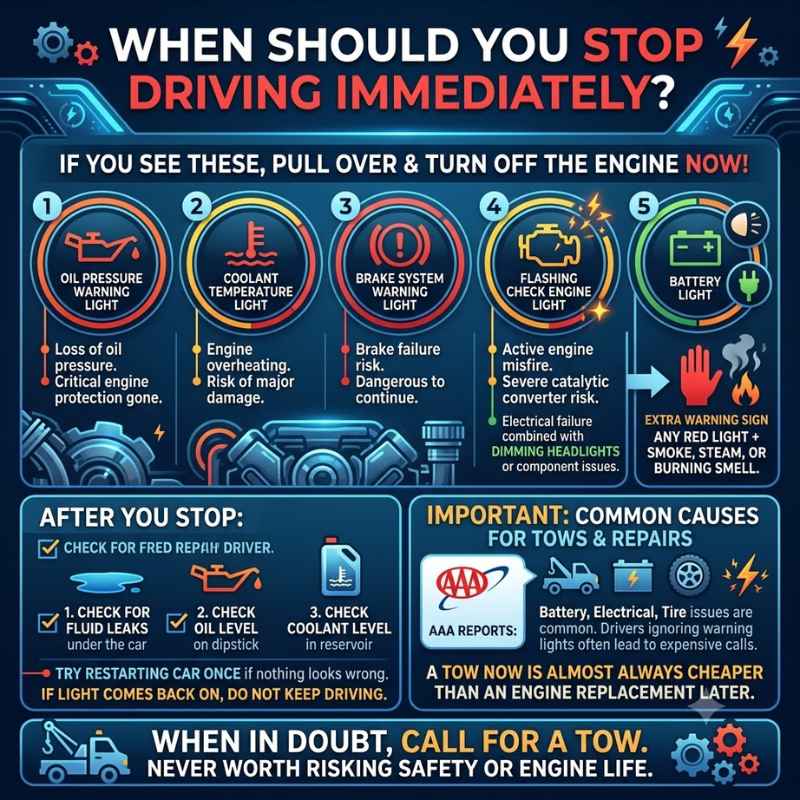
Some warning lights mean stop now, not later. If you see any of the following, pull over to a safe spot and turn off the engine right away:
- The oil pressure warning light, which signals a loss of oil pressure
- The coolant temperature light, which signals overheating
- The brake system warning light, which signals a brake failure risk
- A flashing check engine light, which signals active engine misfire
- The battery light combined with dimming headlights or electrical failures
- Any red light accompanied by smoke, steam, or a burning smell
After you stop, check the obvious things. Look for fluid leaks under the car, check the oil level on the dipstick, and look at the coolant level in the reservoir. If nothing looks wrong, you can try restarting the car once.
If the red light comes back on, do not keep trying to drive.
Important: AAA reports that battery, electrical, and tire issues are among the most common reasons for roadside assistance calls, and many of those calls start with a driver ignoring a warning light. A tow now is almost always cheaper than an engine replacement later.
When in doubt, call for a tow. Driving with your car light on is never worth risking your safety or the life of your engine.
Frequently Asked Questions
Can you drive with the car light on?
You can drive short distances with a solid yellow check engine light if the car runs normally, but you should avoid driving with red lights or a flashing check engine light. Red lights point to active failures that can cause immediate damage. When in doubt, stop the car and get a professional diagnosis.
How much does it cost to fix a check engine light?
CarMD reports that the average check engine light repair costs a few hundred dollars, depending on the issue. Simple fixes like a loose gas cap cost nothing, while parts like a catalytic converter can cost $1,000 or more. The price depends heavily on the code and your vehicle’s make and model.
What does a flashing check engine light mean?
A flashing check engine light means the engine is actively misfiring in a way that sends unburned fuel into the exhaust system. This can overheat and destroy the catalytic converter, and it also risks a fire. Pull over immediately and have the vehicle towed to a shop.
Can a loose gas cap cause a car light to come on?
Yes. A loose or missing gas cap is one of the most common causes of a check engine light because it lets fuel vapors escape. If you tighten the cap until it clicks, the light usually turns off within a day or two of driving.
Is it safe to drive with the tire pressure light on?
You can drive a short distance at reduced speed to reach a gas station or tire shop, but you should not drive long distances. Low tire pressure affects handling, braking, and fuel economy, and it can cause the tire to overheat and fail. Check the pressure with a gauge and inflate the tires to the recommended level.
Final Thoughts
Driving with your car light on is manageable if you understand the color codes and act quickly. Remember that yellow means schedule a repair, red means stop soon, and flashing means stop now. A quick check of the gas cap and fluid levels can resolve many issues, while a proper diagnostic test gives you the full picture.
Stay safe, and keep that dashboard light from turning into a much bigger problem.
See also why is my car light yellow instead of white explained.