What Happens When You Turn on the Car Light? (Real Effects Explained)
Turning on your car’s interior light while driving is not illegal in most places, but it is unsafe. It significantly reduces your night vision by making your pupils constrict, creates distracting glare on the windshield, and can lead to a ticket for distracted driving if it impairs your ability to drive safely.
Have you ever reached to turn on the dome light and heard a passenger gasp, “Don’t do that! You’ll get a ticket!”? It’s a warning many of us heard growing up. It makes you wonder if that little light is somehow against the law. This common belief causes a lot of confusion and even a little bit of fear.
You’re not alone in questioning this. Many drivers are unsure about the rules and dangers of using interior lights on the road. Don’t worry, I’m here to clear everything up for you. We’ll look at the facts, bust the myths, and give you simple, safe advice. Let’s shine a light on the truth together.
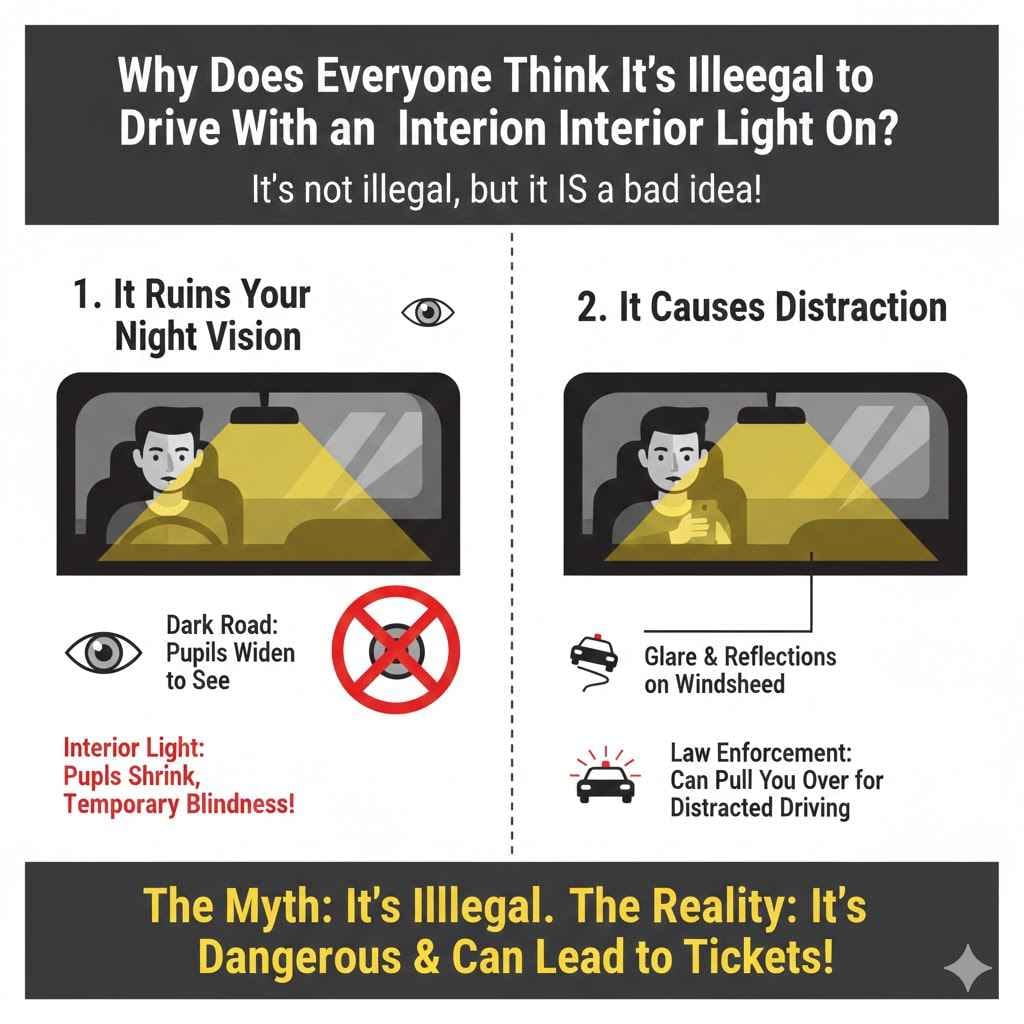
Why Does Everyone Think It’s Illegal to Drive With an Interior Light On?
The myth that driving with your dome light on is illegal is one of the most persistent old wives’ tales of the road. It’s usually passed down from parents to new teen drivers with a stern warning. But where did this idea come from? It’s rooted in a simple truth: it’s a bad idea.

Sayings A Mechanic Hate To Hear From Customers
It Only Happens When There is A…
- Show off a unique sense of humor with this design featuring a clever gorilla mechanic, perfect for car enthusiasts and repair love…
- Show a love for mechanics with this unique design featuring a gorilla mechanic, perfect for automotive enthusiasts or professional…
- Lightweight, Classic fit, Double-needle sleeve and bottom hem
As an Amazon Associate I earn from qualifying purchases.
While there is rarely a specific law that says, “Thou shalt not use thy dome light,” the practice is dangerous for two main reasons:
- It Ruins Your Night Vision: Your eyes are amazing. In the dark, your pupils widen to let in as much light as possible, allowing you to see the road ahead. When you switch on a bright interior light, your pupils instantly shrink to adjust. When you look back at the dark road, your eyes can’t readjust quickly, leaving you temporarily blinded to hazards.
- It Causes Distraction: The light can create glare and reflections on the inside of your windshield, making it harder to see what’s happening outside. Furthermore, whatever is happening inside the car that requires a light—like searching for a fallen item or reading a map—is a distraction in itself. Law enforcement can and will pull you over for distracted driving if they believe you are not in full control of your vehicle.
So, while the act itself isn’t typically illegal, the consequences of it (distraction and impaired vision) absolutely are. This is where the myth comes from—it’s a simplified way to teach a crucial safety lesson.
The Real Deal: Legality vs. Safety
Let’s get straight to the point. In most states and countries, there is no specific law that makes it illegal to drive with a standard, factory-installed interior dome light on. You can search through most state vehicle codes, and you won’t find a statute that mentions the dome light.
However, the law isn’t always so black and white. Police officers have broad authority to stop drivers they believe are operating a vehicle unsafely. An officer could ticket you under broader statutes related to:
- Distracted Driving: If you’re fumbling for something on the floor with the light on, you are clearly distracted.
- Obstructed View: Some laws prohibit lights that obstruct the driver’s vision or cause glare. An overly bright or poorly placed interior light could fall into this category.
- Impeding Traffic: If your actions cause you to drive erratically or too slowly, you could be cited.
The National Highway Traffic Safety Administration (NHTSA) identifies three main types of distraction: visual, manual, and cognitive. Using an interior light can involve all three. Safety should always be your number one priority. Even if it’s “legal,” it’s not safe.
How Interior Lights Wreck Your Night Vision
Imagine your eyes are like a camera. At night, the aperture (your pupil) opens wide to capture as much light as possible from the dark road and your headlights. When you flip on that bright dome light, it’s like a flash going off in a dark room. Your pupils slam shut to protect your eyes from the sudden brightness.
Now, when you look back at the road, your pupils are still tiny. It can take several seconds, or even up to a minute, for them to open up again fully. In that time, a deer could step onto the road, or the car ahead of you could brake suddenly. You wouldn’t see it until it’s too late. That’s not a risk worth taking just to find a dropped pen.
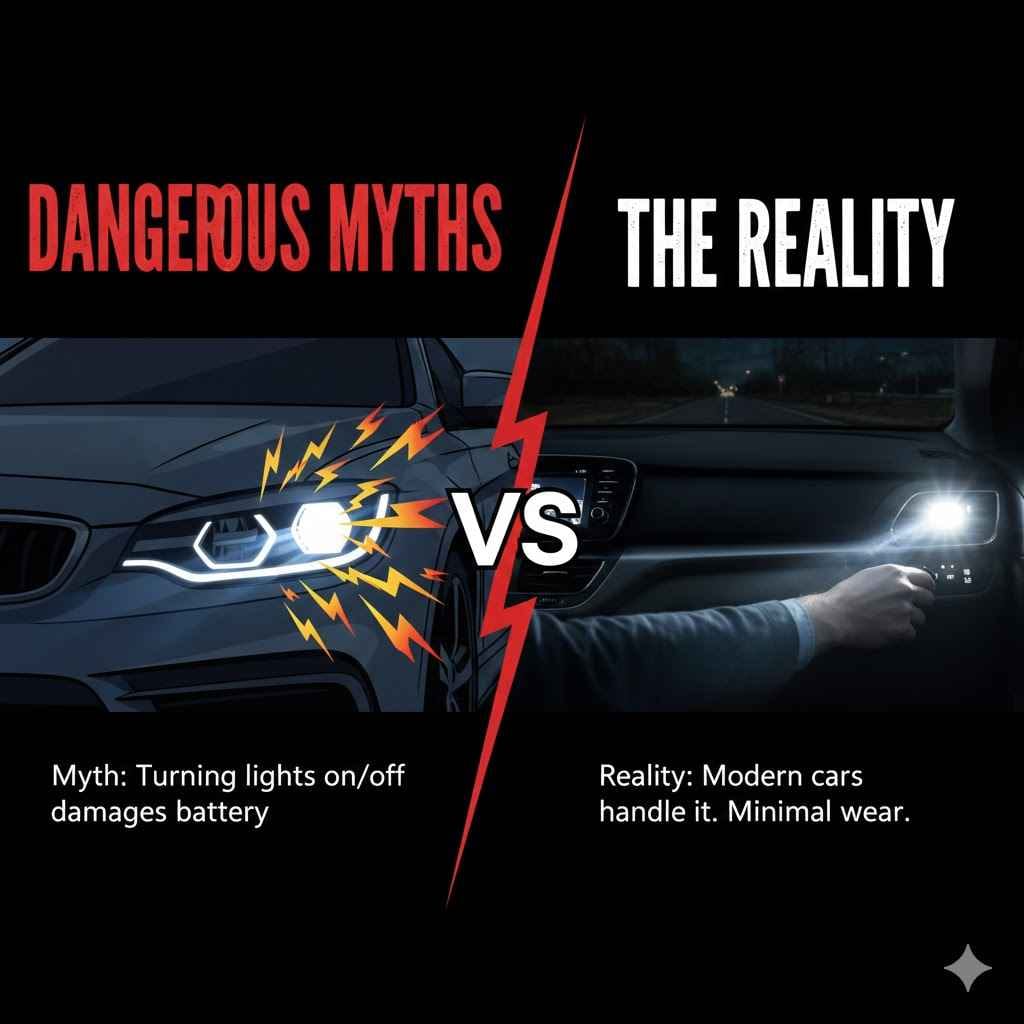
Busted: 4 More Dangerous Myths About Your Car’s Lights
The dome light isn’t the only source of confusion when it comes to a car’s lighting system. Let’s clear the air and bust a few more common and potentially dangerous myths.
Leaving an Interior Light on Will Instantly Kill Your Battery
We’ve all had that moment of panic—realizing you left the map light on overnight. The myth says your battery will be completely dead. The reality is a bit more forgiving.
The Truth: While leaving any light on will drain your car battery, it’s not an instant process. A single, small interior bulb pulls a very small amount of power. A healthy car battery can typically power a standard incandescent dome light for over 8-10 hours and an LED light for days before it’s too weak to start the car. However, an older battery or cold weather can shorten this time significantly. It’s a bad habit, but it’s unlikely to drain a good battery in just an hour or two.
| Bulb Type | Typical Power Draw (Watts) | Estimated Drain Time on Healthy Battery |
|---|---|---|
| Standard Incandescent Dome Bulb | 5-10 Watts | 8 – 12 hours |
| LED Dome Bulb | 0.5-1 Watt | 72+ hours |
Flashing Your High Beams Is the Universal “Cop Ahead” Signal
Many drivers flash their high beams to warn oncoming traffic of a hidden police speed trap. While it may seem like a helpful gesture, it’s a risky and unclear form of communication.
The Truth: First, in many states, flashing your lights to warn others of police can be considered “obstructing a police officer in the performance of their duties,” which can earn you a ticket. Second, this signal is not universal. To another driver, a flash of your high beams could mean:
- “Your headlights are off.”
- “There’s a hazard in the road ahead.”
- “You have your high beams on and are blinding me.”
- “I am about to turn.”
Because it can be misinterpreted and is legally questionable, it’s best to avoid using your high beams for secret signals. Stick to using them for their intended purpose: illuminating the road when no one else is around.
You Should Always Use Your High Beams on Dark, Empty Roads
High beams are fantastic for seeing far down a deserted country road. The myth is that if the road is dark, your high beams should be on.
The Truth: You should use your high beams for maximum visibility, but only when it won’t affect other drivers. According to safety organizations like the Insurance Institute for Highway Safety (IIHS), you must dim your high beams in several situations:
- Within 500 feet of an oncoming vehicle.
- When following another vehicle within 200-300 feet.
- In fog, heavy rain, or snow (the bright light reflects off the precipitation, worsening your visibility).
Failing to dim your lights can temporarily blind other drivers, creating a dangerous situation for everyone.
Automatic” Headlights Are Always Smart Enough for All Conditions
Modern cars with automatic headlights are convenient. They sense when it gets dark and turn on for you. Many drivers assume this system is foolproof and never touch their headlight switch again.
The Truth: Automatic headlight sensors primarily measure ambient light. They work great for tunnels and at dusk, but they can be fooled. They often will not turn on in daytime fog, heavy rain, or snow, because there is still plenty of ambient light. However, in these conditions, you need your lights on so that other drivers can see you. Many states have “wipers on, lights on” laws for this very reason. Always be ready to manually override the automatic system and turn on your full headlights when visibility is poor, day or night.
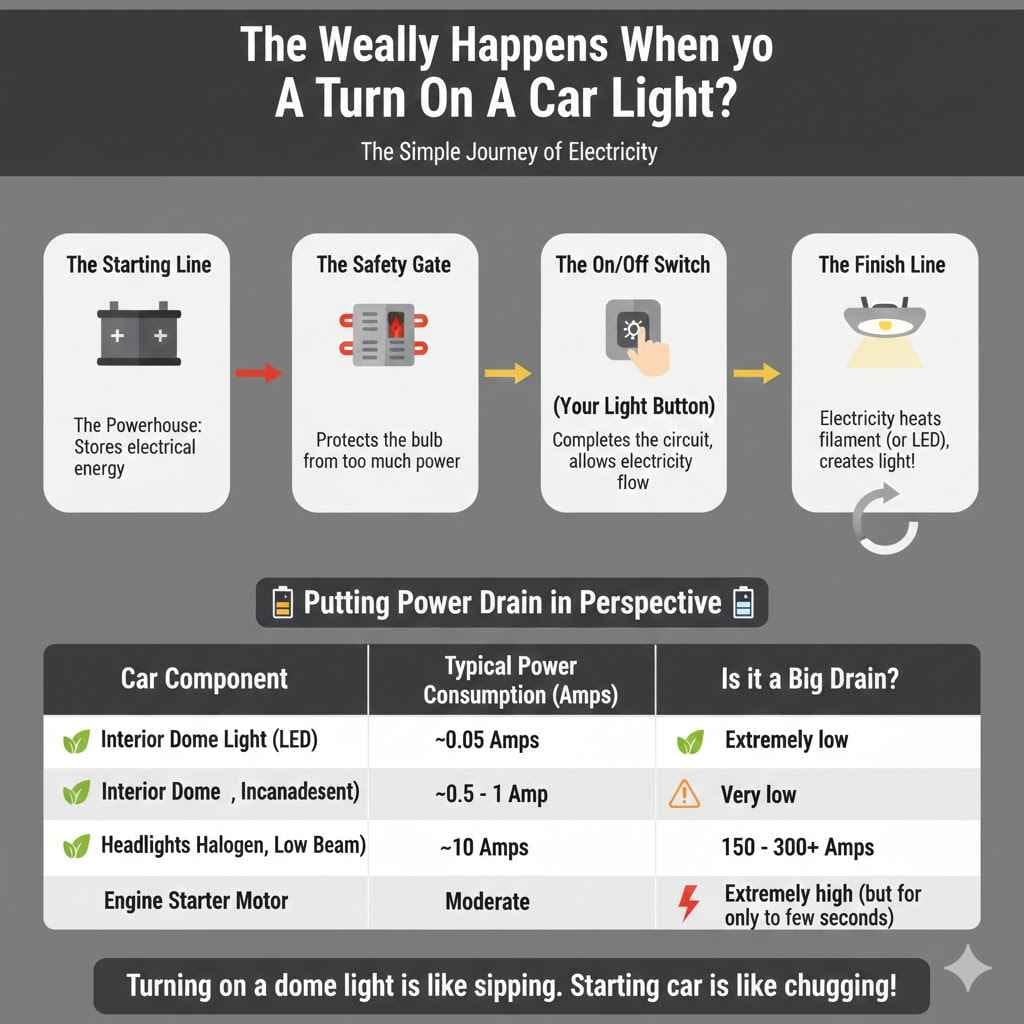
What Really Happens When You Turn on a Car Light? A Simple Look Inside
It feels simple: you press a button, and light appears. But what’s going on behind the scenes? Understanding the basics can help you feel more confident about your car. Don’t worry, we’ll keep it super simple—no mechanic jargon here.
The Simple Journey of Electricity
When you flip a switch for your dome light, you’re completing a very simple electrical circuit. Think of it like a racetrack for tiny bits of energy.
- The Starting Line (The Battery): Your car’s battery is the powerhouse. It stores all the electrical energy needed to run everything, from starting the engine to powering your radio.
- The Safety Gate (The Fuse Box): The electricity first travels to the fuse box. A fuse is like a tiny security guard that protects the light bulb from getting too much power, which could cause it to burn out or create a fire hazard.
- The On/Off Switch (Your Light Button): This is the button you press. When you turn it on, you’re essentially lowering a bridge that allows the electricity to continue its journey.
- The Finish Line (The Bulb): The electricity flows into the light bulb, heating up a tiny wire (called a filament) or powering a small semiconductor (in an LED). This process releases energy in the form of light, and voilà! Your car’s interior is illuminated.
This entire process is instant and has no effect on your engine’s performance or your car’s ability to drive. It’s a small, separate system designed just for lighting.
Putting Power Drain in Perspective
It’s easy to worry about draining your battery, but it helps to know just how little power some things use. Your car’s electrical system is designed to handle many things at once. Here’s how the tiny dome light compares to other power-hungry components.
| Car Component | Typical Power Consumption (Amps) | Is it a Big Drain? |
|---|---|---|
| Interior Dome Light (LED) | ~0.05 Amps | Extremely low |
| Interior Dome Light (Incandescent) | ~0.5 – 1 Amp | Very low |
| Headlights (Halogen, Low Beam) | ~10 Amps | Moderate |
| Engine Starter Motor | 150 – 300+ Amps | Extremely high (but for only a few seconds) |
As you can see, turning on your dome light is like sipping from a giant water bottle, while starting your car is like chugging the whole thing at once. It’s why you can leave a dome light on for hours, but trying to start the car repeatedly with a weak battery will drain it in seconds.
Frequently Asked Questions (FAQ)
Can I get a ticket for driving with my dome light on?
It’s very unlikely you’ll get a ticket for the light itself. However, if the light causes you to drive erratically or an officer believes you are distracted, you can absolutely be pulled over and ticketed for distracted driving or reckless operation.
How long can I leave my interior car light on before the battery dies?
It depends on your battery’s health, age, and the type of bulb. A new, healthy battery can power a traditional incandescent bulb for 8-12 hours. If you have modern LED interior lights, they use so little power that they could stay on for several days before draining the battery.
Are LED interior lights better than regular bulbs?
Yes, in almost every way. LED bulbs are much more energy-efficient, meaning they drain your battery far less. They also last much longer (up to 50,000 hours vs. 1,000 for incandescent) and produce a brighter, cleaner light. Upgrading is an easy and inexpensive DIY project.
Why does the interior light make it hard to see outside at night?
This is because of how your eyes work. In darkness, your pupils open wide to let in more light. A bright interior light causes your pupils to shrink instantly. This makes the dark world outside your car seem even darker, hiding potential dangers on the road.
What should I do if my interior light won’t turn off?
First, check the switch. It often has three positions: On, Off, and Door. Make sure it’s not stuck in the “On” position. If that doesn’t work, check if one of your car doors isn’t fully closed. If the light still stays on, you may have a faulty door switch. To prevent your battery from draining, you can pull the specific fuse for the interior lights from the fuse box until you can get it fixed.
Do police officers drive with their interior lights on?
Sometimes, but their situation is different. They often use special red interior lights. Red light is much better at preserving night vision than white or yellow light, which is why it’s used in airplane cockpits and on naval ships. They also use the light to read their in-car computer or write notes, and they are professionally trained to manage these tasks while driving safely.
Conclusion: Drive Smart, Drive Safe
So, what happens when you turn on the car light while driving? The car doesn’t mind, but your eyes do. While you likely won’t get a ticket just for having the light on, you’re creating an unnecessarily dangerous situation for yourself and others on the road.
The myth that it’s illegal was born from a place of safety. It’s a simple rule to prevent distracted driving and ensure your vision is at its best when you need it most—at night. By understanding the truth behind the myths about our car’s lights, we move beyond fear and confusion and toward becoming more confident, knowledgeable, and, most importantly, safer drivers.
The next time your passenger needs to find something, you’ll know the best and safest advice to give: “Let’s wait until we can pull over.” It’s a simple choice that makes a world of difference.
Related pick: Check today's price on Amazon
Products related to this article
Sponsored / affiliate links. As an Amazon Associate I earn from qualifying purchases. I may earn additional commission from eligible campaigns.