Can Worn Suspension Parts Mimic Tire Problems?
Worn suspension parts can mimic tire problems: if the shake changes with road speed, inspect tire balance and wheel condition; if it starts during braking, turning, or over bumps, look at suspension or steering wear. Misdiagnosis wastes money and leaves the fault in place. This guide shows how to read wear patterns, shake timing, and pull direction.
Suspension tire diagnostic matrix


This matrix separates the common lookalikes by when the symptom appears, where you feel it, and what the tread says. Use it before buying tires or ordering an alignment, because loose parts can make alignment numbers change while the vehicle is moving.
| Symptom trigger | Feel location | Tread pattern | Likely causes | Next inspection step |
|---|---|---|---|---|
| Highway-speed shake | Steering wheel, often above about 50 mph | May show no clear wear, or may pair with cupping | Tire balance, bent wheel, tire damage, wheel bearing play, worn suspension parts | Check tire pressure, inspect for bent wheel and visible tire damage, then check balance and wheel bearing looseness |
| Braking pulsation | Steering wheel or pedal, sometimes through the seat | Can be normal pad wear, but may also follow uneven tire wear from looseness | Brake rotor variation, worn ball joints, worn control arm bushings, alignment drift under load | Inspect brakes first, then check ball joints and bushings for play before any alignment |
| Wandering | Whole vehicle, with frequent steering corrections | Feathering or uneven shoulder wear | Toe error, worn bushings, worn ball joints, loose tie-rod ends, poor alignment | Check tire pressure, then inspect steering and suspension joints for looseness before setting alignment |
| Inside-edge wear | May feel like pull or instability at speed | Inner shoulder wear, sometimes on one tire only | Negative camber, toe error, worn ball joints, worn struts, loose bushings | Measure suspension play, inspect camber-related wear, and repair loose parts before alignment |
| Outside-edge wear | May feel like vague turn-in or pull | Outer shoulder wear | Positive camber, toe error, low pressure, worn bushings, bent or shifted suspension parts | Rule out low pressure first, then inspect bushings, ball joints, and wheel position under load |
| Cupping or scalloping | Rhythmic hum, thump, or vibration | Alternating high and low tread spots across tread blocks | Worn shocks, worn struts, wheel imbalance, bent wheel, tire defect, loose suspension | Inspect damping parts, check balance, and look for a bent wheel or irregular tire carcass |
Alignment should wait until worn parts are replaced if there is looseness. Camber, toe, and caster can look acceptable on a rack and still drift on the road if bushings, ball joints, or struts move under load. Static settings can fail to hold for that reason.
Can worn suspension parts mimic tire problems?
Yes. Worn suspension parts can mimic tire problems because they change wheel motion, contact patch shape, and alignment angles under load. A tire may look guilty, but the real cause can be a loose joint, a weak strut, or a bent wheel that only shows itself at speed or during braking.
Why the same symptom can come from different parts
Road speed, steering angle, and brake force can load the suspension differently. Alignment issues may not show up until highway speeds. That is why a vehicle can feel fine at city speed and still shake, pull, or wander on the freeway.
One cause of vibration is tire balance. A bent wheel can also cause vibration even if the tire still holds air. Add worn bushings or joints, and the wheel can wobble side to side, which changes the footprint and creates symptoms that sound like a tire issue.
How load, speed, and road surface change the clue
A symptom that appears only while braking points somewhere else than a symptom that appears only at 65 mph. Steering wheel shake often points to the front end. Seat or floor vibration may point to rear wheel problems. That split matters because the same car can have different faults on each axle.
Say your steering wheel shudders on the freeway, but the seat stays calm. That pattern leans toward a front tire, wheel, or front suspension fault. If the seat vibrates while the wheel stays steady, inspect the rear tires, rear wheels, and rear suspension first.
How shocks and struts change tire wear
Shocks dampen road impacts and control up-and-down wheel motion. Struts do the same job, but they also provide structural support on many vehicles. When either part wears out, the wheel can bounce after a bump instead of settling quickly, which can create cupping, scalloping, noise, and vibration.
Damping loss and wheel bounce
Bad shocks or struts can cause bouncing on the highway. That bounce lets the tire skip across the road surface, so the tread does not wear evenly. Cupping is linked to poor shock absorption, and worn struts can create cupping, feathering, or scalloping.
This wear often shows up as alternating high and low tread spots on the tread blocks. You may hear a rhythmic hum or feel a thump through the body. The symptom can look like a tire defect, but the root cause may be weak control of wheel motion.
Why cupping often points here
Cupping and scalloping usually suggest the tire is losing steady contact with the road. Poor damping is a common reason. Wheel imbalance can add to it, and a loose bearing or bent wheel can worsen the pattern. That is why cupping should trigger a wider inspection, not a tire-only fix.
Why struts affect alignment geometry
Struts affect alignment geometry and tire contact. When they wear, the wheel can shift enough to change camber or toe under load. Typical strut replacement intervals are 50,000 to 100,000 miles, but wear depends on road use, load, and vehicle design.
Because struts often influence both damping and geometry, they are commonly replaced before an alignment. If they are weak, the alignment can drift again after a short drive.
Which suspension parts cause edge wear?
Edge wear points more directly to geometry than to balance. Inner-edge wear often lines up with negative camber, while outer-edge wear can follow positive camber or a toe problem. Loose ball joints and bushings can shift those angles while the car moves, so the wear pattern may be a clue, not a final answer.
Ball joints and camber drift
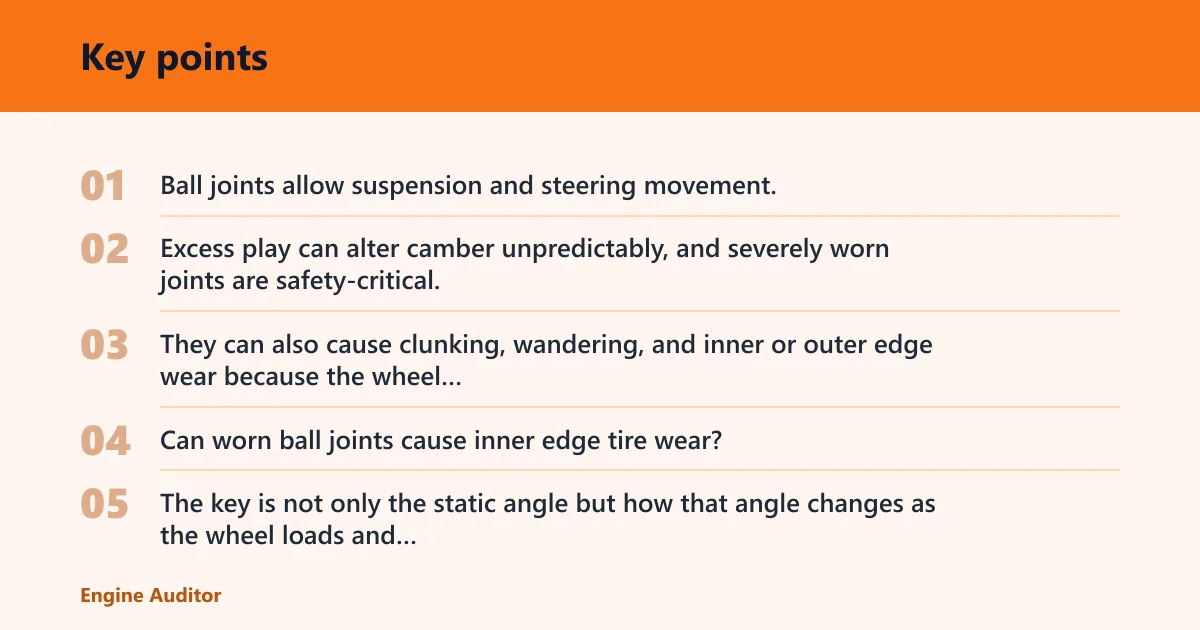
Ball joints allow suspension and steering movement. Excess play can alter camber unpredictably, and severely worn joints are safety-critical. They can also cause clunking, wandering, and inner or outer edge wear because the wheel no longer holds a stable angle under load.
Can worn ball joints cause inner edge tire wear? Yes, they can. The key is not only the static angle but how that angle changes as the wheel loads and unloads. That is why a tire may show shoulder wear even if an alignment printout looks close to target.
Control arm bushings and toe shift
Control arm bushings locate the control arm. When they wear, they can allow fore-aft wheel movement. That movement affects caster and toe under braking and acceleration, which is why worn bushings are associated with feathering and scalloping.
Can bad control arm bushings make my car wander or pull? Yes. A car can pull or drift because the wheel is not staying in the same place when the load changes. Worn bushings can also make the steering feel vague, especially over bumps or during braking.
When looseness becomes a safety issue
If ball joints, bushings, or related steering parts have obvious play, replacement comes before alignment. Bad suspension can increase braking distance, and that is a warning sign, not only a comfort complaint. Severe looseness can also make the vehicle hard to track straight in emergency maneuvers.
What else can look like suspension trouble?
Some of the most common lookalikes are not suspension parts at all. Wheel bearings, bent wheels, tire defects, tire pressure, and balance problems can all create shake, noise, or uneven wear. The trick is to rule out the simple checks in a practical order.
Wheel bearings
Wheel bearings can contribute to vibration and looseness, and they can mimic suspension or tire issues. A noisy or loose wheel bearing can make the vehicle feel vague, add speed-related hum, and blur the diagnosis because the symptom may sound like a tire problem.
Check for play and roughness when the wheel is off the ground. If the wheel feels loose or noisy, the bearing deserves attention before you assume the tire is at fault.
Bent wheels and tire defects
A bent wheel can cause vibration even if the tire still holds air. Tire damage can do the same thing. A separated belt, bulge, or internal defect can create shake that no amount of alignment can fix, so inspect the tire carcass and wheel rim carefully.
Tire pressure and wheel balance
Tire pressure should be ruled out before blaming suspension. Underinflation can mimic handling problems and contribute to shoulder wear. A tire that is low on air may pull, feel soft in corners, and wear the outer shoulder faster than the rest of the tread.
Wheel balance matters too. A tire out of balance can shake at speed, and that symptom can be mistaken for a worn strut or a bad joint. Start with pressure, then check balance, then look for looseness and damage.
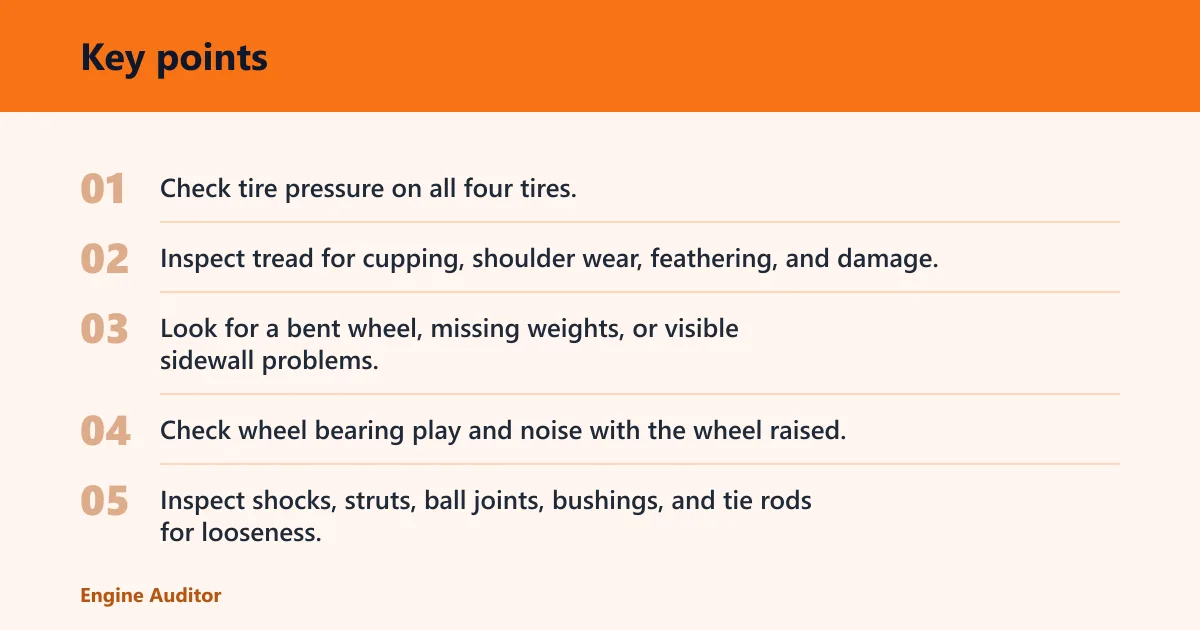
- Check tire pressure on all four tires.
- Inspect tread for cupping, shoulder wear, feathering, and damage.
- Look for a bent wheel, missing weights, or visible sidewall problems.
- Check wheel bearing play and noise with the wheel raised.
- Inspect shocks, struts, ball joints, bushings, and tie rods for looseness.
- Replace worn parts, then perform a wheel alignment.
How vibration, pull, and noise narrow the fault
Vibration, pull, and noise each point in a different direction. The trick is to separate where the symptom is felt from when it happens. That helps you decide whether the problem starts with the tire, the wheel, the bearing, or the suspension.
Steering wheel shake versus seat or floor vibration
Steering wheel shake often points to the front end. Seat or floor vibration may point to rear wheel problems. If the vibration changes with road speed alone, tire balance and wheel condition move higher on the list. If it changes with braking, steering, or bumps, suspension parts move up.
Pulling that changes with braking or acceleration
A pull that changes when you brake suggests a part that moves under load, such as a worn bushing or ball joint. A pull that stays constant may fit alignment, tire pressure, or a tire conicity problem. Alignment drift can involve toe and camber changes, so a static measurement may miss the moving fault.
Picture a sedan with fresh front tires but a steady drift right that gets worse under braking. That pattern does not point to tire wear alone. It points toward a load-sensitive issue, such as a worn bushing, a ball joint with play, or a geometry problem that shifts when the brakes transfer weight forward.
Rhythmic noise from cupping or bearing wear
Cupping and scalloping often create a repeating hum or thump that rises with speed. A bearing usually makes a growl or rumble that can change with cornering load. Both can sound similar from the cabin, so noise alone is not enough; inspect the tread and wheel for the physical clue.
Will an alignment fix tire wear if suspension parts are worn?
Not by itself. An alignment can correct camber, toe, and caster only if the parts holding those angles are sound. If bushings, ball joints, or struts are loose, the settings may move again as soon as the vehicle is driven, which leaves the wear problem in place.
That is why alignment is usually the last step after repair, not the first. If the vehicle has loose parts, fix those first, then recheck alignment. If the tires already show severe damage, they may still need replacement after the repair because the tread has been permanently worn.
A common first-timer mistake is buying an alignment for a car that still has a worn ball joint. The printout may look good in the bay, but the wheel angle can change on the road. The money goes to a setup that cannot stay set.
Frequently asked questions
How do I tell if uneven tire wear is from suspension or alignment?
Use the wear pattern and the way the car behaves. Inner-edge wear often fits camber issues, outer-edge wear can point to camber or low pressure, and feathering often fits toe problems. If the angles will not stay put because parts are loose, suspension repair comes first.
Can bad shocks or struts cause tire vibration?
Yes. Worn shocks or struts can let the wheel bounce, which can create vibration and cupping or scalloping. If the shake is strongest on rough pavement or at highway speed, inspect damping parts along with balance, wheel condition, and tire damage.
What tire wear patterns point to worn suspension parts?
Cupping, scalloping, feathering, and uneven shoulder wear are the main clues. Cupping often suggests poor shock absorption or imbalance. Feathering often fits toe movement. Inner-edge or outer-edge wear can point to camber drift from worn joints, bushings, or struts.
Can worn ball joints cause inner edge tire wear?
Yes. Worn ball joints can change camber unpredictably, which can wear the inner edge or outer edge depending on how the angle shifts. If the joint is severely worn, treat it as a safety issue before you think about alignment or new tires.
What suspension parts should be checked first for tire problems?
Start with shocks and struts, then ball joints, control arm bushings, and wheel bearings. Also check tire pressure, tire balance, and wheel condition. That order catches the most common overlap faults before you pay for an alignment that may not hold.
When should I replace tires after suspension wear?
Replace the tires if the wear is severe, the tread is cupped badly, the cords are exposed, or the tire has structural damage. If the wear is mild and the tire is otherwise sound, repair the suspension first and then judge whether the tread can still be used safely.
Products related to this article
Sponsored / affiliate links. As an Amazon Associate I earn from qualifying purchases. I may earn additional commission from eligible campaigns.