Winter Oil Tips for Turbocharged Engines
For winter turbo protection, pick the lowest cold-viscosity grade your owner’s manual permits, keep the OEM oil spec that covers LSPI and turbo use, and follow a brief light-load cooldown after hard driving. Skip that, and oil can move too slowly at startup, knock control can slip, and heat-soaked oil can cook in the turbo bearings. This covers cold-flow at start, the correct spec for LSPI control, and shutdown habits that help prevent turbo coking.
How should you choose winter oil for a turbo?
Start with the owner’s manual viscosity, then use climate only to choose among approved grades. For winter turbo service, full synthetic oil is often the safer default because it typically flows faster when cold and resists oxidation at turbo temperatures. The grade matters, but the approval matters more, and the manual is the final word.
Why does cold-flow come first?
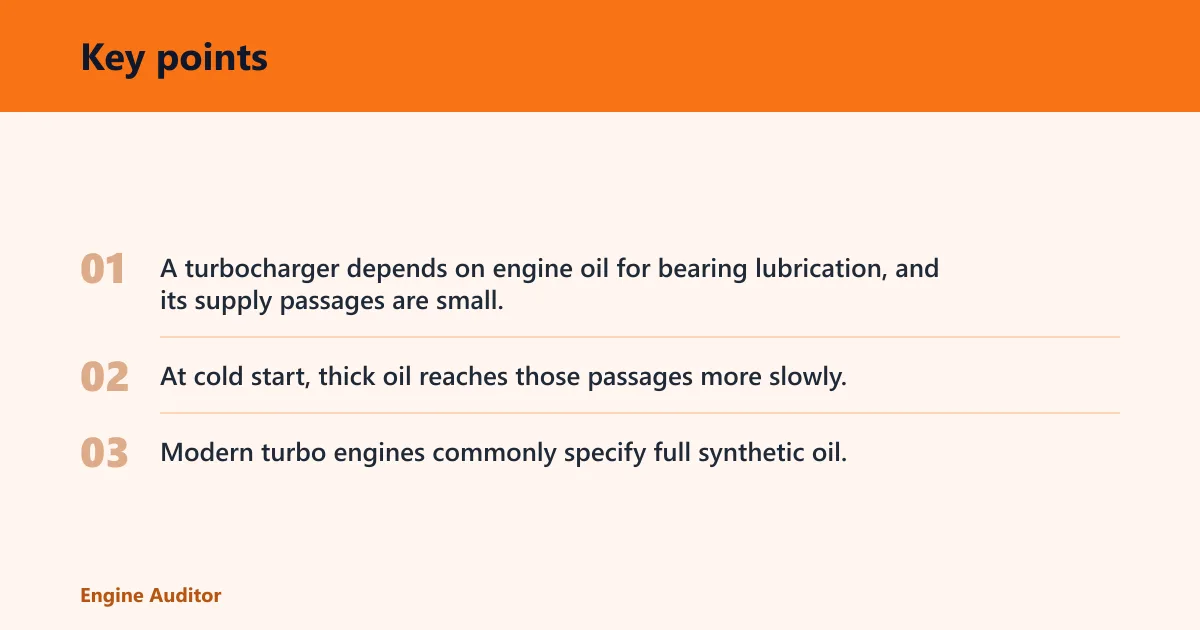
A turbocharger depends on engine oil for bearing lubrication, and its supply passages are small. At cold start, thick oil reaches those passages more slowly. That is why a lower winter grade can help, but only if the manual allows it. SAE viscosity grades are built around cold-cranking and pumpability limits, so do not pick a thinner oil just because the season changed.
How should you use climate within the manual’s range?
If the manual lists more than one viscosity, colder starting conditions usually point you toward the lower winter grade in that approved range. If the manual lists only one grade, keep it. The turbo still needs the specified viscosity film strength when hot, and the approval on the bottle has to match what the OEM asks for.
Why is full synthetic often preferred for winter turbo use?
Modern turbo engines commonly specify full synthetic oil. That choice supports faster cold flow and better resistance to oxidation when exhaust heat soaks the turbo after shutdown. Conventional oil is more likely to leave deposits when repeated heat cycles and short trips stack up, which is why many manuals pair turbo use with synthetic-only recommendations.
What is the turbo oil decision checklist
Use this checklist to stop guessing. Each branch ties winter choice to the engine type, the viscosity window, and the signs that mean the manual should be verified before the next oil fill. It also shows when severe-service use should shorten the interval and when a substitute oil is a bad idea.
| Engine type | Typical winter viscosity range | Ambient-start temperature band | Required approval cues | Severe-service interval cue | Do not substitute warnings | Red-flag symptoms |
|---|---|---|---|---|---|---|
| Gasoline turbo GDI | 0W-20, 0W-30, or 5W-30 if the manual allows it | Coldest expected starts, especially below freezing | API SP; OEM approval for the listed grade; LSPI coverage for turbo GDI use | Short trips, repeated cold starts, and stop-and-go winter use | Do not substitute a random 5W-30 or any oil without the manual’s API SP and OEM approval | Cold-start knock, pinging under light load, oil-pressure delay, rough idle after short trips |
| Gasoline turbo non-GDI | 0W-20, 0W-30, 5W-30, or 0W-40 depending on the manual | Mild to very cold starts, depending on the approved grade | OEM viscosity approval; API SP or the latest approved gasoline spec listed by the maker | Frequent short runs, winter idling, or repeated boost events | Do not substitute a grade outside the manual just because it looks close on the shelf | Noisy cold starts, sluggish cranking recovery, turbo whistle changes, frequent top-off between services |
| Diesel turbo | 5W-40 is common; some manuals allow other grades | Cold starts in demanding winter service | Diesel-rated oil with the OEM approval listed for the engine and emission system | Towing, long idle time, soot-heavy use, or repeated cold starts | Do not substitute a gasoline turbo oil just because the winter grade seems similar | Heavy soot loading, long idle time, rising oil darkening very early, hard cold starts |
| High-mileage turbo | Use the manual first; 0W-30, 5W-30, or 0W-40 may fit some engines | Cold starts where oil pressure delay becomes more noticeable | OEM approval still comes first; choose a full synthetic that matches the stated grade | Oil consumption, leaks, or short-trip winter driving | Do not assume thicker oil is safer unless the manual explicitly allows it | Oil consumption, blue smoke, lifter noise, turbo seal seepage, delayed oil pressure after overnight parking |
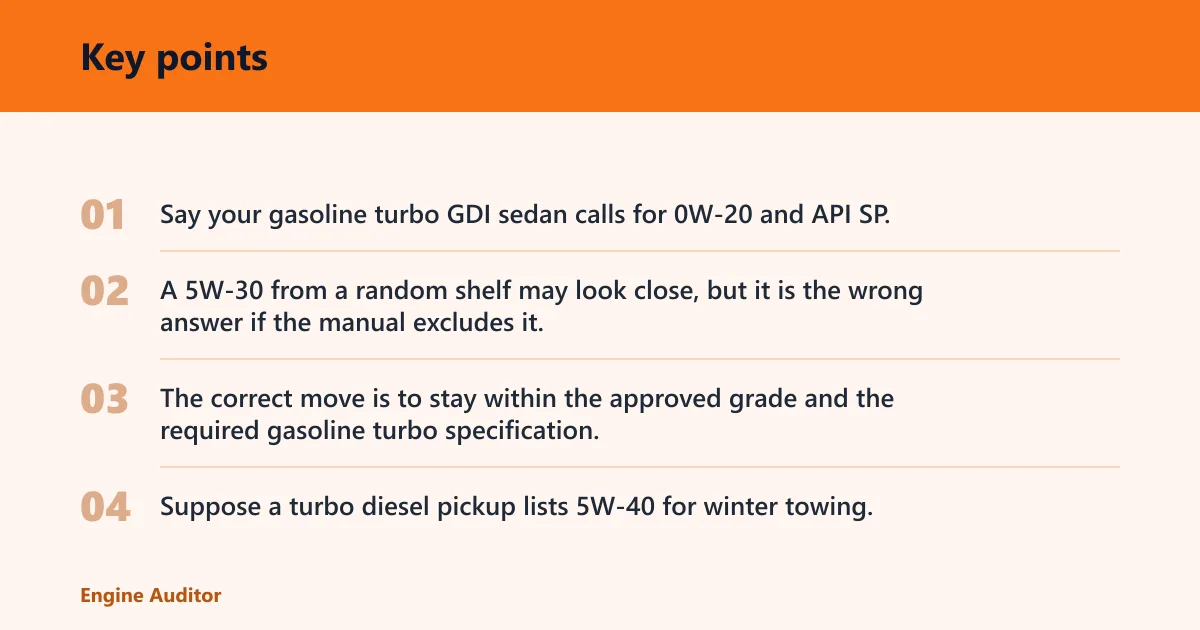
Say your gasoline turbo GDI sedan calls for 0W-20 and API SP. A 5W-30 from a random shelf may look close, but it is the wrong answer if the manual excludes it. The correct move is to stay within the approved grade and the required gasoline turbo specification.
Suppose a turbo diesel pickup lists 5W-40 for winter towing. A lighter gasoline oil is not a shortcut. Diesel turbo oil needs soot handling, and the emission system and load pattern can make that heavier grade the correct one.
Which viscosity works best in winter?
The best winter viscosity is the lowest cold-grade your owner’s manual allows. Many turbo engines use 0W-20, 0W-30, 5W-30, 0W-40, or 5W-40 depending on the platform. Do not choose by season alone; match the manual first, then use climate to pick among approved grades.
Why do 0W grades help at startup?
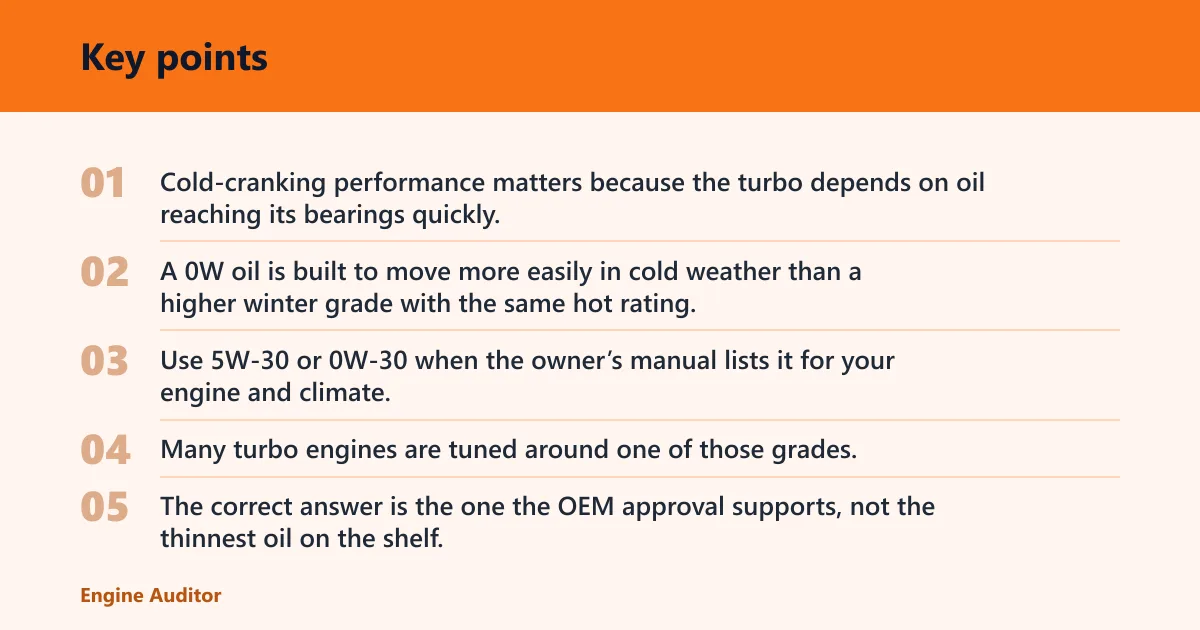
Cold-cranking performance matters because the turbo depends on oil reaching its bearings quickly. That is why 0W grades are often the easiest winter starting point when the manual permits them. A 0W oil is built to move more easily in cold weather than a higher winter grade with the same hot rating.
When is 5W-30 or 0W-30 the right call?
Use 5W-30 or 0W-30 when the owner’s manual lists it for your engine and climate. Many turbo engines are tuned around one of those grades. The correct answer is the one the OEM approval supports, not the thinnest oil on the shelf.
When do 0W-40 or 5W-40 belong in the manual?
Some turbo engines may specify 0W-40 or 5W-40, depending on the vehicle and manual. That does not mean thicker is better. It means the engine was calibrated for that grade’s hot-film behavior, oxidation resistance, and pressure profile.
Why does API SP matter for turbo GDI?
API SP matters because it includes LSPI protection through Sequence IX testing. That is directly relevant to turbo GDI engines, where low-speed pre-ignition can happen under load at low engine speed. For those engines, API SP and the correct OEM approval are more important than brand slogans.
Why do approval labels matter more than claims?
Oil labels often mention turbo protection, but the bottle wording is not the same as a verified spec. Look for the API donut, the API SP mark, and the exact OEM approval named in the manual. If the oil does not list the required approval, keep looking.
How should you read API and OEM cues?
Read the manual first, then match the bottle. If the manual lists API SP and a specific OEM approval, both matter. If the manual names a dexos, VW, BMW, Mercedes-Benz, or similar approval, the label should match that exact requirement for the listed viscosity grade.
-
Check the manual first.
Find the approved viscosity grades and any OEM oil approval named for your engine. If the manual lists more than one, keep the coldest-appropriate option inside that group.
-
Match the gasoline spec.
For turbo GDI engines, look for API SP and the exact approval the manual asks for. That is the cleanest way to cover LSPI control and turbo compatibility at the same time.
-
Confirm winter flow.
Choose the lowest cold-viscosity grade that still fits the manual, such as 0W-20, 0W-30, or 5W-30 where allowed. That improves startup flow without guessing at the hot side of the grade.
-
Plan for shutdown heat.
After hard driving, let the engine idle or cruise lightly for a short cooldown before shutoff. That reduces heat soak, which can otherwise cook oil in the turbo and form coking deposits in small passages.
How do you protect the turbo at shutdown?
Turbo coking happens when hot oil residue bakes in the turbo after shutdown heat soak. Exhaust heat can stay in the turbo long after the engine stops, and that lingering heat can turn oil residue into deposits. A short cooldown and the right oil both matter.
What is heat soak and why does coking happen?
After hard use, the turbo keeps heat long after the engine stops. Oil trapped in the bearing housing can cook into deposits, and those deposits can restrict oil flow. Full synthetic oil helps, but it does not make shutdown habits irrelevant.
Why does idling after hard driving help?
Give the turbo a brief period of light-load operation after a hard pull, merge, or hill climb. That short interval helps carry heat away before the engine stops. Long idle is not necessary for every stop, but immediate shutdown after heavy boost is the pattern to avoid.
How do short trips affect winter oil change timing?
Repeated short trips in winter can load the oil with moisture and fuel while the engine never gets a full warm cycle. If that is your pattern, shorten oil intervals within the manual’s limits. Do not stretch winter oil changes just because the mileage looks low.
What changes for diesel turbo engines?
Diesel turbo engines need the same cold-start and shutdown care, but the oil selection is different. Diesel turbo oil must handle soot, and 5W-40 is common in heavy-duty diesel applications. Follow the diesel-specific approval in the manual rather than copying a gasoline turbo choice.
Why do soot handling and diesel-specific approvals matter?
Diesel oil has to manage soot suspension and deposit control, especially with towing or long idle time. The approval on the bottle should match the engine maker’s diesel requirement. A gasoline turbo oil may miss the soot-handling target even if the viscosity looks familiar.
When does towing change the oil choice?
Towing loads the turbo harder and raises oil temperature. If the manual gives separate duty-cycle guidance, use the severe-service interval and the approved diesel oil grade. Frequent towing in winter makes shutdown discipline and cold-crank performance more important, not less.
How do you know if your turbo engine needs a different oil in cold weather?
If the manual already lists a winter-appropriate approved grade, you may not need a different oil at all. Change only when the manual allows a lower cold-viscosity option, when the engine has a new approval requirement, or when symptoms suggest the current oil is too slow, too thin, or not turbo-specific enough.
Look for a pattern, not a single cold morning. Sluggish oil pressure, noisy startup, pinging in a turbo GDI engine, or repeated short-trip use can point to a wrong grade or missing approval. That is the point to verify the manual before the next fill.
Frequently asked questions
How do you care for a turbo engine in winter?
Use the owner’s manual viscosity, choose full synthetic oil with the required API and OEM approvals, and let the engine idle or cruise lightly for a brief cooldown after hard driving. In winter, short trips matter too, so shorten oil intervals if repeated cold starts keep the oil from fully heating.
Does a turbocharger use engine oil?
Yes. Turbocharger bearings use the same engine oil as the rest of the engine. That oil moves through small supply passages at very high shaft speeds, so cold flow and clean shutdown habits matter. Any delay or deposit buildup can affect the turbo long before the rest of the engine complains.
What oil viscosity is best for winter driving?
The best winter viscosity is the lowest cold-grade your owner’s manual allows. Many turbo engines use 0W-20, 0W-30, 5W-30, 0W-40, or 5W-40 depending on the platform. Do not choose by season alone; match the manual first, then use climate to pick among approved grades.
Which motor oil is best for winter?
For most turbo engines, a full synthetic oil with the correct OEM approval is the best winter choice. Full synthetic flows better when cold and resists oxidation at turbo temperatures. For gasoline turbo GDI engines, API SP is a key cue because it includes LSPI testing through Sequence IX.
How often should I change turbo engine oil in winter?
Follow the manual, then shorten the interval if winter use means lots of short trips, long idle time, towing, or frequent cold starts. Those conditions increase moisture and fuel dilution risk. A turbo engine that never gets fully warm usually needs closer attention than one used for longer drives.
How do I protect a turbo on cold starts?
Start with the right oil grade, usually the lowest approved winter viscosity in the manual, and avoid immediate high load after startup. Let oil pressure stabilize, then drive gently until the engine warms. Cold starts are when the turbo’s small oil passages are most vulnerable to slow flow.
How do I know if my turbo engine needs a different oil in cold weather?
If the engine is noisy at startup, oil pressure takes too long to build, or a turbo GDI engine shows knock or pinging, verify the manual before changing anything. Those signs can point to the wrong viscosity, a missing API SP-level approval, or a diesel-versus-gasoline mismatch.
What oil should I use for a turbo diesel in winter?
Use the diesel oil grade and approval named in the manual. Many heavy-duty turbo diesels use 5W-40 in winter, but the approval must fit the engine and emission system. Diesel oil needs soot-handling capacity, so do not substitute a gasoline turbo oil just because the winter grade looks close.
Products related to this article
Sponsored / affiliate links. As an Amazon Associate I earn from qualifying purchases. I may earn additional commission from eligible campaigns.