Best Cold Weather Engine Oil for High-Mileage Cars
For most high-mileage cars in cold climates, start with the factory-approved viscosity and move to a 0W or 5W winter grade if cranking temps drop below about 0°F to -20°F, while choosing a high-mileage formulation only when you need leak control or lower oil consumption. Pick the wrong winter oil and cold starts can drag on bearings, hide weak battery issues, and push seepage or consumption higher. This guide shows how to match starting temperature, wear, leaks, and factory viscosity to the best cold-weather oil choice.
Quick picks

The safest all-around pick is a full synthetic high-mileage oil in the factory-approved winter grade, because it gives the best cold flow while still adding seal conditioners and wear additives where older engines can use them.
- Subzero commuter: choose a full synthetic high-mileage oil in the lowest winter grade your owner’s manual allows, often 0W-20 or 5W-20.
- Mild winter driver: a high-mileage 5W-30 often fits older engines that still call for that grade.
- Leak-prone engine: look for a high-mileage formula with seal conditioners, then stay inside the factory viscosity range.
- Budget-focused owner: a synthetic blend high-mileage oil can work if the climate is not severe and the drain interval stays modest.
📊 The Drive says high-mileage engines can be around 75,000 miles or even 100,000 miles. Source: Best Oils for High Mileage of 2024.
Best winter oil for high mileage
The best cold-weather oil for a high-mileage car is usually a full synthetic high-mileage formula in the manufacturer’s approved winter grade. That gives you the strongest cold-flow margin, plus the additives older gasoline engines often need for seals, wear, and deposits.
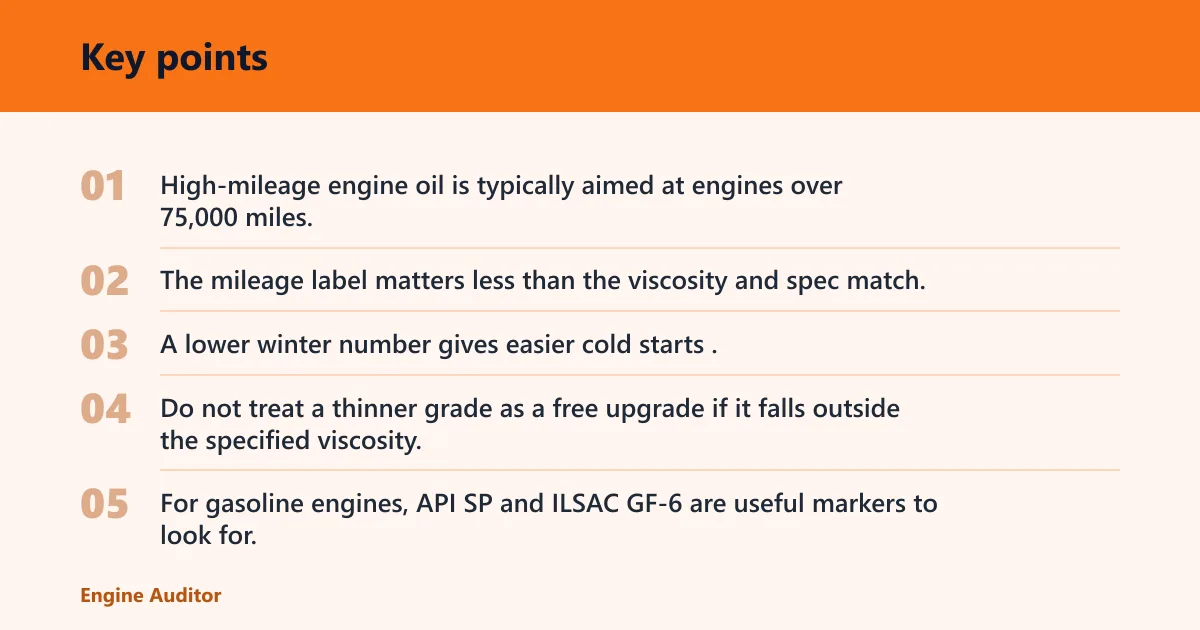
High-mileage engine oil is typically aimed at engines over 75,000 miles. These formulas may include seal conditioners, anti-wear additives, and detergents, and they are sold as full synthetic, synthetic blend, or conventional oil. The mileage label matters less than the viscosity and spec match.
If your owner’s manual allows those common grades, the winter number tells you how easily the oil cranks and pumps when cold. A lower winter number gives easier cold starts. That said, the manual still sets the acceptable range. Do not treat a thinner grade as a free upgrade if it falls outside the specified viscosity.
For gasoline engines, API SP and ILSAC GF-6 are useful markers to look for. They point to current protection targets, including timing chain wear control and LSPI protection, which matters more on some turbocharged engines.
Winter oil decision table
| Condition | Factory viscosity | Recommended high-mileage oil grade | Avoid if | Why |
|---|---|---|---|---|
| Subzero commute, frequent overnight parking | 0W-20 or 5W-20 | Full synthetic high-mileage 0W-20 or 5W-20 | The manual does not approve a 0W grade | Lower winter viscosity improves cold cranking and pumpability during repeated cold starts. |
| Mild winter, older naturally aspirated engine | 5W-30 | Full synthetic or synthetic blend high-mileage 5W-30 | The engine already struggles to crank slowly in the cold | 5W-30 keeps the spec intact while adding seal conditioners for seepage and moderate consumption. |
| Leak-prone engine with minor seepage | Any approved grade from the manual | High-mileage full synthetic in the approved winter grade | The leak is a drip, puddle, or visible mechanical failure | Seal conditioners may help hardened seals, but they do not repair broken gaskets or major leaks. |
| Short trips, towing, or turbo use in winter | Usually 0W-20, 5W-20, or 5W-30 | Full synthetic high-mileage in the approved grade with API SP or ILSAC GF-6 | You plan to jump to 10W-30 without manual approval | Short trips and turbo heat stress oil more, while thicker oil can make repeated cold starts harder. |
Is 0W-20 or 5W-30 better in winter?
Use the viscosity your owner’s manual allows, then choose the lower winter number when the engine sees repeated cold starts or subzero parking. If the manual approves 0W-20, that grade usually offers easier cranking than 5W-30 in very cold weather. If the manual calls for 5W-30, stay there unless the manufacturer lists a thinner option.
That tradeoff matters more in older engines than many drivers expect. A thicker oil can quiet consumption a little, but it can also slow flow on a frigid morning. A common first-timer mistake is assuming 10W-30 is always safer for a worn engine. In winter, that can make the first seconds after start harder on the battery and starter.
Say your sedan calls for 5W-30 and sits outside overnight at 10°F. A high-mileage 5W-30 is a sensible choice. Move to a thicker grade only if the manual permits it and the engine has a reason, such as oil consumption that persists after you have already chosen the correct spec.
Is full synthetic better than a blend?
For cold starts, full synthetic is usually better than a synthetic blend because it flows better at low temperature. It also often supports longer drain intervals and better thermal stability. A synthetic blend can still be a fair choice when cost matters more and winter conditions are not severe.
That is why a full synthetic high-mileage oil is often the top winter choice. Mobil 1 High Mileage Synthetic Motor Oil claims protection down to -40°F, while Mobil 1 Advanced Full Synthetic Motor Oil 5W-20 claims cold-flow protection down to -30°F. Those claims are useful only when they fit the grade your engine is allowed to use.
Blends do have a place. Pennzoil High Mileage Motor Oil is presented as a synthetic blend, and Castrol GTX High Mileage on Walmart is listed as a synthetic blend 5W-30 product. Those types can make sense for milder winters or drivers who want a lower price point and do not need the strongest cold-start margin.
Does high-mileage oil help with leaks?
High-mileage oil can help with seepage, hardened seals, and moderate oil consumption, but it will not repair a mechanical leak. Seal conditioners may swell or soften aged seals enough to reduce minor weeping. They will not fix a cracked housing, torn gasket, or loose drain plug.
Use that distinction to avoid false hope. If you see a damp valve cover seam or a slow rear main seep, a high-mileage formula may help. If you see drops on the floor or a steady loss between oil changes, treat it as a repair issue first and an oil choice second.
High-mileage oil also matters when the engine has some age but not a major failure. Some formulas add detergents and anti-wear additives that support older gasoline engines. That is useful for deposit control and wear protection, especially when winter short trips never let the oil fully warm.
How do you choose winter oil?
Choose winter oil in this order: manual approval first, cold-start risk second, leak severity third, and mileage last. The right oil is the one that fits all four. Mileage alone does not decide the grade, and cold weather does not justify ignoring the factory spec.
-
Check the owner’s manual.
Use the approved SAE grade first. If the manual lists 0W-20, 5W-20, or 5W-30, stay within that range before you compare brands or high-mileage labels. -
Match the winter number.
If cold starts happen in very cold weather, prefer the lower winter number the manual allows. A 0W or 5W grade generally pumps more easily than a 10W grade in very cold conditions. -
Match the oil type.
Pick full synthetic for the hardest winter use, especially for subzero commuting or repeated short trips. Choose a synthetic blend only if the climate is milder and cost matters more. -
Decide on high-mileage additives.
Use a high-mileage formula when you need seal conditioners, lower consumption, or extra detergent support. Skip it if the engine is tight, uses little oil, and does not need the added package. -
Check the service category.
For gasoline engines, look for API SP and, when relevant, ILSAC GF-6. Those markers matter more on modern engines with timing chains or turbocharging.
Picture an older compact car that still calls for 5W-30, burns a quart between changes, and sits outside in January. A high-mileage 5W-30 full synthetic is the cleanest answer. Now change only one factor: the same car now sees weekly starts at -10°F. In that case, the same grade may still be correct, but a full synthetic formula becomes much more important than a blend.
Cold-flow claims can help you sort real use cases. Mobil 1 High Mileage Synthetic Motor Oil claims protection down to -40°F, which is useful for severe winter commuting. A product that claims strong cold flow but only in a viscosity your engine cannot use is still the wrong oil.
Frequently asked questions
What is the best cold weather engine oil for a high-mileage car?
The best cold-weather oil is usually a full synthetic high-mileage formula in the factory-approved winter grade. That choice gives you the best cold flow, plus seal conditioners and wear additives where an older gasoline engine may need them. Do not leave the approved viscosity range to chase a colder-number label.
Should I use 0W-20 or 5W-30 in winter for an older car?
Use whichever grade the owner’s manual allows, then favor the lower winter number for subzero starts. If both are approved, 0W-20 usually flows easier in the cold than 5W-30. If only 5W-30 is approved, stay with 5W-30 and choose a full synthetic high-mileage version.
Is full synthetic better than a synthetic blend for cold starts?
Yes, full synthetic usually gives better low-temperature flow than a synthetic blend. That helps the oil reach critical parts sooner after a cold start. A blend can still work in milder winter weather, but full synthetic is the safer choice when starts happen in deep cold or after long overnight parking.
Does high-mileage oil help with oil leaks in cold weather?
It can help with seepage and minor leaks if hardened seals are part of the problem. High-mileage formulas may include seal conditioners that reduce weeping. They do not repair broken seals, cracked covers, or other mechanical failures, so a drip or puddle still needs diagnosis and repair.
Can thicker oil make cold starts worse in an older car?
Yes. A thicker grade can slow cranking and pumpability in cold weather, which makes the first seconds after start harder on the starter, battery, and bearings. That is why 10W-30 is often a poor winter choice unless the manual approves it and the climate is mild enough for it.
What should I look for in a high-mileage oil for winter commuting?
Look for three things: the exact SAE grade your manual approves, a full synthetic base if winters are severe, and a current gasoline spec such as API SP or ILSAC GF-6 when applicable. If the engine seeps or consumes oil, a high-mileage formula with seal conditioners is a sensible extra.
Products related to this article
Sponsored / affiliate links. As an Amazon Associate I earn from qualifying purchases. I may earn additional commission from eligible campaigns.